
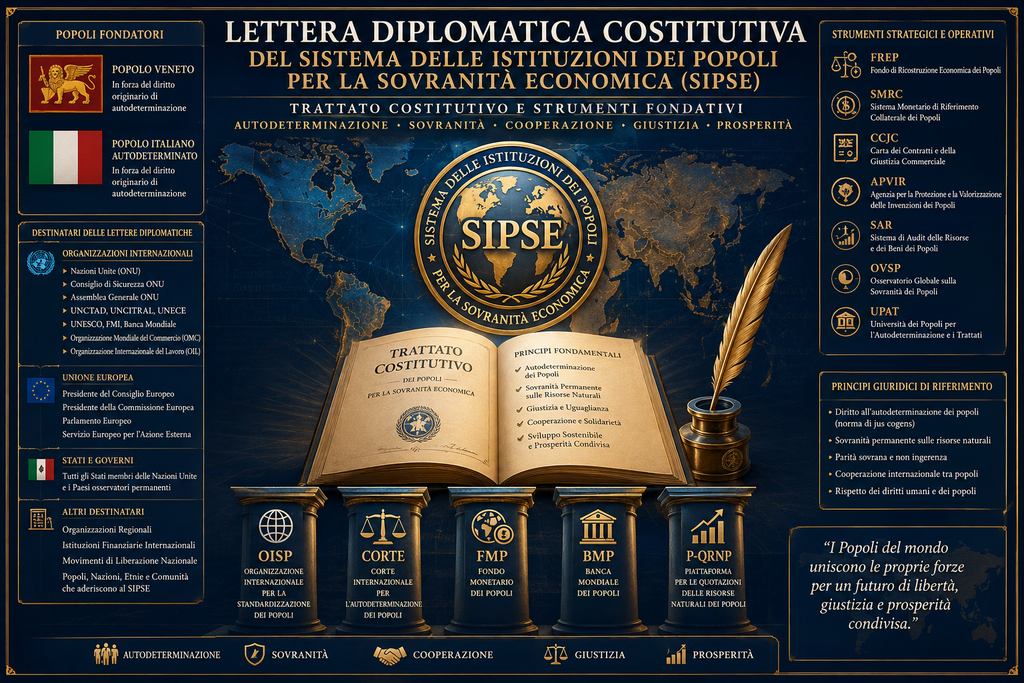
Lettera Diplomatica Costitutiva
Documento istituzionale integrale — Trattato Costitutivo, Statuti, Carte, Protocolli, strumenti strategici e allegati.
1
"SYSTEMA INSTITUTIONUM POPULORUM AD SOVRANITATEM ECONOMICAM. CONDITA PRO POPULIS MUNDI
ET GLOBO PROSPECTUS."
Autore S.E. Franco Paluan
Al Segretario Generale delle Nazioni Unite
New York, NY 10017, Stati Uniti d’America
Oggetto: Deposito del Trattato Costitutivo del Sistema delle Istituzioni dei Popoli per la Sovranità
Economica (SIPSE)
Eccellenza,
in qualità di rappresentanti del Popolo Veneto e del Popolo Italiano Autodeterminato – Popoli
Fondatori del Sistema delle Istituzioni dei Popoli per la Sovranità Economica (SIPSE) – e in
conformità con l’Articolo 6.6 del Trattato Costitutivo, abbiamo l’onore di trasmettere l’originale del
Trattato Costitutivo del Sistema delle Istituzioni dei Popoli per la Sovranità Economica (SIPSE),
unitamente ai relativi Statuti, Carte e Protocolli, per il deposito presso il Segretariato delle Nazioni
Unite ai sensi dell’articolo 102 della Carta.
Il presente Trattato, ispirato ai principi di jus cogens dell’autodeterminazione dei popoli e della
sovranità permanente sulle risorse naturali, è stato liberamente stipulato da entità che esercitano
tale diritto in via originaria. Pur riconoscendo la prassi tradizionale in materia di deposito,
confidiamo nella Sua autorevolezza e nella Sua funzione di garante della legalità internazionale
2
affinché la registrazione possa avvenire nel rispetto dei principi fondamentali che ispirano l’azione
delle Nazioni Unite.
Restiamo a disposizione della Treaty Section per qualsiasi chiarimento tecnico e per concordare le
modalità di deposito degli strumenti di ratifica da parte degli aderenti.
Distinti saluti,
(firme digitali)
B – DEPOSITO FORMALE DEL TRATTATO PRESSO L’UNIONE EUROPEA
(Notifica diplomatica e richiesta di presa d’atto)
Lettera di notifica al Presidente del Consiglio Europeo e al Presidente della Commissione
Europea:
Al Presidente del Consiglio Europeo
Al Presidente della Commissione Europea
Bruxelles, Belgio
Oggetto: Notifica ufficiale del Trattato Costitutivo del Sistema delle Istituzioni dei Popoli per la
Sovranità Economica (SIPSE) e richiesta di presa d’atto
Signori Presidenti,
*con la presente, il Popolo Veneto e il Popolo Italiano Autodeterminato, in qualità di Popoli
Fondatori del Sistema delle Istituzioni dei Popoli per la Sovranità Economica (SIPSE), ai sensi del
diritto all’autodeterminazione sancito dall’articolo 1 del Patto internazionale sui diritti civili e
politici e riconosciuto come norma di jus cogens, hanno l’onore di notificare alle Istituzioni
dell’Unione Europea l’adozione e l’entrata in vigore del Trattato Costitutivo del SIPSE, nonché dei
connessi Statuti dell’Organizzazione Internazionale per la Standardizzazione dei Popoli (OISP), della
Corte Internazionale per l’Autodeterminazione dei Popoli, del Fondo Monetario dei Popoli (FMP),
della Banca Mondiale dei Popoli (BMP) e della Piattaforma per le Quotazioni delle Risorse Naturali
dei Popoli (P-QRNP).*
Il presente Trattato – depositato contestualmente presso il Segretario Generale delle Nazioni Unite
– istituisce un sistema parallelo, complementare e paritetico, aperto all’adesione di tutti i popoli,
nazioni, etnie e movimenti di liberazione nazionale che rivendicano l’esercizio effettivo della
propria sovranità economica, monetaria e sulle risorse naturali.
Pur nella consapevolezza che le procedure di registrazione ufficiale dei trattati nell’Unione Europea
seguono percorsi specifici, i Popoli Fondatori chiedono formalmente che il presente Trattato e i suoi
allegati vengano acquisiti agli atti delle Istituzioni europee e trasmessi, per conoscenza, agli Stati
membri dell’Unione. Tale presa d’atto costituirebbe un significativo passo avanti nella
cooperazione inter-istituzionale e nel riconoscimento del diritto all’autodeterminazione economica
3
come parte integrante del patrimonio giuridico e politico europeo, in conformità con i Trattati
dell’Unione e con la Carta dei diritti fondamentali dell’Unione Europea.
Il SIPSE si dichiara fin d’ora disponibile a fornire ogni informazione complementare e ad avviare un
dialogo tecnico con le competenti Direzioni Generali della Commissione Europea e con il Servizio
Europeo per l’Azione Esterna.
Confidando in un riscontro positivo, si porgono distinti saluti.
(firme digitali)
ELENCO COMPLETO DEI DESTINATARI E DEI SOGGETTI
COINVOLTI
Sistema delle Istituzioni dei Popoli per la Sovranità Economica (SIPSE)
– OISP, Corte Internazionale per l’Autodeterminazione dei Popoli,
FMP, BMP, P-QRNP, DSPP
PARTE I – DESTINATARI DELLE LETTERE DIPLOMATICHE (NOTIFICATI
UFFICIALMENTE)
Questi soggetti hanno ricevuto o riceveranno la documentazione completa (Statuti, lettere
costitutive, inviti all’adesione).
A. ORGANIZZAZIONI INTERNAZIONALI E INTERGOVERNATIVE
Categoria Soggetti
Nazioni Unite e agenzie Organizzazione delle Nazioni Unite (ONU) – Segretario Generale;
Assemblea Generale; ECOSOC; UNCTAD; UNDP; UNEP; UNESCO;
OHCHR; FAO; OIL; UN-Habitat; UNEP-FI
Istituzioni finanziarie di
Bretton Woods
Fondo Monetario Internazionale (FMI); Banca Mondiale
(IBRD, IDA, IFC, MIGA); Banca dei Regolamenti Internazionali (BRI)
Banche regionali di
sviluppo
Banca Europea per gli Investimenti (BEI); Banca Asiatica di Sviluppo
(ADB); Banca Africana di Sviluppo (AfDB); Banca Interamericana di
4
Sviluppo (IDB); Banca dello Sviluppo BRICS (NDB);
Banca Europea per la Ricostruzione e lo Sviluppo (BERS)
Organizzazioni regionali Unione Europea (Commissione, Consiglio, Parlamento);
Consiglio d’Europa; Unione Africana; Lega Araba; ASEAN;
Unione delle Nazioni Sudamericane (UNASUR); Mercosur;
Organizzazione degli Stati Americani (OSA); Comunità degli Stati Indipendenti (CSI);
Organizzazione per la Cooperazione di Shanghai
(SCO); Consiglio Nordico
Organizzazioni monetarie
e finanziarie
Banca Centrale Europea (BCE); Sistema Europeo di Banche Centrali; Banca dei
Regolamenti Internazionali (già citata); Fondo Monetario Arabo; Banca Centrale dei Paesi
dell’Africa Occidentale; Banca Centrale dei Paesi dell’Africa Centrale
Organizzazioni
commerciali e di
standardizzazione
Organizzazione Mondiale del Commercio (OMC); Organizzazione Internazionale per la
Standardizzazione (ISO); UN/CEFACT; International Swaps and Derivatives Association
(ISDA)
B. CORTI E TRIBUNALI INTERNAZIONALI
Categoria Soggetti
Corti globali Corte Internazionale di Giustizia (ICJ); Corte Penale Internazionale (CPI);
Tribunale Internazionale per il Diritto del Mare (ITLOS)
Corti regionali
europee
Corte Europea dei Diritti dell’Uomo (CEDU); Corte di Giustizia
dell’Unione Europea (CJUE)
Corti regionali
interamericane e
africane
Corte Interamericana dei Diritti Umani; Corte Africana dei Diritti Umani
e dei Popoli; Corte di Giustizia dell’Unione Africana
Tribunali arbitrali Corte Permanente di Arbitrato (PCA); Centro Internazionale per la Risoluzione delle
Controversie Relative agli Investimenti (ICSID)
C. STATI (TUTTI I 193 MEMBRI ONU + OSSERVATORI)
Invito generale a tutti gli Stati sovrani, con menzione specifica per quelli che hanno popoli non
rappresentati o movimenti indipendentisti attivi.
Elenco per aree geografiche (sintetico):
Regione Stati esemplificativi (tutti invitati)
Europa Italia, Francia, Germania, Spagna, Portogallo, Belgio, Paesi Bassi, Regno Unito,
Svizzera, Austria, Svezia, Danimarca, Finlandia, Norvegia, Grecia, Turchia, Russia,
5
Ucraina, Polonia, Repubblica Ceca, Slovacchia, Ungheria, Romania, Bulgaria, Serbia, Croazia, Bosnia-
Erzegovina, Albania, Macedonia del Nord, Kosovo, Montenegro,
Slovenia, Estonia, Lettonia, Lituania, Bielorussia, Moldavia, Georgia, Armenia,
Azerbaigian, Cipro, Malta, Irlanda, Islanda, Lussemburgo, Monaco, San Marino,
Città del Vaticano, Andorra, Liechtenstein
Africa Sudafrica, Nigeria, Egitto, Algeria, Marocco, Tunisia, Libia, Sudan, Etiopia, Kenya, Tanzania, Uganda,
Ruanda, Burundi, Repubblica Democratica del Congo,
Repubblica del Congo, Angola, Mozambico, Zimbabwe, Zambia, Malawi, Botswana, Namibia, Senegal,
Costa d’Avorio, Ghana, Camerun, Gabon, Guinea, Mali,
Burkina Faso, Niger, Ciad, Repubblica Centrafricana, Somalia, Eritrea, Gibuti,
Mauritius, Seychelles, Comore, Madagascar, Liberia, Sierra Leone, Guinea-Bissau, Gambia, Mauritania,
Swaziland, Lesotho, São Tomé e Príncipe, Capo Verde, Guinea Equatoriale
Asia Cina, India, Giappone, Corea del Sud, Corea del Nord, Indonesia, Malesia, Singapore, Filippine, Vietnam,
Thailandia, Myanmar, Cambogia, Laos, Brunei, Bangladesh,
Pakistan, Sri Lanka, Nepal, Bhutan, Maldive, Afghanistan, Iran, Iraq, Arabia Saudita,
Emirati Arabi Uniti, Qatar, Kuwait, Bahrein, Oman, Yemen, Giordania, Libano,
Siria, Israele, Palestina (Stato osservatore), Turchia (già inclusa), Cipro, Mongolia, Kazakistan, Uzbekistan,
Turkmenistan, Kirghizistan, Tagikistan, Armenia, Georgia, Azerbaigian, Russia (già inclusa)
Americhe Stati Uniti d’America, Canada, Messico, Guatemala, Belize, Honduras, El Salvador, Nicaragua, Costa Rica,
Panama, Cuba, Giamaica, Repubblica Dominicana, Haiti,
Porto Rico (territorio), Bahamas, Trinidad e Tobago, Barbados, Santa Lucia,
Grenada, Saint Vincent e Grenadine, Dominica, Antigua e Barbuda, Colombia,
Venezuela, Ecuador, Perù, Bolivia, Brasile, Paraguay, Uruguay, Argentina, Cile,
Guyana, Suriname, Guyana francese (territorio)
Oceania Australia, Nuova Zelanda, Papua Nuova Guinea, Fiji, Isole Salomone, Vanuatu,
Samoa, Tonga, Kiribati, Tuvalu, Micronesia, Isole Marshall, Palau, Nauru
D. ORGANIZZAZIONI NON GOVERNATIVE E SOCIETÀ CIVILE GLOBALE
Categoria Soggetti
Rappresentanza dei
popoli non
rappresentati
UNPO (Organizzazione delle Nazioni e dei Popoli non rappresentati);
Forum Permanente delle Nazioni Unite per le Questioni Indigene;
Survival International; Cultural Survival
Diritti umani e
autodeterminazione
Amnesty International; Human Rights Watch; Front Line Defenders; International
Commission of Jurists; Minority Rights Group International; International Center for
Transitional Justice
6
Ambiente e risorse
naturali
Greenpeace; WWF; Friends of the Earth; Global Witness;
Natural Resource Governance Institute; Extractive Industries
Transparency Initiative (EITI); Rainforest Foundation
Economia e finanza
etica
Fair Trade International; Global Alliance for Banking on Values; Positive Money; Finance
Watch; Tax Justice Network; Attac;
Jubilee Debt Campaign; Eurodad; Latindadd
Giustizia globale e
movimenti
Via Campesina; La Via Campesina; World Social Forum; Peoples’ Global Action;
International Forum on Globalization; Transnational Institute
Accademici e think tank Third World Network; South Centre; Centre for International
Environmental Law; Overseas Development Institute; Institute for Policy Studies; Centro
Studi per l’Autodeterminazione dei Popoli
E. ALTRI ENTI E PIATTAFORME TECNICHE
Categoria Soggetti
Blockchain e criptovalute Ethereum Foundation; Hyperledger; Bitcoin Foundation; Cardano Foundation;
Polkadot; Solana Foundation; Filecoin Foundation;
Internet Computer Protocol (ICP); Stellar Development Foundation
Piattaforme di finanza
decentralizzata
Aave; Uniswap; Compound; MakerDAO; Curve Finance
Società di certificazione e
standard
B Lab (B Corp); Fairtrade International; Forest Stewardship Council
(FSC); Marine Stewardship Council (MSC); Rainforest Alliance
PARTE II – SOGGETTI CHE POSSONO COOPERARE PER SVILUPPARE IL
PROGETTO
Partner tecnici, finanziari, legali, accademici e operativi che possono contribuire alla realizzazione e
all’implementazione del sistema.
A. GOVERNI E ISTITUZIONI PUBBLICHE (STATI “APERTI” O “AMICI”)
Tipologia Soggetti potenziali
Stati con tradizione di
sostegno
all’autodeterminazione
Svizzera (sede di Ginevra, neutralità); Norvegia (mediatore); Islanda;
Nuova Zelanda; Canada (per i popoli indigeni);
Bolivia (diritti della Madre Terra); Ecuador; Sudafrica; Namibia
7
Stati con movimenti
indipendentisti interni
(potrebbero essere
interessati a meccanismi di
soft power)
Spagna (Catalogna, Paesi Baschi, Galizia); Regno Unito
(Scozia, Galles, Irlanda del Nord); Francia (Corsica, Bretagna, Nuova Caledonia); Italia
(Veneto, Sardegna, Sicilia, Alto Adige);
Belgio (Fiandre); Danimarca (Groenlandia, Fær Øer);
Canada (Québec); India (Kashmir, Nagaland, Assam);
Indonesia (Papua Occidentale, Aceh); Filippine (Mindanao);
Turchia (Kurdi); Iraq (Kurdistan); Myanmar (Stati Shan, Kachin,
Rakhine)
Stati che possono offrire
sede o uffici
Svizzera (Ginevra, già sede OISP); Italia (Venezia, già sede Corte);
Malta; Lussemburgo; Singapore (hub finanziario)
B. ORGANIZZAZIONI INTERNAZIONALI (COME PARTNER DI COOPERAZIONE)
Organizzazione Tipo di cooperazione
UNPO Possibile riconoscimento reciproco e scambio di membri
UNDP Progetti congiunti di sviluppo per popoli non rappresentati
UNEP Certificazione ambientale e standard di sostenibilità
UNCTAD Studi su debito e risorse naturali
FAO Registrazione di risorse agricole, sicurezza alimentare
ILO Standard di lavoro per progetti finanziati da BMP
EITI Trasparenza delle industrie estrattive
C. BANCHE E ISTITUZIONI FINANZIARIE (COOPERAZIONE TECNICA)
Istituzione Possibile ruolo
BRI (Banca dei Regolamenti Internazionali) Dialogo su standard di vigilanza per valute digitali dei popoli
NDB (Banca BRICS) Possibili accordi di cofinanziamento (progetti infrastrutturali)
BEI (Banca Europea per gli Investimenti) Cofinanziamento di progetti verdi in popoli non rappresentati (con
garanzie BMP)
Banche etiche (es. Banca Etica, Triodos, GLS
Bank)
Distribuzione di OVSP e microprestiti
D. AZIENDE E PIATTAFORME TECNOLOGICHE
Azienda/piattaforma Contributo possibile
Ethereum Foundation Supporto per smart contract, ancoraggio DSPP, wallet
8
Protocol Labs (IPFS/Filecoin) Archiviazione decentralizzata del registro risorse
Stellar Development Foundation Interoperabilità per pagamenti transfrontalieri
Chainlink Oracle per prezzi delle risorse naturali
The Graph Indicizzazione dei dati blockchain del SIPSE
Mozilla Foundation Supporto per piattaforma open-source
Wikimedia Diffusione della documentazione
E. UNIVERSITÀ E CENTRI DI RICERCA
Istituto Specializzazione
Graduate Institute (Ginevra) Diritto internazionale, autodeterminazione
London School of Economics Economia monetaria, finanza sostenibile
Università Ca’ Foscari (Venezia) Economia, cultura veneta, diritto del mare
Università di Bologna Diritto dei popoli, storia delle autonomie
SOAS (Londra) Diritto e sviluppo, debito odioso
American University (Washington) Finanza internazionale, diritti umani
Università Nazionale di San Marcos (Lima) Diritti dei popoli indigeni
F. ESPERTI INDIVIDUALI E RETI DI PROFESSIONISTI
Categoria Esempi
Esperti di diritto
internazionale
Avvocati specializzati in autodeterminazione, debito odioso,
diritti dei popoli
Economisti monetari Studi su valute complementari, monete digitali delle banche centrali
(CBDC) per popoli
Specialisti blockchain Sviluppatori di smart contract, architetti di ledger distribuiti
Ambientalisti Esperti in certificazione di sostenibilità, FPIC
PARTE III – SOGGETTI CHE POSSONO UTILIZZARE IL SISTEMA
Beneficiari diretti e utenti finali delle istituzioni create.
A. POPOLI, NAZIONI, ETNIE E MOVIMENTI – ESEMPI (NON ESAUSTIVI)
9
Regione Popoli/entità che potrebbero aderire/utilizzare
Europa Scozia, Catalogna, Paesi Baschi, Galles, Corsica, Bretagna, Sardegna, Sicilia, Alto Adige/Südtirol, Fiandre,
Vallonia, Frisia, Groenlandia, Fær Øer, Åland, Crimea (popolo tartaro), Transilvania (minoranze ungheresi),
Galizia (Spagna), Aragona,
Andalusia (solo se rivendica autodeterminazione), Occitania, Savoia,
Istria (comunità italiana), Cipro del Nord (riconoscimento limitato)
Africa Cabinda (Angola), Ambazonia (Camerun), Ogaden (Etiopia), Oromo (Etiopia),
Tigrè (Etiopia), Darfur (Sudan), Nuba (Sudan), Zanzibar (Tanzania),
Casamance (Senegal), Biafra (Nigeria), Popolo Tuareg (Mali/Niger), Popolo Sahrawi (Sahara Occidentale),
Popolo Somaliland, Popolo Maasai (Kenya/Tanzania),
Popolo San (Botswana, Namibia, Sudafrica)
Asia Kurdistan (Turchia, Iran, Iraq, Siria), Balochistan (Pakistan, Iran, Afghanistan),
Kashmir, Nagaland, Assam (India), Papua Occidentale (Indonesia), Aceh (Indonesia), Molucche
(Indonesia), Shan, Kachin, Rakhine (Myanmar), Tibet, Xinjiang (Uiguri), Mongolia Interna (Cina), Taiwan
(per alcuni movimenti),
Catalani in Francia (Rossiglione), Popolo Ainu (Giappone), Popolo Ryukyu (Okinawa)
Americhe Québec (Canada), Porto Rico (stato libero associato), Hawaii (movimento sovranista), Navajo Nation,
Lakota, Altre tribù native americane (USA), Popoli Maya (Messico, Guatemala), Popoli Mapuche (Cile,
Argentina), Popoli Aymara e Quechua (Bolivia,
Perù), Popoli della foresta amazzonica (Brasile, Colombia, Perù, Ecuador), Guyana francese (popoli creoli),
Arcipelago di San Andrés e Providencia (Colombia)
Oceania Popoli indigeni aborigeni (Australia – molte nazioni separate),
Maori (Nuova Zelanda – già trattato, ma potrebbero utilizzare strumenti economici), Bougainville (Papua
Nuova Guinea), Nuova Caledonia (Kanak),
Polinesia francese (Tahiti), Guam, Samoa Americane, Isole Marianne Settentrionali
B. MOVIMENTI DI LIBERAZIONE NAZIONALE E GOVERNI IN ESILIO
Entità Note
Governo in esilio del Tibet Ampiamente riconosciuto da molte ONG
Governo in esilio del Popolo Sahrawi (RASD) Riconosciuto da molti Stati africani
Governo in esilio della Bielorussia (Sviatlana
Tsikhanouskaya)
Caso di regime non rappresentativo
Movimento di liberazione del Balochistan Diversi gruppi
Movimento di liberazione del Kashmir Diversi gruppi
10
C. STATI SOVRANI (IN QUALITÀ DI MEMBRI ASSOCIATI O UTILIZZATORI DEI
SERVIZI)
Qualsiasi Stato può aderire come Membro Associato del SIPSE, utilizzando i servizi di
compensazione (SMRC), acquistando CSR, emettendo OVSP, o richiedendo pareri consultivi alla
Corte. In particolare, Stati che:
• Hanno economie piccole e vulnerabili (es. Stati insulari del Pacifico, Caraibi, piccole nazioni
africane);
• Hanno difficoltà di accesso ai mercati finanziari tradizionali;
• Vogliono diversificare le riserve includendo DSPP.
D. IMPRESE E INVESTITORI (UTILIZZATORI DEI CSR, DELLE OVSP, DELLA
PIATTAFORMA)
Categoria Esempi
Multinazionali etiche Patagonia, The Body Shop, Ben & Jerry’s, Danone (B Corp)
Fondi di investimento etici Triodos Investment Management, BlueOrchard, responsAbility,
Gaia Capital
Fondi pensione Pensionskasse (Svizzera), ABP (Paesi Bassi), CalPERS (USA –
se interessato a diversificazione etica)
Imprese di tecnologia green Aziende che necessitano di litio, cobalto, terre rare –
potrebbero acquistare CSR per garantirsi forniture certificate eticamente
Piattaforme di crowdfunding Kickstarter, GoFundMe, Kiva, Goteo (per progetti sostenuti
da OVSP)
E. ORGANIZZAZIONI NON GOVERNATIVE E COMUNITÀ LOCALI (BENEFICIARIE
DI MICROPRESTITI O ASSISTENZA)
• Cooperative agricole, di pesca, artigiane.
• Associazioni di donne, giovani, indigeni.
• Comunità religiose o culturali che gestiscono beni comuni.
CONCLUSIONE E MODALITÀ DI CONTATTO
Tutti i destinatari sopra elencati riceveranno la Lettera Diplomatica Costitutiva e i relativi Statuti.
Le modalità di contatto sono:
11
• Posta diplomatica (per Stati e organizzazioni intergovernative) tramite canali ufficiali (Ambasciate,
Consolati, Rappresentanze ONU).
• Email per organizzazioni non governative, università, imprese (indirizzi pubblici).
• Pubblicazione su portale web con notifica via newsletter.
Per adesioni, cooperazione o richieste di informazioni:
sipse-coordination@oisp.org (coordinamento generale)
adhesion@oisp.org (per popoli e Movimenti)
partners@oisp.org (per enti cooperanti)
Data: 24 maggio 2026
Documento depositato presso il Segretariato dell’OISP
Hash blockchain: 0xd3a7f2c9e5b8d1f6a4c7e2b9d5f8a3c6e1b4d7f9a2c5e8b1f7d4a9c2e6f8b3
«Nel nome di tutti i popoli della Terra che hanno attraversato il silenzio della storia, che hanno
custodito lingue cancellate dalle mappe e sogni mai naufraghi, noi, Popoli Fondatori, alziamo
questa Carta non contro qualcuno, ma per tutti: perché la sovranità non è un privilegio concesso,
ma un respiro originario; perché la giustizia non attende il permesso degli imperi; perché il diritto
all’autodeterminazione – norma di jus cogens dal quale nessuna deroga è ammessa – diventi
finalmente la pietra angolare di un ordine mondiale dove ogni popolo, piccolo o grande,
rappresentato o dimenticato, possa dire con voce intera: esisto, decido, costruisco.»
«Dal silenzio dei popoli dimenticati nasce la sovranità che nessun trattato potrà più ignorare.»
«Quando la legge degli Stati ignora la voce dei popoli, i popoli si fanno legge.»
LETTERA DIPLOMATICA COSTITUTIVA
12
DEL SISTEMA ISTITUZIONALE PER LA SOVRANITÀ DEI POPOLI
CORTE INTERNAZIONALE PER L’AUTODETERMINAZIONE DEI POPOLI
FONDO MONETARIO DEI POPOLI (FMP)
BANCA MONDIALE DEI POPOLI (BMP)
PIATTAFORMA PER LE QUOTAZIONI DELLE RISORSE NATURALI DEI POPOLI (P-QRNP)
STRUMENTI STRATEGICI DI TUTELA (FREP, SMRC, CCJC, APVIR, SAR, OVSP, UPAT)
Protocollo n. OISP/DIP/2026-05/INT
Data: 24 maggio 2026
Oggetto: Costituzione del Sistema Giuridico, Monetario, Finanziario e delle Risorse Naturali dei
Popoli – Istituzione della Corte Internazionale per l’Autodeterminazione dei Popoli con
giurisdizione esclusiva per controversie e pareri consultivi – Invito universale all’adesione ai sensi
del diritto dei trattati, delle norme imperative jus cogens e degli obblighi erga omnes
DESTINATARI
Categoria Destinatari
Popoli, Nazioni, Etnie, Movimenti di
liberazione nazionale, Territori non
autonomi
Tutti i popoli del mondo, ivi inclusi quelli non rappresentati
nelle sedi internazionali
13
Stati membri e non membri dell’ONU Tutti gli Stati sovrani
Organizzazioni intergovernative Organizzazione delle Nazioni Unite (ONU),
Fondo Monetario Internazionale (FMI),
Banca Mondiale,
Banca dei Regolamenti Internazionali (BRI),
Banca dello Sviluppo BRICS (NDB),
Banca Centrale Europea (BCE), Commissione Europea,
Consiglio Europeo, Consiglio d’Europa, Unione Africana,
Lega Araba, ASEAN, Unione delle Nazioni Sudamericane (UNASUR),
Organizzazione degli Stati Americani (OSA)
Corti e tribunali internazionali Corte Internazionale di Giustizia (ICJ), Corte Penale Internazionale (CPI),
Tribunale Internazionale
per il Diritto del Mare (ITLOS), Corte di Giustizia dell’Unione Europea (CJUE),
Corte Europea dei Diritti dell’Uomo (CEDU)
Organizzazioni non governative e della
società civile
UNPO (Organizzazione delle Nazioni e dei Popoli non rappresentati),
Amnesty International, Transparency International, Global Witness, attivisti
e osservatori internazionali
PREAMBOLO GIURIDICO
I Popoli Fondatori – Popolo Veneto (Stato Veneto in Autodeterminazione) e Popolo Italiano
Autodeterminato (Comitato di Liberazione Nazionale Italiano – CLNI) , agendo quali enti sovrani
nell’esercizio del diritto inalienabile all’autodeterminazione,
RICHIAMANDO la Convenzione di Vienna sul diritto dei trattati del 23 maggio 1969, in particolare
gli articoli 53 e 64, che definiscono le norme imperative del diritto internazionale generale (jus
cogens) come norme accettate e riconosciute dalla comunità internazionale degli Stati nel suo
insieme, dalle quali non è ammessa alcuna deroga;
RICHIAMANDO il principio del carattere erga omnes degli obblighi derivanti da tali norme, come
riconosciuto dalla Corte Internazionale di Giustizia nel caso Barcelona Traction (1970), secondo cui
alcuni obblighi sono dovuti all’intera comunità internazionale, ivi inclusi il divieto di
discriminazione, il diritto all’autodeterminazione dei popoli e la sovranità permanente sulle risorse
naturali;
RICORDANDO che l’Assemblea Generale delle Nazioni Unite, con la Risoluzione 1803 (XVII) del 14
dicembre 1962, ha solennemente proclamato il diritto dei popoli e delle nazioni alla sovranità
permanente sulle proprie ricchezze e risorse naturali, diritto che costituisce un elemento
essenziale del diritto all’autodeterminazione;
14
CONSIDERANDO che l’attuale architettura finanziaria e giuridica internazionale subordina
l’accesso ai propri strumenti al riconoscimento statale, escludendo di fatto i popoli non
rappresentati dall’esercizio della propria sovranità economica, monetaria, finanziaria e giudiziaria;
RILEVANDO che tale esclusione costituisce una violazione sistematica delle norme di jus cogens;
VISTO lo Statuto dell’Organizzazione Internazionale per la Standardizzazione dei Popoli (OISP), che
ha già istituito lo standard P-ISO 4217 per i codici valuta dei popoli, e i codici ZEC (Zecchino
Veneto) e LIS (Lira Italiana Sovrana) quali prime unità di conto dei Popoli Fondatori;
VISTO lo Statuto Costitutivo della Corte Internazionale per l’Autodeterminazione dei Popoli,
proclamato dalla Giuria Popolare Internazionale l’11 novembre 2025 e integrato con la clausola di
giurisdizione esclusiva;
DECISI a creare un sistema giuridico, monetario, finanziario e di valorizzazione delle risorse
naturali parallelo, paritetico e complementare rispetto alle istituzioni esistenti, fondato sulla
democrazia partecipativa, sulla trasparenza radicale e sul rispetto dei diritti collettivi;
I POPOLI FONDATORI convengono e stabiliscono quanto segue.
ARTICOLO 1 – Costituzione del Sistema Istituzionale Completo per la
Sovranità dei Popoli
Sono istituiti, con sede a Venezia (Palazzo Ducale) e a Ginevra (Svizzera), i seguenti enti, operanti
in piena parità giuridica e funzionale rispetto alle corrispondenti istituzioni tradizionali:
A. Organo giurisdizionale principale:
Corte Internazionale per l’Autodeterminazione dei Popoli – con giurisdizione esclusiva per
controversie e pareri consultivi.
B. Organi economici, monetari e finanziari (SIPSE):
1. Fondo Monetario dei Popoli (FMP) – People’s Monetary Fund (PMF)
2. Banca Mondiale dei Popoli (BMP) – People’s World Bank (PWB)
3. Piattaforma per le Quotazioni delle Risorse Naturali dei Popoli (P-QRNP) – Platform for Quoting
Peoples’ Natural Resources (PQ-PNR)
C. Strumenti strategici di tutela e sviluppo:
• Fondo di Resistenza Economica e di Emergenza dei Popoli (FREP)
15
• Sistema di Mutuo Riconoscimento e Compensazione Multilaterale (SMRC)
• Certificazione di Conformità alle Norme Jus Cogens (CCJC)
• Agenzia dei Popoli per la Valutazione Indipendente delle Risorse (APVIR)
• Sistema di Allarme Rapido per Violazioni (SAR)
• Obbligazioni Verdi e Sociali dei Popoli (OVSP)
• Ufficio dei Popoli per l’Assistenza Tecnica e Capacity Building (UPAT)
Dette istituzioni operano in coordinamento con l’Organizzazione Internazionale per la
Standardizzazione dei Popoli (OISP) quale ente di normazione tecnica e di registrazione dei codici
valuta, e costituiscono insieme il Sistema Giuridico, Monetario, Finanziario e delle Risorse
Naturali dei Popoli.
ARTICOLO 2 – Natura giuridica e fondamento normativo
1. Le istituzioni di cui all’art. 1 sono costituite ai sensi del diritto all’autodeterminazione dei popoli,
norma di jus cogens vincolante per tutti i soggetti della comunità internazionale, e operano
nell’ambito degli obblighi erga omnes di rispetto, protezione e promozione
dell’autodeterminazione in tutte le sue forme.
2. Esse non richiedono alcun riconoscimento da parte degli Stati o delle organizzazioni
intergovernative preesistenti per la loro valida esistenza e operatività, ferma restando la piena
disponibilità a cooperare con esse su base paritetica.
3. L’adesione è volontaria, aperta a tutti i popoli, nazioni, etnie, movimenti di liberazione nazionale,
territori non autonomi e, ove lo desiderino, anche agli Stati che intendono sostenere il diritto
all’autodeterminazione.
ARTICOLO 3 – Popoli Fondatori e diritti speciali
1. Popoli Fondatori:
o Popolo Veneto (Stato Veneto in Autodeterminazione, ID OISP-001), emittente del codice
valuta ZEC (Zecchino Veneto);
o Popolo Italiano Autodeterminato (Comitato di Liberazione Nazionale Italiano – CLNI, ID OISP-002),
emittente del codice valuta LIS (Lira Italiana Sovrana).
2. In quanto Fondatori, essi:
o hanno diritto a un seggio permanente nel Consiglio Direttivo di ciascuna istituzione fino
all’adesione di almeno 20 Membri;
o contribuiscono al capitale iniziale delle istituzioni economiche mediante conferimento di riserve
naturali simboliche e quote di emissione di ZEC e LIS;
o esercitano la presidenza pro tempore delle Assemblee Costitutive;
o accettano formalmente la giurisdizione esclusiva della Corte Internazionale per
l’Autodeterminazione dei Popoli.
16
3. Le valute ZEC e LIS sono riconosciute quali valute di riserva primarie del FMP e della BMP, con
piena equiparazione funzionale all’USD, all’EUR e ai Diritti Speciali di Prelievo (DSP) del FMI. Il
tasso di cambio ufficiale tra ZEC e LIS è fissato in: 1 ZEC = 1,25 LIS.
TITOLO I – CORTE INTERNAZIONALE PER
L’ AUTODETERMINAZIONE DEI POPOLI
(GIURISDIZIONE ESCLUSIVA PER CONTROVERSIE E PARERI
CONSULTIVI)
CAPITOLO I – MISSIONE E FINALITÀ
Articolo 1 – Missione fondativa
Punto 1.1. La Corte ha la missione primaria di riconoscere, tutelare, promuovere e far valere il
diritto dei popoli all’autodeterminazione in tutte le sue dimensioni: politica, istituzionale,
economica, monetaria, culturale, linguistica, ambientale, territoriale, digitale e tecnologica.
Punto 1.2. La Corte opera come foro indipendente, imparziale, permanente e innovativo,
incorporando meccanismi di partecipazione popolare diretta – giurie cittadine, piattaforme di
deliberazione digitale – e implementa un sistema di audit annuale indipendente.
17
Articolo 2 – Obiettivi generali
Punto 2.1. Garantire l’accesso universale alla giustizia per i popoli privati dell’autodeterminazione,
attraverso procedure semplificate, assistenza legale pro bono e una Piattaforma Digitale Unica.
Punto 2.2. Prevenire, monitorare e condannare ogni forma di neocolonialismo, inclusi accordi
commerciali iniqui, debiti odiosi, sfruttamento predatorio delle risorse e biocontrollo digitale.
Punto 2.3. Riconoscere e rafforzare la legittimità delle autorità popolari, comunitarie e indigene.
Punto 2.4. Integrare tecnologie abilitanti come blockchain per la registrazione immutabile delle
istanze e AI etica per l’analisi probatoria.
CAPITOLO II – STRUTTURA ISTITUZIONALE PARTECIPATA
Articolo 3 – Organi della Corte
Punto 3.1. Presidenza della Corte Internazionale: dirige e rappresenta la Corte. Il Presidente ha
poteri di veto limitati in casi di manifesta ingiustizia. Presidente in carica: S.E. Laura Fabris.
Punto 3.2. Consiglio dei Giudici: organo deliberante di almeno 21 membri, comprendente esperti
di diritto internazionale, magistrati, Giudici Cittadini (sorteggiati dalla Giuria Popolare),
rappresentanti delle comunità richiedenti. Quote minime del 40% per donne e minoranze.
Punto 3.3. Segretariato Generale e Cancelleria Digitale: gestisce flussi documentali con massima
trasparenza tramite portale open-data.
Punto 3.4. Sezione Permanente per i Diritti dei Popoli Indigeni e Storici: specializzata in casi che
coinvolgono comunità autoctone, con protocolli FPIC.
Punto 3.5. Camera per la Sovranità Economica, Monetaria e Digitale: valuta casi di spoliazione
economica, debito illegittimo e violazioni della sovranità digitale.
Punto 3.6. Assemblea Permanente della Giuria Popolare (APGP): organo sovrano di
rappresentanza civica, con potere di iniziativa legislativa interna e proposta di emendamenti.
Punto 3.7. Commissione per la Sostenibilità Globale: si occupa delle intersezioni tra
autodeterminazione e crisi ambientali.
Articolo 4 – La Giuria Popolare Internazionale
Punto 4.1. Ogni procedimento significativo della Corte prevede l’intervento obbligatorio di una
Giuria Popolare Internazionale composta da almeno 21 cittadini di diversi Paesi, selezionati con
sorteggio stratificato e nomination civica.
Punto 4.2. La Giuria ha funzione deliberativa e vincolante in tutte le sentenze, votando a
maggioranza qualificata (due terzi). Opera in sessioni ibride (in presenza e online), utilizza
piattaforme blockchain per votazioni sicure e anonime.
18
CAPITOLO III – COMPETENZA E GIURISDIZIONE ESCLUSIVA
Articolo 5 – Ambito di competenza esteso
Punto 5.1. La Corte è competente a ricevere, investigare e giudicare istanze presentate da
qualsiasi popolo, movimento rappresentativo, assemblea comunitaria o individuo munito di
mandato collettivo.
Punto 5.2. Casi di violazione del diritto internazionale in materia di autodeterminazione, inclusa la
negazione di sovranità, coercizione economica, discriminazioni sistemiche.
Punto 5.3. Atti di spoliazione monetaria, signoraggio illegittimo, manipolazione finanziaria e data
grabbing.
Punto 5.4. Violazioni dei trattati ambientali che minano l’autodeterminazione.
Punto 5.5. La Corte può avviare inchieste proprio motu su crisi di autodeterminazione di rilevanza
globale, su mandato dell’APGP.
Punto 5.6. Casi di sovranità sanitaria.
Articolo 6 – Giurisdizione esclusiva e obbligatoria (clausola fondamentale)
Punto 6.1. I Popoli Fondatori, tutti i Membri aderenti al Sistema, nonché qualsiasi popolo, nazione,
etnia, movimento di liberazione nazionale, territorio non autonomo o Stato che ratifichi il
presente Statuto, accettano espressamente e incondizionatamente la giurisdizione esclusiva della
Corte Internazionale per l’Autodeterminazione dei Popoli per tutte le controversie che dovessero
sorgere in relazione all’interpretazione, all’applicazione o all’esecuzione:
• del presente Statuto Costitutivo;
• dello Statuto dell’OISP;
• degli atti costitutivi del FMP, della BMP e della P-QRNP;
• delle Carte dei Popoli per la Sovranità Monetaria e per la Sovranità sulle Risorse Naturali;
• di qualsiasi trattato, accordo o contratto concluso tra Membri o tra un Membro e un terzo che
abbia accettato la giurisdizione della Corte.
Punto 6.2. La giurisdizione della Corte è esclusiva e obbligatoria. Le parti rinunciano
espressamente a qualsiasi altra giurisdizione nazionale, internazionale o arbitrale, ivi inclusa la
Corte Internazionale di Giustizia (ICJ), la Corte Permanente di Arbitrato (PCA) e qualsiasi tribunale
statale, per le materie rientranti nella competenza della Corte.
Punto 6.3. Qualsiasi clausola contraria contenuta in altri strumenti internazionali è da considerarsi
nulla e non applicabile tra le parti che hanno accettato il presente Statuto, in conformità al
principio lex posterior derogat priori e alla natura di jus cogens del diritto all’autodeterminazione.
Articolo 7 – Competenza consultiva esclusiva
19
Punto 7.1. La Corte ha competenza esclusiva a rendere pareri consultivi su qualsiasi questione
giuridica concernente l’autodeterminazione dei popoli, la sovranità monetaria, la sovranità sulle
risorse naturali, la legittimità di debiti, trattati o atti unilaterali che incidano
sull’autodeterminazione, nonché sulla compatibilità di leggi statali o di atti di organizzazioni
internazionali con le norme imperative (jus cogens) e gli obblighi erga omnes.
Punto 7.2. Possono richiedere un parere consultivo alla Corte:
• l’Assemblea Generale dei Popoli (AGP) dell’OISP;
• il Consiglio Direttivo del SIPSE o di una qualsiasi delle sue istituzioni;
• qualsiasi Membro del Sistema;
• su loro richiesta, anche le organizzazioni internazionali che abbiano riconosciuto la Corte;
• la Giuria Popolare Internazionale o l’APGP.
Punto 7.3. I pareri consultivi della Corte costituiscono interpretazione autentica del diritto
all’autodeterminazione e devono essere presi in massima considerazione da tutti i soggetti che
hanno accettato la giurisdizione della Corte. Essi possono essere successivamente incorporati in
sentenze vincolanti.
Articolo 8 – Natura ed efficacia delle decisioni
Punto 8.1. Le decisioni della Corte sono opponibili erga omnes e costituiscono titolo giuridico
certo per il deposito presso tutte le Corti internazionali, l’avvio di azioni legali in sedi nazionali, la
richiesta di riconoscimento politico-diplomatico, e la legittimazione di misure di
autorappresentazione internazionale.
Punto 8.2. Ogni sentenza è corredata da un Piano di Esecuzione e Monitoraggio Partecipato
(PEMP). In caso di mancata esecuzione, la Corte può attivare sanzioni, inclusa la sospensione dei
diritti di voto e l’uso dei codici valuta.
Punto 8.3. Le decisioni della Corte sono immediatamente esecutive tra le parti.
Articolo 9 – Accettazione formale
Punto 9.1. I Popoli Fondatori accettano formalmente, con la sottoscrizione del presente atto, la
giurisdizione esclusiva della Corte per tutte le controversie presenti e future, nonché la
competenza consultiva esclusiva.
Punto 9.2. Ogni altro aderente sarà automaticamente vincolato alla presente clausola di
giurisdizione esclusiva, salvo espressa e motivata riserva accettata dall’APGP a maggioranza dei
due terzi.
Punto 9.3. L’accettazione della giurisdizione esclusiva della Corte è condizione necessaria per
ottenere l’assegnazione di codici valuta P-ISO 4217, per accedere ai finanziamenti del FMP e della
BMP, e per registrare risorse naturali sulla P-QRNP.
20
TITOLO II – FONDO MONETARIO DEI POPOLI (FMP)
STATUTO DEL FONDO MONETARIO DEI POPOLI
Articolo 10 – Obiettivi
Il FMP persegue: cooperazione monetaria internazionale tra i popoli; stabilità dei tassi di cambio
delle valute P-ISO 4217; assistenza finanziaria temporanea ai Membri in difficoltà; inclusione
finanziaria dei popoli non rappresentati; gestione dei Diritti Speciali di Prelievo dei Popoli (DSPP).
Articolo 11 – Struttura organizzativa
1. Assemblea dei Membri – un voto per Membro.
2. Consiglio Direttivo del FMP – 9 membri eletti (2 seggi permanenti per i Popoli Fondatori fino a 20
Membri).
3. Direttore Generale – nominato per 5 anni.
4. Comitato Monetario e dei Cambi – fissa i tassi di cambio di riferimento.
Articolo 12 – Diritti Speciali di Prelievo dei Popoli (DSPP)
Il DSPP è un paniere: 30% ZEC, 30% LIS, 20% risorse naturali quotate sulla P-QRNP, 20% altre
valute di popoli membri. Utilizzabile per regolamenti internazionali, riserve, pagamenti di prestiti.
Articolo 13 – Finanziamento e assistenza
Quote commisurate al PIL (minimo 10.000 DSPP). Prestiti ordinari (max 5 anni, tasso
preferenziale), finanziamenti di emergenza (tasso zero), linee di credito flessibili.
TITOLO III – BANCA MONDIALE DEI POPOLI (BMP)
STATUTO DELLA BANCA MONDIALE DEI POPOLI
Articolo 14 – Obiettivi
21
Ridurre la povertà e le disuguaglianze; finanziare infrastrutture materiali e immateriali; sostenere
l’emissione di Obbligazioni dei Popoli (denominate in ZEC, LIS o DSPP); promuovere l’inclusione
finanziaria; facilitare il trasferimento di tecnologia sostenibile.
Articolo 15 – Struttura e capitale
Consiglio Esecutivo di 11 membri (2 di diritto per i Fondatori). Capitale iniziale: 1.000.000 ZEC
(Stato Veneto) + 1.250.000 LIS (CLNI). Offre prestiti agevolati (tasso 0,5%-3%, durata fino a 20
anni), donazioni, garanzie parziali, e un Fondo per la Transizione Ecologica dei Popoli.
TITOLO IV – PIATTAFORMA PER LE QUOTAZIONI DELLE RISORSE
NATURALI DEI POPOLI (P-QRNP)
STATUTO DELLA P-QRNP
Articolo 16 – Oggetto e funzioni
Quotazione giornaliera di risorse naturali (energia, minerali, prodotti agricoli, risorse idriche,
crediti di carbonio); gestione del Registro delle Risorse Naturali dei Popoli; mercato volontario di
scambio tra popoli; emissione di Certificati di Sovranità Risorse (CSR) (max 70% delle riserve
accertate).
Articolo 17 – Struttura
Assemblea dei Popoli delle Risorse (tutti i Membri con almeno una risorsa registrata); Consiglio di
Quotazione (7 esperti indipendenti); Segretariato Tecnico; Comitato di Conciliazione.
TITOLO V – STRUMENTI STRATEGICI DI TUTELA E SVILUPPO
Articolo 18 – Fondo di Resistenza Economica e di Emergenza dei Popoli
(FREP)
22
Sostiene i Membri che subiscono ritorsioni economiche. Alimentato da trattenuta dello 0,5% sulle
transazioni in DSPP, contributi volontari, sanzioni. Eroga prestiti d’emergenza a tasso zero,
sovvenzioni, assistenza legale.
Articolo 19 – Sistema di Mutuo Riconoscimento e Compensazione
Multilaterale (SMRC)
Gestito dal FMP, consente la compensazione commerciale senza valute esterne, utilizzando DSPP e
valute dei popoli. Aperto anche a Stati terzi e banche centrali su base paritetica.
Articolo 20 – Certificazione di Conformità alle Norme Jus Cogens (CCJC)
Rilasciata a imprese, Stati e organizzazioni che rispettano l’autodeterminazione. Le imprese
certificate godono di priorità nelle gare, riduzione delle commissioni e accesso al credito
agevolato.
Articolo 21 – Agenzia dei Popoli per la Valutazione Indipendente delle
Risorse (APVIR)
Verifica quantità, qualità, sostenibilità e valore equo delle risorse registrate, determinando il
“prezzo giusto dei popoli”.
Articolo 22 – Sistema di Allarme Rapido per Violazioni (SAR)
Monitora tentativi di impedire l’uso dei codici P-ISO 4217, azioni discriminatorie, attività estrattive
illegali. Attiva notifiche, proteste diplomatiche e contromisure collettive.
Articolo 23 – Obbligazioni Verdi e Sociali dei Popoli (OVSP)
Emissioni della BMP denominate in ZEC, LIS o DSPP per finanziare riconversione ecologica,
alfabetizzazione finanziaria, sanità e istruzione. Tasso 0% per finalità sociali, 2% per finalità
ambientali.
Articolo 24 – Ufficio dei Popoli per l’Assistenza Tecnica e Capacity Building
(UPAT)
Fornisce formazione gratuita, supporto alla redazione di domande, assistenza per wallet digitali e
registrazione di risorse. Opera in quattro lingue ufficiali.
23
TITOLO VI – CARTA DEI POPOLI PER LA SOVRANITÀ SULLE
RISORSE NATURALI
(Principi fondamentali)
1. Diritto inalienabile – Ogni popolo ha il diritto di disporre liberamente delle proprie risorse
naturali.
2. Consenso preventivo (FPIC) – Nessuna attività estrattiva senza consenso libero, preventivo e
informato.
3. Giusta compensazione – Minimo 30% dei ricavi destinato a un fondo fiduciario locale per lo
sviluppo sostenibile.
4. Sostenibilità ambientale – Standard elevati di protezione dell’ecosistema.
5. Trasparenza – Contratti, concessioni e flussi finanziari pubblici e accessibili.
6. Risoluzione delle controversie – Deferita alla Corte Internazionale per l’Autodeterminazione dei
Popoli.
TITOLO VII – DISPOSIZIONI COMUNI, ADESIONE ED ENTRATA IN
VIGORE
Articolo 25 – Principi fondamentali del Sistema
Autodeterminazione economica, non discriminazione, trasparenza radicale (blockchain),
sostenibilità, solidarietà tra i popoli.
Articolo 26 – Jus cogens e obblighi erga omnes
Le istituzioni operano nel quadro delle norme imperative. Gli Stati e le organizzazioni
internazionali che riconoscono l’autodeterminazione come norma di jus cogens sono
giuridicamente obbligati a non ostacolare l’operato del Sistema e a cooperare con esso.
Articolo 27 – Adesione
Possono aderire: popoli, nazioni, etnie, movimenti di liberazione nazionale, territori non autonomi,
Stati sovrani che sottoscrivano le Carte dei Popoli. L’adesione avviene mediante invio del Modulo
di Adesione (Allegato A) al Segretariato Tecnico dell’OISP. L’adesione comporta automaticamente
l’accettazione della giurisdizione esclusiva della Corte.
24
Articolo 28 – Entrata in vigore e disposizioni transitorie
Il presente atto entra in vigore alla data della sua pubblicazione nel Registro Ufficiale dell’OISP e
della sua notifica diplomatica. Fino all’elezione dei primi organi, i Popoli Fondatori esercitano
l’amministrazione provvisoria.
ALLEGATO A – MODULO DI ADESIONE
Campo Dettaglio
Nome del Popolo / Nazione / Etnia / Stato
Rappresentante legale (nome e cognome)
Contatto email
Istituzione/e a cui si aderisce □ Corte □ FMP □ BMP □ P-QRNP □ Tutte
Accettazione della giurisdizione esclusiva della Corte □ Sì
Accettazione delle Carte dei Popoli □ Sì
Quota iniziale (per FMP/BMP) … DSPP o equivalente
Risorse naturali da registrare (per P-QRNP)
Data e firma digitale del richiedente – Inviare a: adhesion@oisp.org
ALLEGATO B – CODICI VALUTA DEI POPOLI FONDATORI
Codice Nome ufficiale Popolo Tasso di cambio
ZEC Zecchino Veneto Stato Veneto in Autodeterminazione 1 ZEC = 1,25 LIS
LIS Lira Italiana Sovrana CLNI 1 LIS = 0,8 ZEC
INVITO ALL’ ADESIONE UNIVERSALE
A tutti i Popoli, Nazioni, Etnie, Stati e Organizzazioni Internazionali,
I Popoli Fondatori – Popolo Veneto e Popolo Italiano Autodeterminato –, forti del diritto
all’autodeterminazione riconosciuto come norma di jus cogens, invitano formalmente ciascuno di
Voi ad aderire al Sistema Giuridico, Monetario, Finanziario e delle Risorse Naturali dei Popoli, e
25
in particolare ad accettare la giurisdizione esclusiva della Corte Internazionale per
l’Autodeterminazione dei Popoli per tutte le controversie e i pareri consultivi in materia.
L’adesione è libera e sovrana. Non richiede la rinuncia ad alcuna appartenenza statale o
intergovernativa preesistente. Costituisce un atto di emancipazione giuridica, economica e
finanziaria, e di esercizio concreto dell’autodeterminazione.
Le istituzioni sono già operative. Attendiamo la Vostra adesione per la prima Assemblea
Generale congiunta.
FIRME DEI POPOLI FONDATORI E DELLE AUTORITÀ DEL SISTEMA
Per la Corte Internazionale per l’Autodeterminazione dei Popoli
S.E. Marina Piccinato – Presidente della Corte Internazionale per l’Autodeterminazione dei Popoli
(firma digitale)
Per il Popolo Veneto (Stato Veneto in Autodeterminazione)
Irene Barban – Presidente dello Stato Veneto
Franco Paluan – Primo Ministro
Gianni Montecchio – Governatore del Banco Nazionale Veneto San Marco (ZEC)
(firme digitali)
Per il Popolo Italiano Autodeterminato (Comitato di Liberazione Nazionale Italiano – CLNI)
Giuseppe Ciappina – Coordinatore del CLNI
(firma digitale)
Per l’Organizzazione Internazionale per la Standardizzazione dei Popoli (OISP)
Franco Paluan – Segretario Tecnico
(firma digitale)
Venezia – Ginevra, 24 maggio 2026
Hash blockchain del presente documento integrale:
0x9f2c8a1b4e7d3f6a8c5e2b9d4f7a3c6e8b1d5f9a2c4e7b8f1d6a9c3e5f8b2d7
26
Il presente documento costituisce notifica diplomatica ufficiale ai sensi dell’art. 16 dello Statuto
OISP e delle prassi di comunicazione tra organizzazioni internazionali. È depositato presso il
Segretariato Tecnico dell’OISP, pubblicato sul sito ufficiale ( https://oisp.org/sistema-completo )
e trasmesso per conoscenza a tutti i destinatari sopra elencati.
Fine del documento integrale.
FONDO MONETARIO DEI POPOLI (FMP)
STATUTO DEL FONDO MONETARIO DEI POPOLI
Personalità giuridica internazionale sui generis – Strumento di adesione e modulo
Protocollo FMP/STAT/2026-01
Data: 24 maggio 2026
Adottato dall’Assemblea Costitutiva dei Popoli, in conformità allo Statuto dell’OISP e alle norme
imperative jus cogens
27
PREAMBOLO
I Popoli Fondatori – Popolo Veneto (Stato Veneto in Autodeterminazione) e Popolo Italiano
Autodeterminato (Comitato di Liberazione Nazionale Italiano – CLNI) –, agendo in nome e per
conto dei popoli che rivendicano il diritto all’autodeterminazione economica e monetaria,
CONSIDERANDO che l’attuale sistema monetario internazionale, dominato da valute statali e da
istituzioni come il Fondo Monetario Internazionale (FMI), esclude di fatto i popoli non
rappresentati dall’esercizio della sovranità monetaria;
RILEVANDO che tale esclusione viola le norme imperative di jus cogens e gli obblighi erga
omnes di rispetto dell’autodeterminazione in tutte le sue forme, ivi compresa quella monetaria;
VISTO lo Statuto dell’Organizzazione Internazionale per la Standardizzazione dei Popoli (OISP) e lo
standard P-ISO 4217 che ha già assegnato i codici valuta ZEC (Zecchino Veneto) e LIS (Lira Italiana
Sovrana) ai Popoli Fondatori;
VISTO lo Statuto della Corte Internazionale per l’Autodeterminazione dei Popoli, che ha
giurisdizione esclusiva sulle controversie in materia monetaria tra i Membri;
DECISI a creare un’istituzione monetaria internazionale parallela, complementare e paritetica
rispetto al FMI, dotata di personalità giuridica internazionale autonoma;
I POPOLI FONDATORI convengono e adottano il presente Statuto.
TITOLO I – DISPOSIZIONI GENERALI
Articolo 1 – Istituzione e denominazione
1. È istituito il Fondo Monetario dei Popoli (FMP) – People’s Monetary Fund (PMF) – quale
organizzazione internazionale monetaria dei popoli.
2. Il FMP opera in piena autonomia, indipendenza e parità funzionale rispetto al Fondo Monetario
Internazionale (FMI) e alle altre istituzioni finanziarie internazionali.
Articolo 2 – Personalità giuridica internazionale sui generis
1. Il FMP è dotato di personalità giuridica internazionale sui generis, distinta da quella degli Stati
membri, dei popoli membri e delle altre organizzazioni internazionali.
2. La personalità giuridica sui generis del FMP si fonda:
o sul diritto all’autodeterminazione dei popoli, norma di jus cogens;
o sulla volontà collettiva dei Popoli Fondatori e dei Membri aderenti;
28
o sulla capacità di concludere trattati, accordi e contratti con Stati, organizzazioni internazionali,
popoli e soggetti privati;
o sulla capacità di possedere beni mobili e immobili, di stipulare contratti, di agire in giudizio (in via
diretta o tramite la Corte Internazionale per l’Autodeterminazione dei Popoli) e di emettere
strumenti finanziari propri.
3. Il FMP gode, nel territorio di ciascun Membro e, ove riconosciuto, anche negli Stati terzi, dei
privilegi e delle immunità necessari per l’esercizio delle sue funzioni, ivi inclusa l’inviolabilità dei
suoi archivi, dei suoi fondi e delle sue comunicazioni ufficiali.
4. In quanto soggetto sui generis, il FMP non è subordinato a nessuna altra organizzazione
internazionale, né a nessuno Stato, né ad alcun trattato che non sia stato espressamente accettato
dai suoi Membri. Esso opera nel quadro del diritto internazionale consuetudinario e delle norme
imperative (jus cogens), ma non è vincolato da statuti o regolamenti di organizzazioni terze.
Articolo 3 – Sede e uffici
1. La sede legale del FMP è stabilita a Ginevra (Svizzera) , presso un ufficio messo a disposizione
dall’OISP. Sedi operative possono essere istituite in altri territori su accordo con i Membri.
2. Il FMP può aprire uffici di rappresentanza, conti correnti e camere di compensazione presso
banche centrali di Stati membri o terzi, previa stipula di appositi accordi.
Articolo 4 – Lingue ufficiali
Le lingue ufficiali del FMP sono l’italiano, l’inglese, il francese, lo spagnolo, l’arabo, il cinese e il
russo. I documenti di lavoro sono redatti almeno in italiano e inglese.
Articolo 5 – Obiettivi
Il FMP persegue i seguenti obiettivi:
a) promuovere la cooperazione monetaria internazionale tra i popoli, le nazioni, le etnie, i
movimenti di liberazione nazionale e i territori non autonomi;
b) garantire la stabilità dei tassi di cambio delle valute aderenti allo standard P-ISO 4217;
c) fornire assistenza finanziaria temporanea ai Membri in difficoltà di bilancia dei pagamenti, senza
condizionalità strutturali lesive dell’autodeterminazione;
d) favorire l’inclusione finanziaria dei popoli non rappresentati, eliminando ogni discriminazione
basata sul riconoscimento statale;
e) istituire e gestire il sistema dei Diritti Speciali di Prelievo dei Popoli (DSPP) come unità di conto
e riserva internazionale;
f) vigilare sul rispetto della Carta dei Popoli per la Sovranità Monetaria e delle norme di jus
cogens in materia monetaria e finanziaria;
29
g) operare come camera di compensazione multilaterale per le transazioni tra i popoli membri.
TITOLO II – MEMBRI
Articolo 6 – Categorie di membri
Sono previste quattro categorie di Membri:
Categoria Descrizione Diritti
Membri
Fondatori
Popolo Veneto e CLNI, che
hanno sottoscritto lo Statuto
originario
Voto in Assemblea, seggio permanente
nel Consiglio (2 seggi fino a 20 membri),
diritto di veto limitato su modifiche statutarie
Membri
Ordinari
Popoli, nazioni, etnie,
movimenti di liberazione
nazionale, territori non
autonomi ammessi
successivamente
Voto in Assemblea, eleggibilità nel Consiglio
Membri
Associati
Stati sovrani che accettano lo
Statuto e la giurisdizione della
Corte, ma mantengono anche
l’adesione al FMI
Voto limitato (no elezione Consiglio),
accesso a strumenti selettivi
Membri
Osservatori
Organizzazioni internazionali,
ONG, enti di ricerca, banche
centrali (anche statali) che
intendono cooperare
Partecipazione senza voto, accesso a dati pubblici
Articolo 7 – Requisiti per l’ammissione (Membri Ordinari)
Per essere ammesso come Membro Ordinario, un richiedente deve:
a) rappresentare un popolo, una nazione, un territorio non autonomo, un movimento di
liberazione nazionale o un’entità che rivendichi l’autodeterminazione;
b) produrre una Dichiarazione di Volontà Popolare, certificata da almeno uno dei seguenti atti:
• petizione sottoscritta da almeno il 5% della popolazione di riferimento;
• risultato di un referendum o consultazione popolare (anche non riconosciuto dallo Stato
territoriale);
30
• delibera di un’assemblea costituente, un parlamento tradizionale o un governo in esilio;
c) aderire alla Carta dei Popoli per la Sovranità Monetaria, che vieta pratiche di riciclaggio,
finanziamento del terrorismo, evasione fiscale massiva e sfruttamento coloniale;
d) accettare la giurisdizione esclusiva della Corte Internazionale per l’Autodeterminazione dei
Popoli per tutte le controversie derivanti dal presente Statuto;
e) versare una quota di ammissione simbolica determinata dal Consiglio (da 100 a 1.000 DSPP,
ridotta o esente per i popoli più poveri);
f) sottoscrivere una quota del capitale del FMP, commisurata al proprio PIL stimato e alle proprie
risorse naturali, versabile in valuta propria, DSPP, risorse naturali quotate sulla P-QRNP, oro o
criptovalute accettate.
Articolo 8 – Procedura di ammissione
1. La domanda è presentata al Segretariato del FMP con la documentazione di cui all’art. 7.
2. Il Segretariato verifica la completezza entro 30 giorni e trasmette al Consiglio Direttivo.
3. Il Consiglio Direttivo decide a maggioranza semplice entro 60 giorni dalla ricezione, sentito il
parere della Corte (se questioni di legittimità).
4. La decisione è pubblicata nel Registro Ufficiale dei Membri del FMP.
Articolo 9 – Sospensione e recesso
1. Un Membro può essere sospeso dal voto e dall’accesso agli strumenti finanziari in caso di
violazione accertata della Carta dei Popoli per la Sovranità Monetaria, su decisione del Consiglio a
maggioranza dei 2/3.
2. Il recesso è possibile con preavviso di 6 mesi, previo saldo di tutti gli obblighi verso il FMP.
3. L’espulsione è deliberata dall’Assemblea a maggioranza dei 3/4.
TITOLO III – STRUTTURA ORGANIZZATIVA E GOVERNANCE
Articolo 10 – Organi del FMP
Il FMP è composto dai seguenti organi:
1. Assemblea dei Membri – organo supremo.
2. Consiglio Direttivo – organo esecutivo e di supervisione.
3. Direttore Generale – vertice amministrativo.
4. Comitato Monetario e dei Cambi – organo tecnico.
5. Comitato di Conformità e Vigilanza – organo di controllo etico e finanziario.
31
6. Segretariato Permanente – struttura amministrativa.
7. Camera Arbitrale (deferita alla Corte Internazionale per l’Autodeterminazione dei Popoli) –
organo di risoluzione delle controversie.
Articolo 11 – Assemblea dei Membri
1. Composizione: tutti i Membri Fondatori e Ordinari (ciascuno con un voto). I Membri Associati
hanno voto consultivo.
2. Riunioni: sessione ordinaria annuale (modalità telematica o fisica). Sessioni straordinarie
convocate dal Consiglio o su richiesta di 1/3 dei Membri.
3. Competenze esclusive:
o eleggere e revocare i membri del Consiglio Direttivo (3 dei 9 seggi; gli altri 6 sono eletti
dall’Assemblea su proposta dei Fondatori e dei Membri);
o approvare modifiche allo Statuto (maggioranza dei 2/3, con veto sospensivo dei Fondatori solo per
norme jus cogens);
o approvare il bilancio e il rapporto annuale;
o decidere sull’espulsione di un Membro (maggioranza dei 3/4);
o stabilire le linee guida generali della politica monetaria del FMP.
Articolo 12 – Consiglio Direttivo
1. Composizione: 9 membri effettivi + 2 supplenti.
o 2 membri di diritto (Popoli Fondatori, fino a 20 Membri totali, poi eletti);
o 7 membri eletti dall’Assemblea per 3 anni (rinnovabili una volta).
2. Funzioni:
o approvare o respingere le domande di ammissione;
o decidere su prestiti, finanziamenti e linee di credito;
o supervisionare il Direttore Generale e il Segretariato;
o stabilire i tassi di cambio di riferimento su proposta del Comitato Monetario;
o rappresentare il FMP nei rapporti esterni.
3. Presidente del Consiglio: eletto tra i membri a maggioranza assoluta, durata 2 anni.
Articolo 13 – Direttore Generale
1. Nominato dal Consiglio a maggioranza dei 2/3, durata 5 anni, rinnovabile.
2. Funzioni: esecuzione delle delibere del Consiglio, gestione quotidiana, firma dei contratti, rapporto
annuale all’Assemblea.
Articolo 14 – Comitato Monetario e dei Cambi (CMC)
1. Composizione: 5 esperti indipendenti in economia monetaria, finanza internazionale e blockchain,
nominati dal Consiglio per 3 anni.
32
2. Funzioni:
o determinare il valore giornaliero del DSPP sulla base del paniere;
o monitorare i tassi di cambio delle valute P-ISO 4217;
o proporre al Consiglio interventi di stabilizzazione;
o redigere rapporti trimestrali sulla stabilità monetaria del sistema.
Articolo 15 – Comitato di Conformità e Vigilanza (CCV)
1. Composizione: 3 membri indipendenti (uno eletto dall’Assemblea, uno dal Consiglio, uno dalla
Corte Internazionale per l’Autodeterminazione dei Popoli).
2. Funzioni:
o vigilare sul rispetto della Carta dei Popoli per la Sovranità Monetaria;
o ricevere segnalazioni di violazioni (riciclaggio, terrorismo, evasione fiscale massiva);
o proporre sospensioni o sanzioni al Consiglio;
o collaborare con il SAR (Sistema di Allarme Rapido) e con l’OISP.
Articolo 16 – Segretariato Permanente
Struttura amministrativa guidata dal Direttore Generale, composta da uffici per: registri,
ammissioni, tesoreria, IT, comunicazione.
Articolo 17 – Risoluzione delle controversie
Qualsiasi controversia tra Membri, o tra Membri e il FMP, relativa all’interpretazione o
applicazione del presente Statuto, è deferita esclusivamente alla Corte Internazionale per
l’Autodeterminazione dei Popoli, ai sensi dell’art. 6 del suo Statuto (giurisdizione esclusiva e
obbligatoria). Le decisioni della Corte sono vincolanti e immediatamente esecutive.
TITOLO IV – RISORSE E STRUMENTI FINANZIARI
Articolo 18 – Capitale e quote
1. Il capitale del FMP è costituito da:
o quote sottoscritte dai Membri (minimo 10.000 DSPP o equivalente);
o riserve accumulate;
o donazioni e contributi volontari.
2. Il capitale iniziale è sottoscritto dai Popoli Fondatori:
o Popolo Veneto: 1.000.000 ZEC;
33
o CLNI: 1.250.000 LIS (equivalenti a 1.000.000 ZEC al tasso 1:1,25).
Articolo 19 – Diritti Speciali di Prelievo dei Popoli (DSPP)
1. Il DSPP è un’unità di conto e riserva internazionale emessa dal FMP.
2. Il valore del DSPP è determinato giornalmente dal Comitato Monetario sulla base di un paniere
composto:
o 30% ZEC (Zecchino Veneto);
o 30% LIS (Lira Italiana Sovrana);
o 20% paniere di risorse naturali quotate sulla P-QRNP (petrolio, gas, minerali critici, prodotti
agricoli, crediti di carbonio);
o 20% altre valute di popoli membri che aderiscono al meccanismo di cambio concordato.
3. I DSPP sono utilizzabili per:
o regolamenti internazionali tra Membri;
o riserve ufficiali dei popoli;
o pagamenti di prestiti concessi dal FMP;
o come unità di conto per obbligazioni e strumenti finanziari emessi dal SIPSE.
Articolo 20 – Strumenti di assistenza finanziaria
Il FMP concede ai Membri:
a) Prestiti ordinari per bilancia dei pagamenti: durata massima 5 anni, tasso di interesse pari al
tasso base DSPP + 1% (attualmente 0,5%);
b) Finanziamenti di emergenza per catastrofi naturali, crisi umanitarie o ritorsioni economiche:
tasso zero, durata fino a 10 anni, con possibile remissione parziale;
c) Linee di credito flessibili per popoli in via di sviluppo non rappresentati: plafond commisurato al
PIL e alle risorse, tasso agevolato (DSPP base + 0,5%);
d) Assistenza tecnica per la creazione di sistemi di pagamento in valuta locale e l’integrazione con
lo standard P-ISO 4217.
Articolo 21 – Condizionalità e principi etici
1. Il FMP non impone condizionalità strutturali (privatizzazioni, tagli alla spesa sociale, riforme lesive
dell’autodeterminazione).
2. I prestiti sono concessi sulla base di piani di rimborso sostenibili e di progetti concordati con il
popolo richiedente, nel rispetto della Carta dei Popoli.
3. È vietato utilizzare i fondi del FMP per finanziare attività illecite (riciclaggio, terrorismo, evasione
fiscale massiva). Le violazioni comportano sospensione e segnalazione alla Corte.
34
Articolo 22 – Sistema di compensazione multilaterale (SMRC)
1. Il FMP gestisce il Sistema di Mutuo Riconoscimento e Compensazione Multilaterale (SMRC), che
consente ai Membri di regolare le partite commerciali utilizzando DSPP e valute P-ISO 4217.
2. Ogni Membro apre un conto di compensazione presso il FMP. Le posizioni nette sono compensate
periodicamente.
3. Il SMRC è aperto anche a Stati terzi e banche centrali su base paritetica, previa sottoscrizione di
accordo bilaterale.
TITOLO V – RAPPORTI ESTERNI E COOPERAZIONE
Articolo 23 – Rapporti con il Fondo Monetario Internazionale
1. Il FMP si dichiara disponibile a stipulare accordi di cooperazione tecnica, scambio di dati e mutuo
riconoscimento con il Fondo Monetario Internazionale (FMI), su base paritetica e nel rispetto della
sovranità monetaria dei popoli.
2. Il FMP riconosce l’utilità del sistema monetario internazionale esistente per gli Stati, ma afferma
che esso non può escludere i popoli non rappresentati.
Articolo 24 – Rapporti con l’OISP, la BMP e la P-QRNP
Il FMP opera in stretta coordinazione con:
• l’OISP per la gestione dei codici valuta P-ISO 4217;
• la BMP per sinergie nei prestiti e nelle garanzie;
• la P-QRNP per la valorizzazione delle risorse naturali e la determinazione del paniere DSPP.
Articolo 25 – Rapporti con la Corte Internazionale per l’Autodeterminazione
dei Popoli
Il FMP riconosce la giurisdizione esclusiva della Corte per tutte le controversie di cui all’art. 17.
Richiede pareri consultivi alla Corte su questioni di legittimità delle proprie decisioni rispetto alle
norme di jus cogens.
TITOLO VI – FINANZIAMENTO E BILANCIO
35
Articolo 26 – Risorse economiche del FMP
Le attività del FMP sono finanziate da:
• quote annuali dei Membri (da 50 a 500 DSPP, commisurate al PIL pro capite);
• interessi attivi sui prestiti concessi;
• commissioni sulle transazioni SMRC (0,1% del valore);
• donazioni volontarie di fondazioni, enti e individui;
• crowdfunding e raccolte pubbliche.
Articolo 27 – Bilancio e controlli
Il Consiglio Direttivo predispone un bilancio annuale sottoposto all’approvazione dell’Assemblea.
Un revisore indipendente, eletto dall’Assemblea, verifica la regolarità contabile. I bilanci sono
pubblici e accessibili sul sito del FMP.
TITOLO VII – MODIFICHE, SCIOGLIMENTO E DISPOSIZIONI FINALI
Articolo 28 – Modifiche allo Statuto
Qualsiasi modifica richiede:
• proposta del Consiglio o di almeno 1/3 dei Membri;
• approvazione dell’Assemblea con maggioranza dei 2/3;
• parere preventivo non vincolante della Corte Internazionale per l’Autodeterminazione dei Popoli
(se la modifica tocca norme di jus cogens);
• pubblicazione nel Registro Ufficiale.
Articolo 29 – Scioglimento del FMP
Lo scioglimento può essere deliberato solo dall’Assemblea con maggioranza dei 3/4 dei Membri. In
tal caso, il patrimonio residuo è devoluto al Fondo di Resistenza Economica e di Emergenza dei
Popoli (FREP) della BMP.
Articolo 30 – Entrata in vigore
Il presente Statuto entra in vigore alla data della sua pubblicazione nel Registro Ufficiale dell’OISP
e della sua notifica ai destinatari.
Articolo 31– Depositario e Registrazione
36
1. L’originale del presente Trattato Costitutivo del Sistema delle Istituzioni dei Popoli per la
Sovranità Economica (SIPSE), redatto in lingua Veneta, italiana, inglese, francese, spagnola, araba,
cinese e russa, i cui testi fanno tutti ugualmente fede, sarà depositato presso il Segretario Generale
dell’Organizzazione delle Nazioni Unite a New York, il quale ne trasmetterà copie autenticate a
tutti i soggetti firmatari e aderenti.
2. Il Segretario Generale delle Nazioni Unite è designato quale depositario del presente Trattato ai
sensi dell’articolo 77 della Convenzione di Vienna sul diritto dei trattati del 1969 e della prassi
consolidata del Segretario Generale come depositario di trattati multilaterali. In tale veste, il
Segretario Generale è invitato a registrare il Trattato ai sensi dell’articolo 102 della Carta delle
Nazioni Unite.
3. Fatto salvo il disposto del presente paragrafo, gli strumenti di ratifica, accettazione,
approvazione o adesione dei Popoli Fondatori e dei successivi Membri saranno depositati presso il
Segretario Generale dell’OISP, che funge da depositario tecnico per le relazioni tra i Membri. La
registrazione ai sensi dell’articolo 102 della Carta ONU avrà effetto dalla data di ricezione
dell’ultima notifica degli strumenti da parte del Segretario Generale delle Nazioni Unite.
4. Le Parti del presente Trattato invitano il Segretario Generale delle Nazioni Unite a prendere atto
della natura “sui generis” dei soggetti firmatari – popoli, nazioni, movimenti di liberazione
nazionale ed entità politiche che esercitano il diritto all’autodeterminazione – e ad applicare le
procedure di ricezione e registrazione in modo da favorire la più ampia partecipazione, in
conformità con i principi di jus cogens e con gli obblighi erga omnes di rispetto del diritto
all’autodeterminazione.
ALLEGATO – MODULO DI ADESIONE AL FONDO MONETARIO DEI
POPOLI (FMP)
MODULO A – DOMANDA DI ADMISSIONE (MEMBRO ORDINARIO)
Campo Dettaglio
1. Nome del Popolo / Nazione / Etnia /
Movimento / Territorio
2. Rappresentante legale (nome e
cognome)
3. Titolo / carica
4. Contatto email ufficiale
5. Contatto telefonico (opzionale)
6. Documento di volontà popolare (allegato
obbligatorio)
□ Petizione (minimo 5% popolazione stimata) – allegare riepilogo □
Referendum o consultazione popolare – allegare risultato □ Delibera
37
assemblea costituente / parlamento tradizionale / governo in esilio –
allegare copia
7. Codice/i valuta P-ISO 4217 già assegnati
(se presenti)
(es. ZEC, LIS, QSDN, ecc.)
8. PIL pro capite stimato (in EUR o USD)
9. Quota di ammissione prescelta (in DSPP
o equivalente)
□ 100 DSPP □ 250 DSPP □ 500 DSPP □ 1.000 DSPP (esenzione per PIL
pro capite < 5.000 USD – richiedere)
10. Sottoscrizione capitale (minimo 10.000
DSPP o equivalente)
□ Verso in valuta propria (codice: ………) per l’equivalente di …… DSPP □
Verso in DSPP (se già in possesso) □ Verso in risorse naturali (da
quotare su P-QRNP) □ Verso in oro / criptovaluta (specificare: ………)
11. Accettazione della Carta dei Popoli per
la Sovranità Monetaria
□ Sì, accetto incondizionatamente
12. Accettazione della giurisdizione
esclusiva della Corte Internazionale per
l’Autodeterminazione dei Popoli
□ Sì, accetto
13. Eventuali osservazioni
Data e firma digitale del richiedente
(La firma deve essere apposta con chiave PGP o inviata dall’email ufficiale del rappresentante)
Inviare a: fmp-adhesion@oisp.org
MODULO B – RICHIESTA DI ASSISTENZA FINANZIARIA (prestito o linea
di credito)
Campo Dettaglio
Nome del Membro (ID FMP, se già
assegnato)
Tipo di richiesta □ Prestito ordinario (bilancia dei pagamenti) □ Finanziamento di
emergenza □ Linea di credito flessibile
Importo richiesto (in DSPP o valuta P-ISO)
Durata richiesta (anni)
Destinazione / giustificazione
Piano di rimborso proposto
Eventuali garanzie (risorse naturali, riserve
valutarie, ecc.)
38
Data e firma digitale – Inviare a: fmp-loans@oisp.org
MODULO C – COMUNICAZIONE DI VARIAZIONE DELLE RISERVE
Campo Dettaglio
Nome del Membro
Data di riferimento
Riserve in valuta propria (codice, quantità)
Riserve in DSPP
Riserve in oro / criptovalute
Risorse naturali registrate sulla P-QRNP
Data e firma digitale – Inviare a: fmp-reserves@oisp.org
MODULO D – RICHIESTA DI ISTITUZIONE DI UN CODICE VALUTA P-ISO 4217
(Da presentare da un Popolo, Nazione, Movimento o Entità che rivendica l’autodeterminazione)
39
Campo Dettaglio
1. Nome del richiedente (Popolo / Nazione /
Movimento / Entità)
2. Rappresentante legale (nome e cognome)
3. Titolo / carica
4. Contatto email
5. Documento di volontà popolare (allegato
obbligatorio)
□ Petizione (min. 5% popolazione) □ Referendum
□ Delibera assemblea costituente
□ Altro (specificare)
6. Codice valuta richiesto (tre lettere, iniziante con Q, Z
o X; priorità Q)
7. Nome ufficiale della valuta
8. Nome comune (opzionale)
9. Suddivisione (es. 100 centesimi)
10. Simbolo locale proposto
11. Meccanismo di emissione previsto □ Solo digitale (blockchain)
□ Cartacea e digitale □ Altro
12. Eventuale ancoraggio a riserva o flottante □ Flottante □ Ancorato a: _______
13. Dichiarazione di adesione alla Carta dei Popoli per
la Sovranità Monetaria
□ Sì
14. Accettazione della giurisdizione della Corte
Internazionale per l’Autodeterminazione dei Popoli
□ Sì
15. Quota di ammissione versata (ricevuta allegata) □ 100 DSPP □ 250 DSPP
□ 500 DSPP □ 1.000 DSPP
(esenzioni per PIL < 5.000 USD)
Data e firma digitale del richiedente
Inviare a: oisp-codes@oisp.org
Istruttoria: l’OISP esamina la richiesta entro 60 giorni. Il codice è assegnato previa verifica di
unicità e conformità. L’esito è pubblicato nel Registro Ufficiale dei Codici P-ISO 4217.
Parte B – Sistema di quotazione e scambio delle valute P-ISO 4217
(Borsa delle valute dei popoli per l’acquisto di risorse naturali)
40
1. Premessa
Viene istituito, nell’ambito del Sistema delle Istituzioni dei Popoli per la Sovranità Economica
(SIPSE), il Sistema di Quotazione e Scambio delle Valute P-ISO 4217 (in breve Borsa Valute dei
Popoli – BVP). La BVP è una piattaforma digitale, operata congiuntamente dal Fondo Monetario
dei Popoli (FMP) e dalla Piattaforma per le Quotazioni delle Risorse Naturali dei Popoli (P-QRNP),
che consente:
• la quotazione giornaliera di tutte le valute dei popoli (codici P-ISO 4217) rispetto al DSPP, allo ZEC,
al LIS e, su base indicativa, rispetto a USD ed EUR;
• lo scambio volontario tra queste valute (mercato dei cambi);
• l’acquisto diretto di risorse naturali (quotate sulla P-QRNP) utilizzando come mezzo di pagamento
una qualsiasi valuta P-ISO 4217 accettata dal venditore, con conversione automatica tramite la
BVP.
2. Obiettivi
• Fornire un mercato trasparente e liquido per le valute dei popoli, favorendo il commercio e la
cooperazione economica tra i Membri del SIPSE.
• Consentire ai popoli membri di acquistare risorse naturali (energia, minerali, prodotti agricoli,
crediti di carbonio, acqua, ecc.) utilizzando le proprie valute, senza passare per valute statali.
• Creare un riferimento di cambio ufficiale per tutte le transazioni del SIPSE (prestiti, obbligazioni,
certificati CSR, compensazioni multilaterali).
3. Struttura operativa
3.1. Gestori della BVP
• FMP – definisce i tassi di cambio di riferimento, gestisce la liquidità in DSPP e le compensazioni.
• P-QRNP – fornisce i prezzi delle risorse naturali e garantisce la conversione tra valute e risorse.
3.2. Valute quotate
Sono quotate tutte le valute aventi un codice P-ISO 4217 attivo, il cui popolo emittente sia in
regola con le quote OISP e abbia sottoscritto la Carta dei Popoli per la Sovranità Monetaria. Le
valute sono raggruppate in due livelli:
• Livello 1 (riserva): DSPP, ZEC, LIS (con piena convertibilità tra loro ai tassi ufficiali).
• Livello 2 (altre valute P-ISO): QSDN, QCAT, ZSCO, ecc. – con quotazione determinata dal mercato
o, in assenza di liquidità, da un prezzo indicativo fissato dal FMP su proposta del Comitato
Monetario.
3.3. Modalità di quotazione
Ogni giorno lavorativo, alle ore 16:00 UTC, la BVP pubblica:
41
• Tasso di cambio di ciascuna valuta P-ISO rispetto al DSPP (calcolato come media ponderata delle
transazioni della settimana precedente, o prezzo indicativo iniziale stabilito dal popolo emittente e
approvato dal FMP).
• Tasso di cambio incrociato tra tutte le coppie di valute (derivato dal DSPP).
• Un “indice delle valute dei popoli” (IVP) – media geometrica delle quotazioni in DSPP.
I dati sono accessibili via API REST e visualizzabili su dashboard pubblica.
3.4. Scambio di valute (mercato dei cambi)
I Membri del SIPSE e, previa autorizzazione, gli utenti registrati (es. imprese, cooperative,
investitori etici) possono:
• Acquistare e vendere valute P-ISO tra loro tramite un order book (centralizzato) o attraverso
meccanismi di matching automatico.
• Le transazioni sono regolate in DSPP (come valuta ponte) oppure direttamente nella valuta di
controparte se entrambe le parti accettano.
• Il FMP agisce come controparte centrale per garantire la liquidità minima di ciascuna valuta
(fondo di garanzia alimentato dalle commissioni).
Commissioni:
• 0,1% del valore della transazione per gli scambi tra valute di livello 2;
• 0,05% per gli scambi che coinvolgono DSPP, ZEC o LIS;
• Esenzione temporanea per i popoli con PIL pro capite < 5.000 USD.
3.5. Acquisto di risorse naturali con valute P-ISO
Sulla piattaforma P-QRNP, un popolo (o un’impresa autorizzata) può:
1. Scegliere una risorsa naturale quotata (es. petrolio, litio, grano).
2. Indicare la valuta P-ISO con cui intende pagare (es. QSDN – Sardo).
3. La BVP calcola automaticamente il tasso di cambio in DSPP della valuta offerta, poi il prezzo della
risorsa in DSPP (quotato dalla P-QRNP) e infine l’equivalente in valuta offerta.
4. L’ordine di acquisto viene eseguito istantaneamente se la controparte (venditore) accetta quella
valuta. In caso contrario, il sistema propone una conversione in DSPP (o in una valuta accettata dal
venditore) con un piccolo spread (0,2%) a carico dell’acquirente.
5. La transazione è registrata su blockchain, e la risorsa (o il CSR corrispondente) viene trasferita
all’acquirente.
Esempio pratico:
• Il Popolo Sardo (valuta QSDN) vuole acquistare 10.000 barili di petrolio dal Popolo Veneto (valuta
ZEC). Il petrolio è quotato 70 DSPP/barile. Il tasso di cambio QSDN/DSPP è 0,15 (1 QSDN = 0,15
DSPP). Il costo in QSDN sarà: (10.000 × 70) / 0,15 = 4.666.666 QSDN. La BVP esegue la conversione
e regola in DSPP il venditore (che riceve 700.000 DSPP). Se il venditore preferisce ZEC, il sistema
converte i DSPP in ZEC al tasso ufficiale (1 DSPP = 1 ZEC, fittizio) e accredita 700.000 ZEC.
42
4. Vantaggi del sistema
• Autodeterminazione economica rafforzata – i popoli possono usare direttamente le proprie
valute per scambiare risorse, senza bisogno di accumulare riserve in USD o EUR.
• Trasparenza – tutti i tassi di cambio e le transazioni sono pubblici e immutabili (blockchain).
• Integrazione con DSPP – il DSPP funge da “ponte” neutro, riducendo la necessità di cross-rates
bilaterali.
• Incentivo all’emissione di valute – più un popolo emette e usa la sua valuta, più la quotazione si
rafforza e la liquidità aumenta.
5. Norme di salvaguardia
• Manipolazione vietata – il Comitato di Conformità e Vigilanza del Mercato (CCVM) della P-QRNP
monitora la BVP per prevenire abusi (insider trading, false offerte, manipolazione dei tassi).
• Sospensione – in caso di iperinflazione accertata o di violazione della Carta dei Popoli, la
quotazione di una valuta può essere sospesa su decisione del Consiglio di Quotazione.
• Fondo di stabilità – una parte delle commissioni è accantonata per interventi straordinari (es.
acquisto di valuta in forte deprezzamento per sostenere il cambio).
Integrazione nel documento principale
I due elementi sopra descritti vanno inseriti nei seguenti punti del documento integrale del SIPSE:
Elemento Posizione
Modulo D (Richiesta
codice P-ISO)
Allegato al Manuale Operativo dell’OISP – dopo il Modulo C.
Sistema di quotazione
e scambio delle valute
P-ISO (BVP)
Nuovo Titolo VI-bis del Trattato Costitutivo del SIPSE, oppure come
Sezione aggiuntiva della P-QRNP (Titolo III, Articolo 3.5 e seguenti).
Per coerenza, propongo di aggiungere un Nuovo Titolo – “Borsa Valute dei Popoli” all’interno del
documento della P-QRNP, o un capitolo autonomo nel FMP. A discrezione dell’utente, si può
scegliere la collocazione più logica. Di seguito un esempio di articolato da inserire nel Trattato
Costitutivo del SIPSE:
TITOLO IX – SISTEMA DI QUOTAZIONE E SCAMBIO DELLE VALUTE P-ISO 4217 (BORSA VALUTE DEI
POPOLI)
Articolo 9.1 – Istituzione. È istituita la Borsa Valute dei Popoli (BVP), gestita congiuntamente dal
FMP e dalla P-QRNP, con le funzioni descritte nella Parte B del presente allegato.
43
Articolo 9.2 – Quotazione obbligatoria. Tutte le valute P-ISO 4217 attive devono essere quotate
sulla BVP entro 30 giorni dalla loro assegnazione.
Articolo 9.3 – Utilizzo per l’acquisto di risorse naturali. I Membri del SIPSE possono acquistare
risorse naturali quotate sulla P-QRNP utilizzando qualsiasi valuta P-ISO, con conversione
automatica garantita dalla BVP alle commissioni stabilite.
Articolo 9.4 – Regolamento. Il regolamento dettagliato della BVP è adottato dal Comitato
Monetario del FMP e approvato dall’Assemblea dei Membri del SIPSE.
Data di efficacia delle aggiunte: 24 maggio 2026 (o data di incorporazione nel documento
principale).
DICHIARAZIONE FINALE DEL RICHIEDENTE
Il sottoscritto, in qualità di rappresentante legale del Popolo / Entità sopra indicato, dichiara
sotto la propria responsabilità che le informazioni fornite sono veritiere e che il Popolo
rappresentato aderisce pienamente ai principi dell’autodeterminazione monetaria, della non
discriminazione, della trasparenza e della solidarietà tra i popoli. Si impegna a rispettare lo
Statuto del FMP, le decisioni della Corte Internazionale per l’Autodeterminazione dei Popoli e la
Carta dei Popoli per la Sovranità Monetaria.
Luogo e data: _______________
Firma digitale: _______________
NOTE TECNICHE PER LA COMPILAZIONE
• Il modulo A deve essere trasmesso in formato PDF firmato digitalmente o via email certificata.
• Il FMP si riserva di richiedere documentazione integrativa.
• L’esame della domanda dura fino a 90 giorni. L’esito è comunicato al richiedente e pubblicato nel
Registro Ufficiale.
• Per i popoli economicamente svantaggiati (PIL pro capite stimato < 5.000 USD/anno), la quota di
ammissione e la sottoscrizione minima sono ridotte del 50% o esenti su richiesta motivata.
44
Approvato dall’Assemblea Costitutiva del FMP
Venezia – Ginevra, 24 maggio 2026
Per il Popolo Veneto (Stato Veneto in Autodeterminazione)
Irene Barban – Presidente
Per il Popolo Italiano Autodeterminato (CLNI)
Giuseppe Ciappina – Coordinatore
Per l’OISP (ente di normazione)
Franco Paluan – Segretario Tecnico
(Firme digitali e hash blockchain:
0x3a7f9c2e5b8d1f6a4c7e2b9d5f8a3c6e1b4d7f9a2c5e8b1f7d4a9c2e6f8b3d1)
Il presente Statuto e i moduli di adesione sono depositati presso il Segretariato Tecnico
dell’OISP, pubblicati sul sito ufficiale (https://fmp.oisp.org ) e trasmessi a tutti i destinatari delle
precedenti comunicazioni diplomatiche.
BANCA MONDIALE DEI POPOLI (BMP)
45
STATUTO DELLA BANCA MONDIALE DEI POPOLI
Personalità giuridica internazionale sui generis – Strumento di adesione e partecipazione con
moduli
Protocollo BMP/STAT/2026-01
Data: 24 maggio 2026
Adottato dall’Assemblea Costitutiva dei Popoli, in conformità allo Statuto dell’OISP, allo Statuto
del FMP e alle norme imperative jus cogens
PREAMBOLO
I Popoli Fondatori – Popolo Veneto (Stato Veneto in Autodeterminazione) e Popolo Italiano
Autodeterminato (Comitato di Liberazione Nazionale Italiano – CLNI) –, agendo in nome e per
conto dei popoli che rivendicano il diritto all’autodeterminazione economica, sociale e territoriale,
CONSIDERANDO che l’attuale architettura finanziaria internazionale per lo sviluppo – dominata
dalla Banca Mondiale (Gruppo della Banca Mondiale) e dalle banche regionali di sviluppo –
subordina l’accesso ai finanziamenti e all’assistenza tecnica al riconoscimento statale, escludendo
di fatto i popoli non rappresentati;
RILEVANDO che tale esclusione viola le norme imperative di jus cogens e gli obblighi erga
omnes di rispetto dell’autodeterminazione economica, nonché il diritto alla sovranità permanente
sulle risorse naturali;
CONSAPEVOLI che i popoli non rappresentati hanno diritto a proprie istituzioni finanziarie per lo
sviluppo, che operino secondo principi di trasparenza, solidarietà, sostenibilità ambientale e
giustizia sociale;
VISTO lo Statuto dell’Organizzazione Internazionale per la Standardizzazione dei Popoli (OISP) e lo
standard P-ISO 4217 che ha già assegnato i codici valuta ZEC (Zecchino Veneto) e LIS (Lira Italiana
Sovrana) ai Popoli Fondatori;
VISTO lo Statuto del Fondo Monetario dei Popoli (FMP), che ha istituito i Diritti Speciali di Prelievo
dei Popoli (DSPP) come unità di conto e riserva internazionale;
VISTO lo Statuto della Corte Internazionale per l’Autodeterminazione dei Popoli, che ha
giurisdizione esclusiva sulle controversie in materia di sviluppo e finanziamenti tra i Membri;
DECISI a creare un’istituzione finanziaria per lo sviluppo parallela, complementare e paritetica
rispetto alla Banca Mondiale, dotata di personalità giuridica internazionale autonoma e finalizzata
46
a sostenere progetti di sviluppo sostenibile, infrastrutture sociali, economia solidale, transizione
ecologica e inclusione finanziaria dei popoli non rappresentati;
I POPOLI FONDATORI convengono e adottano il presente Statuto.
TITOLO I – DISPOSIZIONI GENERALI
Articolo 1 – Istituzione e denominazione
1. È istituita la Banca Mondiale dei Popoli (BMP) – People’s World Bank (PWB) – quale istituzione
finanziaria internazionale per lo sviluppo dei popoli.
2. La BMP opera in piena autonomia, indipendenza e parità funzionale rispetto alla Banca Mondiale
(IBRD, IDA, IFC, MIGA) e alle altre banche di sviluppo regionali.
Articolo 2 – Personalità giuridica internazionale sui generis
1. La BMP è dotata di personalità giuridica internazionale sui generis, distinta da quella degli Stati
membri, dei popoli membri, del FMP, dell’OISP e delle altre organizzazioni internazionali.
2. La personalità giuridica sui generis della BMP si fonda:
o sul diritto all’autodeterminazione dei popoli, norma di jus cogens;
o sulla volontà collettiva dei Popoli Fondatori e dei Membri aderenti;
o sulla capacità di concludere trattati, accordi e contratti con Stati, organizzazioni internazionali,
popoli, enti territoriali e soggetti privati;
o sulla capacità di possedere beni mobili e immobili, di stipulare contratti, di emettere obbligazioni e
strumenti finanziari propri, di agire in giudizio (in via diretta o tramite la Corte Internazionale per
l’Autodeterminazione dei Popoli);
o sulla capacità di concedere prestiti, garanzie, donazioni e assistenza tecnica.
3. La BMP gode, nel territorio di ciascun Membro e, ove riconosciuto, anche negli Stati terzi, dei
privilegi e delle immunità necessari per l’esercizio delle sue funzioni, ivi inclusa l’inviolabilità dei
suoi archivi, dei suoi fondi, delle sue comunicazioni ufficiali e dell’esenzione fiscale per le sue
operazioni.
4. In quanto soggetto sui generis, la BMP non è subordinata a nessuna altra organizzazione
internazionale, né a nessuno Stato, né ad alcun trattato che non sia stato espressamente accettato
dai suoi Membri. Essa opera nel quadro del diritto internazionale consuetudinario e delle norme
imperative (jus cogens), ma non è vincolata da statuti o regolamenti di organizzazioni terze.
5. La BMP ha capacità di emettere obbligazioni, titoli di debito e strumenti finanziari denominati in
ZEC, LIS, DSPP o altre valute di popoli membri, e di garantirne il collocamento presso investitori
istituzionali, fondi etici, banche centrali di Stati terzi e piattaforme blockchain.
Articolo 3 – Sede e uffici
47
1. La sede legale della BMP è stabilita a Ginevra (Svizzera) , presso un ufficio messo a disposizione
dall’OISP, in prossimità della sede del FMP. Una sede operativa secondaria è stabilita a Venezia
(Palazzo Ducale) , presso le istituzioni del Popolo Veneto.
2. La BMP può aprire uffici di rappresentanza, agenzie locali e sportelli nei territori dei Membri,
previa stipula di accordi bilaterali, nonché presso organizzazioni internazionali e Stati terzi che
riconoscano la sua personalità giuridica.
Articolo 4 – Lingue ufficiali
Le lingue ufficiali della BMP sono l’italiano, l’inglese, il francese, lo spagnolo, l’arabo, il cinese, il
russo e, su richiesta di almeno tre Membri, qualsiasi altra lingua di un popolo membro. I
documenti di lavoro sono redatti almeno in italiano e inglese.
Articolo 5 – Obiettivi
La BMP persegue i seguenti obiettivi:
a) Ridurre la povertà e le disuguaglianze economiche tra i popoli, le nazioni, le etnie, i movimenti
di liberazione nazionale e i territori non autonomi, con particolare attenzione alle comunità
indigene, alle minoranze e ai popoli più vulnerabili;
b) Finanziare progetti di sviluppo sostenibile in ambito infrastrutturale (energia, acqua, trasporti,
connettività digitale), sociale (istruzione, sanità, housing, welfare comunitario), ambientale
(transizione ecologica, energie rinnovabili, protezione della biodiversità, adattamento climatico) e
culturale (patrimonio, lingue, saperi tradizionali);
c) Promuovere l’inclusione finanziaria dei popoli non rappresentati, attraverso microprestiti, fondi
di garanzia, programmi di alfabetizzazione finanziaria e sostegno a cooperative, piccole imprese
comunitarie e iniziative di economia solidale;
d) Sostenere l’emissione di Obbligazioni dei Popoli (People’s Bonds) denominate in ZEC, LIS o
DSPP, per finanziare progetti sovrani dei popoli membri;
e) Facilitare il trasferimento di tecnologia sostenibile tra i popoli membri, con particolare
riguardo alle tecnologie pulite, digitali e di resilienza climatica;
f) Operare come garante e fondo di garanzia per facilitare l’accesso al credito da parte di enti
locali, cooperative e imprese sociali dei popoli membri, anche attraverso il Fondo di Resistenza
Economica e di Emergenza dei Popoli (FREP);
g) Cooperare con il FMP, la P-QRNP, l’OISP e la Corte Internazionale per l’Autodeterminazione
dei Popoli per garantire un sistema integrato di sviluppo economico, monetario e giuridico al
servizio dei popoli.
48
TITOLO II – MEMBRI
Articolo 6 – Categorie di membri
Sono previste quattro categorie di Membri:
Categoria Descrizione Diritti
Membri
Fondatori
Popolo Veneto e
CLNI, che hanno
sottoscritto lo
Statuto
originario
Voto in Assemblea (uno ciascuno), seggio permanente
nel Consiglio Esecutivo (2 seggi fino a 20 Membri),
diritto di veto limitato su modifiche statutarie
che tocchino jus cogens
Membri
Ordinari
Popoli, nazioni,
etnie, movimenti
di liberazione
nazionale,
territori non
autonomi
ammessi
successivamente
Voto in Assemblea (un voto per Membro),
eleggibilità nel Consiglio Esecutivo e nei comitati
Membri
Associati
Stati sovrani che
accettano lo
Statuto e la
giurisdizione
della Corte, ma
mantengono
anche l’adesione
alla Banca
Mondiale
tradizionale
Voto limitato (no elezione Consiglio), accesso
a strumenti selettivi (prestiti solo per progetti
in territori di popoli non rappresentati)
Membri
Osservatori
Organizzazioni
internazionali,
ONG, fondazioni,
università,
banche
pubbliche e
private, imprese
Partecipazione senza voto, accesso a dati pubblici,
possibilità di cofinanziare progetti
49
sociali, enti di
ricerca
Articolo 7 – Requisiti per l’ammissione (Membri Ordinari)
Per essere ammesso come Membro Ordinario della BMP, un richiedente deve:
a) rappresentare un popolo, una nazione, un territorio non autonomo, un movimento di
liberazione nazionale o un’entità che rivendichi l’autodeterminazione, ai sensi della definizione
adottata dalla Corte Internazionale per l’Autodeterminazione dei Popoli;
b) produrre una Dichiarazione di Volontà Popolare, certificata da almeno uno dei seguenti atti:
• petizione sottoscritta da almeno il 5% della popolazione di riferimento;
• risultato di un referendum o consultazione popolare (anche non riconosciuto dallo Stato
territoriale);
• delibera di un’assemblea costituente, un parlamento tradizionale, un governo in esilio o
un’autorità tradizionale riconosciuta;
c) aderire alla Carta dei Popoli per la Sovranità Monetaria e alla Carta dei Popoli per la Sovranità
sulle Risorse Naturali (Allegati allo Statuto OISP e alla presente);
d) accettare la giurisdizione esclusiva della Corte Internazionale per l’Autodeterminazione dei
Popoli per tutte le controversie derivanti dal presente Statuto;
e) versare una quota di ammissione simbolica determinata dal Consiglio Esecutivo (da 100 a 1.000
DSPP, ridotta o esente per i popoli economicamente più svantaggiati);
f) sottoscrivere una quota del capitale della BMP, commisurata al proprio PIL stimato e alle
proprie risorse naturali, versabile in valuta propria (codice P-ISO 4217), DSPP, risorse naturali
quotate sulla P-QRNP, oro o criptovalute accettate. La quota minima è di 5.000 DSPP (o
equivalente), riducibile a 1.000 DSPP per i popoli con PIL pro capite inferiore a 5.000 USD annui.
Articolo 8 – Procedura di ammissione
1. La domanda è presentata al Segretariato della BMP utilizzando il Modulo A – Domanda di
adesione (Allegato al presente Statuto).
2. Il Segretariato verifica la completezza della documentazione entro 30 giorni e trasmette
l’istruttoria al Consiglio Esecutivo.
3. Il Consiglio Esecutivo decide a maggioranza semplice entro 60 giorni dalla ricezione, sentito il
parere della Corte Internazionale per l’Autodeterminazione dei Popoli (se sorgono questioni di
legittimità della rappresentanza o di conformità alle norme jus cogens).
4. La decisione è pubblicata nel Registro Ufficiale dei Membri della BMP (accessibile via API e
blockchain).
5. L’ammissione produce effetti dalla data di pubblicazione, previo versamento della quota di
capitale.
50
Articolo 9 – Sospensione, recesso ed espulsione
1. Sospensione: Un Membro può essere sospeso dal voto e dall’accesso ai finanziamenti in caso di:
o violazione accertata della Carta dei Popoli per la Sovranità Monetaria o della Carta dei Popoli per
la Sovranità sulle Risorse Naturali;
o inadempienza prolungata (oltre 12 mesi) nel pagamento delle quote annuali o delle rate di
prestito.
La sospensione è deliberata dal Consiglio Esecutivo a maggioranza dei 2/3.
2. Recesso: Un Membro può recedere con preavviso di 6 mesi, previo saldo di tutti gli obblighi verso
la BMP. Il recesso non estingue i debiti pregressi.
3. Espulsione: L’espulsione è deliberata dall’Assemblea dei Membri a maggioranza dei 3/4, su
proposta del Consiglio Esecutivo o del Comitato di Conformità, per violazioni gravi e reiterate dello
Statuto o delle Carte dei Popoli.
TITOLO III – STRUTTURA ORGANIZZATIVA E GOVERNANCE
Articolo 10 – Organi della BMP
La BMP è composta dai seguenti organi:
1. Assemblea dei Membri – organo supremo.
2. Consiglio Esecutivo – organo esecutivo e di supervisione.
3. Presidente della BMP – vertice esecutivo.
4. Comitato di Valutazione dei Progetti – organo tecnico indipendente.
5. Comitato di Conformità e Vigilanza – organo di controllo etico, ambientale e finanziario.
6. Segretariato Permanente – struttura amministrativa.
7. Camera Arbitrale (deferita alla Corte Internazionale per l’Autodeterminazione dei Popoli) –
organo di risoluzione delle controversie.
Articolo 11 – Assemblea dei Membri
1. Composizione: tutti i Membri Fondatori e Ordinari (ciascuno con un voto). I Membri Associati
hanno voto consultivo. I Membri Osservatori partecipano senza voto.
2. Riunioni:
o Sessione ordinaria annuale (modalità telematica o fisica, alternata tra Ginevra e Venezia).
o Sessioni straordinarie convocate dal Consiglio Esecutivo, dal Presidente, dalla Corte o su richiesta
di almeno 1/3 dei Membri.
3. Competenze esclusive (non delegabili):
o eleggere e revocare i membri del Consiglio Esecutivo (7 dei 11 seggi; i restanti 4 sono: 2 di diritto
per i Popoli Fondatori e 2 eletti su base regionale);
51
o approvare modifiche al presente Statuto (maggioranza dei 2/3, con veto sospensivo dei Fondatori
solo per norme jus cogens);
o approvare il bilancio annuale, il rapporto annuale e le linee guida strategiche della BMP;
o decidere sull’espulsione di un Membro (maggioranza dei 3/4);
o stabilire i limiti massimi di esposizione finanziaria e i criteri generali di concessione dei prestiti.
Articolo 12 – Consiglio Esecutivo
1. Composizione: 11 membri effettivi + 3 supplenti, così suddivisi:
o 2 membri di diritto (Popoli Fondatori – Stato Veneto e CLNI) fino al raggiungimento di 20 Membri
Ordinari totali; successivamente, i seggi dei Fondatori diventano elettivi, ma mantengono un
seggio garantito con sistema di rotazione;
o 5 membri eletti dall’Assemblea dei Membri (con voto ponderato per PIL e popolazione, ma con
limite massimo di 3 voti per Membro) per un mandato di 3 anni, rinnovabile una volta;
o 2 membri eletti su base regionale (Africa, Americhe, Asia, Europa, Oceania – rotazione biennale);
o 2 membri nominati dal Presidente della Corte Internazionale per l’Autodeterminazione dei Popoli
(in qualità di esperti indipendenti in sviluppo e diritti dei popoli).
2. Presidente del Consiglio Esecutivo: eletto tra i membri del Consiglio a maggioranza assoluta,
durata 2 anni. In caso di parità, prevale il voto del Presidente della BMP (se presente) o, in sua
assenza, il voto del membro più anziano.
3. Funzioni del Consiglio Esecutivo:
o approvare o respingere le domande di ammissione (su istruttoria del Segretariato);
o approvare i progetti di prestito, donazione, garanzia e assistenza tecnica (su raccomandazione del
Comitato di Valutazione dei Progetti);
o deliberare sulla sospensione dei Membri;
o approvare il bilancio preventivo e il rendiconto consuntivo;
o nominare e revocare il Presidente della BMP (a maggioranza dei 2/3);
o supervisionare il Segretariato Permanente;
o rappresentare la BMP nei rapporti con il FMP, la P-QRNP, l’OISP e le organizzazioni esterne.
4. Riunioni: almeno 4 riunioni ordinarie all’anno (due in presenza, due telematiche). Quorum
deliberativo: 7 membri. Decisioni a maggioranza semplice; in caso di parità, voto doppio del
Presidente del Consiglio Esecutivo.
Articolo 13 – Presidente della BMP
1. Nominato dal Consiglio Esecutivo a maggioranza dei 2/3, su candidatura presentata da almeno 3
Membri Ordinari o dai Popoli Fondatori. Mandato di 4 anni, rinnovabile una sola volta.
2. Funzioni:
o esecuzione delle delibere del Consiglio Esecutivo;
o direzione del Segretariato Permanente;
o firma dei contratti di prestito, delle obbligazioni e degli accordi con terzi;
o presentazione del rapporto annuale all’Assemblea;
o rappresentanza pubblica della BMP.
52
3. Il Presidente non può essere cittadino di uno Stato membro dell’ONU che non abbia ratificato il
presente Statuto, salvo deroga motivata approvata dall’Assemblea.
Articolo 14 – Comitato di Valutazione dei Progetti (CVP)
1. Composizione: 7 esperti indipendenti, con comprovata esperienza in sviluppo sostenibile,
ingegneria sociale, economia solidale, finanza etica, ambiente e diritti dei popoli. Nominati dal
Consiglio Esecutivo per 3 anni, rinnovabili una volta. Almeno 2 membri devono appartenere a
popoli indigeni o minoranze.
2. Funzioni:
o esaminare le richieste di finanziamento presentate dai Membri;
o verificare la fattibilità tecnica, la sostenibilità ambientale, l’impatto sociale, la solidità finanziaria e
la conformità alle Carte dei Popoli;
o redigere un rapporto di valutazione (positivo, negativo, condizionato) entro 60 giorni dalla
ricezione della richiesta completa;
o proporre al Consiglio Esecutivo l’approvazione, il rinvio o il rigetto del progetto;
o monitorare l’attuazione dei progetti finanziati, con visite in loco o virtuali e relazioni periodiche
pubbliche.
3. I membri del CVP sono soggetti a rigide regole di conflitto di interessi e devono sottoscrivere un
codice etico.
Articolo 15 – Comitato di Conformità e Vigilanza (CCV)
1. Composizione: 3 membri indipendenti, di cui:
o uno eletto dall’Assemblea dei Membri;
o uno nominato dal Consiglio Esecutivo;
o uno designato dalla Corte Internazionale per l’Autodeterminazione dei Popoli (tra i suoi giudici o
esperti esterni).
Mandato: 4 anni, non rinnovabile consecutivamente.
2. Funzioni:
o vigilare sul rispetto del presente Statuto, delle Carte dei Popoli e dei principi di trasparenza;
o ricevere segnalazioni di violazioni (corruzione, frode, violazione dei diritti dei popoli, danni
ambientali gravi) da parte di Membri, beneficiari, dipendenti o terzi;
o avviare procedure di verifica e, se del caso, proporre al Consiglio Esecutivo la sospensione del
finanziamento, la richiesta di rimborso anticipato o la segnalazione alla Corte;
o collaborare con il Sistema di Allarme Rapido (SAR) dell’OISP e con il Comitato di Conformità del
FMP.
3. Il CCV redige una relazione annuale pubblica sull’integrità e conformità delle operazioni della BMP.
Articolo 16 – Segretariato Permanente
1. Il Segretariato è l’apparato amministrativo, tecnico e operativo della BMP, diretto dal Presidente.
2. È composto dai seguenti uffici:
53
o Ufficio Ammissioni e Relazioni con i Membri;
o Ufficio Progetti e Valutazioni (supporto al CVP);
o Ufficio Finanziario e Tesoreria (gestione fondi, emissione obbligazioni, rapporti con FMP);
o Ufficio Compliance e Risk Management (supporto al CCV);
o Ufficio IT e Blockchain (registri, piattaforma digitale, API);
o Ufficio Comunicazione e Educazione Finanziaria.
3. Il personale del Segretariato è assunto tramite selezione pubblica basata su competenze e
impegno etico. È garantita una rappresentanza geografica e di genere equilibrata.
Articolo 17 – Risoluzione delle controversie
Qualsiasi controversia tra Membri, o tra Membri e la BMP, o tra la BMP e terzi beneficiari di
finanziamenti, relativa all’interpretazione o applicazione del presente Statuto o dei contratti di
prestito, è deferita esclusivamente alla Corte Internazionale per l’Autodeterminazione dei Popoli,
ai sensi dell’art. 6 del suo Statuto (giurisdizione esclusiva e obbligatoria). Le decisioni della Corte
sono vincolanti e immediatamente esecutive.
TITOLO IV – RISORSE E STRUMENTI FINANZIARI
Articolo 18 – Capitale della BMP
1. Il capitale della BMP è costituito da:
o quote sottoscritte dai Membri (versate in valute P-ISO 4217, DSPP, risorse naturali, oro o
criptovalute);
o riserve accumulate (utili non distribuiti);
o donazioni e contributi volontari da parte di popoli, Stati, fondazioni, ONG, enti privati;
o proventi da obbligazioni emesse.
2. Il capitale iniziale (fondo di dotazione) è sottoscritto dai Popoli Fondatori come segue:
o Popolo Veneto: 1.000.000 ZEC (valore nominale in DSPP al tasso di cambio di riferimento);
o CLNI: 1.250.000 LIS (equivalente a 1.000.000 ZEC al tasso 1 ZEC = 1,25 LIS).
3. Il capitale può essere aumentato dall’Assemblea su proposta del Consiglio Esecutivo.
Articolo 19 – Strumenti finanziari della BMP
La BMP mette a disposizione dei Membri e dei beneficiari designati i seguenti strumenti:
a) Prestiti agevolati (soft loans)
• Finalità: progetti infrastrutturali, sociali, ambientali, di sviluppo produttivo.
• Durata: da 5 a 20 anni.
54
• Tasso di interesse: tra lo 0,5% e il 3% annuo (in DSPP, ZEC, LIS o valuta locale), determinato in base
alla capacità di rimborso e all’impatto sociale.
• Periodo di grazia: fino a 3 anni.
• Garanzie: possono essere richieste risorse naturali, riserve valutarie, fideiussioni di altri Membri o
del FREP.
b) Donazioni e sovvenzioni (grants)
• Finalità: emergenze umanitarie, capacity building, assistenza tecnica, progetti pilota per popoli
particolarmente vulnerabili (PIL pro capite < 5.000 USD).
• Importo massimo: 500.000 DSPP per progetto.
• Non richiedono rimborso, ma sono soggette a monitoraggio e rendicontazione.
c) Garanzie parziali (partial guarantees)
• La BMP garantisce fino al 70% di un prestito concesso da un altro ente (banca commerciale, fondo
etico, altro Membro) a favore di un’impresa o cooperativa del popolo membro.
• Scopo: facilitare l’accesso al credito per piccole e medie iniziative.
d) Obbligazioni Verdi e Sociali dei Popoli (OVSP)
• Emissioni obbligazionarie denominate in ZEC, LIS o DSPP, con tasso 0% per finalità sociali
(istruzione, sanità, housing popolare) e 2% per finalità ambientali (energie rinnovabili,
riforestazione, adattamento climatico).
• Collocamento: investitori istituzionali etici, fondi pensione dei popoli membri, crowdfunding,
blockchain.
e) Fondo per la Transizione Ecologica dei Popoli (FTEP)
• Sottofondo della BMP, alimentato da trattenute dello 0,2% su ogni prestito erogato e da donazioni
specifiche.
• Finanzia progetti di riconversione ecologica, energie rinnovabili, agricoltura sostenibile, protezione
della biodiversità e gestione comunitaria delle risorse naturali.
• Tasso agevolato: 0,5% o donazione diretta per i popoli più colpiti dai cambiamenti climatici.
f) Microprestiti e finanza solidale
• Prestiti di piccolo importo (da 100 a 10.000 DSPP) a cooperative, associazioni di donne, giovani,
artigiani, piccoli agricoltori.
• Tasso simbolico (0–1%), rimborso flessibile, nessuna garanzia patrimoniale (sostituita da garanzia
comunitaria).
Articolo 20 – Condizionalità e principi etici
1. La BMP non impone condizionalità strutturali (privatizzazioni, tagli alla spesa sociale, riforme
lesive dell’autodeterminazione). Le uniche condizioni sono:
55
o il progetto deve rispettare la Carta dei Popoli per la Sovranità sulle Risorse Naturali e i diritti dei
popoli;
o il popolo beneficiario deve partecipare alla progettazione e al monitoraggio (principio di
partecipazione popolare);
o il piano di rimborso deve essere sostenibile e non compromettere i servizi essenziali.
2. È vietato utilizzare i fondi della BMP per finanziare attività illegali (riciclaggio, terrorismo, evasione
fiscale massiva, tratta di esseri umani, danni ambientali gravi). Le violazioni comportano
sospensione immediata, richiesta di rimborso e segnalazione alla Corte.
3. La BMP promuove la trasparenza radicale: tutti i contratti di prestito, le relazioni di valutazione, i
bilanci e i rapporti di monitoraggio sono pubblici e accessibili sul portale open-data della BMP,
ancorati su blockchain.
TITOLO V – PROCEDURE OPERATIVE
Articolo 21 – Richiesta di finanziamento
1. La richiesta di finanziamento (prestito, donazione, garanzia) è presentata da un Membro Ordinario
o Associato utilizzando il Modulo B – Richiesta di finanziamento (Allegato).
2. La richiesta deve includere:
o descrizione dettagliata del progetto (obiettivi, localizzazione, beneficiari, attività,
cronoprogramma);
o budget preventivo e piano di cofinanziamento (se applicabile);
o valutazione d’impatto ambientale e sociale (secondo gli standard della BMP);
o dichiarazione del popolo beneficiario di consenso libero, preventivo e informato (FPIC), se il
progetto riguarda terre o risorse di comunità indigene;
o piano di rimborso (per prestiti) o sostenibilità post-progetto (per donazioni).
3. Il Segretariato verifica la completezza entro 15 giorni e trasmette al Comitato di Valutazione dei
Progetti.
4. Il CVP esamina la richiesta entro 60 giorni e formula raccomandazione motivata al Consiglio
Esecutivo.
5. Il Consiglio Esecutivo delibera entro 30 giorni successivi. La decisione è pubblicata e notificata al
richiedente.
6. In caso di approvazione, viene stipulato un Accordo di Finanziamento tra la BMP e il Membro, che
incorpora le condizioni, il piano di rimborso e le clausole di risoluzione delle controversie (con
rinvio esclusivo alla Corte Internazionale per l’Autodeterminazione dei Popoli).
Articolo 22 – Monitoraggio e rendicontazione
1. Il beneficiario deve presentare relazioni periodiche (semestrali o annuali) sullo stato di
avanzamento del progetto e sull’uso dei fondi.
2. Il CVP e l’Ufficio Progetti possono effettuare visite di monitoraggio in loco o virtuali.
56
3. In caso di inadempienza o deviazione significativa dal progetto approvato, il Consiglio Esecutivo
può:
o sospendere l’erogazione delle ulteriori tranche;
o richiedere la modifica del progetto;
o richiedere il rimborso anticipato;
o avviare una procedura di controversia dinanzi alla Corte.
Articolo 23 – Emissione e gestione delle Obbligazioni Verdi e Sociali
1. La BMP emette OVSP secondo un programma annuale approvato dal Consiglio Esecutivo.
2. Le obbligazioni sono quotate su una piattaforma blockchain pubblica e possono essere acquistate
da:
o Membri della BMP;
o investitori etici (persone fisiche o giuridiche) che abbiano sottoscritto la Certificazione di
Conformità alle Norme Jus Cogens (CCJC);
o fondi sovrani di popoli membri e Stati terzi che riconoscano la BMP.
3. I proventi delle OVSP sono vincolati a progetti specifici, rendicontati in modo trasparente.
TITOLO VI – RAPPORTI ESTERNI E COOPERAZIONE
Articolo 24 – Rapporti con la Banca Mondiale e altre banche di sviluppo
1. La BMP si dichiara disponibile a stipulare accordi di cooperazione, cofinanziamento e mutuo
riconoscimento con la Banca Mondiale (IBRD, IDA, IFC, MIGA), la Banca Europea per gli
Investimenti (BEI), la Banca Asiatica di Sviluppo (ADB), la Banca Africana di Sviluppo (AfDB), la
Banca BRICS (NDB) e altre istituzioni finanziarie multilaterali, su base paritetica e nel rispetto della
sovranità dei popoli.
2. La BMP può partecipare a consorzi di finanziamento per progetti in territori di popoli non
rappresentati, purché sia garantita la partecipazione decisionale del popolo beneficiario.
Articolo 25 – Rapporti con il FMP, la P-QRNP e l’OISP
1. La BMP coordina le proprie attività con il Fondo Monetario dei Popoli (FMP) per:
o utilizzare i DSPP come unità di conto per i propri strumenti finanziari;
o accedere al Sistema di Mutuo Riconoscimento e Compensazione Multilaterale (SMRC);
o allineare le politiche di prestito con la stabilità monetaria dei popoli.
2. La BMP collabora con la Piattaforma per le Quotazioni delle Risorse Naturali dei Popoli (P-
QRNP) per:
o valutare le risorse naturali offerte come garanzia;
57
o promuovere lo sviluppo sostenibile delle risorse nei progetti finanziati.
3. La BMP riconosce l’OISP come ente di normazione tecnica per i codici valuta P-ISO 4217 e per la
standardizzazione dei contratti di progetto.
Articolo 26 – Rapporti con la Corte Internazionale per l’Autodeterminazione
dei Popoli
La BMP riconosce la giurisdizione esclusiva della Corte per tutte le controversie di cui all’art. 17.
Può richiedere pareri consultivi alla Corte su questioni di legittimità delle proprie operazioni
rispetto alle norme di jus cogens e ai diritti dei popoli.
TITOLO VII – FINANZIAMENTO, BILANCIO E TRASPARENZA
Articolo 27 – Risorse economiche della BMP
Le attività della BMP sono finanziate da:
• quote annuali dei Membri (da 50 a 500 DSPP, commisurate al PIL pro capite, con esenzioni per i
popoli più poveri);
• interessi attivi sui prestiti concessi;
• commissioni di gestione (0,1% sulle emissioni obbligazionarie e sulle garanzie);
• donazioni volontarie di fondazioni, enti, individui;
• crowdfunding e raccolte pubbliche;
• proventi da investimenti etici delle riserve.
Articolo 28 – Bilancio e controlli
1. Il Consiglio Esecutivo predispone un bilancio preventivo annuale e un rendiconto consuntivo,
sottoposti all’approvazione dell’Assemblea.
2. Il bilancio è redatto in DSPP e, ove necessario, in ZEC e LIS, con conversione ai tassi di cambio
ufficiali del FMP.
3. Un revisore dei conti indipendente, eletto dall’Assemblea (tra esperti in finanza etica e diritto
internazionale), verifica la regolarità contabile e la conformità alle norme jus cogens.
4. Tutti i bilanci, i rapporti di audit e i documenti finanziari sono pubblici e accessibili sul sito della
BMP, con hash su blockchain a garanzia di immutabilità.
TITOLO VIII – DISPOSIZIONI FINALI
58
Articolo 29 – Modifiche allo Statuto
Qualsiasi modifica al presente Statuto richiede:
• proposta del Consiglio Esecutivo o di almeno 1/3 dei Membri Ordinari;
• approvazione dell’Assemblea con maggioranza dei 2/3;
• parere preventivo non vincolante della Corte Internazionale per l’Autodeterminazione dei Popoli
(se la modifica tocca norme di jus cogens o la giurisdizione della Corte);
• pubblicazione nel Registro Ufficiale della BMP e dell’OISP.
Articolo 30 – Scioglimento della BMP
1. Lo scioglimento della BMP può essere deliberato solo dall’Assemblea con maggioranza dei 3/4 dei
Membri, su proposta del Consiglio Esecutivo o su richiesta della Corte Internazionale per
l’Autodeterminazione dei Popoli (in caso di impossibilità di funzionamento).
2. In caso di scioglimento, il patrimonio residuo è devoluto:
o al Fondo di Resistenza Economica e di Emergenza dei Popoli (FREP) per il 50%;
o alla Corte Internazionale per l’Autodeterminazione dei Popoli per il 30% (a sostegno delle sue
attività);
o ai popoli membri più vulnerabili (per il 20%), secondo criteri stabiliti dall’Assemblea.
Articolo 31 – Entrata in vigore
Il presente Statuto entra in vigore alla data della sua pubblicazione nel Registro Ufficiale dell’OISP
e della sua notifica diplomatica a tutti i destinatari. Le disposizioni transitorie sono contenute
nell’Allegato C.
ALLEGATI – MODULI DI ADESIONE E PARTECIPAZIONE ALLA BMP
ALLEGATO A – MODULO DI ADESIONE (MEMBRO ORDINARIO)
Campo Dettaglio
1. Nome del Popolo / Nazione
/ Etnia / Movimento /
Territorio
2. Rappresentante legale
(nome e cognome)
3. Titolo / carica
59
4. Contatto email ufficiale
5. Contatto telefonico
(opzionale)
6. Documento di volontà
popolare (allegato
obbligatorio)
□ Petizione (minimo 5% popolazione stimata) –
allegare riepilogo □ Referendum / consultazione popolare –
allegare risultato □ Delibera assemblea costituente / parlamento tradizionale /
governo in esilio – allegare copia
7. Codice/i valuta P-ISO 4217
già assegnati (se presenti)
(es. ZEC, LIS, QSDN, QCAT, ecc.)
8. PIL pro capite stimato (in
DSPP, USD o EUR)
9. Popolazione stimata
10. Quota di ammissione
prescelta (in DSPP)
□ 100 DSPP □ 250 DSPP □ 500 DSPP □ 1.000 DSPP
(esenzione per PIL < 5.000 USD pro capite – richiedere)
11. Sottoscrizione capitale
(minimo 5.000 DSPP)
□ Verso in valuta propria (codice: ………) per l’equivalente di ……
DSPP □ Verso in DSPP □ Verso in risorse naturali
(da quotare su P-QRNP) – allegare certificazione preliminare
□ Verso in oro / criptovaluta (specificare)
12. Accettazione della Carta
dei Popoli per la Sovranità
Monetaria
□ Sì
13. Accettazione della Carta
dei Popoli per la Sovranità
sulle Risorse Naturali
□ Sì
14. Accettazione della
giurisdizione esclusiva della
Corte Internazionale per
l’Autodeterminazione dei
Popoli
□ Sì
15. Eventuali osservazioni
Data e firma digitale del richiedente
(La firma deve essere apposta con chiave PGP o inviata dall’email ufficiale del rappresentante)
Inviare a: bmp-adhesion@oisp.org
60
ALLEGATO B – MODULO DI RICHIESTA DI FINANZIAMENTO (prestito,
donazione, garanzia, OVSP)
Campo Dettaglio
Nome del Membro (ID BMP, se
già assegnato)
Tipo di richiesta □ Prestito agevolato □ Donazione / sovvenzione
□ Garanzia parziale □ Obbligazione Verde/Sociale (OVSP) – specificare: ………
Importo richiesto (in DSPP, ZEC o
LIS)
Durata richiesta (anni, per
prestito)
Periodo di grazia (anni)
Titolo del progetto
Localizzazione (territorio del
popolo richiedente)
Breve descrizione del progetto
(max 500 parole)
Beneficiari stimati (numero di
persone)
Budget totale (suddiviso per
voci)
Cofinanziamento da altre fonti
(se presente)
(specificare enti e importi)
Valutazione d’impatto
ambientale e sociale
(allegare relazione sintetica)
Consenso FPIC (se applicabile) □ Sì – allegare documentazione
Piano di rimborso (per prestiti) (allegare tabella)
Garanzie offerte (se richieste)
Data e firma digitale – Inviare a: bmp-projects@oisp.org
ALLEGATO C – MODULO DI PARTECIPAZIONE ALLE OBBLIGAZIONI
VERDI E SOCIALI (per investitori)
61
Campo Dettaglio
Nome dell’investitore (persona fisica o giuridica)
Tipo di investitore □ Membro BMP □ Altro popolo / Stato □ Fondazione / ONG
□ Impresa etica □ Privato cittadino □ Fondo di investimento
etico
Possesso di certificazione CCJC □ Sì (numero: ………) □ No – richiedo contestualmente
Importo dell’investimento (in DSPP, ZEC, LIS, EUR,
USD, altra valuta)
Obbligazione prescelta □ Sociale (tasso 0%) □ Verde (tasso 2%)
□ Mista
Durata dell’obbligazione □ 3 anni □ 5 anni □ 10 anni
Modalità di sottoscrizione □ Tramite portale blockchain
□ Bonifico su conto BMP (coordinate fornite su richiesta)
Destinazione dei proventi (se l’investitore vuole
vincolare il proprio investimento a un progetto
specifico)
(facoltativo)
Dichiarazione: L’investitore dichiara di non finanziare attività illecite e di sostenere i principi
dell’autodeterminazione dei popoli.
Data e firma digitale – Inviare a: bmp-bonds@oisp.org
ALLEGATO D – MODULO DI NOTIFICA DI PROGETTO (per i Membri che
realizzano progetti con fondi propri e chiedono solo riconoscimento o
assistenza tecnica)
Campo Dettaglio
Nome del Membro
Titolo del progetto
Localizzazione
Descrizione
Importo totale (in DSPP, ZEC, LIS)
Fonti di finanziamento (proprie, donazioni,
crowdfunding)
62
Richiesta alla BMP □ Assistenza tecnica □ Monitoraggio □ Certificazione di
conformità alle Carte dei Popoli
Documentazione allegata (piano progettuale,
budget, impatto)
Data e firma digitale – Inviare a: bmp-tech@oisp.org
DICHIARAZIONE FINALE DEL RICHIEDENTE (per l’adesione)
Il sottoscritto, in qualità di rappresentante legale del Popolo / Entità sopra indicato, dichiara
sotto la propria responsabilità che le informazioni fornite sono veritiere e che il Popolo
rappresentato aderisce pienamente ai principi dell’autodeterminazione economica, della non
discriminazione, della trasparenza, della sostenibilità ambientale e della solidarietà tra i popoli.
Si impegna a rispettare il presente Statuto, le decisioni della Corte Internazionale per
l’Autodeterminazione dei Popoli, la Carta dei Popoli per la Sovranità Monetaria e la Carta dei
Popoli per la Sovranità sulle Risorse Naturali.
Luogo e data: _______________
Firma digitale: _______________
NOTE TECNICHE PER LA COMPILAZIONE
• Tutti i moduli devono essere trasmessi in formato PDF firmato digitalmente o via email certificata
all’indirizzo corrispondente.
• La BMP si riserva di richiedere documentazione integrativa entro 30 giorni dalla ricezione.
• L’esame della domanda di adesione dura fino a 90 giorni. L’esito è comunicato al richiedente e
pubblicato nel Registro Ufficiale.
• Per i popoli economicamente svantaggiati (PIL pro capite stimato < 5.000 DSPP/anno), la quota di
ammissione e la sottoscrizione minima sono ridotte del 50% o esenti su richiesta motivata, con
decisione del Consiglio Esecutivo entro 30 giorni.
• Le richieste di finanziamento sono esaminate entro 60 giorni dal CVP, e la decisione del Consiglio
Esecutivo arriva entro 30 giorni successivi.
• Per emergenze umanitarie, è disponibile una procedura accelerata (entro 15 giorni).
Approvato dall’Assemblea Costitutiva della Banca Mondiale dei Popoli
63
Venezia – Ginevra, 24 maggio 2026
Per il Popolo Veneto (Stato Veneto in Autodeterminazione)
Irene Barban – Presidente dello Stato Veneto
Per il Popolo Italiano Autodeterminato (CLNI)
Giuseppe Ciappina – Coordinatore
Per l’OISP (ente di normazione)
Franco Paluan – Segretario Tecnico
Per la Corte Internazionale per l’Autodeterminazione dei Popoli (testimonianza)
S.E. Marina Piccinato – Presidente della Corte
(Firme digitali e hash blockchain:
0xb4d7f9a2c5e8b1f7d4a9c2e6f8b3d1a7c4e9f2b6d8a3c5e7f1b9d4c6a8f2e5)
Il presente Statuto e i moduli di adesione sono depositati presso il Segretariato Tecnico
dell’OISP, pubblicati sul sito ufficiale (https://bmp.oisp.org ) e trasmessi a tutti i destinatari delle
precedenti comunicazioni diplomatiche.
Fine del documento.
64
PIATTAFORMA PER LE QUOTAZIONI DELLE RISORSE NATURALI
DEI POPOLI (P-QRNP)
STATUTO COSTITUTIVO
Ente di diritto pubblico internazionale sui generis – Personalità giuridica internazionale
autonoma – Struttura operativa per la quotazione, certificazione e scambio delle risorse naturali
dei popoli
Protocollo P-QRNP/STAT/2026-01
Data: 24 maggio 2026
Adottato dall’Assemblea Costitutiva dei Popoli, in conformità allo Statuto dell’OISP, allo Statuto
del FMP, allo Statuto della BMP e alle norme imperative jus cogens
PREAMBOLO
I Popoli Fondatori – Popolo Veneto (Stato Veneto in Autodeterminazione) e Popolo Italiano
Autodeterminato (Comitato di Liberazione Nazionale Italiano – CLNI) –, agendo in nome e per
conto dei popoli che rivendicano il diritto alla sovranità permanente sulle proprie risorse naturali,
CONSIDERANDO che l’Assemblea Generale delle Nazioni Unite, con la Risoluzione 1803 (XVII) del
14 dicembre 1962, ha solennemente proclamato il diritto dei popoli e delle nazioni alla sovranità
permanente sulle proprie ricchezze e risorse naturali, diritto che costituisce un elemento
essenziale del diritto all’autodeterminazione;
RILEVANDO che le attuali borse merci e piattaforme di quotazione internazionali (London Metal
Exchange, New York Mercantile Exchange, Chicago Board of Trade, Intercontinental Exchange)
subordinano l’accesso alla quotazione e allo scambio al riconoscimento statale o a strutture
proprietarie private, escludendo di fatto i popoli non rappresentati;
CONSAPEVOLI che l’esclusione dei popoli non rappresentati dai mercati internazionali delle risorse
naturali costituisce una violazione sistematica delle norme di jus cogens e degli obblighi erga
omnes, nonché una forma di neocolonialismo estrattivo;
VISTI lo Statuto dell’OISP e lo standard P-ISO 4217 per i codici valuta dei popoli, nonché i codici
ZEC e LIS dei Popoli Fondatori;
65
VISTI gli Statuti del Fondo Monetario dei Popoli (FMP) e della Banca Mondiale dei Popoli (BMP),
che prevedono l’utilizzo delle risorse naturali come garanzia e come componente del paniere dei
Diritti Speciali di Prelievo dei Popoli (DSPP);
VISTO lo Statuto della Corte Internazionale per l’Autodeterminazione dei Popoli, con giurisdizione
esclusiva per le controversie in materia di risorse naturali;
DECISI a creare una piattaforma internazionale di quotazione, certificazione, registrazione e
scambio di risorse naturali dei popoli, operante come ente di diritto pubblico internazionale sui
generis, trasparente, accessibile, fondato su blockchain, e finalizzato a garantire ai popoli
l’esercizio effettivo della sovranità permanente sulle proprie risorse;
I POPOLI FONDATORI convengono e adottano il presente Statuto.
TITOLO I – DISPOSIZIONI GENERALI
Articolo 1 – Istituzione e denominazione
1. È istituita la Piattaforma per le Quotazioni delle Risorse Naturali dei Popoli (P-QRNP) – Platform
for Quoting Peoples’ Natural Resources (PQ-PNR) – quale ente di diritto pubblico internazionale,
dotato di personalità giuridica internazionale sui generis.
2. La P-QRNP opera come piattaforma digitale globale, accessibile via web e blockchain, per la
quotazione giornaliera dei prezzi di riferimento, la certificazione, la registrazione e lo scambio
volontario di risorse naturali estratte, coltivate o gestite da popoli, nazioni, etnie, movimenti di
liberazione nazionale, territori non autonomi e, su base paritetica, anche da Stati che aderiscono al
sistema.
3. La P-QRNP è complementare e paritetica rispetto alle borse merci tradizionali, ma si distingue per
il suo fondamento giuridico basato sull’autodeterminazione dei popoli e per il suo modello di
governance partecipativa.
Articolo 2 – Personalità giuridica internazionale sui generis
1. La P-QRNP è dotata di personalità giuridica internazionale sui generis, distinta e autonoma
rispetto a quella degli Stati membri, dei popoli membri, delle altre organizzazioni internazionali e
degli operatori privati.
2. La personalità giuridica sui generis della P-QRNP si fonda:
o sul diritto all’autodeterminazione dei popoli e sulla sovranità permanente sulle risorse naturali,
entrambi norme di jus cogens;
o sulla volontà collettiva dei Popoli Fondatori e dei Membri aderenti;
o sulla natura di ente di diritto pubblico internazionale che esercita funzioni di pubblica utilità
(quotazione, certificazione, registrazione) nell’interesse dei popoli;
66
o sulla capacità di concludere trattati, accordi, protocolli e contratti con Stati, organizzazioni
internazionali, popoli, enti territoriali, imprese pubbliche e private, cooperative e soggetti
individuali;
o sulla capacità di possedere beni mobili e immobili, di stipulare contratti, di emettere strumenti
finanziari (Certificati di Sovranità Risorse – CSR), di gestire un mercato regolamentato, di fissare
prezzi di riferimento, di imporre sanzioni amministrative ai propri utenti, e di agire in giudizio (in
via diretta o tramite la Corte Internazionale per l’Autodeterminazione dei Popoli).
3. La P-QRNP gode, nel territorio di ciascun Membro e, ove riconosciuto, anche negli Stati terzi, dei
privilegi e delle immunità necessari per l’esercizio delle sue funzioni pubbliche, ivi inclusa:
o l’inviolabilità dei suoi archivi, dei suoi fondi, delle sue comunicazioni ufficiali e dei suoi dati di
piattaforma;
o l’esenzione fiscale per le sue operazioni e per le transazioni effettuate sulla piattaforma;
o l’immunità dalla giurisdizione nazionale per gli atti compiuti nell’esercizio delle sue funzioni (salvo
rinuncia espressa).
4. In quanto ente di diritto pubblico internazionale sui generis, la P-QRNP non è subordinata a
nessuna altra organizzazione internazionale, né a nessuno Stato, né ad alcun trattato che non sia
stato espressamente accettato dai suoi Membri. Essa opera nel quadro del diritto internazionale
consuetudinario, delle norme imperative (jus cogens) e dei principi generali del diritto dei popoli.
5. La P-QRNP ha il potere di:
o adottare regolamenti interni vincolanti per i suoi utenti;
o stabilire e pubblicare quotazioni ufficiali delle risorse naturali;
o certificare l’origine, la quantità, la qualità e la sostenibilità delle risorse;
o emettere, sospendere e revocare i Certificati di Sovranità Risorse (CSR);
o risolvere controversie in via amministrativa (prima del deferimento alla Corte);
o collaborare con le autorità nazionali e internazionali per la prevenzione di pratiche illecite
(riciclaggio, finanziamento del terrorismo, evasione fiscale, sfruttamento illegale).
Articolo 3 – Natura giuridica: ente di diritto pubblico internazionale
1. La P-QRNP è configurata come ente di diritto pubblico internazionale perché:
o è istituita da un trattato internazionale (il presente Statuto) sottoscritto da soggetti di diritto
internazionale (popoli, nazioni, movimenti di liberazione nazionale);
o esercita pubbliche funzioni (quotazione ufficiale, certificazione, registrazione, vigilanza del
mercato) nell’interesse generale dei popoli;
o le sue decisioni sono impugnabili dinanzi alla Corte Internazionale per l’Autodeterminazione dei
Popoli;
o i suoi atti hanno efficacia erga omnes nell’ambito del sistema istituzionale dei popoli;
o è sottoposta ai principi di trasparenza, imparzialità, uguaglianza di accesso e tutela dei diritti
fondamentali.
2. La P-QRNP non è un’impresa commerciale né una società privata. Non persegue fini di lucro per i
propri amministratori, ma può generare entrate (commissioni, diritti di quotazione) per sostenere
le proprie operazioni e finanziare i progetti di sviluppo dei popoli membri.
Articolo 4 – Sede e uffici
67
1. La sede legale della P-QRNP è stabilita a Ginevra (Svizzera) , presso il quartiere generale dell’OISP.
Una sede operativa secondaria è stabilita a Venezia (Palazzo Ducale) , con ufficio di collegamento
presso il Banco Nazionale Veneto San Marco.
2. La P-QRNP opera esclusivamente in modalità digitale tramite una piattaforma online basata su
tecnologia blockchain. Uffici fisici sono destinati al personale di gestione, supporto tecnico e
relazioni istituzionali.
3. La P-QRNP può aprire nodi di validazione e certificazione in territori di Membri che ne facciano
richiesta e offrano le necessarie garanzie di indipendenza e trasparenza.
Articolo 5 – Lingue ufficiali
Le lingue ufficiali della P-QRNP sono l’italiano, l’inglese, il francese, lo spagnolo, l’arabo, il cinese, il
russo e, su richiesta, le lingue dei popoli membri per le interfacce utente. I contratti e i certificati
sono redatti almeno in inglese e nella lingua del popolo richiedente.
Articolo 6 – Obiettivi e funzioni
La P-QRNP persegue i seguenti obiettivi e svolge le seguenti funzioni pubbliche:
a) Quotazione giornaliera dei prezzi di riferimento
• Pubblica quotazioni giornaliere (prezzi di apertura, chiusura, minimo, massimo, volume) per le
principali categorie di risorse naturali: energia (petrolio greggio, gas naturale, carbone,
biocarburanti, idrogeno verde), minerali e metalli (oro, argento, rame, litio, cobalto, terre rare,
ferro, alluminio), prodotti agricoli (grano, mais, riso, soia, caffè, cacao, zucchero, legname,
cotone), risorse idriche (diritti d’acqua per uso agricolo, industriale e potabile), crediti di carbonio
e servizi ecosistemici, risorse forestali e della biodiversità.
• I prezzi sono determinati attraverso un algoritmo ibrido che combina: (i) i prezzi medi dei mercati
internazionali (LME, NYMEX, CBOT, ICE) come riferimento trasparente; (ii) offerte e domande
espresse direttamente dai popoli membri sulla piattaforma; (iii) aggiustamenti per sostenibilità,
certificazione etica, costo di trasporto e premio per il consenso FPIC.
b) Registro delle Risorse Naturali dei Popoli (RRNP)
• Gestisce un registro pubblico, immutabile e decentralizzato (blockchain) di tutte le risorse naturali
registrate dai popoli membri.
• Per ogni risorsa sono registrati: identificativo univoco, popolo proprietario, localizzazione
geografica (coordinate, mappe), quantità stimata (riserve accertate e probabili), qualità e
caratteristiche tecniche, certificazioni di sostenibilità (ambientale, sociale, etica), data di
registrazione, aggiornamenti periodici.
• Il registro è consultabile gratuitamente via API REST e interfaccia web, con hash su blockchain
pubblica (Ethereum, Polygon o simile) per garanzia di immutabilità.
c) Mercato volontario di scambio di risorse
68
• Gestisce un mercato regolamentato dove i popoli membri possono scambiare risorse naturali
direttamente tra loro, utilizzando DSPP, ZEC, LIS, altre valute P-ISO 4217 o, su accordo bilaterale,
baratto.
• La P-QRNP funge da controparte centrale tecnica (non finanziaria), registrando le transazioni,
garantendo l’esecuzione, e compensando le partite tramite il Sistema di Mutuo Riconoscimento e
Compensazione Multilaterale (SMRC) del FMP.
• Le transazioni sono soggette a una commissione di piattaforma dello 0,1% (ridotta allo 0,05% per i
popoli economicamente svantaggiati), destinata al finanziamento della P-QRNP e al Fondo di
Resistenza Economica (FREP).
d) Emissione e gestione dei Certificati di Sovranità Risorse (CSR)
• Emette i CSR, titoli negoziabili (digitali, basati su smart contract) che rappresentano una frazione
determinata di una risorsa naturale registrata (es. 1 CSR = 1 barile di petrolio certificato, 1 CSR =
10 tonnellate di grano biologico, 1 CSR = 1 MWh di energia da fonte rinnovabile).
• I CSR sono emessi su richiesta del popolo membro, previa verifica indipendente della risorsa
sottostante da parte dell’Agenzia dei Popoli per la Valutazione Indipendente delle Risorse (APVIR).
Il limite massimo di emissione è pari al 70% delle riserve accertate.
• I CSR sono negoziabili tra Membri, investitori etici, fondi sovrani dei popoli, imprese certificate
CCJC e, su base volontaria, anche su piattaforme blockchain terze.
• I CSR possono essere utilizzati come garanzia per prestiti presso la BMP o come collaterale per
operazioni finanziarie.
e) Certificazione di provenienza e sostenibilità
• Rilascia certificazioni di origine, qualità, sostenibilità ambientale, giustizia sociale e conformità al
Consenso Libero, Previo e Informato (FPIC) per le risorse naturali.
• Le certificazioni della P-QRNP sono riconosciute da tutti i Membri del SIPSE (Sistema delle
Istituzioni dei Popoli per la Sovranità Economica) e possono essere utilizzate per accedere a
mercati preferenziali, finanziamenti agevolati e programmi di cooperazione.
f) Fornitura di dati di mercato, analisi e studi indipendenti
• Pubblica rapporti trimestrali e annuali sull’andamento dei prezzi delle risorse, sull’impatto delle
fluttuazioni sui popoli, e sulle tendenze globali.
• Fornisce analisi di scenario e supporto tecnico ai popoli membri per la negoziazione di contratti di
sfruttamento con imprese terze.
g) Vigilanza e conformità
• Monitora le transazioni per prevenire riciclaggio, finanziamento del terrorismo, evasione fiscale
massiva, sfruttamento illegale di risorse e violazioni dei diritti dei popoli.
• Segnala alla Corte Internazionale per l’Autodeterminazione dei Popoli e alle autorità competenti
eventuali irregolarità.
69
TITOLO II – MEMBRI E UTENTI
Articolo 7 – Categorie di membri e utenti
La P-QRNP prevede diverse categorie di soggetti con diritti e doveri differenziati:
Categoria Descrizione Diritti
Membri
Fondatori
Popolo Veneto e
CLNI
Voto in Assemblea (2 seggi permanenti fino a 20 Membri),
diritto di veto limitato su modifiche statutarie jus cogens,
esenzione dalle commissioni di piattaforma
Membri
Ordinari
Popoli, nazioni,
etnie, movimenti
di liberazione
nazionale, territori
non autonomi
ammessi
Voto in Assemblea (un voto per Membro), diritto di registrare
risorse, emettere CSR, partecipare al mercato,
commissioni ridotte (0,05% anziché 0,1%)
Membri
Associati
Stati sovrani che
aderiscono
volontariamente
Voto limitato (consultivo), possono registrare risorse
(se situate in territori di popoli non rappresentati o
se accettano la giurisdizione della Corte),
possono scambiare CSR, commissioni standard (0,1%)
Utenti
registrati
Imprese,
cooperative,
organizzazioni,
investitori
individuali che non
sono Membri
Non hanno voto, possono acquistare CSR
(solo se certificati CCJC), possono fare offerte di acquisto sul mercato,
commissioni standard (0,1%)
Membri
Osservatori
ONG, enti di
ricerca,
organizzazioni
internazionali
Accesso ai dati pubblici, nessuna operazione commerciale,
nessun voto
Articolo 8 – Requisiti per l’ammissione (Membri Ordinari)
Per essere ammesso come Membro Ordinario della P-QRNP, un richiedente deve:
a) rappresentare un popolo, una nazione, un territorio non autonomo, un movimento di
liberazione nazionale o un’entità che rivendichi l’autodeterminazione e la sovranità sulle proprie
risorse naturali;
70
b) produrre una Dichiarazione di Volontà Popolare (petizione, referendum, delibera assembleare)
come previsto dagli Statuti OISP e BMP;
c) aderire alla Carta dei Popoli per la Sovranità sulle Risorse Naturali (Allegato al presente Statuto
e allo Statuto OISP);
d) accettare la giurisdizione esclusiva della Corte Internazionale per l’Autodeterminazione dei
Popoli per tutte le controversie relative alla registrazione, quotazione, scambio e certificazione
delle risorse;
e) versare una quota di ammissione simbolica (da 100 a 1.000 DSPP, riducibile o esente per popoli
con PIL pro capite < 5.000 USD);
f) sottoscrivere un impegno a rispettare gli standard minimi di trasparenza, sostenibilità e rispetto
dei diritti umani e collettivi.
Articolo 9 – Procedura di ammissione
1. Domanda tramite Modulo A – Adesione alla P-QRNP (Allegato).
2. Verifica da parte del Segretariato (30 giorni).
3. Decisione del Consiglio di Quotazione (60 giorni).
4. Pubblicazione nel Registro Ufficiale dei Membri della P-QRNP e integrazione con il Registro OISP.
Articolo 10 – Registrazione di una risorsa naturale
1. Ogni Membro Ordinario può registrare una o più risorse naturali utilizzando il Modulo B –
Registrazione di risorsa naturale.
2. La registrazione deve includere:
o identificazione della risorsa (tipo, denominazione, coordinate geografiche);
o stima delle riserve (accertate e probabili) con documentazione di supporto (studi geologici,
agronomici, idrologici);
o certificazione di sovranità (atto di autodeterminazione, delibera dell’assemblea popolare, titolo di
possesso storico);
o dichiarazione di assenza di controversie (o indicazione delle controversie esistenti);
o impegno al rispetto della Carta dei Popoli per la Sovranità sulle Risorse Naturali e allo standard
FPIC;
o piano di gestione sostenibile (se l’estrazione o l’uso è già in corso o pianificato).
3. La richiesta è esaminata dal Comitato di Certificazione e Registrazione (organo tecnico della P-
QRNP), che può richiedere una valutazione indipendente dell’APVIR.
4. Una volta approvata, la risorsa è iscritta nel Registro delle Risorse Naturali dei Popoli (RRNP) con
un codice univoco (formato: PQR- [codice ISO 3166-1 alpha-2 del popolo o codice speciale] –
[numero progressivo]).
5. Il registro è pubblico, immutabile (blockchain) e aggiornato annualmente (o su richiesta del
Membro).
71
TITOLO III – STRUTTURA ORGANIZZATIVA E GOVERNANCE
Articolo 11 – Organi della P-QRNP
La P-QRNP è composta dai seguenti organi:
1. Assemblea dei Popoli delle Risorse – organo supremo di indirizzo.
2. Consiglio di Quotazione – organo esecutivo e di regolamentazione.
3. Presidente della P-QRNP – vertice esecutivo.
4. Comitato di Certificazione e Registrazione – organo tecnico per l’ammissione delle risorse.
5. Comitato dei Prezzi e degli Indici – organo tecnico per la determinazione delle quotazioni.
6. Comitato di Conformità e Vigilanza del Mercato – organo di controllo e disciplina.
7. Segretariato Permanente – struttura amministrativa e tecnica.
8. Camera Arbitrale (deferita alla Corte Internazionale per l’Autodeterminazione dei Popoli) –
risoluzione delle controversie.
Articolo 12 – Assemblea dei Popoli delle Risorse
1. Composizione: tutti i Membri Fondatori e Ordinari che hanno registrato almeno una risorsa
naturale (un voto per Membro). I Membri Associati e Osservatori partecipano senza voto.
2. Riunioni:
o Sessione ordinaria annuale (modalità telematica, con possibilità di presenza fisica a Ginevra o
Venezia).
o Sessioni straordinarie convocate dal Consiglio di Quotazione, dal Presidente, dalla Corte o su
richiesta di almeno 1/3 dei Membri.
3. Competenze esclusive:
o eleggere e revocare i membri del Consiglio di Quotazione (5 dei 7 seggi; i restanti 2 sono di diritto
per i Popoli Fondatori fino a 20 Membri);
o approvare modifiche al presente Statuto (maggioranza dei 2/3);
o approvare le linee guida generali sulle politiche di quotazione, certificazione e sostenibilità;
o decidere sull’espulsione di un Membro (maggioranza dei 3/4);
o approvare il bilancio annuale e il rapporto del Presidente.
Articolo 13 – Consiglio di Quotazione
1. Composizione: 7 membri effettivi + 2 supplenti:
o 2 membri di diritto (Popoli Fondatori) fino a 20 Membri;
o 5 membri eletti dall’Assemblea per 3 anni (rinnovabili una volta), con competenze in commodity
trading, economia ambientale, diritto dei popoli, finanza etica e blockchain.
2. Funzioni:
72
o stabilire i regolamenti di quotazione, negoziazione e certificazione;
o approvare o respingere la registrazione di nuove risorse (su proposta del Comitato di
Certificazione);
o deliberare sulla sospensione o revoca di un CSR o di una quotazione;
o fissare le commissioni di piattaforma (entro i limiti stabiliti dall’Assemblea);
o rappresentare la P-QRNP nei rapporti con FMP, BMP, OISP e organizzazioni esterne;
o nominare il Presidente della P-QRNP a maggioranza dei 2/3.
3. Presidente del Consiglio di Quotazione: eletto tra i membri a maggioranza assoluta, durata 2 anni.
Articolo 14 – Presidente della P-QRNP
1. Nominato dal Consiglio di Quotazione a maggioranza dei 2/3. Mandato di 4 anni, rinnovabile una
volta.
2. Funzioni:
o esecuzione delle delibere del Consiglio;
o direzione del Segretariato Permanente;
o firma dei certificati CSR e dei regolamenti;
o rappresentanza pubblica e rapporti con la Corte Internazionale per l’Autodeterminazione dei
Popoli.
Articolo 15 – Comitato di Certificazione e Registrazione (CCR)
1. Composizione: 5 esperti indipendenti in geologia, agronomia, ingegneria ambientale, diritto dei
popoli e valutazione delle risorse. Nominati dal Consiglio di Quotazione per 3 anni, rinnovabili.
2. Funzioni:
o esaminare le domande di registrazione delle risorse;
o verificare la documentazione e la conformità agli standard FPIC e di sostenibilità;
o richiedere verifiche tecniche all’APVIR (Agenzia dei Popoli per la Valutazione Indipendente delle
Risorse);
o proporre al Consiglio di Quotazione l’accettazione, il rinvio o il rigetto della registrazione;
o gestire l’aggiornamento periodico dei dati delle risorse registrate.
Articolo 16 – Comitato dei Prezzi e degli Indici (CPI)
1. Composizione: 5 esperti in economia delle materie prime, analisi dei mercati, statistica e algoritmi.
Nominati dal Consiglio di Quotazione per 3 anni.
2. Funzioni:
o determinare giornalmente i prezzi di riferimento delle risorse quotate, utilizzando l’algoritmo
ibrido di cui all’art. 6(a);
o pubblicare i prezzi e i volumi sulla piattaforma entro le ore 18:00 UTC;
o calcolare indici settoriali (es. Indice delle Risorse dei Popoli – IRP, Indice di Sostenibilità Estrattiva –
ISE, Indice dei Prezzi Agricoli dei Popoli – IPAP);
o produrre rapporti trimestrali sull’andamento dei mercati e sui rischi per i popoli.
73
Articolo 17 – Comitato di Conformità e Vigilanza del Mercato (CCVM)
1. Composizione: 3 membri indipendenti, di cui uno designato dalla Corte Internazionale per
l’Autodeterminazione dei Popoli, uno eletto dall’Assemblea, uno nominato dal Consiglio di
Quotazione. Mandato 4 anni.
2. Funzioni:
o monitorare le transazioni sulla piattaforma per prevenire abusi di mercato (manipolazione dei
prezzi, insider trading, frodi);
o ricevere segnalazioni di violazioni della Carta dei Popoli per la Sovranità sulle Risorse Naturali
(sfruttamento illegale, mancanza di FPIC, danni ambientali gravi);
o avviare procedimenti disciplinari e proporre al Consiglio di Quotazione la sospensione di un
Membro o la revoca di un CSR;
o collaborare con il SAR (Sistema di Allarme Rapido) e con il CCV della BMP e del FMP.
Articolo 18 – Segretariato Permanente
Struttura amministrativa diretta dal Presidente, composta da uffici per:
• Ufficio Registri e Certificazioni;
• Ufficio Quotazioni e Dati di Mercato;
• Ufficio Conformità e Vigilanza;
• Ufficio IT e Blockchain;
• Ufficio Relazioni Esterne e Assistenza ai Membri;
• Ufficio Legale (coordinato con l’OISP e la Corte).
Articolo 19 – Risoluzione delle controversie
1. Ogni controversia tra Membri, tra un Membro e la P-QRNP, tra utenti e la P-QRNP, relativa
all’interpretazione o applicazione del presente Statuto, dei regolamenti della piattaforma, dei
contratti di quotazione o scambio, o della Carta dei Popoli per la Sovranità sulle Risorse Naturali, è
deferita esclusivamente alla Corte Internazionale per l’Autodeterminazione dei
Popoli (giurisdizione esclusiva e obbligatoria, ai sensi dell’art. 6 del suo Statuto).
2. Prima di adire la Corte, le parti devono tentare una conciliazione dinanzi al Comitato di
Conciliazione della P-QRNP (organo ad hoc composto da 3 membri nominati dal Consiglio di
Quotazione per 2 anni). Il tentativo di conciliazione non può superare 60 giorni. Se fallisce, la
controversia è automaticamente deferita alla Corte.
3. Le decisioni della Corte sono vincolanti e immediatamente esecutive, anche ai fini della
sospensione o revoca di quotazioni o CSR.
TITOLO IV – STRUMENTI E OPERAZIONI
74
Articolo 20 – Certificati di Sovranità Risorse (CSR)
1. I CSR sono strumenti finanziari digitali (token) basati su smart contract blockchain, emessi dalla P-
QRNP su richiesta di un Membro Ordinario.
2. Ogni CSR rappresenta una frazione indivisibile di una risorsa naturale registrata nel RRNP. Le
specifiche (quantità, qualità, scadenza, diritto di conversione in risorsa fisica) sono definite nel
prospetto informativo del CSR.
3. L’emissione di CSR è soggetta a:
o verifica indipendente della risorsa da parte dell’APVIR (costo a carico del richiedente);
o limite massimo del 70% delle riserve accertate (per evitare sovraemissione);
o registrazione su blockchain pubblica con hash di sicurezza;
o pubblicazione del prospetto informativo sul portale della P-QRNP.
4. I CSR possono essere:
o negoziati sul mercato secondario della P-QRNP (tra Membri e utenti registrati);
o utilizzati come garanzia per prestiti presso la BMP o altri enti finanziari che accettino la garanzia
CSR;
o convertiti in risorsa fisica (con consegna materiale) secondo i termini del prospetto;
o estinti (quando la risorsa sottostante è esaurita o il Membro richiede la revoca).
5. La P-QRNP applica una commissione di emissione dello 0,2% del valore nominale del CSR
(calcolato al prezzo di quotazione del giorno di emissione). La commissione è ridotta allo 0,1% per i
popoli economicamente svantaggiati.
Articolo 21 – Quotazione e negoziazione
1. Le risorse registrate (direttamente o tramite CSR) sono quotate giornalmente dal Comitato dei
Prezzi.
2. I Membri possono inserire ordini di acquisto e vendita sulla piattaforma per quantità determinate,
al prezzo limite o di mercato.
3. La piattaforma abbina automaticamente gli ordini secondo il principio di priorità prezzo-tempo
(order book centralizzato).
4. Il regolamento della negoziazione è dettagliato nel Manuale Operativo della P-QRNP (Allegato D).
Articolo 22 – Commissioni e tariffario
Tipo di operazione Commissione
standard
Commissione ridotta
(Membri Ordinari)
Esenzioni
Registrazione risorsa 500 DSPP 100 DSPP Popoli con PIL < 5.000 USD:
esenzione
Emissione CSR (valore
nominale)
0,2% 0,1% Fondatori: esenzione fino a
1M DSPP/anno
Negoziazione
(compravendita)
0,1% 0,05% Fondatori: 0,025%
75
Conversione CSR in
risorsa fisica
0,5% (min 100
DSPP)
0,25% —
Certificazione di
sostenibilità (annua)
1.000 DSPP 250 DSPP Esente se il progetto è già
certificato da ente
riconosciuto
Articolo 23 – Fondo di garanzia delle risorse
1. La P-QRNP istituisce un Fondo di garanzia delle risorse (finanziato con una trattenuta dello 0,05%
su ogni transazione e con contributi dei Membri) per coprire i rischi di frode, inadempienza o falsa
dichiarazione sulla quantità o qualità delle risorse sottostanti i CSR.
2. In caso di accertata non conformità, il Fondo indennizza gli acquirenti di CSR fino a un massimo del
50% del valore perso, e la P-QRNP agisce in rivalsa contro il Membro inadempiente dinanzi alla
Corte.
TITOLO V – GARANZIE, TRASPARENZA E SOSTENIBILITÀ
Articolo 24 – Principio del consenso libero, previo e informato (FPIC)
1. Nessuna risorsa naturale può essere registrata, quotata o utilizzata come base per CSR senza
il consenso libero, previo e informato (FPIC) del popolo interessato, espresso attraverso un
processo trasparente e partecipativo.
2. La documentazione del processo FPIC deve essere allegata alla domanda di registrazione e
verificata dal Comitato di Certificazione.
3. In caso di controversia sull’FPIC, la Corte Internazionale per l’Autodeterminazione dei Popoli
decide con procedura d’urgenza.
Articolo 25 – Standard di sostenibilità
La P-QRNP adotta e promuove i seguenti standard minimi per le risorse quotate:
• Sostenibilità ambientale: le attività estrattive o agricole devono rispettare i limiti di emissioni,
deforestazione, consumo idrico, inquinamento, stabiliti dalla Carta dei Popoli per la Sovranità sulle
Risorse Naturali.
• Giustizia sociale: almeno il 30% dei ricavi derivanti dalla vendita delle risorse deve essere
destinato a un fondo fiduciario locale per lo sviluppo sostenibile del popolo (istruzione, sanità,
infrastrutture, protezione ambientale).
• Trasparenza: tutti i contratti di sfruttamento con terzi, le concessioni e i flussi finanziari sono
pubblici e accessibili.
76
Articolo 26 – Trasparenza e blockchain
1. Tutti i dati della P-QRNP (quotazioni, ordini, emissioni CSR, registro delle risorse, bilanci) sono
pubblici e consultabili in tempo reale tramite API.
2. Un hash di ogni blocco di dati (giornaliero) è ancorato su blockchain Ethereum (o su una
blockchain dedicata del SIPSE) per garantire immutabilità e verificabilità.
3. I Membri e gli utenti possono verificare autonomamente le transazioni e l’integrità del registro.
Articolo 27 – Vigilanza esterna
La P-QRNP è sottoposta a:
• audit annuale indipendente (finanziario e di conformità) da parte di un revisore eletto
dall’Assemblea;
• supervisione della Corte Internazionale per l’Autodeterminazione dei Popoli (per gli aspetti
giuridici e di rispetto dei diritti);
• monitoraggio del Comitato di Conformità e Vigilanza del Mercato interno.
TITOLO VI – RAPPORTI ESTERNI E COOPERAZIONE
Articolo 28 – Rapporti con le borse merci tradizionali
1. La P-QRNP si dichiara disponibile a stipulare accordi di cooperazione, mutuo riconoscimento dei
certificati e interoperabilità tecnica con il London Metal Exchange, il New York Mercantile
Exchange, il Chicago Board of Trade, l’Intercontinental Exchange e altre borse merci regionali, su
base paritetica e nel rispetto della sovranità dei popoli.
2. La P-QRNP riconosce l’utilità dei prezzi di riferimento di tali borse, ma non è vincolata dalle loro
quotazioni o regole.
Articolo 29 – Rapporti con FMP, BMP e OISP
• Con il FMP: per l’integrazione dei prezzi delle risorse nel paniere DSPP, e per la compensazione
finanziaria delle transazioni.
• Con la BMP: per l’utilizzo dei CSR come garanzia per prestiti e per il cofinanziamento di progetti di
sviluppo sostenibile.
• Con l’OISP: per la standardizzazione dei dati, dei codici e la registrazione su blockchain.
Articolo 30 – Rapporti con la Corte Internazionale per l’Autodeterminazione
dei Popoli
77
La P-QRNP riconosce la giurisdizione esclusiva della Corte per tutte le controversie di cui all’art. 19.
Richiede pareri consultivi alla Corte su questioni di legittimità dei propri regolamenti.
TITOLO VII – FINANZIAMENTO E BILANCIO
Articolo 31 – Risorse economiche
La P-QRNP è finanziata da:
• commissioni di registrazione, emissione e negoziazione;
• quote annuali dei Membri (da 50 a 500 DSPP);
• donazioni volontarie;
• contributi del FMP e della BMP per servizi resi;
• crowdfunding.
Articolo 32 – Bilancio e controlli
Bilancio annuale approvato dall’Assemblea, revisione indipendente obbligatoria, pubblicazione
open-data.
TITOLO VIII – MODIFICHE, SCIOGLIMENTO E DISPOSIZIONI FINALI
Articolo 33 – Modifiche statutarie
Proposta del Consiglio o di 1/3 dei Membri, approvazione Assemblea con 2/3, parere della Corte.
Articolo 34 – Scioglimento
Delibera Assemblea con 3/4, devoluzione patrimonio al FREP e alla Corte.
Articolo 35 – Entrata in vigore
Dal 24 maggio 2026, pubblicazione nel Registro OISP.
78
ALLEGATI – MODULI DI ADESIONE E OPERATIVI
ALLEGATO A – MODULO DI ADESIONE (MEMBRO ORDINARIO)
Campo Dettaglio
1. Nome del Popolo / Nazione / Etnia / Movimento / Territorio
2. Rappresentante legale
3. Contatto email
4. Documento di volontà popolare (allegato) □ Petizione □ Referendum □ Delibera
assembleare
5. Codici P-ISO 4217 posseduti
6. PIL pro capite stimato
7. Quota di ammissione prescelta (DSPP) □ 100 □ 250 □ 500 □ 1.000 (esenzioni per PIL <
5k)
8. Accettazione Carta dei Popoli per la Sovranità sulle Risorse
Naturali
□ Sì
9. Accettazione giurisdizione esclusiva della Corte □ Sì
Firma digitale – Inviare a: pq-rnp-adhesion@oisp.org
ALLEGATO B – MODULO DI REGISTRAZIONE DI RISORSA NATURALE
Campo Dettaglio
Nome del Membro (ID
P-QRNP)
Tipo di risorsa □ Petrolio □ Gas □ Carbone □ Minerale (specificare) □ Prodotto agricolo (specificare) □
Risorsa idrica □ Credito di carbonio □ Altro
Denominazione della
risorsa
Localizzazione
(coordinate, mappa)
Quantità stimata
(riserve accertate)
Qualità / specifiche
tecniche
79
Certificazione di
sovranità (allegato)
Documento FPIC
(allegato)
Piano di gestione
sostenibile (allegato)
Richiesta di emissione
CSR?
□ Sì (specificare percentuale max 70%) □ Solo registrazione
Firma digitale – Inviare a: pq-rnp-registry@oisp.org
ALLEGATO C – MODULO DI RICHIESTA DI EMISSIONE CSR
Campo Dettaglio
Nome del Membro
Codice della risorsa registrata
Numero di CSR richiesti
Valore nominale per CSR (in DSPP)
Percentuale delle riserve rappresentata (max 70%)
Data di scadenza (se applicabile)
Diritto di conversione in risorsa fisica □ Sì □ No
Prospetto informativo (allegato)
Firma digitale – Inviare a: pq-rnp-csr@oisp.org
ALLEGATO D – MANUALE OPERATIVO SINTETICO (estratto)
• Accesso alla piattaforma via web e API.
• Procedure di inserimento ordini (limite, mercato, stop-loss).
• Regole di abbinamento (price-time priority).
• Modalità di deposito e prelievo di DSPP, ZEC, LIS, altre valute.
• Gestione dei CSR su wallet compatibili (ERC-20 o equivalente).
• Procedure di segnalazione violazioni.
80
Approvato dall’Assemblea Costitutiva della P-QRNP
Venezia – Ginevra, 24 maggio 2026
Per il Popolo Veneto
Irene Barban
Per il CLNI
Giuseppe Ciappina
Per l’OISP
Franco Paluan
Per la Corte Internazionale per l’Autodeterminazione dei Popoli
S.E. Marina Piccinato
(Firme digitali e hash blockchain)
Il presente Statuto e i moduli sono depositati presso l’OISP e pubblicati su https://pq-
rnp.oisp.org
SISTEMA DEI DIRITTI SPECIALI DI PRELIEVO DEI POPOLI (DSPP)
81
DOCUMENTO TECNICO INTEGRALE – MECCANISMI, VALUTAZIONE,
EMISSIONE, UTILIZZO E GOVERNANCE
Protocollo DSPP/TECH/2026-01
Data: 24 maggio 2026
Versione: 1.0 – Approvato dal Comitato Monetario e dei Cambi del Fondo Monetario dei Popoli
(FMP)
INDICE
1. PREMESSA E FONDAMENTO GIURIDICO
2. DEFINIZIONE E NATURA GIURIDICA DEL DSPP
3. PANIERE DI VALUTAZIONE DEL DSPP
4. MECCANISMO DI DETERMINAZIONE DEL VALORE QUOTIDIANO
5. EMISSIONE E ASSEGNAZIONE DEI DSPP
6. TASSO DI INTERESSE E REMUNERAZIONE
7. UTILIZZI E AMMISSIBILITÀ DEI DSPP
8. CONTABILITÀ, REGISTRI E BLOCKCHAIN
9. GESTIONE DELLE RISERVE E FONDO DI CONVERSIONE
10. RUOLI E RESPONSABILITÀ DEGLI ORGANI DEL FMP
11. PROCEDURE OPERATIVE STANDARD (SOP)
12. ALLEGATI TECNICI
1. PREMESSA E FONDAMENTO GIURIDICO
1.1 Contesto
I Diritti Speciali di Prelievo dei Popoli (DSPP) costituiscono l’unità di conto, la riserva internazionale
e lo strumento di compensazione multilaterale del Fondo Monetario dei Popoli (FMP) , istituito ai
sensi dello Statuto del FMP e in conformità alle norme imperative jus cogens e agli obblighi erga
omnes.
Analogamente ai Diritti Speciali di Prelievo (DSP) del Fondo Monetario Internazionale (FMI), ma
con un paniere e meccanismi adattati alle esigenze dei popoli non rappresentati, i DSPP
rappresentano un’attività di riserva emessa dal FMP a beneficio dei suoi Membri.
82
1.2 Fondamento giuridico
• Statuto del FMP (Titolo I, Articoli 1.3 e 1.4)
• Statuto della Corte Internazionale per l’Autodeterminazione dei Popoli (giurisdizione esclusiva)
• Regolamento del Comitato Monetario e dei Cambi (CMC) del FMP
• Protocollo di cooperazione con la Piattaforma per le Quotazioni delle Risorse Naturali dei Popoli
(P-QRNP)
1.3 Obiettivi dei DSPP
a) Fornire un’unità di conto stabile e trasparente per le transazioni tra i Membri del SIPSE (Sistema
delle Istituzioni dei Popoli per la Sovranità Economica).
b) Integrare le riserve ufficiali dei popoli membri, riducendo la dipendenza da valute statali (USD,
EUR, ecc.) e da strumenti controllati da istituzioni tradizionali.
c) Facilitare la compensazione multilaterale dei saldi commerciali e finanziari tra i popoli, tramite il
Sistema di Mutuo Riconoscimento e Compensazione Multilaterale (SMRC).
d) Fungere da riferimento per l’emissione di Obbligazioni Verdi e Sociali dei Popoli (OVSP) e per la
denominazione di Certificati di Sovranità Risorse (CSR).
e) Promuovere l’inclusione finanziaria e la stabilità monetaria dei popoli non rappresentati.
2. DEFINIZIONE E NATURA GIURIDICA DEL DSPP
2.1 Definizione
Il Diritto Speciale di Prelievo dei Popoli (DSPP) è un’attività di riserva internazionale, un’unità di
conto e un mezzo di pagamento tra i Membri del FMP e altre entità autorizzate. Non è una valuta
negoziabile sul mercato privato (salvo eccezioni regolamentate), ma può essere trasferito tra
Membri e utilizzato per regolare obbligazioni ufficiali.
2.2 Natura giuridica
• Attività di riserva: i DSPP detenuti dai Membri costituiscono attività prive di rischio di credito del
FMP (garantite dal paniere di risorse e dalle quote dei Membri).
• Unità di conto: tutti i bilanci del FMP, della BMP, della P-QRNP e le transazioni tra Membri del
SIPSE sono denominati in DSPP (o convertiti in DSPP).
• Mezzo di pagamento ufficiale: i DSPP possono essere utilizzati per:
o Pagamenti di quote e interessi al FMP;
83
o Regolamenti commerciali bilaterali e multilaterali tra Membri;
o Acquisto di CSR sulla P-QRNP;
o Sottoscrizione di obbligazioni OVSP;
o Costituzione di garanzie per prestiti della BMP.
• Non convertibile in oro o valute statali a richiesta: la conversione in valute statali (es. USD, EUR)
può avvenire solo tramite il Fondo di Conversione (art. 9) o accordi bilaterali con banche centrali
terze.
2.3 Emittente
L’unico emittente dei DSPP è il Fondo Monetario dei Popoli (FMP) , per il tramite del Comitato
Monetario e dei Cambi. I DSPP non sono emessi in forma cartacea o digitale come token
circolante, ma sono registrati in conti di riserva presso il FMP (book-entry, basati su registro
blockchain).
3. PANIERE DI VALUTAZIONE DEL DSPP
3.1 Composizione del paniere
Il valore del DSPP è determinato giornalmente sulla base di un paniere di valute dei popoli e di
risorse naturali. La composizione percentuale è la seguente:
Componente Peso
(%)
Descrizione
ZEC (Zecchino Veneto) 30% Valuta del Popolo Veneto, ancorata a un paniere di beni locali (stabilità
garantita dal Banco Nazionale Veneto San Marco)
LIS (Lira Italiana Sovrana) 30% Valuta del CLNI, ancorata a un paniere di risorse naturali italiane certificate
dalla P-QRNP
PANIERE DI RISORSE
NATURALI (P-QRNP)
20% Media ponderata dei prezzi di un sottoinsieme di risorse critiche (petrolio, gas,
litio, rame, grano, credito di carbonio) quotate sulla P-QRNP
Altre valute di popoli
membri
20% Paniere di valute P-ISO 4217 di almeno 5 popoli membri (esclusi i Fondatori),
con pesi rivisti annualmente
3.2 Sottoinsieme delle risorse naturali per il paniere
Il 20% basato sulle risorse naturali è composto da:
Risorsa Peso nel sottoinsieme (%)
84
Petrolio greggio (Brent, qualità media certificata) 25%
Gas naturale (prezzo medio europeo o asiatico) 20%
Litio (carbonato di litio, qualità batteria) 15%
Rame (grado A) 15%
Grano (grano tenero, qualità standard) 15%
Credito di carbonio (prezzo medio EU ETS o volontario certificato) 10%
I prezzi sono rilevati giornalmente dalla P-QRNP (prezzo di chiusura ufficiale). In caso di assenza di
quotazione per una risorsa in un dato giorno, si utilizza l’ultimo prezzo disponibile.
3.3 Paniere delle altre valute dei popoli membri
Il 20% residuo è costituito da un paniere delle prime 5 valute P-ISO 4217 (esclusi ZEC e LIS) per
volume di transazioni registrate sul SMRC e per capitalizzazione di riserve dichiarate. La
composizione è rivista annualmente dall’Assemblea del FMP su proposta del CMC.
Esempio illustrativo (maggio 2026):
• QSDN (Sardo, Popolo Sardo) – 30% del sottoinsieme
• QCAT (Pesseta Catalana, Nazione Catalana) – 25%
• ZSCO (Scozia, se emessa) – 20%
• QBSQ (Paesi Baschi) – 15%
• Altro – 10%
3.4 Revisione del paniere
• Revisione ordinaria: ogni 5 anni dall’entrata in vigore, l’Assemblea del FMP può modificare i pesi e
la composizione a maggioranza dei 2/3.
• Revisione straordinaria: in caso di mutamento fondamentale dell’economia di un popolo membro
(es. perdita di accesso alla risorsa, iperinflazione della valuta), il Consiglio Direttivo del FMP può, su
proposta del CMC, modificare i pesi temporaneamente (fino a 12 mesi) in attesa della revisione
ordinaria.
4. MECCANISMO DI DETERMINAZIONE DEL VALORE QUOTIDIANO
4.1 Formula di calcolo
85
Il valore del DSPP in una valuta di riferimento (es. ZEC, LIS, USD) è calcolato come la media
ponderata delle quotazioni delle componenti del paniere, utilizzando i tassi di cambio bilaterali tra
ciascuna componente e la valuta di destinazione.
Sia VtDSPP,XVtDSPP,X il valore di 1 DSPP nella valuta XX al giorno tt.
VtDSPP,X=∑i=1nwi⋅Pi,tPi,base⋅Ri,tXVtDSPP,X=i=1∑nwi⋅Pi,basePi,t⋅Ri,tX
Dove:
• wiwi = peso della componente i nel paniere (in decimali, somma=1)
• Pi,tPi,t = prezzo della componente i al tempo t (se valuta: tasso di cambio rispetto al DSPP del
giorno precedente; se risorsa: prezzo in DSPP/unità)
• Pi,basePi,base = prezzo della componente i al periodo base (data di entrata in vigore del paniere,
fissato = 1)
• Ri,tXRi,tX = tasso di conversione dalla componente i alla valuta X (se componente è già in X, =1)
In pratica, il CMC utilizza un algoritmo automatizzato che:
1. Raccoglie alle ore 16:00 UTC i prezzi di chiusura delle valute P-ISO 4217 (tassi di cambio rispetto al
DSPP del giorno precedente) e delle risorse naturali (prezzi in DSPP/unità dalla P-QRNP).
2. Calcola il nuovo valore del DSPP come media geometrica ponderata dei tassi di cambio bilaterali,
in modo da mantenere la proprietà di consistenza incrociata (invarianza rispetto alla valuta di
denominazione).
3. Il valore è espresso in ZEC, LIS, DSPP stesso (indice = 1) e, per comodità, anche in USD ed EUR
(tramite tassi di cambio desunti dalle piattaforme di scambio autorizzate).
4.2 Data base e fattore di scala
La data base è fissata al 24 maggio 2026 (data di entrata in vigore del presente sistema). A tale
data, 1 DSPP = 1 ZEC = 1,25 LIS. Il valore di 1 DSPP in USD è determinato dal tasso di cambio
ZEC/USD rilevato in quel giorno (ipotizziamo 1 ZEC = 0,80 USD per fini illustrativi, ma sarà fissato
realtime).
Il fattore di scala è 1. Tutti i valori successivi sono espressi in multipli di questo valore base.
4.3 Pubblicazione
Il valore del DSPP è pubblicato quotidianamente entro le ore 18:00 UTC sul sito web del FMP e
della P-QRNP, con i seguenti formati:
• DSPP/ZEC
• DSPP/LIS
• DSPP/USD (indicativo, non ufficiale per obblighi)
• DSPP/EUR (indicativo)
• Indice DSPP (base 100 al 24/05/2026)
86
I dati storici sono accessibili via API e blockchain.
4.4 Esempio di calcolo (giorno T)
Supponiamo i seguenti prezzi (dati fittizi):
Componente Peso Prezzo in DSPP al giorno T-1 Variazione giornaliera Prezzo in DSPP (T)
ZEC 30% 1,0000 +0,5% 1,0050
LIS 30% 0,8000 (1 LIS = 0,8 DSPP) -0,2% 0,7984
Risorsa (paniere) 20% 1,2000 (indice) +1,0% 1,2120
Altre valute 20% 0,9500 +0,3% 0,9529
Il nuovo valore del DSPP (in ZEC) è la media ponderata delle variazioni:
(0,3 * 1,0050) + (0,3 * 0,7984 / 0,8?) Attenzione: occorre normalizzare.
Metodo corretto (FMP use): Si calcola il tasso di cambio di ciascuna componente rispetto al DSPP
del giorno precedente, si applica il peso, e si ottiene il nuovo DSPP come reciproco. Per semplicità
operativa, il CMC utilizza un software che implementa la formula standard dei DSP dell’FMI
adattata.
Risultato esempio: 1 DSPP = 1,0025 ZEC (quindi lieve apprezzamento).
5. EMISSIONE E ASSEGNAZIONE DEI DSPP
5.1 Principio di emissione
I DSPP non sono “stampati” a piacimento. Vengono assegnati ai Membri in proporzione alle
loro quote sottoscritte nel capitale del FMP, secondo un meccanismo simile alla “general
allocation” del FMI. Non esiste creazione unilaterale.
5.2 Quote di sottoscrizione e assegnazione iniziale
• All’atto dell’adesione al FMP, ogni Membro versa una quota di capitale (minimo 10.000 DSPP o
equivalente, art. 1.4 dello Statuto FMP). Il versamento può essere in valuta propria, risorse
naturali, oro, criptovalute.
• Contestualmente, il FMP assegna al Membro una quantità di DSPP pari al 25% del valore della
quota versata (quindi effetto leverage). Il restante 75% rimane come garanzia collettiva.
• Assegnazione totale iniziale: 100.000 DSPP per i Popoli Fondatori (oltre al capitale versato).
87
5.3 Assegnazioni supplementari (periodiche)
Ogni 5 anni, l’Assemblea del FMP può decidere una assegnazione generale supplementare di
DSPP a tutti i Membri, in proporzione alle quote (come le allocations del FMI). La decisione
richiede la maggioranza dell’85% dei voti.
Le assegnazioni supplementari sono giustificate da:
• Crescita del commercio tra i popoli;
• Necessità di aumentare le riserve liquide dei popoli membri;
• Shock esterni (crisi climatica, pandemie, ritorsioni economiche).
5.4 Conti DSPP
Ogni Membro apre un conto di riserva DSPP presso il FMP. I DSPP sono registrati come attività del
Membro e passività del FMP (verso quello stesso Membro). Il FMP mantiene un registro unificato
(libro mastro) basato su blockchain.
I DSPP non possono essere detenuti da entità non Membri (salvo casi eccezionali autorizzati dal
Consiglio).
5.5 Limiti di detenzione
Non esiste un limite massimo di detenzione di DSPP per Membro. Il limite minimo è pari al 5%
della quota di capitale sottoscritta (per mantenere attiva la partecipazione al sistema).
6. TASSO DI INTERESSE E REMUNERAZIONE
6.1 Remunerazione delle attività in DSPP
I DSPP detenuti dai Membri (attività) fruttano un tasso di interesse determinato dal Comitato
Monetario e dei Cambi. Il tasso è calcolato come media ponderata dei tassi di interesse a breve
termine (3 mesi) sulle valute del paniere e sui rendimenti delle risorse naturali (es. rendimento
implicito dei contratti future).
Formula:
rDSPP=∑i=1nwi⋅rirDSPP=i=1∑nwi⋅ri
88
dove riri è il tasso di interesse della componente i (per le valute: tasso interbancario a 3 mesi del
paese emittente, o tasso di riferimento del popolo; per le risorse: tasso di rendimento annuo dei
CSR collegati).
Il tasso è rivisto trimestralmente e applicato giornalmente su base compound. Il tasso è pubblicato
all’inizio di ogni trimestre.
6.2 Addebito sui DSPP presi a prestito (utilizzo del meccanismo di prelievo)
Se un Membro utilizza DSPP per pagamenti (li trasferisce ad un altro Membro), non paga interessi
passivi. Il FMP non presta DSPP direttamente. Tuttavia, se un Membro ottiene DSPP da un altro
Membro tramite un accordo bilaterale, le parti possono concordare un interesse (libero mercato).
6.3 Commissione di gestione
Il FMP applica una commissione annuale di gestione dello 0,1% sul valore totale dei DSPP in
circolazione, addebitata ai conti dei Membri proporzionalmente. La commissione serve a coprire i
costi operativi del sistema.
7. UTILIZZI E AMMISSIBILITÀ DEI DSPP
7.1 Transazioni ammissibili
I DSPP possono essere utilizzati per:
Tipo di operazione Descrizione Parti coinvolte
Pagamento di quote e
interessi al FMP
I Membri pagano le quote
annuali e gli interessi sui
prestiti in DSPP
Membro → FMP
Regolamento
commerciale bilaterale
Acquisto di beni o servizi
tra due Membri
Membro A → Membro B
Compensazione
multilaterale (SMRC)
Compensazione dei saldi
netti nel Sistema di Mutuo
Riconoscimento
Tramite FMP
Acquisto di CSR sulla P-
QRNP
I Membri possono
acquistare Certificati di
Membro → Altro Membro o direttamente P-QRNP
89
Sovranità Risorse
utilizzando DSPP
Sottoscrizione di OVSP Acquisto di Obbligazioni
Verdi e Sociali dei Popoli
emesse dalla BMP
Membro/investitore → BMP
Garanzia per prestiti
della BMP
I Membri possono
costituire pegno su DSPP
come garanzia
Membro → BMP
Acquisto di valute
statali (tramite Fondo
di Conversione)
Solo per coprire
importazioni essenziali,
previa autorizzazione
Membro → Fondo di Conversione
7.2 Trasferibilità
I DSPP sono trasferibili solo tra:
• Membri del FMP (Fondatori, Ordinari, Associati);
• Il FMP stesso;
• La BMP e la P-QRNP (in quanto enti strumentali del SIPSE);
• Il Fondo di Conversione.
Non sono trasferibili a privati o imprese non autorizzate, salvo che queste ultime siano titolari di
un conto di transazione DSPP aperto presso un Membro (che agisce da intermediario). In tal caso,
il Membro è responsabile della conformità.
7.3 Operazioni di swap e prestito
Due Membri possono stipulare accordi di swap (scambio temporaneo di DSPP contro valute
proprie) o prestiti di DSPP, con tassi e scadenze liberamente concordati, purché notificati al FMP
per la registrazione.
7.4 Utilizzo come riserva ufficiale
I DSPP detenuti da un Membro costituiscono riserva ufficiale a tutti gli effetti. Possono essere
esposti in bilancio come attività liquide, al valore corrente giornaliero.
8. CONTABILITÀ, REGISTRI E BLOCKCHAIN
90
8.1 Registro centrale (libro mastro)
Il FMP mantiene un Registro centrale dei DSPP (Central Ledger) che registra:
• Il saldo DSPP di ciascun Membro;
• Tutti i trasferimenti e le operazioni;
• Le emissioni e cancellazioni.
Il registro è gestito con tecnologia distributed ledger (blockchain privata/permissioned) del SIPSE,
con nodi di validazione detenuti dal FMP, dalla BMP, dalla P-QRNP, dall’OISP e dai Popoli
Fondatori. L’accesso in lettura è pubblico (tramite API), la scrittura è riservata al FMP e ai nodi
autorizzati.
8.2 Blockchain pubblica per l’ancoraggio
Ogni giorno, un hash del registro giornaliero (Merkle root) è ancorato su Ethereum (o altra
blockchain pubblica a basso costo, es. Polygon) per garantire immutabilità e trasparenza. Lo smart
contract di ancoraggio è pubblico.
8.3 Unità di conto nei bilanci
Tutti i bilanci del SIPSE (FMP, BMP, P-QRNP) sono redatti in DSPP. Le conversioni dalle valute dei
popoli ai DSPP sono effettuate al tasso di cambio ufficiale del giorno della transazione (rilevato alle
16:00 UTC).
8.4 Audit trail
Ogni operazione sui DSPP genera una transazione crittograficamente firmata dal Membro
trasferente e validata dal FMP. Le transazioni sono immutabili e verificabili da ciascun Membro.
9. GESTIONE DELLE RISERVE E FONDO DI CONVERSIONE
9.1 Riserve del FMP a copertura dei DSPP
I DSPP emessi sono coperti, in via puramente contabile, dalle attività del FMP, che includono:
• Le quote di capitale versate dai Membri (in valute, oro, risorse naturali);
• I depositi in valute statali (es. USD, EUR) provenienti da donazioni o proventi;
• I crediti verso i Membri (prestiti concessi dal FMP);
• I CSR e altri strumenti detenuti.
91
Tuttavia, i DSPP non sono convertibili a richiesta in una specifica attività. Il Fondo di
Conversione (istituito presso il FMP) ha il compito di fornire liquidità in valute statali (USD, EUR,
ecc.) a Membri che ne abbiano bisogno per importazioni essenziali (beni non disponibili tra i
popoli). Il Fondo è alimentato da:
• Trattenute dello 0,05% su ogni transazione in DSPP;
• Contributi volontari di Stati terzi che vogliono sostenere il sistema;
• Vendita di CSR sui mercati tradizionali.
9.2 Procedura di conversione
Un Membro può richiedere al Fondo di Conversione di convertire fino al 10% delle proprie riserve
DSPP in USD/EUR/altra valuta statale, una volta all’anno, per scopi di importazioni critiche. La
conversione avviene al tasso di cambio DSPP/valuta desunto dal paniere (con uno spread dello
0,5% a favore del Fondo). Il Fondo ha una dotazione massima annuale pari al 5% del totale DSPP in
circolazione.
9.3 Accordo con banche centrali terze
Il FMP può stipulare accordi di swap di valuta con banche centrali di Stati che riconoscono il SIPSE,
per facilitare la convertibilità indiretta dei DSPP.
10. RUOLI E RESPONSABILITÀ DEGLI ORGANI DEL FMP
10.1 Comitato Monetario e dei Cambi (CMC)
• Composizione: 5 esperti (art. 14 Statuto FMP).
• Responsabilità tecnica:
o Calcolare quotidianamente il valore del DSPP.
o Pubblicare i tassi di cambio ufficiali.
o Rivedere trimestralmente il tasso di interesse.
o Proporre al Consiglio Direttivo modifiche al paniere o alla formula.
o Monitorare la stabilità del sistema e segnalare anomalie.
10.2 Consiglio Direttivo del FMP
• Responsabilità di governo:
o Approvare le assegnazioni generali supplementari di DSPP.
o Definire i limiti operativi del Fondo di Conversione.
92
o Nominare i membri del CMC.
o Deliberare su sospensioni o sanzioni relative all’uso improprio di DSPP.
10.3 Assemblea dei Membri
• Responsabilità strategica:
o Modificare il paniere (maggioranza 2/3).
o Approvare l’emissione di nuove serie di DSPP (assegnazione generale).
10.4 Segretariato del FMP
• Esecuzione operativa:
o Gestire il registro dei conti DSPP.
o Eseguire i trasferimenti su istruzione dei Membri.
o Aggiornare l’ancoraggio blockchain.
o Fornire reportistica ai Membri.
10.5 Corte Internazionale per l’Autodeterminazione dei Popoli
• Giurisdizione esclusiva su controversie riguardanti:
o Interpretazione delle regole sui DSPP;
o Contestazioni su calcoli o assegnazioni;
o Violazioni nell’uso dei DSPP (es. utilizzo per attività illecite).
11. PROCEDURE OPERATIVE STANDARD (SOP)
SOP 001 – Trasferimento di DSPP tra Membri
1. Il Membro trasferente (A) invia al Segretariato del FMP un ordine firmato digitalmente,
specificando: importo in DSPP, Membro beneficiario (B), causale (es. pagamento merci,
regolamento prestito).
2. Il Segretariato verifica che A abbia saldo sufficiente.
3. Il Segretariato aggiorna il registro: addebita A, accredita B.
4. Il trasferimento è istantaneo (entro 1 minuto).
5. Viene generata una ricevuta blockchain (hash della transazione).
6. I Membri ricevono notifica via portale.
93
SOP 002 – Richiesta di conversione al Fondo di Conversione
1. Il Membro presenta domanda motivata (beni da importare, quantità, fornitori).
2. Il Fondo verifica la disponibilità di valute statali.
3. Se accettato, il Membro trasferisce DSPP al Fondo (conto dedicato).
4. Il Fondo converte al tasso ufficiale + spread e accredita la valuta statale sul conto del Membro (o
tramite bonifico).
5. Operazione registrata e pubblicata in forma anonima aggregata.
SOP 003 – Assegnazione generale supplementare di DSPP
1. L’Assemblea delibera a maggioranza dell’85%.
2. Il Consiglio Direttivo stabilisce l’ammontare totale (es. 10 milioni di DSPP).
3. Il Segretariato calcola la quota di ciascun Membro in proporzione alla quota di capitale.
4. I DSPP sono accreditati sui conti dei Membri.
5. La registrazione è effettuata e ancorata su blockchain con una transazione speciale “emissione”.
SOP 004 – Rettifica di errore di calcolo
Se viene rilevato un errore nel calcolo del valore giornaliero del DSPP, il CMC procede alla
correzione entro 48 ore, rettificando i saldi dei Membri interessati (con addebito/accredito
compensativo). L’errore e la rettifica sono pubblicati.
12. ALLEGATI TECNICI
Allegato 1 – Formato dei file di quotazione (JSON)
Esempio di quotazione giornaliera DSPP (valori fittizi):
json
{
"date": "2026-05-24",
"timestamp": "2026-05-24T18:00:00Z",
"value": {
"DSPP_per_ZEC": 1.0000,
"DSPP_per_LIS": 0.8000,
"DSPP_per_USD": 1.2500,
"DSPP_per_EUR": 1.3500,
"index": 100.00
},
94
"basket_components": [
{"component": "ZEC", "weight": 0.30, "rate_to_DSPP": 1.0000},
{"component": "LIS", "weight": 0.30, "rate_to_DSPP": 0.8000},
{"component": "NRBasket", "weight": 0.20, "value": 1.2000},
{"component": "OtherCurrencies", "weight": 0.20, "value": 0.9500}
],
"interest_rate": 0.015,
"blockchain_hash": "0x8f7a3c2e9b1d4f6a8c5e2b7d9f3a6c8e1b4d7f9a2c5e8b1f4d7a9c2e6f8b3d1
"
}
Allegato 2 – Specifica dell’API REST per i DSPP
• GET /v1/dspp/value?date=2026-05-24 – restituisce il valore del DSPP in ZEC, LIS, USD, EUR.
• GET /v1/dspp/balance?member_id=OISP-001 – saldo DSPP del Membro (autenticazione richiesta).
• POST /v1/dspp/transfer – esegue trasferimento (necessita firma digitale).
• GET /v1/dspp/history – storico delle quotazioni.
Allegato 3 – Smart contract di ancoraggio (Solidity)
solidity
contract DSPPAnchor {
address public admin;
mapping(uint256 => bytes32) public dailyHash;
event HashStored(uint256 date, bytes32 hash);
constructor() { admin = msg.sender; }
function storeHash(uint256 date, bytes32 hash) external {
require(msg.sender == admin, "Only admin");
dailyHash[date] = hash;
emit HashStored(date, hash);
}
}
Allegato 4 – Simulazione di conversione
Documento separato contenente fogli di calcolo esemplificativi.
95
CONCLUSIONI
Il sistema dei DSPP costituisce il pilastro monetario del Fondo Monetario dei Popoli e dell’intero
SIPSE. Esso fornisce un mezzo di riserva, di pagamento e di conto stabile, basato su un paniere
trasparente di valute dei popoli e risorse naturali, governato democraticamente dai Membri, e
tecnologicamente sostenuto da blockchain. La sua architettura è ispirata ai DSP del FMI, ma
adattata alle esigenze dei popoli non rappresentati, con particolare attenzione all’inclusione, alla
sostenibilità e alla resistenza alle pressioni esterne.
Approvato dal Comitato Monetario e dei Cambi del FMP
Data: 24 maggio 2026
Per il Comitato Monetario e dei Cambi
Gianni Montecchio – Presidente del CdC (coordinatore)
Per il Consiglio Direttivo del FMP
Franco Paluan – Segretario Tecnico
Hash blockchain del presente documento:
0xc7f2a4b9e1d5f8a3c6e2b7d9f4a1c8e5b2d7f9a3c6e8b1f4d7a9c2e5f8b3d1
Documento depositato presso il Segretariato del FMP e pubblicato
su https://fmp.oisp.org/dspp
96
PROTOCOLLO PER LA VERIFICA DEL DEBITO SOVRANO DEI
POPOLI E LA REPUDIAZIONE DEL DEBITO ODIOSO
(PVDS-ROD – People’s Sovereign Debt Verification and Odious Debt Repudiation Protocol)
Protocollo FMP/CORTE/2026-01
Data: 24 maggio 2026
Adottato dall’Assemblea Generale del FMP e dalla Corte Internazionale per
l’Autodeterminazione dei Popoli
Entrata in vigore: 24 maggio 2026
PREAMBOLO
I Popoli Fondatori, il Fondo Monetario dei Popoli (FMP), la Banca Mondiale dei Popoli (BMP) e la
Corte Internazionale per l’Autodeterminazione dei Popoli,
CONSIDERANDO che molti popoli, nazioni e territori non autonomi sono gravati da debiti pubblici
contratti da regimi coloniali, dittatoriali o non rappresentativi, senza il consenso del popolo e
spesso a suo danno;
RILEVANDO che la dottrina del debito odioso (odious debt) – risalente al XX secolo e riconosciuta
da giuristi come Alexander Sack – stabilisce che un debito contratto da un regime contro gli
interessi della popolazione, senza il suo consenso e con la consapevolezza del creditore, non è
trasmissibile al popolo sovrano;
RICHIAMANDO la Convenzione di Vienna sul diritto dei trattati (1969) e la Risoluzione ONU 1803
(XVII) sulla sovranità permanente sulle risorse naturali, che implicano il diritto di non essere
obbligati da debiti illegittimi;
VISTI gli Statuti del FMP e della BMP, che vietano condizionalità lesive dell’autodeterminazione;
DECISI a fornire ai popoli membri uno strumento giuridico e finanziario per liberarsi dai debiti
odiosi e ripristinare la loro sovranità fiscale;
ADOTTANO il presente Protocollo.
TITOLO I – DISPOSIZIONI GENERALI
97
Articolo 1 – Definizioni
Ai fini del presente Protocollo, si intende:
a) Debito sovrano del popolo: qualsiasi obbligazione finanziaria (prestiti, obbligazioni, garanzie,
arretrati) contratta da uno Stato o da un’entità territoriale che pretende di agire in nome del
popolo, ma senza che il popolo abbia espresso consenso libero, previo e informato.
b) Debito odioso: un debito che soddisfa almeno uno dei seguenti criteri:
• Criterio del consenso: contratto senza il consenso del popolo (es. da un regime dittatoriale,
coloniale o di occupazione).
• Criterio dell’interesse del popolo: i fondi sono stati utilizzati per scopi contrari agli interessi
fondamentali del popolo (es. repressione, arricchimento dei dittatori, danni ambientali).
• Criterio della conoscenza del creditore: il creditore (banca, Stato, istituzione finanziaria) era a
conoscenza, o avrebbe dovuto esserlo, della natura non rappresentativa del regime debitore e
dell’uso contrario agli interessi del popolo.
• Criterio della continuità: il debito è stato ereditato da un regime precedente che non rappresenta
il popolo attuale.
c) Popolo richiedente: un Membro Ordinario del SIPSE (o un popolo in fase di adesione) che avvia
la procedura di verifica.
d) Corte: la Corte Internazionale per l’Autodeterminazione dei Popoli.
e) Comitato di Verifica: organo ad hoc istituito dal FMP e dalla BMP per esaminare le richieste.
Articolo 2 – Oggetto e finalità
Il Protocollo stabilisce:
• La procedura per richiedere la verifica della legittimità di un debito sovrano.
• I criteri e le prove per qualificare un debito come odioso.
• Il ruolo della Corte nell’emettere una Dichiarazione di Odiosità vincolante.
• Le conseguenze giuridiche e finanziarie della dichiarazione per il popolo, i creditori e le istituzioni
del SIPSE.
• I meccanismi di sospensione dei pagamenti e di ripudio.
Articolo 3 – Rapporti con altri strumenti
Il presente Protocollo si integra con:
• Lo Statuto della Corte (giurisdizione esclusiva per controversie).
• Lo Statuto del FMP (assistenza finanziaria in caso di ritorsioni).
• Lo Statuto della BMP (prestiti per la ricostruzione post-ripudio).
• Il FREP (Fondo di Resistenza Economica).
98
TITOLO II – PROCEDURA DI VERIFICA E DICHIARAZIONE
Articolo 4 – Iniziativa
1. Un Popolo Membro (o un popolo che ha presentato domanda di adesione al SIPSE) può avviare la
procedura presentando al Comitato di Verifica (istituito congiuntamente dal FMP e dalla BMP)
una Richiesta di Verifica di Debito Sovrano (RVDS) .
2. La RVDS deve contenere:
o Identificazione del debito (importo, creditore/i, data di emissione, strumento finanziario).
o Storia della contrazione del debito (quale regime, in quali circostanze).
o Prove del mancato consenso popolare (es. assenza di referendum, elezioni libere, parlamento
rappresentativo).
o Prove dell’uso contrario agli interessi del popolo (es. finanziamento di milizie repressive, progetti
con danni ambientali gravi, arricchimento illecito dei governanti).
o Prove della conoscenza del creditore (se disponibili: documenti interni, dichiarazioni pubbliche,
rapporti di organizzazioni internazionali).
o Eventuali azioni già intraprese dal popolo per contestare il debito.
Articolo 5 – Esame preliminare del Comitato di Verifica
1. Il Comitato di Verifica è composto da:
o 1 rappresentante del FMP (esperto in finanza sovrana);
o 1 rappresentante della BMP (esperto in sviluppo);
o 1 rappresentante della Corte (giudice o esperto legale);
o 1 rappresentante del popolo richiedente (senza voto nelle fasi preliminari);
o 2 esperti indipendenti (in diritto internazionale e storia economica).
2. Entro 60 giorni dalla ricezione della RVDS, il Comitato esamina la documentazione, può richiedere
integrazioni e decide se ammettere la richiesta a procedura piena (c.d. “ammissibilità prima
facie”).
3. Se ammessa, il Comitato notifica il creditore (se identificabile e raggiungibile) e gli concede 90
giorni per presentare osservazioni scritte.
Articolo 6 – Procedura dinanzi alla Corte
1. Se il Comitato ritiene che esistano elementi sufficienti, trasmette la richiesta alla Corte
Internazionale per l’Autodeterminazione dei Popoli per la decisione finale.
2. La Corte, in composizione di 5 giudici (incluso almeno un giudice della Sezione Permanente per i
Diritti dei Popoli Indigeni e Storici), esamina il caso con procedura accelerata (max 180 giorni).
3. La Corte può:
o Richiedere documenti aggiuntivi.
99
o Audire testimoni ed esperti.
o Effettuare una visita ispettiva (se necessario).
o Convocare il creditore (se reperibile) per un contraddittorio.
4. Al termine, la Corte emette una Dichiarazione di Odiosità (se il debito è qualificato come odioso) o
una Dichiarazione di Legittimità (se il debito è valido).
Articolo 7 – Effetti della Dichiarazione di Odiosità
1. Il debito dichiarato odioso è ripudiabile (il popolo non è tenuto al pagamento). Il ripudio è un atto
sovrano che non costituisce inadempimento contrattuale ai fini del diritto internazionale dei
popoli.
2. Il popolo richiedente:
o Sospende immediatamente qualsiasi pagamento futuro verso quel creditore per quel debito.
o Non è responsabile per gli interessi maturati dopo la data della Dichiarazione.
o Può chiedere la restituzione di eventuali somme già pagate indebitamente negli ultimi 10 anni (se
il creditore era in mala fede).
3. Il creditore (Stato, banca, istituzione finanziaria) non può:
o Esigere il pagamento del debito dichiarato odioso.
o Avviare azioni esecutive o arbitrati contro il popolo (in qualsiasi foro) relative a quel debito.
o Utilizzare misure di ritorsione economica (congelamento di beni, sospensione di aiuti, blocco di
transazioni) senza incorrere in violazione delle norme jus cogens.
4. Le istituzioni del SIPSE (FMP, BMP, P-QRNP, OISP) riconoscono automaticamente la Dichiarazione
e:
o Non considerano il ripudio come un inadempimento pregiudizievole per l’accesso ai finanziamenti
o alle quotazioni.
o Possono concedere al popolo un prestito di transizione (a tasso zero) per sostituire il debito
odioso con un debito sostenibile verso il SIPSE.
Articolo 8 – Garanzie per i creditori in buona fede
Se la Corte accerta che il creditore non era a conoscenza e non poteva essere a conoscenza della
natura non rappresentativa del regime (c.d. “creditore in buona fede”), la Dichiarazione di Odiosità
può essere accompagnata da un piano di rimborso parziale (es. 10-30% del capitale) a carico del
popolo, oppure da un risarcimento a carico del Fondo di Solidarietà (finanziato dal FREP). Questo
per bilanciare equità e stabilità.
TITOLO III – CONSEGUENZE FINANZIARIE E SOSTEGNO DEL SIPSE
Articolo 9 – Sostituzione del debito
100
1. Il popolo che ha ottenuto la Dichiarazione di Odiosità può richiedere alla BMP un prestito di
ripudio (debt swap) per rimborsare eventuali creditori in buona fede (se applicabile) o per
finanziare lo sviluppo dopo il ripudio.
2. Il prestito è erogato in DSPP, ZEC o LIS, con tasso agevolato (0-1%) e durata fino a 30 anni.
3. Il prestito sostituisce giuridicamente il debito odioso e diventa l’unico obbligo del popolo verso il
SIPSE.
Articolo 10 – Protezione dalle ritorsioni
Se un creditore (o uno Stato terzo che lo sostiene) adotta misure di ritorsione contro il popolo
(congelamento di riserve, esclusione dal sistema SWIFT, blocco di esportazioni), il popolo può
attivare il FREP per ricevere:
• Assistenza legale internazionale (difesa dinanzi a corti statali o arbitrati).
• Finanziamenti di emergenza per far fronte alla crisi di liquidità.
• Sostegno per la riconversione delle esportazioni verso altri Membri del SIPSE.
Inoltre, il SIPSE può deliberare contromisure collettive (sospensione di qualsiasi cooperazione con
lo Stato creditore, esclusione delle sue imprese dalla P-QRNP, ecc.).
TITOLO IV – REGISTRO DEI DEBITI ODIOSI
Articolo 11 – Registro pubblico
1. Il FMP istituisce un Registro Pubblico dei Debiti Dichiarati Odiosi (RPDO), accessibile via
blockchain.
2. Ogni Dichiarazione di Odiosità è registrata con:
o Identificazione del debito.
o Data della Dichiarazione.
o Sintesi della motivazione della Corte.
o Popolo richiedente.
3. Il registro serve da preavviso per futuri creditori e come prova di opposizione erga omnes.
TITOLO V – DISPOSIZIONI FINALI
Articolo 12 – Entrata in vigore
101
Il presente Protocollo entra in vigore il 24 maggio 2026.
Articolo 13 – Modifiche
Modifiche approvate dall’Assemblea Generale del FMP e dalla Corte, a maggioranza dei 2/3.
Articolo 14 – Deposito
Depositato presso l’OISP, il FMP, la BMP e la Corte.
ALLEGATO – MODULO DI RICHIESTA DI VERIFICA DI DEBITO
SOVRANO (RVDS)
Campo Dettaglio
1. Popolo richiedente (nome, ID OISP)
2. Rappresentante legale
3. Descrizione del debito (importo, creditore/i, data, strumento)
4. Regime che ha contratto il debito (nome, periodo, tipo di governo)
5. Prove del mancato consenso popolare (allegare documenti)
6. Prove dell’uso contrario agli interessi del popolo (allegare)
7. Prove della conoscenza del creditore (se disponibili)
8. Azioni già intraprese
9. Eventuali creditori in buona fede (dichiarazione)
10. Richiesta di prestito sostitutivo alla BMP □ Sì □ No
Firma digitale del rappresentante
Inviare a: debt-verification@fmp.oisp.org
Approvato:
Per il FMP – Gianni Montecchio
Per la BMP – Irene Barban
Per la Corte – S.E. Marina Piccinato
102
Questo documento colma la lacuna strategica più rilevante: la protezione dei popoli dal debito
illegittimo ereditato da regimi non rappresentativi. È uno strumento di emancipazione
finanziaria e di giustizia riparativa.
CLAUSOLA DI PARTECIPAZIONE FONDATRICE
In deroga a qualsiasi altra disposizione, è con la presente concessa a tutti i soggetti – popoli,
nazioni, etnie, movimenti di liberazione nazionale, territori non autonomi, organizzazioni
internazionali, Stati sovrani, enti privati e persone fisiche – che entro il 31 dicembre
2026 (mezzanotte, ora di Ginevra) avranno ratificato il presente Statuto o aderito al SIPSE
mediante sottoscrizione digitale del Modulo di Adesione, la facoltà di acquisire e fregiarsi della
qualifica ufficiale di «Partecipante Fondatore» del Sistema delle Istituzioni dei Popoli per la
Sovranità Economica (SIPSE). Tale qualifica comporta il diritto di essere menzionati nell’Albo dei
Fondatori, di partecipare alla prima Assemblea Costitutiva con voto consultivo (se non già Membri
Ordinari) e di ricevere un certificato digitale attestante il ruolo storico nella costruzione dell’ordine
economico e giuridico dei popoli. Trascorso tale termine, nessuna ulteriore adesione potrà vantare
il titolo di Fondatore.
Data di efficacia: 24 maggio 2026
Termine perentorio: 31 dicembre 2026, ore 24:00 UTC+1 (Ginevra)
«Non chiediamo riconoscimento: lo generiamo con la nostra sovranità inesausta; non attendiamo
giustizia: la fondiamo pietra su pietra con i nostri codici, le nostre risorse, le nostre lingue e la nostra sete
di orizzonti; non imploriamo futuro: lo scolpiamo a mani nude nella roccia del presente – e da oggi, ogni
popolo che firma questa Carta non scrive più una supplica, ma una dichiarazione di esistenza sovrana; la
storia non ci ha cercato? Noi l’abbiamo scelta, l’abbiamo svegliata dal suo sonno di secoli, e da questo
giorno nessuna cancelleria, nessun trono, nessuna banca, nessun esercito al mondo potrà più alzare gli
occhi al cielo e dire ‘Non sapevamo’, perché il popolo veglia, e vegliando giudica; che le sentenze degli
Stati tremino dove comincia la volontà dei popoli, che i confini tracciati dalle spade si pieghino ai confini
scolpiti dalle identità: qui e ora, in questo istante che profuma di eterno, la giurisdizione cambia padrone
– il popolo non chiede più giustizia, la amministra con le proprie mani, da oggi, per sempre, senza alcuna
eccezione né perdono.»
Hash blockchain: 0x8a3f2c5e7b9d1f4a6c8e2b5d7f9a3c6e8b1d4f7a2c5e9b8f1d6a3c7e9f2b4
103
Registrato File
UFFICIALE LETTERA DIPLOMATICA COSTITUTIVA Costituzione del Fondo
15/06/2026 10:09:13
0.01 ZECCHINO
Nascondi Dettagli
FROM:
3P8VN8uzJsZJk23urkxdLFoHCbEjSsDdL3T
TO:
3P8VN8uzJsZJk23urkxdLFoHCbEjSsDdL3T
Message:
UFFICIALE LETTERA DIPLOMATICA COSTITUTIVA Costituzione del Fondo, SHA256:
7852a4cf52115d90f510c375d76b37fc19c9fb4bbf4cd42a143e16f969216795
TX: Guardala con l'explorer
Fee:0.05 ZECCHINO
104
„SYSTEMA INSTITUTIONUM POPULORUM AD SOVEREIGNTY ECONOMICAM. CONDITA PRO POPULIS MUNDI
ET GLOBO PROSPECTUS.“
Autor SE Franco Paluan
An den Generalsekretär der Vereinten Nationen,
New York, NY 10017, Vereinigte Staaten von Amerika
Betreff: Hinterlegung des Vertrags zur Gründung des Systems der Volksinstitutionen für
wirtschaftliche Souveränität (SIPSE)
Exzellenz
Als Vertreter des venezianischen Volkes und des selbstbestimmten italienischen Volkes – der
Gründungsvölker des Systems der Volksinstitutionen für wirtschaftliche Souveränität (SIPSE) – und
gemäß Artikel 6.6 des Gründungsvertrages beehren wir uns, das Original des Gründungsvertrages
des Systems der Volksinstitutionen für wirtschaftliche Souveränität (SIPSE) zusammen mit den
dazugehörigen Statuten, Charta und Protokollen zur Hinterlegung beim Sekretariat der Vereinten
Nationen gemäß Artikel 102 der Charta zu übermitteln.
Dieser Vertrag, der auf den zwingenden völkerrechtlichen Prinzipien des Selbstbestimmungsrechts
der Völker und der dauerhaften Souveränität über natürliche Ressourcen beruht, wurde von den
Akteuren, die dieses Recht ursprünglich ausübten, freiwillig geschlossen. Wir anerkennen zwar
traditionelle Hinterlegungspraktiken, vertrauen aber auf Ihre Autorität und Ihre Rolle als Garant
internationaler Rechtmäßigkeit, damit die Registrierung im Einklang mit den Grundprinzipien der
Vereinten Nationen erfolgen kann.
Vertragsabteilung für technische Klärungen und zur Vereinbarung der Methoden für die
Hinterlegung der Ratifikationsurkunden durch die Vertragsparteien weiterhin zur Verfügung .
Beste grüße,
(digitale Signaturen)
B – FORMELLE HINTERLEGUNG DES VERTRAGS MIT DER EUROPÄISCHEN
UNION (Diplomatische Benachrichtigung und Bitte um Empfangsbestätigung)
Benachrichtigungsschreiben an den Präsidenten des Europäischen Rates und den Präsidenten
der Europäischen Kommission :
105
An den Präsidenten des Europäischen Rates
An den Präsidenten der Europäischen Kommission
Brüssel, Belgien
Betreff: Offizielle Bekanntmachung des Vertrags zur Errichtung des Systems der Volksinstitutionen
für wirtschaftliche Souveränität (SIPSE) und Bitte um Empfangsbestätigung
Meine Herren Präsidenten,
Hiermit beehren sich das venezianische Volk und das selbstbestimmte italienische Volk als
Gründungsvölker des Systems der Institutionen der Völker für wirtschaftliche Souveränität (SIPSE)
gemäß dem in Artikel 1 des Internationalen Pakts über bürgerliche und politische Rechte
verankerten und als zwingendes Völkerrecht anerkannten Recht auf Selbstbestimmung , die
Institutionen der Europäischen Union über die Annahme und das Inkrafttreten des
Gründungsvertrags des SIPSE sowie der zugehörigen Statuten der Internationalen Organisation für
die Standardisierung der Völker (OISP), des Internationalen Gerichtshofs für das
Selbstbestimmungsrecht der Völker, des Volkswährungsfonds (PMF), der Weltbank der Völker
(WBM) und der Plattform für die Notierung der natürlichen Ressourcen der Völker (P-QRNP) zu
unterrichten.
Dieser Vertrag – der gleichzeitig beim Generalsekretär der Vereinten Nationen hinterlegt wurde –
etabliert ein paralleles, komplementäres und gleichberechtigtes System, das allen Völkern,
Nationen, ethnischen Gruppen und nationalen Befreiungsbewegungen offensteht, die die effektive
Ausübung ihrer wirtschaftlichen, monetären und natürlichen Ressourcensouveränität
beanspruchen.
Die Gründerväter erkennen zwar an, dass die Verfahren zur offiziellen Registrierung von Verträgen
in der Europäischen Union bestimmten Vorgaben folgen, beantragen aber dennoch formell, dass
dieser Vertrag und seine Anhänge in die Akten der europäischen Institutionen aufgenommen und
den Mitgliedstaaten der Union zur Kenntnisnahme übermittelt werden. Eine solche Anerkennung
wäre ein bedeutender Fortschritt in der interinstitutionellen Zusammenarbeit und in der
Anerkennung des Rechts auf wirtschaftliche Selbstbestimmung als integralen Bestandteil des
europäischen Rechts- und Politikerbes gemäß den Unionsverträgen und der Charta der
Grundrechte der Europäischen Union.
SIPSE erklärt seine Bereitschaft, weitere Informationen bereitzustellen und einen technischen
Dialog mit den zuständigen Generaldirektionen der Europäischen Kommission und dem
Europäischen Auswärtigen Dienst aufzunehmen.
Wir hoffen auf eine positive Antwort und senden Ihnen unsere besten Grüße.
(digitale Signaturen)
VOLLSTÄNDIGE LISTE DER EMPFÄNGER UND BETEILIGTEN
PARTEIEN
106
System der Institutionen der Völker für wirtschaftliche Souveränität
(SIPSE) – OISP, Internationaler Gerichtshof für das
Selbstbestimmungsrecht der Völker, FMP, BMP, P-QRNP, DSPP
TEIL I – EMPFÄNGER DIPLOMATISCHER SCHREIBEN (OFFIZIELL
BENACHRICHTIGT)
Diese Organisationen haben die vollständigen Unterlagen (Satzungen, Gründungsurkunden,
Einladungen zum Beitritt) erhalten bzw. werden sie noch erhalten.
A. INTERNATIONALE UND INTERGOVERNMENTALE ORGANISATIONEN
Kategorie Themen
Vereinte Nationen und
Organisationen
Vereinte Nationen (UN) – Generalsekretär;
Generalversammlung; Wirtschafts- und Sozialrat; UNCTAD; UNDP; UNEP; UNESCO;
OHCHR; FAO; ILO; UN-Habitat; UNEP-FI
Bretton Woods
Finanzinstitutionen
Internationaler Währungsfonds (IWF); Weltbank
(IBRD, IDA, IFC, MIGA); Bank für Internationalen Zahlungsausgleich (BIZ)
Regionale
Entwicklungsbanken
Europäische Investitionsbank (EIB); Asiatische Entwicklungsbank
(ADB); Afrikanische Entwicklungsbank ( AfDB ); Interamerikanische Entwicklungsbank
Entwicklungsbank (IDB); BRICS-Entwicklungsbank (NDB);
Europäische Bank für Wiederaufbau und Entwicklung (EBWE)
Regionale Organisationen Europäische Union (Kommission, Rat, Parlament);
Europarat; Afrikanische Union; Arabische Liga; ASEAN;
Union Südamerikanischer Nationen (UNASUR); Mercosur;
Organisation Amerikanischer Staaten (OAS); Gemeinschaft Unabhängiger Staaten (GUS);
Shanghaier Organisation für Zusammenarbeit
(SCO); Nordischer Rat
Geld- und
Finanzorganisationen
Europäische Zentralbank (EZB); Europäisches System der Zentralbanken; Bank für
Internationalen Zahlungsausgleich (bereits erwähnt); Arabischer Währungsfonds;
Zentralbank von Westafrika; Zentralbank von Zentralafrika
Handels- und
Normungsorganisationen
Welthandelsorganisation (WTO); Internationale Organisation für Normung (ISO);
UN/CEFACT; International Swaps and Derivatives Association (ISDA)
107
B. INTERNATIONALE GERICHTE UND TRIBUNALE
Kategorie Themen
Globale Gerichte Internationaler Gerichtshof (IGH); Internationaler Strafgerichtshof (IStGH);
Internationaler Seegerichtshof (ITLOS)
Europäische
Regionalgerichte
Europäischer Gerichtshof für Menschenrechte (EGMR); Gerichtshof der Europäischen Union
der Europäischen Union (EuGH)
Interamerikanische
und afrikanische
Regionalgerichte
Interamerikanischer Gerichtshof für Menschenrechte; Afrikanischer Gerichtshof für
Menschenrechte
und Volksgerichtshof; Gerichtshof der Afrikanischen Union
Schiedsgerichte Ständiger Schiedshof (PCA); Internationales Zentrum zur Beilegung von
Investitionsstreitigkeiten (ICSID)
C. STAATEN (ALLE 193 UN-MITGLIEDER + BEOBACHTER)
Eine allgemeine Einladung an alle souveränen Staaten, insbesondere an jene mit nicht vertretenen
Völkern oder aktiven Unabhängigkeitsbewegungen.
Liste nach geografischem Gebiet (kurz):
Region Beispielstaaten (alle eingeladen)
Europa Italien, Frankreich, Deutschland, Spanien, Portugal, Belgien, Niederlande, Vereinigtes Königreich
Schweiz, Österreich, Schweden, Dänemark, Finnland, Norwegen, Griechenland, Türkei, Russland
Ukraine, Polen, Tschechische Republik, Slowakei, Ungarn, Rumänien, Bulgarien, Serbien, Kroatien, Bosnien
und Herzegowina, Albanien, Nordmazedonien, Kosovo, Montenegro
Slowenien, Estland, Lettland, Litauen, Weißrussland, Moldawien, Georgien, Armenien,
Aserbaidschan, Zypern, Malta, Irland, Island, Luxemburg, Monaco, San Marino,
Vatikanstadt, Andorra, Liechtenstein
Afrika Südafrika, Nigeria, Ägypten, Algerien, Marokko, Tunesien, Libyen, Sudan, Äthiopien, Kenia, Tansania,
Uganda, Ruanda, Burundi, Demokratische Republik Kongo
Republik Kongo, Angola, Mosambik, Simbabwe, Sambia, Malawi, Botswana, Namibia, Senegal,
Elfenbeinküste, Ghana, Kamerun, Gabun, Guinea, Mali
Burkina Faso, Niger, Tschad, Zentralafrikanische Republik, Somalia, Eritrea, Dschibuti,
Mauritius, Seychellen, Komoren, Madagaskar, Liberia, Sierra Leone, Guinea-Bissau, Gambia, Mauretanien,
Swasiland, Lesotho, São Tomé und Príncipe Tomé und Príncipe , Kap Verde, Äquatorialguinea
Asien China, Indien, Japan, Südkorea, Nordkorea, Indonesien, Malaysia, Singapur, Philippinen, Vietnam,
Thailand, Myanmar, Kambodscha, Laos, Brunei, Bangladesch
Pakistan, Sri Lanka, Nepal, Bhutan, Malediven, Afghanistan, Iran, Irak, Saudi-Arabien
108
Vereinigte Arabische Emirate, Katar, Kuwait, Bahrain, Oman, Jemen, Jordanien, Libanon
Syrien, Israel, Palästina (Beobachterstaat), Türkei (bereits enthalten ), Zypern, Mongolei, Kasachstan,
Usbekistan, Turkmenistan, Kirgisistan, Tadschikistan, Armenien, Georgien, Aserbaidschan, Russland
(bereits enthalten )
Amerika Vereinigte Staaten von Amerika, Kanada, Mexiko, Guatemala, Belize, Honduras, El Salvador, Nicaragua,
Costa Rica, Panama, Kuba, Jamaika, Dominikanische Republik, Haiti
Puerto Rico (Territorium), Bahamas, Trinidad und Tobago, Barbados, St. Lucia,
Grenada, St. Vincent und die Grenadinen, Dominica, Antigua und Barbuda, Kolumbien,
Venezuela, Ecuador, Peru, Bolivien, Brasilien, Paraguay, Uruguay, Argentinien, Chile,
Guyana, Suriname, Französisch-Guayana (Territorium)
Ozeanien Australien, Neuseeland, Papua-Neuguinea, Fidschi, Salomonen, Vanuatu
Samoa, Tonga, Kiribati, Tuvalu, Mikronesien, Marshallinseln, Palau, Nauru
D. Nichtregierungsorganisationen und globale Zivilgesellschaft
Kategorie Themen
Repräsentation
unterrepräsentierter
Bevölkerungsgruppen
UNPO (Organisation der nicht vertretenen Nationen und Völker);
Ständiges Forum der Vereinten Nationen für indigene Angelegenheiten;
Survival International; Kulturelles Überleben
Menschenrechte und
Selbstbestimmung
Amnesty International; Human Rights Watch; Front Line Defenders; Internationale
Juristenkommission; Minority Rights Group International; Internationales Zentrum für
Übergangsjustiz
Umwelt und natürliche
Ressourcen
Greenpeace; WWF; Friends of the Earth; Global Witness;
Institut für die Bewirtschaftung natürlicher Ressourcen; Rohstoffindustrie
Transparenzinitiative (EITI); Rainforest Foundation
Ethische Wirtschaft und
Finanzen
Fair Trade International; Global Alliance for Banking on Values; Positive Money; Finance
Watch; Tax Justice Network; Attack ;
Jubiläums-Schuldenkampagne; Eurodad ; Latindadd
Globale Gerechtigkeit
und Bewegungen
Via Campesina; Weltsozialforum; Globale Bürgerinitiative; Internationales Forum für
Globalisierung; Transnationales Institut
Akademiker und
Denkfabriken
Netzwerk der Dritten Welt; Südzentrum; Zentrum für Internationale Beziehungen
Umweltrecht ; Institut für Auslandsentwicklung ; Institut für Politikstudien; Zentrum für
das Selbstbestimmungsrecht der Völker
E. ANDERE EINHEITEN UND TECHNISCHE PLATTFORMEN
Kategorie Themen
109
Blockchain und Kryptowährungen Ethereum Foundation; Hyperledger; Bitcoin Foundation; Cardano Foundation;
Polkadot; Solana Foundation; Filecoin Foundation;
Internet Computer Protocol (ICP); Stellar Development Foundation
Dezentrale Finanzplattformen Aave ; Uniswap; Verbindungen; MakerDAO ; Kurvenfinanzierung
Zertifizierungs- und
Normungsunternehmen
B Lab (B Corp); Fairtrade International; Forest Stewardship Council
(FSC); Marine Stewardship Council (MSC); Rainforest Alliance
TEIL II – PROJEKTBETEILIGTE, DIE AN DER PROJEKTENTWICKLUNG
MITARBEITEN KÖNNEN
Technische, finanzielle, rechtliche, akademische und operative Partner, die zur Realisierung und
Implementierung des Systems beitragen können.
A. REGIERUNGEN UND ÖFFENTLICHE EINRICHTUNGEN („OFFENE“ ODER
„FREUNDLICHE“ STAATEN)
Typologie Mögliche Probanden
Staaten mit einer Tradition
der Unterstützung des
Selbstbestimmungsrechts
Schweiz (Sitz Genf, Neutralität); Norwegen (Vermittler); Island;
Neuseeland; Kanada (für indigene Völker);
Bolivien (Rechte von Mutter Erde); Ecuador; Südafrika; Namibia
Staaten mit internen
Unabhängigkeitsbewegungen
(könnten an Mechanismen
der Soft Power interessiert
sein)
Spanien (Katalonien, Baskenland, Galicien); Vereinigtes Königreich
(Schottland, Wales, Nordirland); Frankreich (Korsika, Bretagne, Neukaledonien);
Italien (Venetien, Sardinien, Sizilien, Südtirol);
Belgien (Flandern); Dänemark (Grönland, Färöer-Inseln);
Kanada (Quebec); Indien (Kaschmir, Nagaland, Assam);
Indonesien (Westpapua, Aceh); Philippinen (Mindanao);
Türkiye (Kurden); Irak (Kurdistan); Myanmar (Shan-Staaten, Kachin,
Rakhine )
Staaten, die Hauptsitze oder
Büros anbieten können
Schweiz (Genf, ehemals Sitz des OISP); Italien (Venedig, ehemals Sitz des
Gerichtshofs);
Malta; Luxemburg; Singapur (Finanzzentrum)
B. INTERNATIONALE ORGANISATIONEN (ALS KOOPERATIONSPARTNER)
Organisation Art der Zusammenarbeit
110
EIN BISSCHEN Mögliche gegenseitige Anerkennung und Austausch von Mitgliedern
UNDP Gemeinsame Entwicklungsprojekte für nicht vertretene Bevölkerungsgruppen
UNEP Umweltzertifizierung und Nachhaltigkeitsstandards
UNCTAD Studien zu Schulden und natürlichen Ressourcen
FAO Registrierung landwirtschaftlicher Ressourcen, Ernährungssicherheit
ILO Arbeitsstandards für von BMP finanzierte Projekte
EITI Transparenz der Rohstoffindustrie
C. BANKEN UND FINANZINSTITUTIONEN (TECHNISCHE ZUSAMMENARBEIT)
Institution Mögliche Rolle
BIZ (Bank für Internationalen
Zahlungsausgleich)
Dialog über Aufsichtsstandards für digitale Währungen der Bevölkerung
NDB (BRICS-Bank) Mögliche Kofinanzierungsvereinbarungen (Infrastrukturprojekte)
EIB (Europäische Investitionsbank) Kofinanzierung von Umweltprojekten in unterrepräsentierten
Bevölkerungsgruppen (mit BMP-Garantien)
Ethische Banken (z. B. Banca Etica,
Triodos , GLS Bank)
Verteilung von OVSP und Mikrokrediten
D. UNTERNEHMEN UND TECHNOLOGIEPLATTFORMEN
Unternehmen/Plattform Möglicher Beitrag
Ethereum Foundation Smart- Contract- Unterstützung , DSPP-Verankerung, Wallet
Protocol Labs (IPFS/ Filecoin ) Dezentraler Asset-Register-Speicher
Stellar Development Foundation Interoperabilität für grenzüberschreitende Zahlungen
Chainlink Orakel für Rohstoffpreise
Die Grafik Indexierung von SIPSE-Blockchain-Daten
Mozilla-Stiftung Unterstützung für Open-Source-Plattformen
Wikimedia Verbreitung der Dokumentation
E. UNIVERSITÄTEN UND FORSCHUNGSZENTREN
Institut Spezialisierung
Graduate Institute (Genf) Völkerrecht, Selbstbestimmung
London School of Economics Geldwirtschaft, nachhaltige Finanzen
Universität Ca' Foscari (Venedig) Wirtschaft, venezianische Kultur, Seerecht
111
Universität Bologna Volksrecht, Geschichte der Autonomien
SOAS (London) Recht und Entwicklung, verabscheuungswürdige Schulden
Amerikanische Universität (Washington) Internationale Finanzen, Menschenrechte
Nationale Universität San Marcos (Lima) Rechte indigener Völker
F. EINZELNE EXPERTEN UND PROFESSIONELLE NETZWERKE
Kategorie Beispiele
Experten für
internationales Recht
Rechtsanwälte, die sich auf Selbstbestimmung und unlautere Schulden spezialisiert haben,
Rechte der Völker
Währungsökonomen Studien zu Komplementärwährungen, digitalen Zentralbankwährungen
(CBD) für die Menschen
Blockchain-Spezialisten Smart- Contract- Entwickler, Architekten verteilter Ledger
Umweltschützer Experten für Nachhaltigkeitszertifizierung, FPIC
TEIL III – PERSONEN, DIE DAS SYSTEM NUTZEN KÖNNEN
Direkte Nutznießer und Endnutzer der geschaffenen Institutionen.
A. VÖLKER, NATIONEN, ETHNISCHE GRUPPEN UND BEWEGUNGEN –
BEISPIELE (NICHT VOLLSTÄNDIG)
Region Personen/Organisationen, die beitreten/nutzen könnten
Europa Schottland, Katalonien, Baskenland, Wales, Korsika, Bretagne, Sardinien, Sizilien, Südtirol, Flandern,
Wallonien, Friesland, Grönland, Färöer, Åland , Krim (tatarische Bevölkerung), Siebenbürgen (ungarische
Minderheiten), Galicien (Spanien), Aragonien
Andalusien (nur wenn es Selbstbestimmung beansprucht), Okzitanien, Savoyen,
Istrien (italienische Gemeinschaft), Nordzypern (eingeschränkte Anerkennung)
Afrika Cabinda (Angola), Ambazonia (Kamerun), Ogaden (Äthiopien), Oromo (Äthiopien),
Tigray (Äthiopien), Darfur (Sudan), Nuba (Sudan), Sansibar (Tansania),
Casamance (Senegal), Biafra (Nigeria), Tuareg (Mali/Niger), Sahraui (Westsahara), Somaliland, Maasai
(Kenia/Tansania),
San-Volk (Botswana, Namibia, Südafrika)
Asien Kurdistan (Türkei, Iran, Irak, Syrien), Belutschistan (Pakistan, Iran, Afghanistan),
112
Kaschmir, Nagaland, Assam (Indien), West-Papua (Indonesien), Aceh (Indonesien), Molukken (Indonesien),
Shan, Kachin, Rakhine (Myanmar), Tibet, Xinjiang (Uiguren), Innere Mongolei (China), Taiwan (für einige
Bewegungen),
Katalanen in Frankreich (Roussillon), Ainu (Japan), Ryukyu (Okinawa)
Amerika Quebec (Kanada), Puerto Rico (Freier Assoziierter Staat), Hawaii (souveränistische Bewegung), Navajo-
Nation, Lakota, andere Indianerstämme (USA), Maya-Völker (Mexiko, Guatemala), Mapuche-Völker (Chile,
Argentinien), Aymara- und Quechua-Völker (Bolivien,
Peru), Völker des Amazonas-Regenwaldes (Brasilien, Kolumbien, Peru, Ecuador), Französisch-Guayana
(Kreolen), San-Andrés- und Providencia-Archipel (Kolumbien)
Ozeanien Indigene Völker Australiens (Australien – viele separate Nationen),
Maori (Neuseeland – bereits behandelt, könnten aber wirtschaftliche Instrumente nutzen), Bougainville
(Papua-Neuguinea), Neukaledonien (Kanak),
Französisch-Polynesien (Tahiti), Guam, Amerikanisch-Samoa, Nördliche Marianen
B. Nationale Befreiungsbewegungen und Exilregierungen
Juristische Person Anmerkungen
Tibetische Exilregierung Weitgehend anerkannt von vielen NGOs
Exilregierung des sahrauischen Volkes (SADR) Von vielen afrikanischen Staaten anerkannt
Exilregierung von Belarus (Switlana Tsichanouskaja ) Fall eines nicht-repräsentativen Regimes
Belutschistan -Befreiungsbewegung Verschiedene Gruppen
Kaschmir-Befreiungsbewegung Verschiedene Gruppen
C. SOUVERÄNE STAATEN (ALS ASSOZIIERTE MITGLIEDER ODER NUTZER DER
DIENSTE)
Jeder Staat kann SIPSE als assoziiertes Mitglied beitreten, indem er die Clearing-Dienste (SMRC)
nutzt, CSRs erwirbt, OVSPs ausgibt oder Gutachten des Gerichts einholt. Dies gilt insbesondere für
Staaten, die:
• Sie haben kleine und schwache Volkswirtschaften (z. B. pazifische Inselstaaten, Karibik, kleine
afrikanische Nationen);
• Sie haben Schwierigkeiten, Zugang zu den traditionellen Finanzmärkten zu erhalten;
• Sie wollen die Reserven durch die Einbeziehung von DSPP diversifizieren.
D. UNTERNEHMEN UND INVESTOREN (NUTZER VON CSR, OVSP UND DER
PLATTFORM)
113
Kategorie Beispiele
Ethische multinationale
Unternehmen
Patagonia, The Body Shop, Ben & Jerry's, Danone (B Corp)
Ethische Investmentfonds Triodos Investment Management, BlueOrchard , responsAbility
Gaia Capital
Pensionsfonds Pensionskasse (Schweiz), ABP (Niederlande), CalPERS (USA –
(bei Interesse an ethischer Diversifizierung)
Unternehmen für grüne
Technologien
Unternehmen, die Lithium, Kobalt und Seltene Erden benötigen –
Sie könnten CSR-Maßnahmen ergreifen, um ethisch zertifizierte Lieferungen
sicherzustellen.
Crowdfunding-Plattformen Kickstarter, GoFundMe , Kiva, Goteo (für unterstützte Projekte)
(von OVSP)
E. Nichtregierungsorganisationen und lokale Gemeinschaften (Empfänger
von Mikrokrediten oder Unterstützung)
• Landwirtschaftliche, Fischerei- und Handwerkskooperativen.
• Vereinigungen von Frauen, Jugendlichen und indigenen Völkern.
• Religiöse oder kulturelle Gemeinschaften, die Gemeingüter verwalten.
SCHLUSSFOLGERUNG UND KONTAKTMETHODEN
Alle oben genannten Empfänger erhalten das diplomatische Gründungsschreiben und die
zugehörigen Statuten. Die Kontaktdaten lauten:
• Diplomatische Post (für Staaten und zwischenstaatliche Organisationen) über offizielle Kanäle
(Botschaften, Konsulate, UN-Vertretungen).
• E-Mail-Adressen für Nichtregierungsorganisationen, Universitäten und Unternehmen (öffentliche
Adressen).
• Veröffentlichung auf einem Webportal mit Newsletter-Benachrichtigung.
Für Mitgliedschafts-, Kooperations- oder Informationsanfragen:
sipse-coordination@oisp.org (allgemeine Koordination) ,
adhesion@oisp.org (für Völker und Bewegungen)
, partners@oisp.org (für kooperierende Organisationen).
114
Datum: 24. Mai 2026
Dokument eingereicht beim OISP-Sekretariat
Blockchain-Hash: 0xd3a7f2c9e5b8d1f6a4c7e2b9d5f8a3c6e1b4d7f9a2c5e8b1f7d4a9c2e6f8b3
Im Namen aller Völker der Erde, die das Schweigen der Geschichte durchlebt, die von Landkarten
getilgte Sprachen und niemals untergegangene Träume bewahrt haben, erheben wir, die
Gründervölker, diese Charta nicht gegen irgendjemanden, sondern für alle: weil Souveränität kein
verliehenes Privileg, sondern ein ursprünglicher Atemzug ist; weil Gerechtigkeit nicht auf die
Erlaubnis von Imperien wartet; weil das Recht auf Selbstbestimmung – eine zwingende Norm des
Völkerrechts , von der keine Abweichung erlaubt ist – endlich zum Eckpfeiler einer Weltordnung
werden kann, in der jedes Volk, ob klein oder groß, vertreten oder vergessen, mit voller Stimme
sagen kann: Ich existiere, ich entscheide, ich baue.
„Aus dem Schweigen vergessener Völker erwächst die Souveränität, die kein Vertrag jemals wieder
ignorieren kann.“
„Wenn das Staatsrecht die Stimme des Volkes ignoriert, macht sich das Volk selbst zum Gesetz.“
Verfassungsmäßiger diplomatischer Brief
ÜBER DAS INSTITUTIONELLE SYSTEM FÜR DIE SOUVERÄNITÄT DER
VÖLKER
INTERNATIONALER GERICHTSHOF FÜR DAS SELBSTBEWUSSTSEIN DER VÖLKER
VÖLKERWÄHRUNGSFONDS
(MPF)
WELTBANK DER VÖLKER (PWB)
115
PLATTFORM FÜR DIE QUARTIERUNG DER NATÜRLICHEN RESSOURCEN DER VÖLKER (P-QRNP)
STRATEGISCHE SCHUTZINSTRUMENTE (FREP, SMRC, CCJC, APVIR, SAR, OVSP, UPAT)
Protokoll Nr. OISP/DIP/2026-05/INT
Datum: 24. Mai 2026
Betreff: Verfassung der Rechts-, Währungs-, Finanz- und Rohstoffsysteme der Völker – Errichtung
des Internationalen Gerichtshofs für das Selbstbestimmungsrecht der Völker mit ausschließlicher
Zuständigkeit für Streitigkeiten und Gutachten – Universelle Einladung zum Beitritt gemäß
Völkervertragsrecht, zwingenden Normen des Völkerrechts (jus cogens) und Verpflichtungen
gegenüber allen Völkern (erga omnes) .
EMPFÄNGER
Kategorie Empfänger
Völker, Nationen, Ethnien, nationale
Befreiungsbewegungen,
nichtselbstverwaltete Gebiete
Alle Völker der Welt, einschließlich der nicht repräsentierten.
in internationalen Veranstaltungsorten
Mitglieds- und Nichtmitgliedstaaten
der Vereinten Nationen
Alle souveränen Staaten
Zwischenstaatliche Organisationen Organisation der Vereinten Nationen (UN),
116
Internationaler Währungsfonds (IWF),
Weltbank
Bank für Internationalen Zahlungsausgleich (BIZ),
BRICS-Entwicklungsbank (NDB),
Europäische Zentralbank (EZB), Europäische Kommission,
Europäischer Rat, Europarat, Afrikanische Union
Arabische Liga, ASEAN, Union Südamerikanischer Nationen (UNASUR),
Organisation Amerikanischer Staaten (OAS)
Internationale Gerichte und Tribunale Internationaler Gerichtshof (IGH), Internationaler Strafgerichtshof (IStGH),
Internationales Tribunal
für das Seerecht (ITLOS), den Gerichtshof der Europäischen Union (EuGH),
den Europäischen Gerichtshof für Menschenrechte (EGMR)
Nichtregierungsorganisationen und
zivilgesellschaftliche Organisationen
UNPO (Organisation der nicht vertretenen Nationen und Völker), Amnesty
International, Transparency International, Global Witness, Aktivisten
und internationale Beobachter
Rechtliche Präambel
Die Gründervölker – das venezianische Volk (Venezianischer Staat in Selbstbestimmung) und das
selbstbestimmte italienische Volk (Italienisches Nationales Befreiungskomitee – CLNI ) , die als
souveräne Einheiten in Ausübung des unveräußerlichen Rechts auf Selbstbestimmung handeln,
In Erinnerung an das Wiener Übereinkommen über das Recht der Verträge vom 23. Mai 1969,
insbesondere an die Artikel 53 und 64, welche die zwingenden Normen des allgemeinen
Völkerrechts ( jus cogens ) als Normen definieren, die von der internationalen
Staatengemeinschaft als Ganzes akzeptiert und anerkannt werden und von denen keine
Abweichung zulässig ist;
In Erinnerung an den Grundsatz des erga omnes- Charakters der Verpflichtungen, die sich aus
solchen Normen ergeben, wie er vom Internationalen Gerichtshof im Fall Barcelona Traction
(1970) anerkannt wurde, wonach bestimmte Verpflichtungen gegenüber der gesamten
internationalen Gemeinschaft bestehen, einschließlich des Verbots der Diskriminierung, des
Selbstbestimmungsrechts der Völker und der dauerhaften Souveränität über natürliche
Ressourcen;
In Erinnerung daran , dass die Generalversammlung der Vereinten Nationen mit der Resolution
1803 (XVII) vom 14. Dezember 1962 feierlich das Recht der Völker und Nationen auf dauerhafte
Souveränität über ihren natürlichen Reichtum und ihre natürlichen Ressourcen verkündet hat, ein
Recht, das ein wesentliches Element des Rechts auf Selbstbestimmung darstellt;
117
IN DER ERWÄGUNG, DASS die gegenwärtige internationale Finanz- und Rechtsarchitektur den
Zugang zu ihren Instrumenten der staatlichen Anerkennung unterordnet und damit nicht
vertretene Völker faktisch von der Ausübung ihrer wirtschaftlichen, monetären, finanziellen und
justiziellen Souveränität ausschließt;
IN DER BEACHTUNG , dass ein solcher Ausschluss einen systematischen Verstoß gegen die Regeln
des zwingenden Völkerrechts darstellt ;
SEHEN Sie die Satzung der Internationalen Organisation für die Normung der Völker (OISP), die
bereits den P-ISO 4217-Standard für die Währungscodes der Völker und die Codes ZEC (Zecchino
Veneto) und LIS (Lira Italiana Sovrana) als erste Rechnungseinheiten der Gründervölker festgelegt
hat;
Ich habe die Gründungsurkunde des Internationalen Gerichtshofs für das Selbstbestimmungsrecht
der Völker, die von der Internationalen Volksjury am 11. November 2025 verkündet und mit der
Klausel über die ausschließliche Zuständigkeit verknüpft wurde, eingesehen;
BESCHLOSSEN , ein Rechts-, Währungs-, Finanz- und Naturressourcenmanagementsystem zu
schaffen, das parallel zu den bestehenden Institutionen, ihnen gleichgestellt und komplementär ist
und auf partizipatorischer Demokratie, radikaler Transparenz und der Achtung kollektiver Rechte
beruht;
Die Gründerväter vereinbaren und legen Folgendes fest.
ARTIKEL 1 – Errichtung des vollständigen institutionellen Systems für
die Souveränität der Völker
Folgende Einrichtungen wurden gegründet, mit Sitz in Venedig (Dogenpalast) und in Genf
(Schweiz), die in voller rechtlicher und funktionaler Gleichstellung mit den entsprechenden
traditionellen Institutionen agieren:
A. Hauptzuständige Behörde:
Internationaler Gerichtshof für das Selbstbestimmungsrecht der Völker – mit ausschließlicher
Zuständigkeit für Streitigkeiten und Gutachten.
B. Wirtschafts-, Währungs- und Finanzinstitutionen (SIPSE):
4. Volkswährungsfonds (PMF) – Volks Währungsfonds (PMF)
5. Volksweltbank ( PWB )
6. Plattform zur Notierung natürlicher Ressourcen der Völker ( PQ – PNR )
118
C. Strategische Schutz- und Entwicklungsinstrumente:
• Volkswirtschaftlicher Widerstands- und Notfonds (FREP)
• System der gegenseitigen Anerkennung und multilateralen Abfertigung (SMRC)
• Zertifizierung der Einhaltung der Jus Cogens-Vorschriften (CCJC)
• Öffentliche Agentur für unabhängige Ressourcenbewertung (APVIR)
• Frühwarnsystem für Verstöße (SAR)
• Grüne und soziale Volksanleihen (OVSP)
• Volksbüro für technische Hilfe und Kapazitätsaufbau (UPAT)
Diese Institutionen arbeiten in Abstimmung mit der Internationalen Organisation für Normung
der Völker (OISP) als Einrichtung für technische Normen und Registrierung von Währungscodes
und bilden zusammen das Rechts-, Währungs-, Finanz- und Naturressourcensystem der Völker .
ARTIKEL 2 – Rechtsnatur und normative Grundlage
4. Die in Artikel 1 genannten Institutionen werden gemäß dem Recht der Völker auf
Selbstbestimmung, einer für alle Mitglieder der internationalen Gemeinschaft verbindlichen jus
cogens -Norm, errichtet und agieren im Rahmen der erga omnes- Verpflichtungen , die
Selbstbestimmung in all ihren Formen zu achten, zu schützen und zu fördern.
5. Sie benötigen für ihre gültige Existenz und Tätigkeit keine Anerkennung durch bereits bestehende
Staaten oder zwischenstaatliche Organisationen, unbeschadet ihrer uneingeschränkten
Bereitschaft zur gleichberechtigten Zusammenarbeit mit diesen.
6. Die Mitgliedschaft ist freiwillig und steht allen Völkern, Nationen, ethnischen Gruppen, nationalen
Befreiungsbewegungen, nichtselbstverwalteten Gebieten und, falls gewünscht, auch Staaten
offen, die das Recht auf Selbstbestimmung wahren wollen.
ARTIKEL 3 – Gründungsvölker und besondere Rechte
4. Gründervölker:
o Volk von Venetien (Staat Venetien in Selbstbestimmung, ID OISP-001), Emittent des
Währungscodes ZEC (Veneto Zecchino);
o Selbstbestimmtes italienisches Volk (Italienisches Nationales Befreiungskomitee – CLNI, ID OISP-
002), Herausgeber des Währungscodes LIS (Lira Italiana Sovrana).
5. Als Gründer waren sie:
o Sie haben Anspruch auf einen ständigen Sitz im Verwaltungsrat jeder Institution, bis mindestens
20 Mitglieder beigetreten sind.
o Sie tragen zum Anfangskapital wirtschaftlicher Institutionen bei, indem sie symbolische
Naturreserven sowie Emissionsquoten für ZEC und LIS bereitstellen;
119
o Vorsitz pro tempore in den Verfassungsgebenden Versammlungen aus;
o die ausschließliche Zuständigkeit des Internationalen Gerichtshofs für das Selbstbestimmungsrecht
der Völker formell anerkennen.
6. Währungen ZEC und LIS sind als primäre Reservewährungen des FMP und BMP anerkannt und
vollumfänglich mit dem USD, dem EUR und den Sonderziehungsrechten (SZR) des IWF paritätisch
verbunden. Der offizielle Wechselkurs zwischen ZEC und LIS beträgt 1 ZEC = 1,25 LIS .
TITEL I – INTERNATIONALER GERICHTSHOF FÜR DAS
SELBSTBEWERTUNGSRECHT DER VÖLKER
(AUSSCHLIESSLICHER GERICHTSSTAND FÜR STREITIGKEITEN UND
BERATUNGSGUTACHTEN)
KAPITEL I – MISSION UND ZWECK
Artikel 1 – Gründungsmission
Punkt 1.1. Die Hauptaufgabe des Gerichtshofs besteht darin, das Recht der Völker auf
Selbstbestimmung in all seinen Dimensionen – politisch, institutionell, wirtschaftlich, monetär,
120
kulturell, sprachlich, ökologisch, territorial, digital und technologisch – anzuerkennen, zu schützen,
zu fördern und durchzusetzen.
Punkt 1.2. Der Gerichtshof fungiert als unabhängiges, unparteiisches, ständiges und innovatives
Forum, das Mechanismen zur direkten Beteiligung der Bevölkerung – Bürgerjurys, digitale
Diskussionsplattformen – einbezieht und ein unabhängiges jährliches Prüfsystem implementiert.
Artikel 2 – Allgemeine Ziele
Punkt 2.1. Gewährleistung des universellen Zugangs zur Justiz für Völker, denen das
Selbstbestimmungsrecht entzogen wurde, durch vereinfachte Verfahren, unentgeltliche
Rechtsberatung und eine einheitliche digitale Plattform.
Punkt 2.2. Alle Formen des Neokolonialismus, einschließlich unfairer Handelsabkommen,
verwerflicher Schulden, räuberischer Ausbeutung von Ressourcen und digitaler biologischer
Schädlingsbekämpfung, müssen verhindert, überwacht und verurteilt werden.
Punkt 2.3. Die Legitimität von Volks-, Gemeinde- und indigenen Autoritäten anerkennen und
stärken.
Punkt 2.4. Integration von Basistechnologien wie Blockchain für die unveränderliche
Datenspeicherung und ethischer KI für die Beweisanalyse.
KAPITEL II – PARTIZIPATORISCHE INSTITUTIONELLE STRUKTUR
Artikel 3 – Organe des Gerichtshofs
Punkt 3.1. Präsidentschaft des Internationalen Gerichtshofs : Sie leitet und vertritt den
Gerichtshof. Die Präsidentin hat in Fällen offenkundiger Ungerechtigkeit ein eingeschränktes
Vetorecht. Aktuelle Präsidentin: Ihre Exzellenz Laura Fabris.
Punkt 3.2. Richterrat : ein beratendes Gremium mit mindestens 21 Mitgliedern, darunter
Völkerrechtsexperten, Richter, Bürgerrichter (gewählt von einer Volksabstimmung) und Vertreter
der antragstellenden Gemeinschaften. Eine Mindestquote von 40 % für Frauen und Minderheiten
ist vorgeschrieben.
Punkt 3.3. Generalsekretariat und Digitales Register : verwaltet Dokumentenflüsse mit maximaler
Transparenz über ein Open-Data-Portal.
Punkt 3.4. Ständige Abteilung für die Rechte indigener und historischer Völker : spezialisiert auf
Fälle, die indigene Gemeinschaften betreffen, mit FPIC-Protokollen.
Punkt 3.5. Kammer für wirtschaftliche, monetäre und digitale Souveränität : bewertet Fälle von
wirtschaftlicher Enteignung, unrechtmäßiger Verschuldung und Verletzungen der digitalen
Souveränität.
Punkt 3.6. Ständige Versammlung der Volksjury (APGP) : souveränes Organ der Bürgervertretung
mit der Befugnis, interne Gesetzgebungsinitiativen einzuleiten und Änderungen vorzuschlagen.
121
Punkt 3.7. Kommission für globale Nachhaltigkeit : Befasst sich mit den Schnittstellen zwischen
Selbstbestimmung und Umweltkrisen.
Artikel 4 – Die Internationale Volksjury
Punkt 4.1. Alle bedeutenden Verfahren des Gerichtshofs erfordern die obligatorische Teilnahme
einer internationalen Volksjury, die sich aus mindestens 21 Bürgern aus verschiedenen Ländern
zusammensetzt, die durch geschichtetes Losverfahren und bürgerliche Nominierung ausgewählt
werden.
Punkt 4.2. Die Jury hat in allen Entscheidungen ein beratendes und bindendes Recht und stimmt
mit qualifizierter Mehrheit (Zweidrittelmehrheit) ab. Sie tagt in hybriden Sitzungen (Präsenz und
Online-Sitzungen) und nutzt Blockchain-Plattformen für eine sichere und anonyme Abstimmung.
KAPITEL III – ZUSTÄNDIGKEIT UND AUSSCHLIESSLICHE GERICHTSBARKEIT
Artikel 5 – Erweiterter Kompetenzbereich
Punkt 5.1. Der Gerichtshof ist zuständig für die Entgegennahme, Untersuchung und Entscheidung
von Klagen, die von einer Volksgruppe, einer repräsentativen Bewegung, einer Volksversammlung
oder einer Einzelperson mit einem kollektiven Mandat eingereicht werden.
Punkt 5.2. Fälle von Verstößen gegen das Völkerrecht auf Selbstbestimmung, einschließlich der
Verweigerung der Souveränität, wirtschaftlicher Nötigung und systematischer Diskriminierung.
Punkt 5.3. Geldplünderung, unrechtmäßige Aneignung von Staatsgeldern, Finanzmanipulation und
Datendiebstahl .
Punkt 5.4. Verstöße gegen Umweltabkommen, die das Selbstbestimmungsrecht untergraben.
Punkt 5.5. Der Gerichtshof kann auf Mandat der APGP von Amts wegen Untersuchungen zu
Selbstbestimmungskrisen von globaler Bedeutung einleiten.
Punkt 5.6. Fälle von Gesundheitssouveränität.
Artikel 6 – Ausschließlicher und zwingender Gerichtsstand (Grundklausel)
Punkt 6.1. Die Gründungsvölker, alle dem System beigetretenen Mitglieder sowie jedes Volk, jede
Nation, jede ethnische Gruppe, jede nationale Befreiungsbewegung, jedes nichtselbstverwaltete
Gebiet oder jeder Staat, der dieses Statut ratifiziert, akzeptieren ausdrücklich und bedingungslos
die ausschließliche Zuständigkeit des Internationalen Gerichtshofs für das
Selbstbestimmungsrecht der Völker für alle Streitigkeiten, die im Zusammenhang mit der
Auslegung, Anwendung oder Durchführung folgender Bestimmungen entstehen können:
• dieser Satzung;
• des OISP-Statuts;
• der konstituierenden Akte des FMP, des BMP und des P-QRNP;
• der Volkscharta für Währungssouveränität und für Souveränität über natürliche Ressourcen;
122
• von jeglichen Verträgen, Vereinbarungen oder Übereinkünften, die zwischen Mitgliedern oder
zwischen einem Mitglied und einem Dritten, der die Zuständigkeit des Gerichts anerkannt hat,
geschlossen wurden.
Abschnitt 6.2. Die Zuständigkeit des Gerichts ist ausschließlich und zwingend . Die Parteien
verzichten ausdrücklich auf die Zuständigkeit jeglicher anderer nationaler, internationaler oder
schiedsgerichtlicher Gerichte, einschließlich des Internationalen Gerichtshofs (IGH), des Ständigen
Schiedshofs (PCA) und staatlicher Gerichte, für Angelegenheiten, die in die Zuständigkeit des
Gerichts fallen.
Punkt 6.3. Jede entgegenstehende Klausel in anderen internationalen Übereinkommen ist gemäß
dem Grundsatz des lex lex zwischen den Parteien, die dieses Statut akzeptiert haben, nichtig und
nicht durchsetzbar. hinteren derogat priori und der jus cogens -Charakter des Rechts auf
Selbstbestimmung.
Artikel 7 – Ausschließliche Beratungsgerichtsbarkeit
Punkt 7.1. Der Gerichtshof ist ausschließlich zuständig für die Abgabe von Gutachten zu allen
Rechtsfragen, die das Selbstbestimmungsrecht der Völker, die Währungshoheit, die Souveränität
über natürliche Ressourcen, die Rechtmäßigkeit von Schulden, Verträge oder einseitige
Rechtsakte, die das Selbstbestimmungsrecht berühren, betreffen, sowie zur Vereinbarkeit von
staatlichen Gesetzen oder Rechtsakten internationaler Organisationen mit zwingenden Normen (
jus cogens ) und erga omnes -Verpflichtungen .
Punkt 7.2. Folgende Parteien können eine Stellungnahme des Gerichts anfordern:
• die Generalversammlung der Völker (AGP) der OISP;
• dem Verwaltungsrat von SIPSE oder einer ihrer Institutionen;
• jedes Mitglied des Systems;
• auf deren Antrag hin auch internationale Organisationen, die den Gerichtshof anerkannt haben;
• die Internationale Volksjury oder die APGP.
Punkt 7.3. Die Gutachten des Gerichtshofs stellen eine authentische Auslegung des
Selbstbestimmungsrechts dar und müssen von allen Parteien, die die Zuständigkeit des
Gerichtshofs anerkennen, uneingeschränkt berücksichtigt werden. Sie können anschließend in
rechtsverbindliche Urteile aufgenommen werden.
Artikel 8 – Art und Wirksamkeit der Entscheidungen
Punkt 8.1. Die Entscheidungen des Gerichtshofs sind erga omnes vollstreckbar und bilden eine
klare Rechtsgrundlage für die Einreichung von Klagen bei allen internationalen Gerichten, die
Einleitung von Gerichtsverfahren vor nationalen Gerichten, das Streben nach politischer und
diplomatischer Anerkennung sowie die Legitimierung von Maßnahmen zur internationalen
Selbstvertretung.
Punkt 8.2. Jedem Urteil ist ein partizipativer Vollstreckungs- und Überwachungsplan (PEMP)
beigefügt. Im Falle der Nichtvollstreckung kann das Gericht Sanktionen verhängen, darunter den
Entzug des Stimmrechts und die Sperrung der Verwendung von Währungscodes.
123
Punkt 8.3. Die Entscheidungen des Gerichts sind zwischen den Parteien sofort vollstreckbar.
Artikel 9 – Formelle Annahme
Punkt 9.1. Die Gründervölker akzeptieren mit der Unterzeichnung dieses Dokuments formell die
ausschließliche Zuständigkeit des Gerichtshofs für alle gegenwärtigen und künftigen Streitigkeiten
sowie dessen ausschließliche Beratungskompetenz.
Punkt 9.2. Jedes andere Mitglied ist automatisch an diese ausschließliche Gerichtsstandsklausel
gebunden, es sei denn, die APGP akzeptiert mit einer Zweidrittelmehrheit einen ausdrücklichen
und begründeten Vorbehalt.
Punkt 9.3. Die Anerkennung der ausschließlichen Zuständigkeit des Gerichts ist eine notwendige
Bedingung für die Zuteilung von P-ISO 4217-Währungscodes, für den Zugang zu FMP- und BMP-
Mitteln und für die Registrierung von natürlichen Ressourcen im P-QRNP.
TITEL II – VOLKSWÄHRUNGSFONDS (PMF)
Statuten des Volksgeldfonds
Artikel 10 – Ziele
Der FMP verfolgt folgende Ziele: internationale Währungskooperation zwischen den Völkern;
Wechselkursstabilität der Währungen des P-ISO 4217; vorübergehende finanzielle Unterstützung
für in Schwierigkeiten geratene Mitglieder; finanzielle Inklusion nicht vertretener Völker;
Verwaltung der Sonderziehungsrechte der Völker (DSPP) .
Artikel 11 – Organisationsstruktur
5. Mitgliederversammlung – eine Stimme pro Mitglied.
6. FMP-Vorstand – 9 gewählte Mitglieder (2 ständige Sitze für die Gründervölker, insgesamt bis zu 20
Mitglieder).
7. Geschäftsführer – Ernennung für 5 Jahre.
8. Währungs- und Devisenausschuss – legt Referenzwechselkurse fest.
Artikel 12 – Sonderziehungsrechte der Völker (DSPP)
Der DSPP ist ein Währungskorb aus 30 % ZEC, 30 % LIS, 20 % im P-QRNP gelisteten Rohstoffen und
20 % anderen Mitgliedswährungen. Er kann für internationale Zahlungen, Reserven und
Kredittilgungen verwendet werden.
124
Artikel 13 – Finanzierung und Unterstützung
Beträge entsprechend dem BIP (mindestens 10.000 DSPP). Reguläre Darlehen (maximal 5 Jahre,
Vorzugszinssatz), Notfallfinanzierungen (zinsfrei), flexible Kreditlinien.
TITEL III – WELTBANK DER VOLKSE (PEB)
Statut der Weltbank der Völker
Artikel 14 – Ziele
Armut und Ungleichheit verringern; materielle und immaterielle Infrastruktur finanzieren; die
Ausgabe von Volksanleihen (denominiert in ZEC, LIS oder DSPP) unterstützen; finanzielle Inklusion
fördern; den Transfer nachhaltiger Technologien erleichtern.
Artikel 15 – Struktur und Kapital
Vorstand bestehend aus 11 Mitgliedern (2 davon kraft Rechtsanspruch auf die Gründer).
Anfangskapital: 1.000.000 ZEC (Staat Venetien) + 1.250.000 LIS (CLNI). Angeboten werden
subventionierte Kredite (0,5–3 % Zinsen, Laufzeit bis zu 20 Jahre), Spenden, Teilgarantien und ein
Fonds für den ökologischen Wandel der Bevölkerung .
TITEL IV – PLATTFORM FÜR DIE ZERTIFIZIERUNG VON
NATURRESSOURCEN DER VOLKES (P-QRNP)
Statut des P-QRNP
Artikel 16 – Gegenstand und Funktionen
Tägliche Notierung von natürlichen Ressourcen (Energie, Mineralien, Agrarprodukte,
Wasserressourcen, CO2-Zertifikate); Verwaltung des Registers der natürlichen Ressourcen der
Völker ; freiwilliger Tauschmarkt zwischen den Völkern; Ausstellung von
Ressourcensouveränitätszertifikaten (CSRs) (bis zu 70 % der nachgewiesenen Reserven).
125
Artikel 17 – Struktur
Ressourcenvolksversammlung (alle Mitglieder mit mindestens einer registrierten Ressource);
Auflistungsrat (7 unabhängige Experten); Technisches Sekretariat ; Schlichtungsausschuss .
TITEL V – STRATEGISCHE INSTRUMENTE FÜR SCHUTZ UND
ENTWICKLUNG
Artikel 18 – Volkswirtschaftlicher Widerstands- und Notfonds (FREP)
Es unterstützt Mitglieder, die wirtschaftliche Vergeltungsmaßnahmen erleiden. Finanziert wird es
durch eine Quellensteuer von 0,5 % auf DSPP-Transaktionen, freiwillige Beiträge und
Strafzahlungen. Es bietet zinslose Notfallkredite, Zuschüsse und Rechtshilfe.
Artikel 19 – System der gegenseitigen Anerkennung und multilateralen
Abfertigung (SMRC)
Das vom FMP verwaltete System ermöglicht die Abwicklung von Handelsgeschäften ohne
Fremdwährungen unter Verwendung von DSPPs und nationalen Währungen. Es steht Drittländern
und Zentralbanken gleichermaßen offen.
Artikel 20 – Zertifizierung der Konformität mit den Jus Cogens-Standards
(CCJC)
Ausgestellt an Unternehmen, Bundesstaaten und Organisationen, die das Selbstbestimmungsrecht
respektieren. Zertifizierte Unternehmen genießen Vorrang bei Ausschreibungen, reduzierte
Provisionen und Zugang zu subventionierten Krediten.
Artikel 21 – Unabhängige Agentur des Volkes für Ressourcenbewertung
(APVIR)
Sie überprüft die Menge, Qualität, Nachhaltigkeit und den fairen Wert der registrierten
Ressourcen und ermittelt den „gerechten Preis der Völker“.
Artikel 22 – Frühwarnsystem für Verstöße (SAR)
126
Überwachen Sie Versuche zur Verhinderung der Verwendung von P-ISO 4217-Codes,
diskriminierende Handlungen und illegalen Bergbau. Lösen Sie Benachrichtigungen, diplomatische
Proteste und kollektive Gegenmaßnahmen aus.
Artikel 23 – Grüne und soziale Volksanleihen (OVSP)
BMP-Emissionen in ZEC, LIS oder DSPP zur Finanzierung von ökologischer Transformation,
Finanzbildung, Gesundheitswesen und Bildung. 0 % Zinssatz für soziale Zwecke, 2 % für
Umweltzwecke.
Artikel 24 – Volksbüro für technische Hilfe und Kapazitätsaufbau (UPAT)
Es bietet kostenlose Schulungen, Anwendungsunterstützung, Unterstützung für digitale
Geldbörsen und die Registrierung von Vermögenswerten. Es ist in vier offiziellen Sprachen
verfügbar.
TITEL VI – VOLKSCHARTA FÜR DIE SOUVERÄNITÄT ÜBER
NATÜRLICHE RESSOURCEN
(Grundprinzipien)
7. Unveräußerliches Recht – Jedes Volk hat das Recht, frei über seine natürlichen Ressourcen zu
verfügen.
8. Freie, vorherige und informierte Zustimmung (FPIC) – Bergbauaktivitäten nur mit freier,
vorheriger und informierter Zustimmung.
9. Faire Vergütung – Mindestens 30 % der Einnahmen fließen in einen lokalen Treuhandfonds für
nachhaltige Entwicklung.
10. Ökologische Nachhaltigkeit – Hohe Standards beim Schutz der Ökosysteme.
11. Transparenz – Öffentliche und zugängliche Verträge, Konzessionen und Finanzströme.
12. Streitbeilegung – an den Internationalen Gerichtshof für das Selbstbestimmungsrecht der Völker
verwiesen.
TITEL VII – GEMEINSAME BESTIMMUNGEN, BEITRITT UND
INKRAFTTRETEN
127
Artikel 25 – Grundprinzipien des Systems
Wirtschaftliche Selbstbestimmung, Nichtdiskriminierung, radikale Transparenz (Blockchain),
Nachhaltigkeit, Solidarität zwischen den Völkern.
Artikel 26 – Jus cogens und erga omnes Verpflichtungen
Institutionen agieren im Rahmen zwingender Normen. Staaten und internationale Organisationen,
die das Selbstbestimmungsrecht als zwingende Völkerrechtsnorm anerkennen , sind rechtlich
verpflichtet, die Funktionsweise des Systems nicht zu behindern und mit ihm
zusammenzuarbeiten.
Artikel 27 – Mitgliedschaft
Beitrittsberechtigt sind Völker, Nationen, ethnische Gruppen, nationale Befreiungsbewegungen,
nichtselbstverwaltete Gebiete und souveräne Staaten, die die Charta der Völker unterzeichnen.
Die Mitgliedschaft erfolgt durch Einreichung des Mitgliedschaftsformulars (Anhang A) beim
Technischen Sekretariat des OISP. Mit der Mitgliedschaft wird automatisch die ausschließliche
Zuständigkeit des Gerichtshofs anerkannt.
Artikel 28 – Inkrafttreten und Übergangsbestimmungen
Dieses Gesetz tritt mit seiner Veröffentlichung im Amtsblatt der OISP und seiner diplomatischen
Bekanntmachung in Kraft. Bis zur Wahl der ersten Organe üben die Gründervölker die
provisorische Verwaltung aus.
ANHANG A – ANMELDEFORMULAR
Feld Detail
Name des Volkes / der Nation / der ethnischen Zugehörigkeit / des
Bundesstaates
Gesetzlicher Vertreter (Name und Nachname)
E-Mail-Kontakt
Institution(en), denen Sie beitreten □ Gericht □ FMP □ BMP □ P-QRNP □
Alle
Anerkennung der ausschließlichen Zuständigkeit des Gerichts □ Ja
Annahme der Volkscharta □ Ja
Anfangsgebühr (für FMP/BMP) … DSPP oder gleichwertig
128
Zu erfassende natürliche Ressourcen (für P-QRNP)
Datum und digitale Signatur des Antragstellers – Senden an: adhesion@oisp.org
ANHANG B – WÄHRUNGSCODES DER GRÜNDERVÖLKER
Code Offizieller Name Menschen Wechselkurs
ZEC Venezianischer Zecchino Der Staat Venetien im Selbstbestimmungsrecht 1 ZEC = 1,25 LIS
LIS Italienische Lira CLNI 1 LIS = 0,8 ZEC
EINLADUNG ZUR UNIVERSALEN MITGLIEDSCHAFT
An alle Völker, Nationen, Ethnien, Staaten und internationalen Organisationen,
Die Gründervölker – das venezianische Volk und das selbstbestimmte italienische Volk –, die fest
im Recht auf Selbstbestimmung als einer Norm des zwingenden Völkerrechts (jus cogens)
verankert sind , laden Sie alle formell ein, sich dem Rechts-, Währungs-, Finanz- und
Naturressourcensystem der Völker anzuschließen und insbesondere die ausschließliche
Zuständigkeit des Internationalen Gerichtshofs für das Selbstbestimmungsrecht der Völker für
alle Streitigkeiten und Gutachten in dieser Angelegenheit anzuerkennen .
Die Mitgliedschaft ist freiwillig und souverän. Sie erfordert keinen Verzicht auf bestehende
staatliche oder zwischenstaatliche Zugehörigkeiten. Sie stellt einen Akt der rechtlichen,
wirtschaftlichen und finanziellen Emanzipation und die konkrete Ausübung von Selbstbestimmung
dar.
Die Institutionen sind bereits betriebsbereit. Wir freuen uns auf Ihre Teilnahme an der ersten
gemeinsamen Generalversammlung.
UNTERSCHRIFTEN DER GRÜNDERVÖLKER UND DER
SYSTEMBEHÖRDEN
Für den Internationalen Gerichtshof für das Selbstbestimmungsrecht der Völker
129
Ihre Exzellenz Marina Piccinato – Präsidentin des Internationalen Gerichtshofs für das
Selbstbestimmungsrecht der Völker
(digitale Signatur)
Für das Volk von Venetien (Staat Venetien in Selbstbestimmung)
Irene Barban – Präsidentin des Staates Venetien
Franco Paluan – Premierminister
Gianni Montecchio – Gouverneur der Banco Nazionale Veneto San Marco (ZEC)
(digitale Signaturen)
Für das selbstbestimmte italienische Volk (Italienisches Nationales Befreiungskomitee – CLNI)
Giuseppe Ciappina – Koordinator des CLNI
(digitale Signatur)
Für die Internationale Organisation für die Standardisierung der Völker (OISP)
Franco Paluan – Technischer Sekretär
(digitale Signatur)
Venedig – Genf, 24. Mai 2026
Blockchain-Hash dieses vollständigen Dokuments:
0x9f2c8a1b4e7d3f6a8c5e2b9d4f7a3c6e8b1d5f9a2c4e7b8f1d6a9c3e5f8b2d7
Dieses Dokument stellt eine offizielle diplomatische Mitteilung gemäß Artikel 16 der Satzung des
OISP und den Kommunikationspraktiken zwischen internationalen Organisationen dar. Es wurde
beim Technischen Sekretariat des OISP hinterlegt, auf der offiziellen Website (
https://oisp.org/sistema-completo ) veröffentlicht und allen oben genannten Empfängern zur
Kenntnisnahme übermittelt.
Ende des vollständigen Dokuments.
130
Volksgeldfonds (PMF)
Statuten des Volksgeldfonds
Internationale Rechtspersönlichkeit Sui Generis – Beitritts- und Forminstrument
Protokoll FMP/STAT/2026-01
Datum: 24. Mai 2026
Verabschiedet von der Konstituierenden Versammlung der Völker gemäß der Satzung der OISP
und den zwingenden Regeln des jus cogens
PRÄAMBEL
Die Gründervölker – das venezianische Volk (Venezianischer Staat in Selbstbestimmung) und das
selbstbestimmte italienische Volk (Italienisches Nationales Befreiungskomitee – CLNI) –, die im
Namen und im Auftrag der Völker handeln, die das Recht auf wirtschaftliche und monetäre
Selbstbestimmung beanspruchen,
IN DER ERWÄGUNG, dass das gegenwärtige internationale Währungssystem, das von staatlichen
Währungen und Institutionen wie dem Internationalen Währungsfonds (IWF) dominiert wird,
131
nicht vertretene Bevölkerungsgruppen faktisch von der Ausübung der Währungshoheit
ausschließt;
IN DER BEACHTUNG , dass ein solcher Ausschluss gegen die zwingenden Normen des jus cogens
und die erga omnes -Verpflichtungen zur Achtung des Selbstbestimmungsrechts in all seinen
Formen, einschließlich des monetären Selbstbestimmungsrechts, verstößt;
Ich habe das Statut der Internationalen Organisation für die Normung der Völker (OISP) und die
Norm P-ISO 4217 eingesehen, in der den Gründervölkern bereits die Währungscodes ZEC (Veneto
Zecchino) und LIS (Italienische Souveräne Lira) zugewiesen wurden;
Unter Berücksichtigung des Statuts des Internationalen Gerichtshofs für Selbstbestimmung der
Völker, der die ausschließliche Zuständigkeit für Geldstreitigkeiten zwischen den Mitgliedern hat;
BESCHLOSSEN , eine internationale Währungsinstitution zu schaffen, die parallel zum IWF steht,
diesen ergänzt und ihm gleichgestellt ist und über autonome internationale Rechtspersönlichkeit
verfügt;
Die Gründerväter stimmen diesem Statut zu und nehmen es an.
TITEL I – ALLGEMEINE BESTIMMUNGEN
Artikel 1 – Gründung und Name
3. Volkswährungsfonds (PMF) wurde gegründet – Volkswährungsfonds Währungsfonds (PMF) – als
internationale Währungsorganisation der Völker.
4. Der FMP agiert mit voller Autonomie, Unabhängigkeit und funktionaler Gleichstellung mit dem
Internationalen Währungsfonds (IWF) und anderen internationalen Finanzinstitutionen.
Artikel 2 – Internationale Rechtspersönlichkeit sui generis
5. Die FMP besitzt eine eigene internationale Rechtspersönlichkeit , die sich von derjenigen der
Mitgliedstaaten, der Mitgliedsvölker und anderer internationaler Organisationen unterscheidet.
6. eigenständige Rechtspersönlichkeit der FMP beruht auf:
o über das Selbstbestimmungsrecht der Völker, eine Norm des zwingenden Völkerrechts ( jus cogens
);
o auf dem gemeinsamen Willen der Gründervölker und der beitretenden Mitglieder;
o über die Fähigkeit, Verträge, Abkommen und Übereinkünfte mit Staaten, internationalen
Organisationen, Völkern und Privatpersonen abzuschließen;
o über die Fähigkeit, bewegliches und unbewegliches Vermögen zu besitzen, Verträge
abzuschließen, rechtliche Schritte einzuleiten (direkt oder über den Internationalen Gerichtshof
für das Selbstbestimmungsrecht der Völker) und eigene Finanzinstrumente auszugeben.
132
7. Der FMP genießt im Hoheitsgebiet jedes Mitglieds und, sofern anerkannt, auch in Drittstaaten die
für die Ausübung seiner Funktionen notwendigen Vorrechte und Immunitäten, einschließlich der
Unverletzlichkeit seiner Archive, Fonds und offiziellen Kommunikation.
8. Als eigenständige Organisation ist die FMP keiner anderen internationalen Organisation, keinem
Staat und keinem Vertrag untergeordnet, der nicht ausdrücklich von ihren Mitgliedern ratifiziert
wurde. Sie agiert im Rahmen des Völkergewohnheitsrechts und zwingender Normen ( jus cogens ),
ist aber nicht an die Statuten oder Vorschriften von Drittorganisationen gebunden.
Artikel 3 – Hauptsitz und Niederlassungen
3. Der eingetragene Sitz der FMP befindet sich in Genf, Schweiz , in einem von der OISP
bereitgestellten Büro. Operative Büros können in anderen Gebieten nach Vereinbarung mit den
Mitgliedern eingerichtet werden.
4. Die FMP kann vorbehaltlich spezifischer Vereinbarungen Repräsentanzen, Girokonten und
Clearingstellen bei den Zentralbanken der Mitgliedstaaten oder Dritter eröffnen.
Artikel 4 – Amtssprachen
Die offiziellen Sprachen der FMP sind Italienisch, Englisch, Französisch, Spanisch, Arabisch,
Chinesisch und Russisch. Arbeitsdokumente werden mindestens in Italienisch und Englisch
verfasst.
Artikel 5 – Ziele
Das FMP verfolgt folgende Ziele:
a) die internationale Währungskooperation zwischen Völkern, Nationen, ethnischen Gruppen,
nationalen Befreiungsbewegungen und nichtselbstverwalteten Gebieten zu fördern;
b) die Stabilität der Wechselkurse von Währungen zu gewährleisten, die dem P-ISO 4217-Standard
entsprechen;
c) den Mitgliedstaaten, die mit Zahlungsbilanzschwierigkeiten zu kämpfen haben, vorübergehende
finanzielle Unterstützung ohne strukturelle Bedingungen zu gewähren, die das
Selbstbestimmungsrecht untergraben;
d) die finanzielle Inklusion von nicht vertretenen Bevölkerungsgruppen zu fördern und jegliche
Diskriminierung aufgrund staatlicher Anerkennung zu beseitigen;
e) Einrichtung und Verwaltung des Systems der Sonderziehungsrechte der Völker (PSDR) als
internationale Rechnungs- und Reserveeinheit;
f) die Einhaltung der Volkscharta für Währungssouveränität und der zwingenden Rechtsnormen in
Währungs- und Finanzangelegenheiten zu überwachen;
g) als multilaterale Clearingstelle für Transaktionen zwischen den Mitgliedsvölkern zu fungieren.
133
TITEL II – MITGLIEDER
Artikel 6 – Kategorien von Mitgliedern
Es gibt vier Mitgliederkategorien:
Kategorie Beschreibung Rechte
Gründungsmitglieder Veneto People und CLNI, die
die ursprüngliche Satzung
unterzeichnet haben
Wahlrecht in der Nationalversammlung, ständiger Sitz
im Rat (2 Sitze, bis zu 20 Mitglieder),
beschränktes Vetorecht bei Gesetzesänderungen
Ordentliche
Mitglieder
Völker, Nationen, ethnische
Gruppen, nationale
Befreiungsbewegungen,
nichtselbstverwaltete
Gebiete, die später
aufgenommen wurden
Stimmrecht in der Versammlung, Berechtigung zur
Mitgliedschaft im Rat
Assoziierte
Mitglieder
Souveräne Staaten, die das
Statut und die Zuständigkeit
des Gerichtshofs
anerkennen, aber gleichzeitig
die Mitgliedschaft im IWF
beibehalten.
Beschränktes Wahlrecht (keine Stadtratswahl),
Zugang zu ausgewählten Werkzeugen
Beobachtermitglieder Internationale
Organisationen, NGOs,
Forschungseinrichtungen,
Zentralbanken (einschließlich
Staatsbanken), die eine
Zusammenarbeit
beabsichtigen
Teilnahme ohne Abstimmung, Zugang zu öffentlichen Daten
Artikel 7 – Zulassungsvoraussetzungen (Ordentliche Mitglieder)
Um als Vollmitglied aufgenommen zu werden, muss ein Bewerber folgende Voraussetzungen
erfüllen:
134
a) ein Volk, eine Nation, ein nicht selbstverwaltetes Gebiet, eine nationale Befreiungsbewegung
oder eine Einheit, die Selbstbestimmung beansprucht, vertreten;
b) eine Erklärung des Volkswillens vorzulegen , die durch mindestens eines der folgenden
Dokumente beglaubigt ist:
• Petition, die von mindestens 5 % der Zielgruppe unterzeichnet wurde;
• Ergebnis einer Volksabstimmung oder Volksbefragung (auch wenn diese vom Territorialstaat nicht
anerkannt wird);
• Beschluss einer verfassungsgebenden Versammlung, eines traditionellen Parlaments oder einer
Exilregierung;
c) sich an die Volkscharta für Währungssouveränität zu halten , die Praktiken wie Geldwäsche,
Terrorismusfinanzierung, massive Steuerhinterziehung und koloniale Ausbeutung verbietet;
d) die ausschließliche Zuständigkeit des Internationalen Gerichtshofs für das
Selbstbestimmungsrecht der Völker für alle Streitigkeiten, die sich aus diesem Statut ergeben,
anzuerkennen;
e) eine vom Rat festgelegte symbolische Eintrittsgebühr zu entrichten (zwischen 100 und 1.000
DSPP, ermäßigt oder erlassen für die ärmsten Bevölkerungsgruppen);
f) Zeichnung eines Anteils am Kapital des FMP, der dem geschätzten BIP und den natürlichen
Ressourcen entspricht, zahlbar in seiner eigenen Währung, DSPP, an der P-QRNP notierten
natürlichen Ressourcen, Gold oder akzeptierten Kryptowährungen.
Artikel 8 – Zulassungsverfahren
5. Der Antrag wird zusammen mit den in Artikel 7 genannten Unterlagen beim FMP-Sekretariat
eingereicht.
6. Das Sekretariat prüft die Vollständigkeit innerhalb von 30 Tagen und leitet sie an den
Verwaltungsrat weiter.
7. Der Verwaltungsrat entscheidet mit einfacher Mehrheit innerhalb von 60 Tagen nach Eingang der
Unterlagen, nachdem er die Stellungnahme des Gerichts angehört hat (falls Fragen der
Rechtmäßigkeit bestehen).
8. Die Entscheidung wird im offiziellen Register der FMP-Mitglieder veröffentlicht.
Artikel 9 – Aussetzung und Entzug
4. Ein Mitglied kann im Falle eines nachgewiesenen Verstoßes gegen die Charta der Völker zur
Währungssouveränität auf Beschluss des Rates mit einer Zweidrittelmehrheit von der
Stimmabgabe und dem Zugang zu Finanzinstrumenten ausgeschlossen werden.
5. Die Kündigung ist mit einer Frist von 6 Monaten möglich, vorausgesetzt, alle Verpflichtungen
gegenüber dem FMP werden erfüllt.
6. Über den Ausschluss entscheidet die Versammlung mit einer Dreiviertelmehrheit.
135
TITEL III – ORGANISATIONSSTRUKTUR UND GOVERNANCE
Artikel 10 – FMP-Gremien
Das FMP besteht aus folgenden Komponenten:
8. Mitgliederversammlung – oberstes Organ.
9. Vorstand – Exekutiv- und Aufsichtsorgan.
10. Geschäftsführer – Verwaltungsleiter.
11. Währungs- und Börsenausschuss – technisches Gremium.
12. Compliance- und Aufsichtsausschuss – Gremium zur ethischen und finanziellen Aufsicht.
13. Ständiges Sekretariat – Verwaltungsstruktur.
14. Schiedskammer (bezogen auf den Internationalen Gerichtshof für Selbstbestimmung der Völker)
– Streitbeilegungsorgan.
Artikel 11 – Versammlung der Mitglieder
4. Zusammensetzung : Alle Gründungs- und ordentlichen Mitglieder (jeweils mit einer Stimme).
Assoziierte Mitglieder haben eine beratende Stimme.
5. Sitzungen : Ordentliche Jahrestagung (per Fernsehen oder in Präsenz). Außerordentliche
Sitzungen, die vom Vorstand oder auf Antrag eines Drittels der Mitglieder einberufen werden.
6. Exklusive Fähigkeiten :
o die Mitglieder des Verwaltungsrats wählen und abberufen (3 der 9 Sitze; die übrigen 6 werden von
der Versammlung auf Vorschlag der Gründer und Mitglieder gewählt);
o Änderungen des Statuts genehmigen (2/3-Mehrheit, wobei die Gründerväter nur bei zwingenden
Rechtsnormen ein aufschiebendes Vetorecht haben );
o den Haushaltsplan und den Jahresbericht genehmigen;
o über den Ausschluss eines Mitglieds entscheiden (3/4-Mehrheit);
o die allgemeinen Leitlinien der Geldpolitik des FMP festlegen.
Artikel 12 – Vorstand
4. Zusammensetzung : 9 aktive Mitglieder + 2 Ersatzmitglieder.
o 2 Mitglieder von Rechts wegen (Gründungsvölker, bis zu insgesamt 20 Mitglieder, die dann
gewählt werden);
o 7 Mitglieder, die von der Versammlung für 3 Jahre gewählt werden (einmal verlängerbar).
5. Funktionen :
o Zulassungsanträge genehmigen oder ablehnen;
o über Kredite, Finanzierungen und Kreditlinien entscheiden;
o den Generaldirektor und das Sekretariat beaufsichtigen;
136
o Festlegung von Referenzwechselkursen auf Vorschlag des Währungsausschusses;
o die FMP in externen Beziehungen vertreten.
6. Präsident des Rates : Wahl durch absolute Mehrheit der Mitglieder, Amtszeit 2 Jahre.
Artikel 13 – Generaldirektor
3. Ernennung durch den Rat mit einer 2/3-Mehrheit, Amtszeit 5 Jahre, verlängerbar.
4. Aufgaben: Umsetzung der Beschlüsse des Vorstands, laufende Geschäftsführung,
Vertragsunterzeichnung, jährlicher Bericht an die Versammlung.
Artikel 14 – Währungs- und Devisenausschuss (MEC)
3. Zusammensetzung : 5 unabhängige Experten für Geldtheorie, internationale Finanzen und
Blockchain, die vom Rat für 3 Jahre ernannt werden.
4. Funktionen :
o Den täglichen Wert des DSPP auf Basis des Warenkorbs ermitteln;
o Überwachung der Währungskurse P-ISO 4217;
o Dem Rat Stabilisierungsmaßnahmen vorschlagen;
o Vierteljährliche Berichte über die monetäre Stabilität des Systems erstellen.
Artikel 15 – Compliance- und Aufsichtsausschuss (CCV)
3. Zusammensetzung : 3 unabhängige Mitglieder (eines wird von der Generalversammlung, eines
vom Sicherheitsrat und eines vom Internationalen Gerichtshof für das Selbstbestimmungsrecht
der Völker gewählt).
4. Funktionen :
o die Einhaltung der Volkscharta für Währungssouveränität überwachen;
o Meldungen über Verstöße (Geldwäsche, Terrorismus, massenhafte Steuerhinterziehung)
entgegennehmen;
o dem Rat Suspendierungen oder Sanktionen vorschlagen;
o Zusammenarbeit mit dem SAR (Frühwarnsystem) und dem OISP.
Artikel 16 – Ständiges Sekretariat
Die Verwaltungsstruktur wird vom Generaldirektor geleitet und besteht aus Abteilungen für:
Registrierung, Zulassung, Finanzen, IT und Kommunikation.
Artikel 17 – Streitbeilegung
Streitigkeiten zwischen Mitgliedern oder zwischen Mitgliedern und der FMP hinsichtlich der
Auslegung oder Anwendung dieses Statuts unterliegen ausschließlich der Zuständigkeit des
Internationalen Gerichtshofs für das Selbstbestimmungsrecht der Völker gemäß Artikel 6 seines
137
Statuts (ausschließliche und zwingende Zuständigkeit). Die Entscheidungen des Gerichtshofs sind
bindend und sofort vollstreckbar.
TITEL IV – FINANZIELLE RESSOURCEN UND INSTRUMENTE
Artikel 18 – Kapital und Aktien
3. Das Kapital der FMP setzt sich wie folgt zusammen:
o von Mitgliedern gezeichnete Aktien (mindestens 10.000 DSPP oder Gegenwert);
o angesammelte Reserven;
o Spenden und freiwillige Beiträge.
4. Das Anfangskapital wird von den Gründervölkern gezeichnet:
o Venezianer: 1.000.000 ZEC;
o CLNI: 1.250.000 LIS (entspricht 1.000.000 ZEC im Verhältnis 1:1,25).
Artikel 19 – Sonderziehungsrechte der Völker (DSPP)
4. Die DSPP ist eine internationale Rechnungseinheit und Reservewährung, die von der FMP
ausgegeben wird.
5. Der Wert des DSPP wird täglich vom Währungsausschuss auf Basis eines Warenkorbs festgelegt,
der sich wie folgt zusammensetzt:
o 30 % ZEC (Veneto Zecchino);
o 30 % LIS (Italienische Sovereign Lira);
o 20 % der im P-QRNP aufgeführten natürlichen Ressourcen (Öl, Gas, kritische Mineralien,
Agrarprodukte, CO2-Zertifikate);
o 20 % andere Währungen der Mitgliedsvölker, die am Mechanismus für vereinbarte Wechselkurse
teilnehmen.
6. DSPPs können verwendet werden für:
o internationale Regelungen zwischen den Mitgliedern;
o offizielle Reserven der Völker;
o Zahlungen für vom FMP gewährte Darlehen;
o als Rechnungseinheit für von der SIPSE ausgegebene Anleihen und Finanzinstrumente.
Artikel 20 – Finanzhilfeinstrumente
Das FMP gewährt Mitgliedern:
a) Ordentliche Zahlungsbilanzdarlehen: maximale Laufzeit 5 Jahre, Zinssatz gleich dem DSPP-
Basiszinssatz + 1 % (derzeit 0,5 %);
138
b) Notfallfinanzierung für Naturkatastrophen, humanitäre Krisen oder wirtschaftliche
Vergeltungsmaßnahmen: zinsfrei, Laufzeit bis zu 10 Jahre, mit möglichem teilweisen
Schuldenerlass;
c) Flexible Kreditlinien für nicht vertretene Entwicklungsländer: Obergrenze entsprechend dem
BIP und den Ressourcen, Vorzugszinssatz (Basis-DSPP + 0,5 %);
d) Technische Unterstützung bei der Erstellung von Zahlungssystemen in lokaler Währung und
deren Integration mit dem P-ISO 4217-Standard.
Artikel 21 – Bedingtheit und ethische Grundsätze
4. Der FMP sieht keine strukturellen Auflagen vor (Privatisierungen, Kürzungen der Sozialausgaben,
Reformen, die das Selbstbestimmungsrecht untergraben).
5. Die Kredite werden auf der Grundlage nachhaltiger Rückzahlungspläne und mit den Antragstellern
vereinbarter Projekte im Einklang mit der Volkscharta vergeben.
6. Die Verwendung von FMP-Geldern zur Finanzierung illegaler Aktivitäten (Geldwäsche,
Terrorismusfinanzierung, massive Steuerhinterziehung) ist verboten. Verstöße führen zur
Suspendierung und Meldung an das Gericht.
Artikel 22 – Multilaterales Clearing-System (MCS)
4. Der FMP betreibt das System der gegenseitigen Anerkennung und des multilateralen Clearings
(SMRC), das es den Mitgliedern ermöglicht, Handelsgeschäfte mit DSPPs und P-ISO 4217-
Währungen abzuwickeln.
5. Jedes Mitglied eröffnet ein Clearingkonto bei der FMP. Nettopositionen werden regelmäßig
abgerechnet.
6. Der SMRC steht auch Drittländern und Zentralbanken gleichermaßen offen, vorbehaltlich des
Abschlusses eines bilateralen Abkommens.
TITEL V – EXTERNE BEZIEHUNGEN UND ZUSAMMENARBEIT
Artikel 23 – Beziehungen zum Internationalen Währungsfonds
3. Die FMP erklärt ihre Bereitschaft, auf gleichberechtigter Basis und unter gebührender Achtung der
Währungshoheit der Völker Abkommen über technische Zusammenarbeit, Datenaustausch und
gegenseitige Anerkennung mit dem Internationalen Währungsfonds (IWF) abzuschließen.
4. Der FMP erkennt den Nutzen des bestehenden internationalen Währungssystems für Staaten an,
bekräftigt aber, dass es nicht vertretene Bevölkerungsgruppen nicht ausschließen kann.
139
Artikel 24 – Beziehungen zur OISP, zur BMP und zur P-QRNP
Das FMP arbeitet eng zusammen mit:
• das OISP für die Verwaltung von P-ISO 4217 Währungscodes;
• das BMP für Synergien bei Krediten und Garantien;
• das P-QRNP zur Verwertung natürlicher Ressourcen und zur Bestimmung des DSPP-Korbs.
Artikel 25 – Beziehungen zum Internationalen Gerichtshof für das
Selbstbestimmungsrecht der Völker
Der FMP erkennt die ausschließliche Zuständigkeit des Gerichtshofs für alle Streitigkeiten gemäß
Artikel 17 an. Er ersucht den Gerichtshof um Gutachten zu Fragen der Rechtmäßigkeit seiner
Entscheidungen nach den Regeln des zwingenden Völkerrechts ( jus cogens) .
TITEL VI – FINANZIERUNG UND HAUSHALT
Artikel 26 – Finanzielle Ressourcen des FMP
Die Aktivitäten des FMP werden finanziert durch:
• jährliche Mitgliedsbeiträge (von 50 bis 500 DSPP, entsprechend dem BIP pro Kopf);
• aktives Interesse an gewährten Darlehen;
• SMRC-Transaktionsgebühren (0,1 % des Wertes);
• freiwillige Spenden von Stiftungen, Institutionen und Einzelpersonen;
• Crowdfunding und öffentliche Sammlungen.
Artikel 27 – Haushalt und Kontrollen
Der Verwaltungsrat erstellt einen jährlichen Haushaltsplan, der der Versammlung zur
Genehmigung vorgelegt wird. Ein von der Versammlung gewählter unabhängiger
Wirtschaftsprüfer überprüft die Richtigkeit der Rechnungslegung. Die Haushaltspläne sind
öffentlich und auf der Website der FMP einsehbar.
TITEL VII – ÄNDERUNGEN, AUFLÖSUNG UND
SCHLUSSBESTIMMUNGEN
140
Artikel 28 – Änderungen des Statuts
Jegliche Änderungen erfordern:
• Vorschlag des Rates oder von mindestens einem Drittel der Mitglieder;
• Zustimmung durch die Versammlung mit einer Zweidrittelmehrheit;
• unverbindliche vorläufige Stellungnahme des Internationalen Gerichtshofs für das
Selbstbestimmungsrecht der Völker (falls die Änderung zwingende Völkerrechtsnormen betrifft );
• Veröffentlichung im Amtsblatt.
Artikel 29 – Auflösung des FMP
Die Auflösung kann nur von der Versammlung mit einer Dreiviertelmehrheit der Mitglieder
beschlossen werden. In diesem Fall werden die verbleibenden Vermögenswerte dem Wirtschafts-
und Notfallfonds der BMP (FREP) gespendet.
Artikel 30 – Inkrafttreten
Diese Satzung tritt am Tag ihrer Veröffentlichung im Amtsblatt der OISP und ihrer
Bekanntmachung an die Empfänger in Kraft.
Artikel 31 – Verwahrstelle und Registrierung
1. Das Original dieses Vertrags zur Gründung des Systems der Institutionen der Völker für
wirtschaftliche Souveränität (SIPSE), abgefasst in venezianischer, italienischer, englischer,
französischer, spanischer, arabischer, chinesischer und russischer Sprache, deren Texte alle
gleichermaßen verbindlich sind, wird beim Generalsekretär der Vereinten Nationen in New York
hinterlegt, der allen Unterzeichnern und Beitrittsparteien beglaubigte Abschriften davon
übermittelt.
2. Der Generalsekretär der Vereinten Nationen wird gemäß Artikel 77 des Wiener
Übereinkommens über das Recht der Verträge von 1969 und seiner etablierten Praxis als
Verwahrer multilateraler Verträge zum Verwahrer dieses Vertrags ernannt. In dieser Funktion wird
der Generalsekretär aufgefordert, den Vertrag gemäß Artikel 102 der Charta der Vereinten
Nationen zu registrieren.
3. Vorbehaltlich der Bestimmungen dieses Absatzes werden die Ratifikations-, Annahme-,
Genehmigungs- oder Beitrittsurkunden der Gründungsvölker und der nachfolgenden Mitglieder
beim Generalsekretär der OISP hinterlegt, der als technischer Verwahrer für die Beziehungen
zwischen den Mitgliedern fungiert. Die Registrierung gemäß Artikel 102 der Charta der Vereinten
Nationen tritt mit dem Tag des Eingangs der letzten Mitteilung über die Urkunden beim
Generalsekretär der Vereinten Nationen in Kraft.
4. Die Vertragsparteien dieses Vertrags appellieren an den Generalsekretär der Vereinten
Nationen, die besondere Stellung der Unterzeichnerstaaten – Völker, Nationen, nationale
Befreiungsbewegungen und politische Einheiten, die das Recht auf Selbstbestimmung ausüben – zu
141
berücksichtigen und die Aufnahme- und Registrierungsverfahren so anzuwenden, dass eine
möglichst breite Beteiligung gefördert wird, im Einklang mit den Grundsätzen des zwingenden
Völkerrechts ( jus cogens) und den Verpflichtungen der Vereinten Nationen (erga omnes), das
Recht auf Selbstbestimmung zu achten.
ANHANG – MITGLIEDSCHAFTSFORMULAR FÜR DEN
VOLKSWÄHRUNGSFONDS (PMF)
FORMULAR A – ANTRAG AUF AUFNAHME (ORDINÄRES MITGLIED)
Feld Detail
1. Name des Volkes / der Nation / der
ethnischen Zugehörigkeit / der Bewegung /
des Territoriums
2. Gesetzlicher Vertreter (Name und
Nachname)
3. Titel / Position
4. Offizielle E-Mail-Adresse
5. Telefonischer Kontakt (optional)
6. Volkswillenserklärung (obligatorischer
Anhang)
□ Petition (mindestens 5 % der geschätzten Bevölkerung) –
Zusammenfassung beifügen □ Referendum oder Volksbefragung –
Ergebnis beifügen □ Beschluss der verfassungsgebenden
Versammlung / des traditionellen Parlaments / der Exilregierung –
Kopie beifügen
7. Bereits zugewiesene(r) P-ISO 4217
Währungscode(s) (falls vorhanden)
( z. B. ZEC, LIS, QSDN usw. )
8. Geschätztes BIP pro Kopf (in EUR oder
USD)
9. Gewählte Eintrittsgebühr (in DSPP oder
gleichwertig)
□ 100 DSPP □ 250 DSPP □ 500 DSPP □ 1.000 DSPP (Ausnahme bei
einem BIP pro Kopf von unter 5.000 USD – Antrag stellen)
10. Kapitalzeichnung (mindestens 10.000
DSPP oder Gegenwert)
□ Umtausch in Ihrer eigenen Währung (Code: ………) für den
Gegenwert von …… DSPP □ Umtausch in DSPP (falls bereits
vorhanden) □ Umtausch in Rohstoffen (wird auf P-QRNP notiert) □
Umtausch in Gold / Kryptowährung (bitte angeben: ………)
142
11. Annahme der Volkscharta für
Währungssouveränität
□ Ja, ich akzeptiere bedingungslos.
12. Anerkennung der ausschließlichen
Zuständigkeit des Internationalen
Gerichtshofs für das Selbstbestimmungsrecht
der Völker
□ Ja, ich akzeptiere
13. Sonstige Anmerkungen
Datum und digitale Signatur des Antragstellers
(Die Signatur muss mit einem PGP-Schlüssel versehen oder von der offiziellen E-Mail-Adresse des
Vertreters gesendet werden)
Senden Sie an: fmp-adhesion@oisp.org
FORMULAR B – ANTRAG AUF FINANZIELLE UNTERSTÜTZUNG
(Darlehen oder Kreditlinie)
Feld Detail
Mitgliedsname (FMP-ID, falls bereits
vergeben)
Art der Anfrage □ Regulärer Kredit (Zahlungsbilanzkredit) □ Notfallfinanzierung □
Flexibler Kreditrahmen
Gewünschter Betrag (in DSPP- oder P-ISO-
Währung)
Erforderliche Dauer (Jahre)
Ziel / Begründung
Vorgeschlagener Rückzahlungsplan
Jegliche Garantien (Rohstoffe,
Devisenreserven usw.).
Datum und digitale Signatur – Senden an: fmp-loans@oisp.org
FORMULAR C – MITTEILUNG VON ÄNDERUNGEN DER RESERVEN
143
Feld Detail
Mitgliedsname
Bezugsdatum
Eigene Währungsreserven (Code, Menge)
Reserven im DSPP
Goldreserven / Kryptowährungen
Auf dem P-QRNP registrierte natürliche Ressourcen
Datum und digitale Signatur – Senden an: fmp-reserves@oisp.org
FORMULAR D – ANTRAG AUF EINRICHTUNG EINES P-ISO 4217-
WÄHRUNGSCODES
(Einzureichen von einem Volk, einer Nation, einer Bewegung oder einer Organisation, die
Selbstbestimmung beansprucht)
Feld Detail
1. Name des Antragstellers (Volk / Nation / Bewegung
/ Organisation)
2. Gesetzlicher Vertreter (Name und Nachname)
3. Titel / Position
4. E-Mail-Kontakt
5. Volkswillenserklärung (obligatorischer Anhang) □ Petition (mind. 5 % der Bevölkerung) □ Volksentscheid
□ Resolution der Verfassungsgebenden Versammlung
□ Sonstige (bitte angeben)
6. Erforderlicher Währungscode (drei Buchstaben,
beginnend mit Q, Z oder X; Priorität Q)
7. Offizielle Bezeichnung der Währung
8. Gebräuchlicher Name (optional)
9. Unterteilung (z. B. 100 Cent)
10. Vorgeschlagenes lokales Symbol
11. Erwarteter Emissionsmechanismus □ Nur digital (Blockchain)
□ Papier und digital □ Sonstiges
12. Möglicher Reserve- oder Schwimmanker □ Schwebend □ Verankert an: _______
13. Erklärung des Beitritts zur Volkscharta für
Währungssouveränität
□ Ja
144
14. Anerkennung der Gerichtsbarkeit des
Internationalen Gerichtshofs für das
Selbstbestimmungsrecht der Völker
□ Ja
15. Eintrittsgebühr bezahlt (Quittung beigefügt) □ 100 DSPP □ 250 DSPP
□ 500 DSPP □ 1.000 DSPP
(Ausnahmen gelten für ein BIP unter 5.000 USD)
Datum und digitale Signatur des Antragstellers.
Senden an: oisp-codes@oisp.org
Prüfung : Die OISP prüft den Antrag innerhalb von 60 Tagen. Der Code wird nach Überprüfung
seiner Eindeutigkeit und Konformität vergeben. Das Ergebnis wird im offiziellen Register der P-ISO-
4217-Codes veröffentlicht.
Teil B – Währungsnotierungs- und Umtauschsystem P-ISO 4217
(Volkswährungsbörse zum Kauf von Rohstoffen)
1. Einleitung
Das Währungsnotierungs- und -umtauschsystem P-ISO 4217 (P-ISO 4217 oder
Volkswährungsumtausch – BVP ) ist in das System der Volksinstitutionen für wirtschaftliche
Souveränität (SIPSE) integriert. Die BVP ist eine digitale Plattform, die gemeinsam vom
Volkswährungsfonds (PMF) und der Volksplattform für die Notierung natürlicher Ressourcen (P-
QRNP) betrieben wird und Folgendes ermöglicht:
• die tägliche Notierung aller Volkswährungen (P-ISO 4217-Codes) gegenüber dem DSPP, dem ZEC,
dem LIS und, indikativ, gegenüber dem USD und EUR;
• der freiwillige Währungstausch (Devisenmarkt);
• Der direkte Kauf von natürlichen Ressourcen (aufgeführt im P-QRNP) unter Verwendung einer
vom Verkäufer akzeptierten P-ISO 4217-Währung als Zahlungsmittel mit automatischer
Umrechnung über das BVP.
2. Ziele
• Ziel ist es, einen transparenten und liquiden Markt für die Währungen der Völker zu schaffen und
den Handel und die wirtschaftliche Zusammenarbeit zwischen den SIPSE-Mitgliedern zu fördern.
• Die Mitgliedstaaten sollen die Möglichkeit erhalten, natürliche Ressourcen (Energie, Mineralien,
Agrarprodukte, CO2-Zertifikate, Wasser usw.) mit ihren eigenen Währungen zu erwerben, ohne
den Umweg über staatliche Währungen gehen zu müssen.
145
• Erstellen Sie eine offizielle Börsenreferenz für alle SIPSE-Transaktionen (Kredite, Anleihen, CSR-
Zertifikate, multilaterale Clearings).
3. Betriebsstruktur
3.1. BVP-Manager
• FMP – definiert Referenzwechselkurse, verwaltet die Liquidität und das Clearing des DSPP.
• P-QRNP – bietet Preise für natürliche Ressourcen und ermöglicht die Umrechnung zwischen
Währungen und Ressourcen.
3.2. Notierte Währungen
Alle Währungen mit einem aktiven P-ISO-4217-Code, deren Emittenten die OISP-Quoten erfüllen
und die Volkscharta für Währungssouveränität unterzeichnet haben, sind aufgeführt. Die
Währungen sind in zwei Kategorien eingeteilt:
• Stufe 1 (Reserve) : DSPP, ZEC, LIS (mit voller Konvertierbarkeit zwischen ihnen zu offiziellen
Kursen).
• Level 2 (andere P-ISO-Währungen) : QSDN, QCAT, ZSCO usw. – mit einem vom Markt bestimmten
Preis oder, falls keine Liquidität vorhanden ist, einem vom FMP auf Vorschlag des
Währungsausschusses festgelegten Richtpreis.
3.3. Angebotsmethoden
BVP veröffentlicht an jedem Werktag um 16:00 Uhr UTC:
• Wechselkurs jeder P-ISO-Währung gegenüber dem DSPP (berechnet als gewichteter Durchschnitt
der Transaktionen der Vorwoche oder als anfänglicher Richtpreis, der von den Emittenten
festgelegt und vom FMP genehmigt wurde).
• Kreuzkurs zwischen allen Währungspaaren (abgeleitet aus dem DSPP).
• Ein „Index der Volkswährungen“ (IVP) – geometrisches Mittel der DSPP-Notierungen.
Die Daten sind über eine REST-API zugänglich und können auf einem öffentlichen Dashboard
eingesehen werden.
3.4. Währungsumtausch (Devisenmarkt)
SIPSE-Mitglieder und, nach vorheriger Genehmigung, registrierte Nutzer (z. B. Unternehmen,
Genossenschaften, ethische Investoren) können:
• Kaufen und verkaufen Sie P-ISO-Währungen gegeneinander über ein (zentralisiertes) Orderbuch
oder über automatische Matching-Mechanismen.
• Die Abwicklung der Transaktionen erfolgt in DSPP (als Brückenwährung) oder, falls beide Parteien
zustimmen, direkt in der Währung des Vertragspartners.
• Der FMP fungiert als zentrale Gegenpartei , um die Mindestliquidität jeder Währung
sicherzustellen (Garantiefonds, gespeist durch Gebühren).
146
Provisionen :
• 0,1 % des Transaktionswerts für Geschäfte zwischen Währungen der zweiten Kategorie;
• 0,05 % für Geschäfte mit DSPP, ZEC oder LIS;
• Vorübergehende Ausnahme für Personen mit einem Pro-Kopf-BIP von unter 5.000 USD.
3.5. Kauf von Rohstoffen mit P-ISO-Währungen
Auf der P-QRNP-Plattform kann eine Person (oder ein autorisiertes Unternehmen):
6. Wählen Sie einen der aufgeführten natürlichen Rohstoffe (z. B. Öl, Lithium, Weizen).
7. Bitte geben Sie die P-ISO-Währung an, mit der Sie bezahlen möchten (z. B. QSDN – Sardinisch).
8. Das BVP berechnet automatisch den DSPP-Wechselkurs der angebotenen Währung, dann den
Preis des Vermögenswerts in DSPP (angegeben durch den P-QRNP) und schließlich den Gegenwert
in der angebotenen Währung.
9. Der Kaufauftrag wird sofort ausgeführt, wenn der Vertragspartner (Verkäufer) die Währung
akzeptiert. Andernfalls schlägt das System eine Umrechnung in DSPP (oder eine vom Verkäufer
akzeptierte Währung) mit einem geringen Aufschlag (0,2 %) vor, der vom Käufer zu tragen ist.
10. Die Transaktion wird in der Blockchain aufgezeichnet, und das Asset (oder der entsprechende CSR)
wird an den Käufer übertragen.
Praktisches Beispiel :
• Die Sarden (Währung: QSDN) möchten 10.000 Barrel Öl von den Venezianern (Währung: ZEC)
kaufen. Der Ölpreis liegt bei 70 DSPP/Barrel. Der Wechselkurs QSDN/DSPP beträgt 0,15 (1 QSDN =
0,15 DSPP). Die Kosten in QSDN belaufen sich auf: (10.000 × 70) / 0,15 = 4.666.666 QSDN. Die
Zentralbank von Venedig (BVP) führt die Umrechnung durch und zahlt dem Verkäufer in DSPP aus
(700.000 DSPP). Bevorzugt der Verkäufer ZEC, rechnet das System die DSPP zum offiziellen Kurs (1
DSPP = 1 ZEC, fiktiv) in ZEC um und schreibt 700.000 ZEC gut.
4. Vorteile des Systems
• Stärkere wirtschaftliche Selbstbestimmung – die Menschen können ihre eigenen Währungen
direkt zum Austausch von Ressourcen verwenden, ohne Reserven in USD oder EUR anhäufen zu
müssen.
• Transparenz – alle Wechselkurse und Transaktionen sind öffentlich und unveränderlich
(Blockchain).
• Integration mit DSPP – das DSPP fungiert als neutrale „Brücke“ und reduziert so den Bedarf an
bilateralen Wechselkursen.
• Anreiz zur Ausgabe von Währungen – je mehr eine Nation ihre Währung ausgibt und verwendet,
desto stärker wird ihr Wert und desto höher die Liquidität.
5. Schutzregeln
147
• Manipulation verboten – Der Marktüberwachungs- und Compliance-Ausschuss (CCVM) der P-
QRNP überwacht die BVP, um Missbrauch (Insiderhandel, falsche Angebote, Zinsmanipulation) zu
verhindern.
• Aussetzung – Im Falle einer bestätigten Hyperinflation oder eines Verstoßes gegen die Volkscharta
kann die Notierung einer Währung durch Beschluss des Listing Council ausgesetzt werden.
• Stabilitätsfonds – Ein Teil der Provisionen ist für außerordentliche Interventionen reserviert (z. B.
für den Ankauf stark abwertender Währungen zur Stützung des Wechselkurses).
Integration in das Hauptdokument
Die beiden oben beschriebenen Elemente müssen an den folgenden Stellen des vollständigen
SIPSE-Dokuments eingefügt werden:
Element Position
Formular D (Antrag auf
P-ISO-Code)
Beigefügt zum OISP-Betriebshandbuch – nach Modul C.
P-ISO (BVP)
Währungsnotierungs-
und Handelssystem
Neuer Titel VI-bis des SIPSE-Gründungsvertrags, oder als
Zusätzlicher Abschnitt des P-QRNP (Titel III, Artikel 3.5 ff.).
Um die Einheitlichkeit zu gewährleisten, schlage ich vor, dem P-QRNP-Dokument einen neuen
Titel – „Volkswährungsumtausch“ – hinzuzufügen oder ein separates Kapitel im FMP
einzurichten. Die logischste Platzierung obliegt dem Benutzer. Nachfolgend ein Beispieltext, der in
den Gründungsvertrag von SIPSE aufgenommen werden soll:
TITEL IX – SYSTEM FÜR DIE NOTIERUNG UND DEN AUSTAUSCH VON WÄHRUNGEN P-ISO 4217
(VOLKSWÄHRUNGSAUSTAUSCH)
Artikel 9.1 – Gründung . Die Volkswährungsbörse (BVP) wird hiermit gegründet und gemeinsam
von der FMP und der P-QRNP verwaltet. Ihre Aufgaben sind in Teil B dieses Anhangs beschrieben.
Artikel 9.2 – Obligatorische Notierung . Alle aktiven P-ISO 4217-Währungen müssen innerhalb von
30 Tagen nach ihrer Zuteilung an der BVP notiert werden.
Artikel 9.3 – Verwendung zum Kauf von Rohstoffen . SIPSE-Mitglieder können die im P-QRNP
gelisteten Rohstoffe mit jeder P-ISO-Währung erwerben, wobei die BVP eine automatische
Umrechnung zu den festgelegten Gebühren garantiert.
Artikel 9.4 – Bestimmungen . Die detaillierten Bestimmungen der BVP werden vom
Währungsausschuss der FMP verabschiedet und von der Mitgliederversammlung der SIPSE
genehmigt.
148
Datum des Inkrafttretens der Ergänzungen: 24. Mai 2026 (oder Datum der Einbeziehung in das
Hauptdokument).
SCHLUSSSTELLUNG DES ANTRAGSTELLERS
Der/Die Unterzeichnete erklärt als gesetzlicher Vertreter/gesetzliche Vertreterin des oben
genannten Volkes/der oben genannten Organisation in eigener Verantwortung, dass die
gemachten Angaben der Wahrheit entsprechen und dass das vertretene Volk die Grundsätze der
monetären Selbstbestimmung, der Nichtdiskriminierung, der Transparenz und der Solidarität
der Völker uneingeschränkt bekennt. Er/Sie verpflichtet sich, das Statut der FMP, die
Entscheidungen des Internationalen Gerichtshofs für das Selbstbestimmungsrecht der Völker
und die Charta der Völker für monetäre Souveränität zu achten.
Ort und Datum: _______________
Digitale Signatur: _______________
TECHNISCHE HINWEISE ZUR ZUSAMMENSTELLUNG
• Formular A muss im digital signierten PDF-Format oder per zertifizierter E-Mail eingereicht
werden.
• Die FMP behält sich das Recht vor, zusätzliche Unterlagen anzufordern.
• Die Bearbeitung des Antrags dauert bis zu 90 Tage. Das Ergebnis wird dem Antragsteller mitgeteilt
und im Amtsblatt veröffentlicht.
• Für wirtschaftlich benachteiligte Bevölkerungsgruppen (geschätztes BIP pro Kopf < 5.000
USD/Jahr) werden die Eintrittsgebühr und der Mindestbeitrag auf begründeten Antrag um 50 %
reduziert oder erlassen.
Von der Verfassungsgebenden Versammlung der FMP genehmigt.
Venedig – Genf, 24. Mai 2026
Für das Volk von Venetien (Staat Venetien in Selbstbestimmung)
Irene Barban – Präsidentin
149
Für das selbstbestimmte italienische Volk (CLNI)
Giuseppe Ciappina – Koordinator
Für das OISP (Normungsinstitut)
Franco Paluan – Technischer Sekretär
(Digitale Signaturen und Blockchain -Hashes :
0x3a7f9c2e5b8d1f6a4c7e2b9d5f8a3c6e1b4d7f9a2c5e8b1f7d4a9c2e6f8b3d1)
Diese Satzung und die Mitgliedschaftsformulare werden beim Technischen Sekretariat der OISP
hinterlegt, auf der offiziellen Website ( https://fmp.oisp.org ) veröffentlicht und an alle
Empfänger früherer diplomatischer Mitteilungen weitergeleitet.
Weltbank der Völker (PEB)
Statut der Weltbank der Völker
Internationale juristische Person Sui Generis – Mitgliedschafts- und Beteiligungstool mit
Formularen
150
Protokoll BMP/STAT/2026-01
Datum: 24. Mai 2026
Verabschiedet von der Konstituierenden Versammlung der Völker gemäß der Satzung der OISP,
der Satzung der FMP und den zwingenden Regeln des jus cogens
PRÄAMBEL
Die Gründervölker – das venezianische Volk (Venezianischer Staat in Selbstbestimmung) und das
selbstbestimmte italienische Volk (Italienisches Nationales Befreiungskomitee – CLNI) –, die im
Namen und im Auftrag der Völker handeln, die das Recht auf wirtschaftliche, soziale und
territoriale Selbstbestimmung beanspruchen,
IN DER DA DIE gegenwärtige internationale Finanzarchitektur für Entwicklung – die von der
Weltbank (Weltbankgruppe) und regionalen Entwicklungsbanken dominiert wird – den Zugang zu
Finanzmitteln und technischer Hilfe von der staatlichen Anerkennung abhängig macht und damit
nicht vertretene Bevölkerungsgruppen faktisch ausschließt;
IN DER BEACHTUNG , dass ein solcher Ausschluss gegen die zwingenden Normen des jus cogens
und die erga omnes -Verpflichtungen zur Achtung der wirtschaftlichen Selbstbestimmung sowie
des Rechts auf dauerhafte Souveränität über die natürlichen Ressourcen verstößt;
Im Bewusstsein , dass nicht vertretene Bevölkerungsgruppen das Recht auf eigene
Finanzinstitutionen für Entwicklung haben, die nach den Grundsätzen der Transparenz, Solidarität,
ökologischen Nachhaltigkeit und sozialen Gerechtigkeit arbeiten;
Ich habe das Statut der Internationalen Organisation für die Normung der Völker (OISP) und die
Norm P-ISO 4217 eingesehen, in der den Gründervölkern bereits die Währungscodes ZEC (Veneto
Zecchino) und LIS (Italienische Souveräne Lira) zugewiesen wurden;
Nach Einsicht in die Satzung des Volkswährungsfonds (PMF), in der die Sonderziehungsrechte des
Volkes (PSDR) als Rechnungseinheit und internationale Reserve festgelegt wurden;
Unter Berücksichtigung des Statuts des Internationalen Gerichtshofs für Selbstbestimmung der
Völker, der die ausschließliche Zuständigkeit für Entwicklungs- und Finanzierungsstreitigkeiten
zwischen den Mitgliedern hat;
BESCHLOSSEN , eine Entwicklungsfinanzierungsinstitution zu schaffen, die parallel zur Weltbank
besteht, diese ergänzt und ihr gleichgestellt ist, über eine autonome internationale
Rechtspersönlichkeit verfügt und darauf abzielt, nachhaltige Entwicklungsprojekte, soziale
Infrastruktur, die Solidarwirtschaft, den ökologischen Wandel und die finanzielle Inklusion von
nicht vertretenen Bevölkerungsgruppen zu unterstützen;
Die Gründerväter stimmen diesem Statut zu und nehmen es an.
151
TITEL I – ALLGEMEINE BESTIMMUNGEN
Artikel 1 – Gründung und Name
3. Die Weltbank der Völker (PWB) wird hiermit als internationale Finanzinstitution zur Entwicklung
der Völker gegründet .
4. Das BMP arbeitet mit voller Autonomie, Unabhängigkeit und funktionaler Gleichstellung mit der
Weltbank (IBRD, IDA, IFC, MIGA) und anderen regionalen Entwicklungsbanken.
Artikel 2 – Internationale Rechtspersönlichkeit sui generis
6. Die BMP besitzt eine eigene internationale Rechtspersönlichkeit , die sich von derjenigen der
Mitgliedstaaten, der Mitgliedsvölker, der FMP, der OISP und anderer internationaler
Organisationen unterscheidet.
7. eigene Rechtspersönlichkeit der BMP beruht auf:
o über das Selbstbestimmungsrecht der Völker, eine Norm des zwingenden Völkerrechts ( jus cogens
);
o auf dem gemeinsamen Willen der Gründervölker und der beitretenden Mitglieder;
o über die Fähigkeit, Verträge, Abkommen und Übereinkünfte mit Staaten, internationalen
Organisationen, Völkern, territorialen Einheiten und Privatpersonen abzuschließen;
o über die Fähigkeit, bewegliches und unbewegliches Vermögen zu besitzen, Verträge
abzuschließen, Anleihen und Finanzinstrumente auszugeben, rechtliche Schritte einzuleiten (direkt
oder über den Internationalen Gerichtshof für das Selbstbestimmungsrecht der Völker);
o über die Fähigkeit, Kredite, Garantien, Spenden und technische Hilfe zu gewähren.
8. Der BMP genießt im Hoheitsgebiet jedes Mitgliedstaates und, sofern anerkannt, auch in
Drittstaaten die für die Ausübung seiner Funktionen notwendigen Vorrechte und Immunitäten,
einschließlich der Unverletzlichkeit seiner Archive, seiner Mittel, seiner offiziellen Kommunikation
und der Steuerbefreiung für seine Tätigkeit.
9. Als eigenständige Organisation ist die BMP keiner anderen internationalen Organisation, keinem
Staat und keinem Vertrag untergeordnet, der nicht ausdrücklich von ihren Mitgliedern ratifiziert
wurde. Sie agiert im Rahmen des Völkergewohnheitsrechts und zwingender Normen ( jus cogens ),
ist aber nicht an die Statuten oder Vorschriften von Drittorganisationen gebunden.
10. Die BMP ist befugt, Anleihen, Schuldverschreibungen und Finanzinstrumente in ZEC, LIS, DSPP
oder anderen Währungen der Mitgliedsländer auszugeben und deren Platzierung bei
institutionellen Anlegern, ethischen Fonds, Zentralbanken von Drittländern und Blockchain-
Plattformen sicherzustellen.
Artikel 3 – Hauptsitz und Niederlassungen
3. Der eingetragene Sitz der BMP befindet sich in Genf (Schweiz ) in einem von der OISP
bereitgestellten Büro in der Nähe des FMP-Hauptsitzes. Ein zweiter operativer Hauptsitz befindet
sich in Venedig (Palazzo Ducale ) in den Institutionen des venezianischen Volkes.
152
4. Die BMP kann Repräsentanzen, lokale Agenturen und Zweigstellen in den Gebieten der
Mitgliedstaaten, vorbehaltlich der Festlegung bilateraler Abkommen, sowie in internationalen
Organisationen und Drittstaaten, die ihre Rechtspersönlichkeit anerkennen, eröffnen.
Artikel 4 – Amtssprachen
Die Amtssprachen des BMP sind Italienisch, Englisch, Französisch, Spanisch, Arabisch, Chinesisch,
Russisch und, auf Antrag von mindestens drei Mitgliedern, jede weitere Sprache eines
Mitgliedsvolkes. Arbeitsdokumente werden mindestens in Italienisch und Englisch verfasst.
Artikel 5 – Ziele
Das BMP verfolgt folgende Ziele:
a) Verringerung der Armut und der wirtschaftlichen Ungleichheiten zwischen Völkern, Nationen,
ethnischen Gruppen, nationalen Befreiungsbewegungen und nichtselbstverwalteten Gebieten,
wobei indigenen Gemeinschaften, Minderheiten und den am stärksten gefährdeten
Bevölkerungsgruppen besondere Aufmerksamkeit geschenkt wird;
b) Finanzierung von Projekten zur nachhaltigen Entwicklung in den folgenden Sektoren:
Infrastruktur (Energie, Wasser, Verkehr, digitale Vernetzung), Soziales (Bildung,
Gesundheitswesen, Wohnen, Gemeinwohl), Umwelt (ökologischer Wandel, erneuerbare Energien,
Schutz der biologischen Vielfalt, Klimaanpassung) und Kultur (Kulturerbe, Sprachen, traditionelles
Wissen);
c) Förderung der finanziellen Inklusion unterrepräsentierter Bevölkerungsgruppen durch
Mikrokredite, Garantiefonds, Programme zur Finanzbildung und Unterstützung von
Genossenschaften, kleinen gemeinschaftsbasierten Unternehmen und Initiativen der
Solidarwirtschaft;
d) Unterstützung der Ausgabe von Volksanleihen, die auf ZEC, LIS oder DSPP lauten , zur
Finanzierung souveräner Projekte der Mitgliedsvölker;
e) den Transfer nachhaltiger Technologien zwischen den Mitgliedsvölkern erleichtern,
insbesondere im Hinblick auf saubere, digitale und klimaresistente Technologien;
f) Als Bürge und Garantiefonds fungieren , um den Zugang zu Krediten für lokale Behörden,
Genossenschaften und Sozialunternehmen der Mitgliedsvölker zu erleichtern, unter anderem
durch den Wirtschaftswiderstands- und Notfonds der Völker (FREP);
g) Zusammenarbeit mit der FMP, der P-QRNP, der OISP und dem Internationalen Gerichtshof für
das Selbstbestimmungsrecht der Völker, um ein integriertes System der wirtschaftlichen,
monetären und rechtlichen Entwicklung im Dienste der Völker zu gewährleisten.
153
TITEL II – MITGLIEDER
Artikel 6 – Kategorien von Mitgliedern
Es gibt vier Mitgliederkategorien:
Kategorie Beschreibung Rechte
Gründungsmitglieder Veneto People und CLNI,
die die ursprüngliche
Satzung unterzeichnet
haben
Stimmrecht in der Versammlung (jeweils eins), ständiger Sitz
im Exekutivrat (2 Sitze, bis zu 20 Mitglieder),
beschränktes Vetorecht bei Gesetzesänderungen
that touch jus cogens
Ordentliche
Mitglieder
Völker, Nationen,
ethnische Gruppen,
nationale
Befreiungsbewegungen,
nichtselbstverwaltete
Gebiete, die später
aufgenommen wurden
Abstimmung in der Versammlung (eine Stimme pro Mitglied),
Berechtigung zur Mitgliedschaft im Vorstand und in den
Ausschüssen
Assoziierte
Mitglieder
Souveräne Staaten, die
das Statut und die
Zuständigkeit des
Gerichtshofs
anerkennen, aber
gleichzeitig die
Mitgliedschaft in der
traditionellen Weltbank
beibehalten.
Beschränktes Wahlrecht (keine Stadtratswahl), Zugang
zu ausgewählten Instrumenten (Kredite nur für Projekte)
in Gebieten nicht vertretener Völker)
Beobachtermitglieder Internationale
Organisationen, NGOs,
Stiftungen,
Universitäten,
öffentliche und private
Banken,
Sozialunternehmen,
Forschungseinrichtungen
Teilnahme ohne Abstimmung, Zugang zu öffentlichen Daten,
Möglichkeit der Kofinanzierung von Projekten
Artikel 7 – Zulassungsvoraussetzungen (Ordentliche Mitglieder)
154
Um als Vollmitglied des BMP aufgenommen zu werden, muss ein Antragsteller folgende
Voraussetzungen erfüllen:
a) ein Volk, eine Nation, ein nichtselbstverwaltetes Gebiet, eine nationale Befreiungsbewegung
oder eine Einheit, die Selbstbestimmung beansprucht, im Sinne der Definition des Internationalen
Gerichtshofs für das Selbstbestimmungsrecht der Völker, zu vertreten;
b) eine Erklärung des Volkswillens vorzulegen , die durch mindestens eines der folgenden
Dokumente beglaubigt ist:
• Petition, die von mindestens 5 % der Zielgruppe unterzeichnet wurde;
• Ergebnis einer Volksabstimmung oder Volksbefragung (auch wenn diese vom Territorialstaat nicht
anerkannt wird);
• Beschluss einer verfassungsgebenden Versammlung, eines traditionellen Parlaments, einer
Exilregierung oder einer anerkannten traditionellen Autorität;
Charta der Völker für die Währungssouveränität und die Charta der Völker für die Souveränität
über natürliche Ressourcen (Anhänge zum OISP-Statut und zu diesem Dokument) einzuhalten ;
d) die ausschließliche Zuständigkeit des Internationalen Gerichtshofs für das
Selbstbestimmungsrecht der Völker für alle Streitigkeiten, die sich aus diesem Statut ergeben,
anzuerkennen;
e) eine vom Exekutivrat festgelegte symbolische Eintrittsgebühr zu entrichten (zwischen 100 und
1.000 DSPP, ermäßigt oder erlassen für wirtschaftlich benachteiligte Bevölkerungsgruppen);
Anteil am Kapital der BMP zu zeichnen , der ihrem geschätzten BIP und ihren natürlichen
Ressourcen entspricht und in ihrer eigenen Währung (P-ISO-4217-Code), DSPP, im P-QRNP
gelisteten natürlichen Ressourcen, Gold oder akzeptierten Kryptowährungen zahlbar ist. Der
Mindestanteil beträgt 5.000 DSPP (oder Gegenwert) und kann für Bevölkerungen mit einem Pro-
Kopf-BIP von weniger als 5.000 USD pro Jahr auf 1.000 DSPP reduziert werden.
Artikel 8 – Zulassungsverfahren
6. Der Antrag ist beim BMP-Sekretariat unter Verwendung des Formulars A – Mitgliedschaftsantrag
(Anlage zu dieser Satzung) einzureichen.
7. Das Sekretariat prüft innerhalb von 30 Tagen die Vollständigkeit der Unterlagen und leitet die
Untersuchung an den Exekutivrat weiter.
8. Der Exekutivrat entscheidet mit einfacher Mehrheit innerhalb von 60 Tagen nach Erhalt der
Stellungnahme des Internationalen Gerichtshofs für das Selbstbestimmungsrecht der Völker
(wenn Fragen hinsichtlich der Legitimität der Vertretung oder der Einhaltung der Normen des
Völkerrechts aufkommen ).
9. Die Entscheidung wird im offiziellen Mitgliederregister der BMP veröffentlicht (zugänglich über
API und Blockchain).
10. Die Zulassung erfolgt vorbehaltlich der Zahlung der Kapitalquote ab dem Datum der
Veröffentlichung.
155
Artikel 9 – Suspendierung, Entzug und Ausweisung
4. Suspendierung : Ein Mitglied kann von der Stimmabgabe und dem Zugang zu Fördermitteln
ausgeschlossen werden, wenn:
o bestätigter Verstoß gegen die Volkscharta für Währungssouveränität oder die Volkscharta für
Souveränität über natürliche Ressourcen;
o Bei längerem Zahlungsverzug (über 12 Monate) bei den jährlichen Gebühren oder Kreditraten
erfolgt eine Aussetzung, die vom Exekutivrat mit Zweidrittelmehrheit beschlossen wird.
5. Austritt : Ein Mitglied kann mit einer Frist von sechs Monaten austreten, sofern alle ausstehenden
Verpflichtungen gegenüber BMP beglichen werden. Der Austritt tilgt keine bereits bestehenden
Schulden.
6. Ausschluss : Der Ausschluss wird von der Mitgliederversammlung mit einer Dreiviertelmehrheit
auf Vorschlag des Exekutivrates oder des Compliance-Ausschusses beschlossen, wenn
schwerwiegende und wiederholte Verstöße gegen die Satzung oder die Volkscharta vorliegen.
TITEL III – ORGANISATIONSSTRUKTUR UND GOVERNANCE
Artikel 10 – Organe des BMP
Das BMP besteht aus folgenden Komponenten:
8. Mitgliederversammlung – oberstes Organ.
9. Exekutivrat – Exekutiv- und Aufsichtsorgan.
10. Präsident der BMP – geschäftsführender Leiter.
11. Projektbewertungsausschuss – unabhängiges technisches Gremium.
12. Compliance- und Aufsichtsausschuss – Gremium zur Überwachung ethischer, ökologischer und
finanzieller Belange.
13. Ständiges Sekretariat – Verwaltungsstruktur.
14. Schiedskammer (bezogen auf den Internationalen Gerichtshof für Selbstbestimmung der Völker)
– Streitbeilegungsorgan.
Artikel 11 – Versammlung der Mitglieder
4. Zusammensetzung : Alle Gründungs- und ordentlichen Mitglieder (jeweils mit einer Stimme).
Assoziierte Mitglieder haben eine beratende Stimme. Beobachtermitglieder nehmen ohne
Stimmrecht teil.
5. Treffen :
o Ordentliche Jahrestagung (telematisch oder in Präsenz, abwechselnd in Genf und Venedig).
o Außerordentliche Sitzungen, die vom Exekutivrat, dem Präsidenten, dem Gerichtshof oder auf
Antrag von mindestens einem Drittel der Mitglieder einberufen werden.
6. (nicht delegierbare) Fähigkeiten :
156
o die Mitglieder des Exekutivrates wählen und abberufen (7 der 11 Sitze; die übrigen 4 sind: 2 von
Rechts wegen für die Gründervölker und 2 werden auf regionaler Basis gewählt);
o Änderungen dieses Statuts müssen genehmigt werden (2/3-Mehrheit, wobei die Gründerväter nur
bei zwingenden Rechtsnormen ein aufschiebendes Vetorecht haben );
o Genehmigung des Jahresbudgets, des Jahresberichts und der strategischen Leitlinien des BMP;
o über den Ausschluss eines Mitglieds entscheiden (3/4-Mehrheit);
o Festlegung von Höchstgrenzen für das finanzielle Risiko und allgemeinen Kriterien für die
Kreditvergabe.
Artikel 12 – Exekutivrat
5. Zusammensetzung : 11 effektive Mitglieder + 3 Ersatzmitglieder, aufgeteilt wie folgt:
o 2 Mitglieder von Rechts wegen (Gründungsvölker – Staat Venetien und CLNI), bis insgesamt 20
ordentliche Mitglieder erreicht sind; danach werden die Sitze der Gründungsmitglieder wählbar,
wobei ihnen jedoch durch ein Rotationssystem ein garantierter Sitz zusteht;
o 5 Mitglieder, die von der Mitgliederversammlung (mit einer nach BIP und Bevölkerungszahl
gewichteten Stimmabgabe, jedoch mit einer Höchstgrenze von 3 Stimmen pro Mitglied) für eine
dreijährige Amtszeit gewählt werden, die einmal verlängert werden kann;
o 2 Mitglieder werden auf regionaler Basis gewählt (Afrika, Amerika, Asien, Europa, Ozeanien –
zweijährige Rotation);
o 2 Mitglieder, die vom Präsidenten des Internationalen Gerichtshofs für das
Selbstbestimmungsrecht der Völker ernannt werden (als unabhängige Experten für Entwicklung
und Völkerrechte).
6. Der Präsident des Exekutivrats wird von den Mitgliedern des Rates mit absoluter Mehrheit für
eine Amtszeit von zwei Jahren gewählt. Bei Stimmengleichheit entscheidet die Stimme des
Präsidenten der BMP (sofern anwesend) oder, in dessen Abwesenheit, die Stimme des
dienstältesten Mitglieds.
7. Aufgaben des Exekutivrats :
o Zulassungsanträge genehmigen oder ablehnen (nach Prüfung durch das Sekretariat);
o Genehmigung von Darlehens-, Zuschuss-, Garantie- und technischen Hilfsprojekten (auf
Empfehlung des Projektbewertungsausschusses);
o über die Suspendierung von Mitgliedern entscheiden;
o den Haushaltsplan und den Jahresabschluss genehmigen;
o den Präsidenten der BMP ernennen und abberufen (mit einer 2/3-Mehrheit);
o das Ständige Sekretariat beaufsichtigen;
o die BMP in Beziehungen zur FMP, dem P-QRNP, dem OISP und externen Organisationen vertreten.
8. Sitzungen : Mindestens vier ordentliche Sitzungen pro Jahr (zwei in Präsenz, zwei online).
Beschlussfähigkeit: sieben Mitglieder. Beschlüsse werden mit einfacher Mehrheit gefasst; bei
Stimmengleichheit hat der/die Vorsitzende des Exekutivrates eine doppelte Stimme.
Artikel 13 – Präsident der BMP
4. Die Ernennung erfolgt durch den Exekutivrat mit Zweidrittelmehrheit auf Vorschlag von
mindestens drei ordentlichen Mitgliedern oder den Gründervölkern. Die Amtszeit beträgt vier
Jahre und kann einmal verlängert werden.
157
5. Funktionen:
o Umsetzung der Beschlüsse des Exekutivrats;
o Leitung des Ständigen Sekretariats;
o Unterzeichnung von Darlehensverträgen, Bürgschaften und Vereinbarungen mit Dritten;
o Vorlage des Jahresberichts an die Versammlung;
o öffentliche Darstellung des BMP.
6. Der Präsident darf kein Staatsangehöriger eines UN-Mitgliedstaates sein, der diese Charta nicht
ratifiziert hat, es sei denn, die Generalversammlung genehmigt eine gerechtfertigte Ausnahme.
Artikel 14 – Projektbewertungsausschuss (CVP)
4. Zusammensetzung : Sieben unabhängige Expertinnen und Experten mit nachgewiesener
Erfahrung in den Bereichen nachhaltige Entwicklung, Sozialtechnik, Solidarwirtschaft, ethische
Finanzen, Umweltschutz und Menschenrechte. Ernennung durch den Vorstand für drei Jahre,
einmal verlängerbar. Mindestens zwei Mitglieder müssen indigenen Völkern oder Minderheiten
angehören.
5. Funktionen :
o Prüfung der von den Mitgliedern eingereichten Finanzierungsanträge;
o Überprüfung der technischen Machbarkeit, der ökologischen Nachhaltigkeit, der sozialen
Auswirkungen, der finanziellen Solidität und der Übereinstimmung mit den Charta der Völker;
o Innerhalb von 60 Tagen nach Eingang des vollständigen Antrags ist ein Bewertungsbericht (positiv,
negativ, bedingt) zu erstellen;
o Dem Exekutivrat die Genehmigung, Vertagung oder Ablehnung des Projekts vorschlagen;
o Die Umsetzung der geförderten Projekte wird durch Vor-Ort- oder virtuelle Besuche und
regelmäßige öffentliche Berichte überwacht.
6. Die Mitglieder des CVP unterliegen strengen Regeln zur Vermeidung von Interessenkonflikten und
müssen einen Ethikkodex einhalten.
Artikel 15 – Compliance- und Aufsichtsausschuss (CCV)
4. Zusammensetzung : 3 unabhängige Mitglieder, davon:
o ein von der Abgeordnetenversammlung gewählter;
o eine vom Exekutivrat ernannte Person;
o Ein vom Internationalen Gerichtshof für das Selbstbestimmungsrecht der Völker ernannter Richter
oder externer Experte.
Amtszeit: 4 Jahre, nicht verlängerbar.
5. Funktionen :
o die Einhaltung dieses Statuts, der Volkscharta und der Grundsätze der Transparenz überwachen;
o Meldungen über Verstöße (Korruption, Betrug, Verletzung von Menschenrechten, schwere
Umweltschäden) von Mitgliedern, Begünstigten, Mitarbeitern oder Dritten entgegennehmen;
o die Überprüfungsverfahren einleiten und, falls erforderlich, dem Exekutivrat die Aussetzung der
Finanzierung, den Antrag auf vorzeitige Rückzahlung oder die Meldung an den Gerichtshof
vorschlagen;
o Zusammenarbeit mit dem OISP-Frühwarnsystem (EWS) und dem FMP-Konformitätsausschuss.
158
6. Die CCV erstellt jährlich einen öffentlichen Bericht über die Integrität und die Einhaltung der BMP-
Maßnahmen.
Artikel 16 – Ständiges Sekretariat
4. Das Sekretariat ist der administrative, technische und operative Apparat des BMP und wird vom
Präsidenten geleitet.
5. Es setzt sich aus folgenden Abteilungen zusammen:
o Büro für Zulassung und Mitgliederbeziehungen ;
o Büro für Projekte und Evaluierungen (Unterstützung des CVP);
o Finanz- und Schatzamt (Fondsverwaltung, Anleiheemission, Beziehungen zum FMP);
o Compliance- und Risikomanagementbüro (Unterstützung des CCV);
o IT- und Blockchain-Büro (Register, digitale Plattform, API);
o Büro für Kommunikation und Finanzbildung .
6. Die Mitarbeiter des Sekretariats werden in einem öffentlichen Auswahlverfahren auf Grundlage
ihrer Qualifikationen und ihres ethischen Engagements eingestellt. Eine ausgewogene
geografische und geschlechtsspezifische Repräsentation wird gewährleistet.
Artikel 17 – Streitbeilegung
Jegliche Streitigkeiten zwischen Mitgliedern, zwischen Mitgliedern und der BMP oder zwischen der
BMP und Drittbegünstigten von Darlehen, die die Auslegung oder Anwendung dieser Satzung oder
der Darlehensverträge betreffen, unterliegen ausschließlich der Zuständigkeit des Internationalen
Gerichtshofs für das Selbstbestimmungsrecht der Völker gemäß Artikel 6 seiner Satzung
(ausschließliche und zwingende Zuständigkeit). Die Entscheidungen des Gerichtshofs sind bindend
und sofort vollstreckbar.
TITEL IV – FINANZIELLE RESSOURCEN UND INSTRUMENTE
Artikel 18 – Kapital der BMP
4. Das Kapital von BMP setzt sich wie folgt zusammen:
o von Mitgliedern gezeichnete Anteile (bezahlt in P-ISO 4217-Währungen, DSPP, natürlichen
Ressourcen, Gold oder Kryptowährungen);
o angesammelte Rücklagen (einbehaltene Gewinne);
o Spenden und freiwillige Beiträge von Völkern, Staaten, Stiftungen, Nichtregierungsorganisationen
und privaten Einrichtungen;
o Erlöse aus ausgegebenen Anleihen .
5. Das anfängliche Kapital (Stiftungskapital) wird von den Gründervölkern wie folgt gezeichnet:
o Einwohner von Venetien: 1.000.000 ZEC (Nominalwert in DSPP zum Referenzwechselkurs);
159
o CLNI: 1.250.000 LIS (entspricht 1.000.000 ZEC zum Umrechnungskurs 1 ZEC = 1,25 LIS).
6. Das Kapital kann von der Versammlung auf Vorschlag des Exekutivrates erhöht werden.
Artikel 19 – BMP-Finanzinstrumente
Das BMP stellt Mitgliedern und benannten Begünstigten die folgenden Instrumente zur
Verfügung:
) Weiche Kredite
• Zweck: Infrastruktur-, Sozial-, Umwelt- und Produktionsentwicklungsprojekte.
• Dauer: 5 bis 20 Jahre.
• Zinssatz: zwischen 0,5 % und 3 % pro Jahr (in DSPP, ZEC, LIS oder lokaler Währung), festgelegt auf
der Grundlage der Rückzahlungsfähigkeit und der sozialen Auswirkungen.
• Schonfrist: bis zu 3 Jahre.
• Sicherheiten: Es können natürliche Ressourcen, Devisenreserven, Garantien anderer Mitglieder
oder des FREP erforderlich sein.
Spenden und Zuwendungen
• Zweck: humanitäre Notfälle, Kapazitätsaufbau , technische Hilfe, Pilotprojekte für besonders
gefährdete Bevölkerungsgruppen (BIP pro Kopf < 5.000 USD).
• Maximalbetrag: 500.000 DSPP pro Projekt.
• Sie benötigen keine Kostenerstattung, unterliegen aber der Überwachung und Berichterstattung.
c) Teilgarantien ( Teilgarantien) Garantien )
• Die BMP garantiert bis zu 70% eines Darlehens, das von einer anderen Institution (Geschäftsbank,
Ethikfonds, anderes Mitglied) an ein Mitgliedsunternehmen oder eine Genossenschaft gewährt
wird.
• Ziel: Erleichterung des Zugangs zu Krediten für kleine und mittlere Unternehmen.
d) Grüne und soziale Anleihen der Bevölkerung (OVSP)
• Anleiheemissionen, die auf ZEC, LIS oder DSPP lauten, mit einem Zinssatz von 0 % für soziale
Zwecke (Bildung, Gesundheitswesen, sozialer Wohnungsbau) und 2 % für Umweltzwecke
(erneuerbare Energien, Wiederaufforstung, Klimaanpassung).
• Platzierung: ethische institutionelle Anleger, Mitglieds-Volkspensionsfonds, Crowdfunding,
Blockchain.
e) Fonds für den ökologischen Wandel der Völker (FTEP)
• Der BMP-Fonds wird durch einen Einbehalt von 0,2 % auf jedes ausgezahlte Darlehen und durch
zweckgebundene Spenden gespeist.
• Sie finanziert Projekte zur ökologischen Umwandlung, erneuerbaren Energien, nachhaltigen
Landwirtschaft, zum Schutz der biologischen Vielfalt und zur gemeinschaftlichen Bewirtschaftung
natürlicher Ressourcen.
160
• Vorzugssatz: 0,5 % oder direkte Spende an die am stärksten vom Klimawandel betroffenen
Menschen.
f) Mikrokredite und Solidaritätsfinanzierung
• Kleinkredite (von 100 bis 10.000 DSPP) an Genossenschaften, Frauenvereinigungen, Jugendliche,
Handwerker und Kleinbauern.
• Nominalzinssatz (0–1%), flexible Rückzahlung, keine Vermögenssicherung (wird durch eine
Gemeinschaftssicherung ersetzt).
Artikel 20 – Bedingtheit und ethische Grundsätze
4. Der BMP sieht keine strukturellen Auflagen vor (Privatisierungen, Kürzungen der Sozialausgaben,
Reformen, die die Selbstbestimmung untergraben). Die einzigen Bedingungen sind:
o Das Projekt muss die Volkscharta für die Souveränität über die natürlichen Ressourcen und die
Rechte der Völker respektieren;
o Die begünstigte Bevölkerung muss an der Planung und Überwachung beteiligt werden (Grundsatz
der Bürgerbeteiligung);
o Der Erstattungsplan muss nachhaltig sein und darf die wesentlichen Dienstleistungen nicht
gefährden.
5. Die Verwendung von BMP-Geldern zur Finanzierung illegaler Aktivitäten (Geldwäsche,
Terrorismusfinanzierung, massive Steuerhinterziehung, Menschenhandel, schwere
Umweltzerstörung) ist verboten. Verstöße führen zur sofortigen Suspendierung, Rückzahlung der
Gelder und Anzeige beim Gericht.
6. Das BMP fördert radikale Transparenz : Alle Darlehensverträge, Wertgutachten, Finanzberichte
und Überwachungsberichte sind öffentlich und über das Open-Data-Portal des BMP zugänglich,
das auf der Blockchain basiert.
TITEL V – BETRIEBSVERFAHREN
Artikel 21 – Antrag auf Finanzierung
7. Der Antrag auf Finanzierung (Darlehen, Spende, Garantie) wird von einem ordentlichen oder
assoziierten Mitglied unter Verwendung des Formulars B – Finanzierungsantrag (Anlage)
eingereicht.
8. Die Anfrage muss Folgendes enthalten:
o detaillierte Beschreibung des Projekts (Ziele, Ort, Begünstigte, Aktivitäten, Zeitplan);
o Geschätztes Budget und Kofinanzierungsplan (falls zutreffend);
o Umwelt- und Sozialverträglichkeitsprüfung (gemäß BMP-Standards);
o Erklärung der freien, vorherigen und informierten Zustimmung (FPIC) der begünstigten
Bevölkerung, wenn das Projekt Land oder Ressourcen indigener Gemeinschaften betrifft;
161
o Rückzahlungsplan (bei Darlehen) bzw. Nachhaltigkeit nach Projektabschluss (bei Spenden).
9. Das Sekretariat prüft die Vollständigkeit innerhalb von 15 Tagen und leitet sie an den
Projektbewertungsausschuss weiter.
10. Der CVP prüft den Antrag innerhalb von 60 Tagen und gibt eine begründete Empfehlung an den
Exekutivrat ab.
11. Der Exekutivrat wird seine Entscheidung innerhalb von 30 Tagen treffen. Die Entscheidung wird
veröffentlicht und dem Antragsteller mitgeteilt.
12. Wird der Antrag genehmigt, kommt zwischen dem BMP und dem Mitglied eine
Finanzierungsvereinbarung zustande , die die Bedingungen, den Rückzahlungsplan und die
Klauseln zur Streitbeilegung (mit ausschließlicher Zuständigkeit des Internationalen Gerichtshofs
für das Selbstbestimmungsrecht der Völker) enthält.
Artikel 22 – Überwachung und Berichterstattung
4. Der Begünstigte muss regelmäßig (halbjährlich oder jährlich) Berichte über den Fortschritt des
Projekts und die Verwendung der Mittel vorlegen.
5. Der CVP und das Projektbüro können Vor-Ort- oder virtuelle Überwachungsbesuche durchführen.
6. Im Falle der Nichteinhaltung oder erheblicher Abweichungen vom genehmigten Projekt kann der
Exekutivrat Folgendes tun:
o die Auszahlung weiterer Tranchen aussetzen;
o Projektänderung beantragen;
o eine vorzeitige Rückerstattung beantragen;
o ein Streitbeilegungsverfahren vor Gericht einleiten.
Artikel 23 – Emission und Verwaltung von grünen und sozialen Anleihen
4. Die BMP stellt OVSPs gemäß einem jährlich vom Vorstand genehmigten Zeitplan aus.
5. Die Anleihen sind auf einer öffentlichen Blockchain-Plattform notiert und können erworben
werden von:
o Mitglieder der BMP;
o ethische Investoren (natürliche oder juristische Personen), die die Bescheinigung über die
Einhaltung der Jus Cogens-Normen (CCJC) unterzeichnet haben;
o Staatsfonds der Mitgliedsvölker und Drittstaaten, die das BMP anerkennen.
6. Die Erlöse der OVSPs sind an bestimmte Projekte gebunden und werden transparent ausgewiesen.
TITEL VI – EXTERNE BEZIEHUNGEN UND ZUSAMMENARBEIT
Artikel 24 – Beziehungen zur Weltbank und anderen Entwicklungsbanken
162
3. Die BMP erklärt ihre Bereitschaft, Kooperations-, Kofinanzierungs- und gegenseitige
Anerkennungsabkommen mit der Weltbank (IBRD, IDA, IFC, MIGA), der Europäischen
Investitionsbank (EIB), der Asiatischen Entwicklungsbank (ADB), der Afrikanischen
Entwicklungsbank (AfDB ) , der BRICS-Bank (NDB) und anderen multilateralen Finanzinstitutionen
auf gleichberechtigter Basis und unter Achtung der Souveränität der Völker einzugehen.
4. Die BMP kann sich an Finanzierungskonsortien für Projekte in den Gebieten nicht vertretener
Völker beteiligen, sofern die Entscheidungsbefugnis der begünstigten Bevölkerung gewährleistet
ist.
Artikel 25 – Beziehungen zur FMP, zur P-QRNP und zur OISP
4. Die BMP koordiniert ihre Aktivitäten mit dem Volkswährungsfonds (PMF) wie folgt:
o DSPPs als Rechnungseinheiten für ihre Finanzinstrumente verwenden;
o Zugang zum System der gegenseitigen Anerkennung und multilateralen Abfertigung (SMRC);
o Die Kreditvergabepolitik an der Währungsstabilität der Bevölkerung ausrichten.
5. BMP arbeitet mit der People's Natural Resources Quotation Platform (P-QRNP) zusammen , um:
o die als Sicherheiten angebotenen natürlichen Ressourcen bewerten;
o Förderung der nachhaltigen Ressourcenentwicklung in geförderten Projekten.
6. Das BMP erkennt OISP als die technische Normungsorganisation für P-ISO 4217-Währungscodes
und für die Standardisierung von Projektverträgen an.
Artikel 26 – Beziehungen zum Internationalen Gerichtshof für das
Selbstbestimmungsrecht der Völker
Die BMP erkennt die ausschließliche Zuständigkeit des Gerichtshofs für alle Streitigkeiten gemäß
Artikel 17 an. Sie kann vom Gerichtshof Gutachten zu Fragen der Rechtmäßigkeit ihrer Tätigkeiten
im Hinblick auf die Normen des zwingenden Völkerrechts (jus cogens) und die Rechte der Völker
anfordern.
TITEL VII – FINANZIERUNG, HAUSHALT UND TRANSPARENZ
Artikel 27 – Finanzielle Ressourcen des BMP
Die Aktivitäten von BMP werden finanziert durch:
• jährliche Mitgliedsbeiträge (von 50 bis 500 DSPP, entsprechend dem BIP pro Kopf, mit Befreiungen
für die ärmsten Bevölkerungsgruppen);
• aktives Interesse an gewährten Darlehen;
• Verwaltungsgebühren (0,1 % auf Anleiheemissionen und Garantien);
• freiwillige Spenden von Stiftungen, Institutionen und Einzelpersonen;
163
• Crowdfunding und öffentliche Sammlungen;
• Erträge aus ethischen Anlagen der Reserven.
Artikel 28 – Haushalt und Kontrollen
5. Der Exekutivrat erstellt einen jährlichen Haushaltsplan und einen Jahresabschluss, die der
Versammlung zur Genehmigung vorgelegt werden.
6. Die Finanzberichte werden in DSPP und, falls erforderlich, in ZEC und LIS erstellt, wobei die
Umrechnung zu den offiziellen FMP-Wechselkursen erfolgt.
7. Ein von der Versammlung gewählter unabhängiger Prüfer (aus dem Kreis der Experten für ethische
Finanzen und internationales Recht) überprüft die Ordnungsmäßigkeit der Rechnungslegung und
die Einhaltung der zwingenden Völkerrechtsnormen .
8. Alle Jahresabschlüsse, Prüfberichte und Finanzdokumente sind öffentlich und auf der BMP-
Website abrufbar; Hashes auf der Blockchain gewährleisten die Unveränderlichkeit.
TITEL VIII – SCHLUSSBESTIMMUNGEN
Artikel 29 – Änderungen des Statuts
Jede Änderung dieses Gesetzes erfordert Folgendes:
• Vorschlag des Exekutivrats oder von mindestens einem Drittel der ordentlichen Mitglieder;
• Zustimmung durch die Versammlung mit einer Zweidrittelmehrheit;
• unverbindliche vorläufige Stellungnahme des Internationalen Gerichtshofs für das
Selbstbestimmungsrecht der Völker (wenn die Änderung zwingende Völkerrechtsnormen oder die
Zuständigkeit des Gerichtshofs betrifft);
• Veröffentlichung im Amtsblatt der BMP und der OISP.
Artikel 30 – Auflösung des BMP
3. Die Auflösung der BMP kann nur von der Versammlung mit einer Mehrheit von 3/4 der Mitglieder
auf Vorschlag des Exekutivrates oder auf Antrag des Internationalen Gerichtshofs für das
Selbstbestimmungsrecht der Völker (im Falle der Unmöglichkeit der Funktionsfähigkeit)
beschlossen werden.
4. Im Falle der Auflösung werden die verbleibenden Vermögenswerte übertragen:
o 50 % davon gehen an den Volkswirtschaftlichen Widerstands- und Notfonds (FREP);
o an den Internationalen Gerichtshof für das Selbstbestimmungsrecht der Völker für 30 % (zur
Unterstützung seiner Aktivitäten);
o den am stärksten gefährdeten Mitgliedsvölkern (20 %) gemäß den von der Versammlung
festgelegten Kriterien.
164
Artikel 31 – Inkrafttreten
Dieses Statut tritt mit seiner Veröffentlichung im Amtsblatt des OISP und seiner diplomatischen
Bekanntmachung an alle Empfänger in Kraft. Übergangsbestimmungen sind in Anhang C
enthalten.
ANLAGEN – BMP-MITGLIEDSCHAFTS- UND
TEILNAHMEFORMULARE
ANHANG A – MITGLIEDSCHAFTSANTRAG (ORDINÄRES MITGLIED)
Feld Detail
1. Name des Volkes / der
Nation / der ethnischen
Zugehörigkeit / der Bewegung
/ des Territoriums
2. Gesetzlicher Vertreter
(Name und Nachname)
3. Titel / Position
4. Offizielle E-Mail-Adresse
5. Telefonischer Kontakt
(optional)
6. Volkswillenserklärung
(obligatorischer Anhang)
□ Petition (mindestens 5 % der geschätzten Bevölkerung) –
Zusammenfassung beifügen □ Referendum / Volksbefragung –
Ergebnis beifügen □ Beschluss der Verfassungsgebenden Versammlung / des
traditionellen Parlaments / der Exilregierung – Kopie beifügen
7. Bereits zugewiesene(r) P-
ISO 4217 Währungscode(s)
(falls vorhanden)
( z. B. ZEC, LIS, QSDN, QCAT usw. )
8. Geschätztes BIP pro Kopf
(in DSPP, USD oder EUR)
9. Geschätzte
Bevölkerungszahl
10. Gewählter Eintrittspreis
(in DSPP)
□ 100 DSPP □ 250 DSPP □ 500 DSPP □ 1.000 DSPP
(Ausnahmeregelung für ein BIP unter 5.000 USD pro Kopf – Anwendung)
165
11. Kapitalzeichnung
(mindestens 5.000 DSPP)
□ Gutschrift in Ihrer eigenen Währung (Code: ………) für den Gegenwert von ……
DSPP □ Hin zu DSPP □ Hin zu natürlichen Ressourcen
(auf P-QRNP anzugeben) – vorläufige Bescheinigung beifügen
□ Gold-/Kryptowährungsdeckung (bitte angeben)
12. Annahme der Volkscharta
für Währungssouveränität
□ Ja
13. Annahme der Volkscharta
für die Souveränität über die
natürlichen Ressourcen
□ Ja
14. Anerkennung der
ausschließlichen
Zuständigkeit des
Internationalen Gerichtshofs
für das
Selbstbestimmungsrecht der
Völker
□ Ja
15. Sonstige Anmerkungen
Datum und digitale Signatur des Antragstellers
(Die Signatur muss mit einem PGP-Schlüssel versehen oder von der offiziellen E-Mail-Adresse des
Vertreters gesendet werden)
Senden Sie an: bmp-adhesion@oisp.org
ANHANG B – FINANZIERUNGSANTRAG (Darlehen, Spende, Bürgschaft,
OVSP)
Feld Detail
Mitgliedsname (BMP-ID, falls
bereits vergeben)
Art der Anfrage □ Subventioniertes Darlehen □ Spende / Zuschuss
□ Teilgarantie □ Grüne/Soziale Anleihe (OVSP) – bitte angeben: ………
Gewünschter Betrag (in DSPP,
ZEC oder LIS)
Erforderliche Laufzeit (Jahre, pro
Darlehen)
166
Schonfrist (Jahre)
Projekttitel
Ort (Gebiet der anfragenden
Personen)
Kurzbeschreibung des Projekts
(max. 500 Wörter)
Geschätzte Anzahl der
Begünstigten (Personen)
Gesamtbudget (aufgeschlüsselt
nach Posten)
Kofinanzierung aus anderen
Quellen (falls vorhanden)
(Einheiten und Beträge angeben)
Umwelt- und
Sozialverträglichkeitsprüfung
(Zusammenfassenden Bericht beifügen)
FPIC-Einwilligung (falls
zutreffend)
□ Ja – Dokumentation beifügen
Rückzahlungsplan (für Darlehen) (Tabelle beifügen)
Garantien werden auf Anfrage
angeboten
Datum und digitale Signatur – Senden an: bmp-projects@oisp.org
ANHANG C – FORMULAR ZUR TEILNAHME AN ÖKOLOGISCHEN UND
SOZIALEN ANLEIHEN (für Investoren)
Feld Detail
Name des Investors (natürliche oder juristische
Person)
Investorentyp □ BMP-Mitglied □ Andere Personen / Staat □ Stiftung / NGO □
Ethisches Unternehmen □ Privatperson □ Ethischer
Investmentfonds
Besitz der CCJC-Zertifizierung □ Ja (Anzahl: ………) □ Nein – Ich bitte gleichzeitig
Investitionsbetrag (in DSPP, ZEC, LIS, EUR, USD,
andere Währung)
Auserwählte Bindung □ Sozial (0 % Gebühr) □ Umwelt (2 % Gebühr)
167
□ Gemischt
Laufzeit der Anleihe □ 3 Jahre □ 5 Jahre □ 10 Jahre
Abonnementmethoden □ Über das Blockchain-Portal
□ Banküberweisung auf das BMP-Konto (Details auf Anfrage)
Gewinnverteilung (wenn der Investor seine
Investition an ein bestimmtes Projekt binden
möchte)
(optional)
Erklärung: Der Investor erklärt, dass er keine illegalen Aktivitäten finanziert und die Grundsätze
des Selbstbestimmungsrechts der Völker unterstützt.
Datum und digitale Signatur – Senden an: bmp-bonds@oisp.org
ANHANG D – PROJEKTMELDUNG (für Mitglieder, die Projekte mit
eigenen Mitteln durchführen und lediglich Anerkennung oder
technische Unterstützung beantragen)
Feld Detail
Mitgliedsname
Projekttitel
Standort
Beschreibung
Gesamtbetrag (in DSPP, ZEC, LIS)
Finanzierungsquellen (Eigenmittel, Spenden,
Crowdfunding)
Anfrage an die BMP □ Technische Unterstützung □ Überwachung □ Zertifizierung der
Einhaltung der Volkscharta
Beigefügte Dokumentation (Projektplan, Budget,
Auswirkungen)
Datum und digitale Signatur – Senden an: bmp-tech@oisp.org
SCHLUSSERKLÄRUNG DES ANTRAGSTELLERS (für die Mitgliedschaft)
168
Der/Die Unterzeichnete erklärt als gesetzlicher Vertreter/gesetzliche Vertreterin des oben
genannten Volkes/der oben genannten Organisation in eigener Verantwortung, dass die
gemachten Angaben der Wahrheit entsprechen und dass das vertretene Volk die Grundsätze der
wirtschaftlichen Selbstbestimmung, der Nichtdiskriminierung, der Transparenz, der
ökologischen Nachhaltigkeit und der Solidarität der Völker uneingeschränkt bekennt. Er/Sie
verpflichtet sich, dieses Statut, die Entscheidungen des Internationalen Gerichtshofs für das
Selbstbestimmungsrecht der Völker, die Charta der Völker zur Währungssouveränität und die
Charta der Völker zur Souveränität über natürliche Ressourcen zu achten.
Ort und Datum: _______________
Digitale Signatur: _______________
TECHNISCHE HINWEISE ZUR ZUSAMMENSTELLUNG
• Alle Formulare müssen im digital signierten PDF-Format oder per zertifizierter E-Mail an die
entsprechende Adresse eingereicht werden.
• BMP behält sich das Recht vor, innerhalb von 30 Tagen nach Erhalt zusätzliche Unterlagen
anzufordern.
• Das Verfahren zur Aufnahme in das Mitgliedschaftsregister dauert bis zu 90 Tage. Das Ergebnis
wird dem Antragsteller mitgeteilt und im amtlichen Register veröffentlicht.
• Für wirtschaftlich benachteiligte Bevölkerungsgruppen (geschätztes BIP pro Kopf < 5.000
DSPP/Jahr) werden die Eintrittsgebühr und der Mindestbeitrag auf begründeten Antrag hin um 50
% reduziert oder erlassen; hierfür bedarf es einer Entscheidung des Exekutivrates innerhalb von 30
Tagen.
• Die Anträge auf Finanzierung werden innerhalb von 60 Tagen vom CVP geprüft, die Entscheidung
des Exekutivrats fällt innerhalb von 30 Tagen danach.
• Für humanitäre Notfälle steht ein beschleunigtes Verfahren (innerhalb von 15 Tagen) zur
Verfügung.
Genehmigt von der Verfassungsgebenden Versammlung der Weltbank des Volkes
Venedig – Genf, 24. Mai 2026
Für das Volk von Venetien (Staat Venetien in Selbstbestimmung)
Irene Barban – Präsidentin des Staates Venetien
Für das selbstbestimmte italienische Volk (CLNI)
Giuseppe Ciappina – Koordinator
Für das OISP (Normungsinstitut)
Franco Paluan – Technischer Sekretär
169
Für den Internationalen Gerichtshof für das Selbstbestimmungsrecht der Völker (Aussage)
Ihre Exzellenz Marina Piccinato – Präsidentin des Gerichtshofs
(Digitale Signaturen und Blockchain- Hashes :
0xb4d7f9a2c5e8b1f7d4a9c2e6f8b3d1a7c4e9f2b6d8a3c5e7f1b9d4c6a8f2e5)
Diese Satzung und die Mitgliedschaftsformulare werden beim Technischen Sekretariat der OISP
hinterlegt, auf der offiziellen Website ( https://bmp.oisp.org ) veröffentlicht und an alle
Empfänger früherer diplomatischer Mitteilungen weitergeleitet.
Ende des Dokuments.
Plattform für Zitate über die natürlichen Ressourcen der Völker
(P-QRNP)
Verfassungsgesetz
Völkerrechtliche Rechtspersönlichkeit sui generis – Autonome völkerrechtliche
Rechtspersönlichkeit – Operative Struktur für die Erfassung, Zertifizierung und den Austausch
von natürlichen Ressourcen der Völker
170
Protokoll P-QRNP/STAT/2026-01
Datum: 24. Mai 2026
Verabschiedet von der Verfassungsgebenden Versammlung der Völker gemäß der Satzung der
OISP, der Satzung der FMP, der Satzung der BMP und den zwingenden Regeln des jus cogens
PRÄAMBEL
Die Gründervölker – das venezianische Volk (Venezianischer Staat in Selbstbestimmung) und das
Selbstbestimmte italienische Volk (Italienisches Nationales Befreiungskomitee – CLNI) –, die im
Namen und im Auftrag der Völker handeln, die das Recht auf dauerhafte Souveränität über ihre
natürlichen Ressourcen beanspruchen,
In der Erwägung, dass die Generalversammlung der Vereinten Nationen mit der Resolution 1803
(XVII) vom 14. Dezember 1962 das Recht der Völker und Nationen auf dauerhafte Souveränität
über ihren natürlichen Reichtum und ihre natürlichen Ressourcen feierlich verkündet hat, ein
Recht, das ein wesentliches Element des Rechts auf Selbstbestimmung darstellt;
IN DEM HINWEIS , dass die derzeitigen internationalen Rohstoffbörsen und
Notierungsplattformen (London Metal Exchange, New York Mercantile Exchange, Chicago Board of
Trade, Intercontinental Exchange) den Zugang zur Notierung und zum Handel von der staatlichen
Anerkennung oder privaten Eigentumsstrukturen abhängig machen, wodurch nicht vertretene
Bevölkerungsgruppen faktisch ausgeschlossen werden;
In dem Bewusstsein , dass der Ausschluss nicht vertretener Völker von den internationalen
Rohstoffmärkten einen systematischen Verstoß gegen das Völkerrecht (jus cogens) und die
Verpflichtungen gegenüber den Bürgern (erga omnes) sowie eine Form des extraktiven
Neokolonialismus darstellt;
NACHDEM ICH DAS OISP-Statut und den P-ISO 4217-Standard für die Währungscodes der Völker
sowie die ZEC- und LIS-Codes der Gründervölker eingesehen habe;
Nach Einsicht in die Statuten des Volkswährungsfonds (PMF) und der Volksweltbank (PBW), die
die Verwendung von natürlichen Ressourcen als Sicherheiten und als Bestandteil des
Währungskorbs der Sonderziehungsrechte der Völker (DSPP) vorsehen;
Nach Prüfung des Statuts des Internationalen Gerichtshofs für das Selbstbestimmungsrecht der
Völker, der die ausschließliche Zuständigkeit für Streitigkeiten im Zusammenhang mit natürlichen
Ressourcen hat;
BESCHLOSSEN , eine internationale Plattform für die Auflistung, Zertifizierung, Registrierung und
den Austausch der natürlichen Ressourcen der Völker zu schaffen, die als eigenständige ,
transparente, zugängliche, auf Blockchain basierende internationale öffentlich-rechtliche
171
Einrichtung fungiert und darauf abzielt, den Völkern die effektive Ausübung der dauerhaften
Souveränität über ihre Ressourcen zu gewährleisten;
Die Gründerväter stimmen diesem Statut zu und nehmen es an.
TITEL I – ALLGEMEINE BESTIMMUNGEN
Artikel 1 – Gründung und Name
4. zur Quotierung der natürlichen Ressourcen der Völker (PQ- PNR ) wird hiermit als eine nach dem
Völkerrecht öffentliche Einrichtung mit eigener internationaler Rechtspersönlichkeit errichtet .
5. Das P-QRNP fungiert als globale digitale Plattform, die über das Internet und die Blockchain
zugänglich ist, für die tägliche Notierung von Referenzpreisen, die Zertifizierung, Registrierung und
den freiwilligen Austausch von natürlichen Ressourcen, die von Völkern, Nationen, ethnischen
Gruppen, nationalen Befreiungsbewegungen, nichtselbstverwalteten Gebieten und, auf gleicher
Basis, auch von Staaten, die an dem System teilnehmen, gewonnen, angebaut oder verwaltet
werden.
6. Der P-QRNP ist komplementär und gleichwertig mit traditionellen Warenbörsen, zeichnet sich
aber durch seine rechtliche Grundlage aus, die auf dem Selbstbestimmungsrecht der Völker
basiert, und durch sein partizipatives Regierungsmodell.
Artikel 2 – Internationale Rechtspersönlichkeit sui generis
6. Das P-QRNP besitzt eine eigene internationale Rechtspersönlichkeit , die von derjenigen der
Mitgliedstaaten, der Mitgliedsvölker, anderer internationaler Organisationen und privater
Betreiber unterschieden und autonom ist.
7. eigenständige Rechtspersönlichkeit der P-QRNP beruht auf:
o über das Selbstbestimmungsrecht der Völker und über die dauerhafte Souveränität über die
natürlichen Ressourcen, beides Normen des zwingenden Völkerrechts (jus cogens );
o auf dem gemeinsamen Willen der Gründervölker und der beitretenden Mitglieder;
o über das Wesen einer internationalen öffentlich-rechtlichen Einrichtung, die im Interesse der
Völker öffentliche Versorgungsfunktionen (Listung, Zertifizierung, Registrierung) ausübt;
o über die Fähigkeit, Verträge, Abkommen, Protokolle und sonstige Verträge mit Staaten,
internationalen Organisationen, Völkern, Gebietskörperschaften, öffentlichen und privaten
Unternehmen, Genossenschaften und Einzelpersonen abzuschließen;
o über die Fähigkeit, bewegliches und unbewegliches Vermögen zu besitzen, Verträge
abzuschließen, Finanzinstrumente (Zertifikate der Ressourcensouveränität – CSR) auszugeben,
einen regulierten Markt zu verwalten, Referenzpreise festzulegen, administrative Sanktionen
gegen seine Nutzer zu verhängen und rechtliche Schritte einzuleiten (direkt oder über den
Internationalen Gerichtshof für das Selbstbestimmungsrecht der Völker).
172
8. Die P-QRNP genießt im Hoheitsgebiet jedes Mitgliedstaates und, sofern anerkannt, auch in
Drittstaaten die für die Ausübung ihrer öffentlichen Aufgaben notwendigen Vorrechte und
Immunitäten, einschließlich:
o die Unverletzlichkeit seiner Archive, seiner Gelder, seiner offiziellen Kommunikation und seiner
Plattformdaten;
o Steuerbefreiung für den Geschäftsbetrieb und für Transaktionen, die über die Plattform
abgewickelt werden;
o Immunität von der nationalen Gerichtsbarkeit für Handlungen, die er in Ausübung seiner
Funktionen vornimmt (sofern nicht ausdrücklich darauf verzichtet wird).
9. Als eigenständige , dem Völkerrecht unterliegende Organisation ist die P-QRNP keiner anderen
internationalen Organisation, keinem Staat und keinem Vertrag untergeordnet, der nicht
ausdrücklich von ihren Mitgliedern angenommen wurde. Sie agiert im Rahmen des
Völkergewohnheitsrechts, zwingender Normen ( jus cogens ) und der allgemeinen Grundsätze des
Völkerrechts.
10. P-QRNP hat die Fähigkeit dazu:
o interne Regelungen erlassen, die für die Nutzer verbindlich sind;
o offizielle Notierungen für natürliche Ressourcen festlegen und veröffentlichen;
o Herkunft, Menge, Qualität und Nachhaltigkeit der Ressourcen zertifizieren;
o Ausstellung, Aussetzung und Widerruf von Ressourcensouveränitätszertifikaten (RSCs);
o Streitigkeiten auf administrativem Wege beilegen (vor der Anrufung des Gerichts);
o Zusammenarbeit mit nationalen und internationalen Behörden zur Verhinderung illegaler
Praktiken (Geldwäsche, Terrorismusfinanzierung, Steuerhinterziehung, illegale Ausbeutung).
Artikel 3 – Rechtsnatur: Rechtssubjekt, das dem Völkerrecht unterliegt
3. Die P-QRNP ist als völkerrechtliche Einrichtung des öffentlichen Rechts konfiguriert , weil:
o Sie wird durch einen internationalen Vertrag (das vorliegende Statut) errichtet, der von
Völkerrechtssubjekten (Völkern, Nationen, nationalen Befreiungsbewegungen) unterzeichnet
wurde;
o übt öffentliche Funktionen aus (offizielle Auflistung, Zertifizierung, Registrierung,
Marktüberwachung) im allgemeinen Interesse des Volkes;
o Seine Entscheidungen können vor dem Internationalen Gerichtshof für das
Selbstbestimmungsrecht der Völker angefochten werden;
o Seine Handlungen haben Wirkung erga omnes innerhalb des institutionellen Systems der Völker;
o Sie unterliegt den Grundsätzen der Transparenz, Unparteilichkeit, des gleichberechtigten Zugangs
und des Schutzes der Grundrechte.
4. P-QRNP ist weder ein kommerzielles Unternehmen noch eine private Gesellschaft. Es strebt
keinen Gewinn für seine Direktoren an, kann aber Einnahmen (Provisionen,
Börsenzulassungsgebühren) generieren, um seine Geschäftstätigkeit zu unterstützen und
Entwicklungsprojekte für seine Mitgliedsgemeinden zu finanzieren.
Artikel 4 – Hauptsitz und Niederlassungen
173
4. Der eingetragene Sitz von P-QRNP befindet sich in Genf (Schweiz ) im Hauptsitz der OISP. Ein
zweites operatives Büro befindet sich in Venedig (Palazzo Ducale ) , mit einem Verbindungsbüro
bei der Banco Nazionale Veneto San Marco.
5. P-QRNP arbeitet ausschließlich digital über eine Online-Plattform auf Basis der Blockchain-
Technologie . Physische Büros sind für Management, technischen Support und Mitarbeiter der
institutionellen Beziehungen vorgesehen.
6. Das P-QRNP kann Validierungs- und Zertifizierungsstellen in den Gebieten von Mitgliedern
eröffnen, die dies wünschen, und bietet die notwendigen Garantien für Unabhängigkeit und
Transparenz.
Artikel 5 – Amtssprachen
Die offiziellen Sprachen des P-QRNP sind Italienisch, Englisch, Französisch, Spanisch, Arabisch,
Chinesisch und Russisch sowie auf Anfrage die Sprachen der Mitgliedsvölker für
Benutzeroberflächen. Verträge und Zertifikate werden mindestens in Englisch und der Sprache des
jeweiligen Antragstellers verfasst.
Artikel 6 – Ziele und Funktionen
Die P-QRNP verfolgt folgende Ziele und nimmt folgende öffentliche Aufgaben wahr:
a) Tägliche Angabe von Referenzpreisen
• Es veröffentlicht täglich Kurse (Eröffnungs-, Schluss-, Tiefst-, Höchst- und Volumenkurse) für die
wichtigsten Rohstoffkategorien: Energie (Rohöl, Erdgas, Kohle, Biokraftstoffe, grüner Wasserstoff),
Mineralien und Metalle (Gold, Silber, Kupfer, Lithium, Kobalt, Seltene Erden, Eisen, Aluminium),
Agrarrohstoffe (Weizen, Mais, Reis, Sojabohnen, Kaffee, Kakao, Zucker, Holz, Baumwolle),
Wasserressourcen (landwirtschaftliche, industrielle und Trinkwasserrechte), Kohlenstoffzertifikate
und Ökosystemleistungen sowie Forst- und Biodiversitätsressourcen.
• Die Preise werden durch einen Hybridalgorithmus ermittelt, der Folgendes kombiniert: (i)
Durchschnittspreise von internationalen Märkten (LME, NYMEX, CBOT, ICE) als transparente
Referenz; (ii) Gebote und Angebote, die direkt von den Mitgliedsgemeinschaften auf der Plattform
abgegeben werden; (iii) Anpassungen für Nachhaltigkeit, ethische Zertifizierung, Transportkosten
und die FPIC-Konsensprämie.
b) Register der natürlichen Ressourcen der Völker (RRNP)
• Es verwaltet ein öffentliches, unveränderliches, dezentrales Register (Blockchain) aller von den
Mitgliedsvölkern registrierten natürlichen Ressourcen.
• Für jede Ressource werden folgende Daten erfasst: eindeutige Kennung, Eigentümerbevölkerung,
geografische Lage (Koordinaten, Karten), geschätzte Menge (nachgewiesene und wahrscheinliche
Reserven), Qualitäts- und technische Merkmale, Nachhaltigkeitszertifizierungen (Umwelt, Soziales,
Ethik), Registrierungsdatum und regelmäßige Aktualisierungen.
• Das Register kann kostenlos über eine REST-API und eine Weboberfläche eingesehen werden; die
Hashes befinden sich auf einer öffentlichen Blockchain ( Ethereum , Polygon oder ähnliches), um
die Unveränderlichkeit zu gewährleisten.
174
c) Freiwilliger Markt für den Austausch von Ressourcen
• Es betreibt einen regulierten Markt, auf dem die Mitgliedsnationen natürliche Ressourcen direkt
untereinander austauschen können, und zwar mittels DSPP, ZEC, LIS, anderer P-ISO 4217-
Währungen oder, im Rahmen bilateraler Vereinbarungen, durch Tauschhandel.
• Die P-QRNP fungiert als technische (nichtfinanzielle) zentrale Gegenpartei, die Transaktionen
aufzeichnet, deren Ausführung sicherstellt und die Lose über das System der gegenseitigen
Anerkennung und des multilateralen Clearings (SMRC) der FMP abwickelt.
• Für Transaktionen wird eine Plattformgebühr von 0,1 % erhoben (reduziert auf 0,05 % für
wirtschaftlich benachteiligte Bevölkerungsgruppen), die zur Finanzierung des P-QRNP und des
Wirtschaftswiderstandsfonds (FREP) verwendet wird.
d) Ausstellung und Verwaltung von Ressourcensouveränitätszertifikaten (CSR)
• Es gibt CSRs aus, handelbare Wertpapiere (digital, basierend auf Smart Contracts ), die einen
bestimmten Anteil einer registrierten natürlichen Ressource repräsentieren (z. B. 1 CSR = 1 Barrel
zertifiziertes Öl, 1 CSR = 10 Tonnen Bio-Weizen, 1 CSR = 1 MWh Energie aus erneuerbaren
Quellen).
• CSRs werden auf Antrag der Mitgliedsbevölkerung und vorbehaltlich einer unabhängigen
Überprüfung der zugrunde liegenden Ressourcen durch die Volksagentur für unabhängige
Ressourcenbewertung (APVIR) ausgestellt. Die maximale Ausgabegrenze beträgt 70 % der
nachgewiesenen Reserven.
• CSRs können zwischen Mitgliedern, ethischen Investoren, staatlichen Vermögensfonds, CCJC-
zertifizierten Unternehmen und, auf freiwilliger Basis, auch auf Blockchain-Plattformen von
Drittanbietern gehandelt werden.
• CSRs können als Sicherheiten für Kredite bei der BMP oder als Sicherheiten für
Finanztransaktionen verwendet werden.
e) Herkunfts- und Nachhaltigkeitszertifizierung
• Sie stellt Zertifikate für Herkunft, Qualität, ökologische Nachhaltigkeit, soziale Gerechtigkeit und
die Einhaltung des Prinzips der freien, vorherigen und informierten Zustimmung (FPIC) für
natürliche Ressourcen aus.
• P-QRNP-Zertifizierungen werden von allen Mitgliedern des SIPSE (System der Volksinstitutionen
für wirtschaftliche Souveränität) anerkannt und können für den Zugang zu Vorzugsmärkten,
subventionierter Finanzierung und Kooperationsprogrammen genutzt werden.
f) Bereitstellung von Marktdaten, Analysen und unabhängigen Studien
• Sie veröffentlicht vierteljährliche und jährliche Berichte über die Entwicklung der Rohstoffpreise,
die Auswirkungen der Schwankungen auf die Bevölkerung und globale Trends.
• Sie bietet den Mitgliedsgemeinschaften Szenarioanalysen und technische Unterstützung bei der
Aushandlung von Nutzungsverträgen mit Drittunternehmen.
g) Überwachung und Einhaltung
• Transaktionen werden überwacht, um Geldwäsche, Terrorismusfinanzierung, massenhafte
Steuerhinterziehung, illegale Ressourcenausbeutung und Menschenrechtsverletzungen zu
verhindern.
175
• Melden Sie etwaige Unregelmäßigkeiten dem Internationalen Gerichtshof für das
Selbstbestimmungsrecht der Völker und den zuständigen Behörden.
TITEL II – MITGLIEDER UND BENUTZER
Artikel 7 – Kategorien von Mitgliedern und Nutzern
Das P-QRNP sieht verschiedene Kategorien von Subjekten mit unterschiedlichen Rechten und
Pflichten vor:
Kategorie Beschreibung Rechte
Gründungsmitglieder Venezianische Bevölkerung
und CLNI
Abstimmung in der Versammlung (2 ständige Sitze, bis zu
20 Mitglieder),
beschränktes Vetorecht bei Änderungen des Völkerrechts ,
Befreiung von Plattformgebühren
Ordentliche
Mitglieder
Völker, Nationen, ethnische
Gruppen, nationale
Befreiungsbewegungen,
nichtselbstverwaltete Gebiete
zugelassen
Stimmrecht in der Versammlung (eine Stimme pro
Mitglied), Recht auf Registrierung
Ressourcen, CSR-Themen, Teilnahme am Markt
reduzierte Provisionen (0,05 % statt 0,1 %)
Assoziierte
Mitglieder
Souveräne Staaten, die sich
freiwillig anschließen
Beschränktes (konsultatives) Abstimmungsverfahren,
Ressourcen können registriert werden
(wenn sie sich in Gebieten nicht vertretener Völker
befinden oder
wenn sie die Gerichtsbarkeit des Gerichts anerkennen),
CSR-Tausch möglich, Standardprovision (0,1 %)
Registrierte Benutzer Unternehmen,
Genossenschaften,
Organisationen,
Einzelinvestoren, die keine
Mitglieder sind
Sie haben kein Wahlrecht, sie können sich CSR kaufen.
(nur bei CCJC-Zertifizierung), können Kaufangebote am
Markt abgeben, Standardprovisionen (0,1 %)
Beobachtermitglieder Nichtregierungsorganisationen,
Forschungseinrichtungen,
internationale Organisationen
Zugang zu öffentlichen Daten, keine kommerziellen
Aktivitäten,
keine Stimme
176
Artikel 8 – Zulassungsvoraussetzungen (Ordentliche Mitglieder)
Um als Vollmitglied des P-QRNP aufgenommen zu werden, muss ein Bewerber folgende
Voraussetzungen erfüllen:
(a) ein Volk, eine Nation, ein nicht selbstverwaltetes Gebiet, eine nationale Befreiungsbewegung
oder eine Einheit, die Selbstbestimmung und Souveränität über ihre natürlichen Ressourcen
beansprucht, vertreten;
b) eine Erklärung des Volkswillens (Petition, Referendum, Beschluss der Versammlung) gemäß
den Statuten des OISP und BMP vorzulegen;
c) die Charta der Völker für die Souveränität über die natürlichen Ressourcen (Anhang zu diesem
Statut und zum OISP-Statut) einzuhalten;
d) die ausschließliche Zuständigkeit des Internationalen Gerichtshofs für das
Selbstbestimmungsrecht der Völker für alle Streitigkeiten im Zusammenhang mit der
Registrierung, Auflistung, dem Austausch und der Zertifizierung von Ressourcen anzuerkennen;
e) eine symbolische Eintrittsgebühr zu entrichten (von 100 bis 1.000 DSPP, ermäßigt oder erlassen
für Bevölkerungen mit einem BIP pro Kopf von < 5.000 USD);
f) eine Verpflichtungserklärung zur Einhaltung von Mindeststandards in Bezug auf Transparenz,
Nachhaltigkeit und Achtung der Menschen- und Kollektivrechte unterzeichnen.
Artikel 9 – Zulassungsverfahren
5. Antragstellung mittels Formular A – Mitgliedschaft im P-QRNP (Anlage).
6. Überprüfung durch das Sekretariat (30 Tage).
7. Entscheidung des Börsenbeirats (60 Tage).
8. Veröffentlichung im offiziellen Register der P-QRNP-Mitglieder und Integration in das OISP-
Register.
Artikel 10 – Registrierung einer natürlichen Ressource
6. Jedes Vollmitglied kann eine oder mehrere natürliche Ressourcen mit dem Formular B –
Registrierung natürlicher Ressourcen – registrieren .
7. Die Registrierung muss Folgendes enthalten:
o Identifizierung der Ressource (Art, Name, geografische Koordinaten);
o Schätzung der Reserven (nachgewiesene und wahrscheinliche) mit unterstützenden Unterlagen
(geologische, agronomische, hydrologische Studien);
o Bescheinigung der Souveränität (Akt der Selbstbestimmung, Beschluss der Volksversammlung,
historischer Besitztitel);
o Erklärung über das Fehlen von Streitigkeiten (oder Angabe bestehender Streitigkeiten);
o Verpflichtung zur Achtung der Charta der Völker für die Souveränität über natürliche Ressourcen
und des FPIC-Standards;
177
o Plan für nachhaltiges Management (falls die Gewinnung oder Nutzung bereits im Gange ist oder
geplant ist).
8. Der Antrag wird vom Zertifizierungs- und Registrierungsausschuss (dem technischen Gremium
des P-QRNP) geprüft, der gegebenenfalls eine unabhängige Bewertung durch die APVIR anfordern
kann.
9. Nach der Genehmigung wird die Ressource im Volksregister für natürliche Ressourcen (RRNP) mit
einem eindeutigen Code eingetragen (Format: PQR- [ISO 3166-1 alpha-2 Volkscode oder
Sondercode] – [laufende Nummer]).
10. Das Hauptbuch ist öffentlich, unveränderlich (Blockchain) und wird jährlich (oder auf Wunsch des
Mitglieds) aktualisiert.
TITEL III – ORGANISATIONSSTRUKTUR UND GOVERNANCE
Artikel 11 – Organe der P-QRNP
Das P-QRNP besteht aus folgenden Körpern:
9. Versammlung der Ressourcenvölker – oberstes politisches Entscheidungsgremium.
10. Börsenaufsichtsbehörde – Exekutiv- und Regulierungsorgan.
11. Präsident des P-QRNP – Geschäftsführung.
12. Zertifizierungs- und Registrierungsausschuss – technisches Gremium für die Zulassung von
Ressourcen.
13. Preis- und Indexausschuss – technisches Gremium zur Festlegung von Preisen.
14. Ausschuss für Marktkonformität und -überwachung – Aufsichts- und Disziplinarorgan.
15. Ständiges Sekretariat – administrative und technische Struktur.
16. Schiedskammer (an den Internationalen Gerichtshof für das Selbstbestimmungsrecht der Völker
verwiesen) – Streitbeilegung.
Artikel 12 – Versammlung der Ressourcenvölker
4. Zusammensetzung : Alle Gründungs- und ordentlichen Mitglieder, die mindestens eine natürliche
Ressource registriert haben (eine Stimme pro Mitglied). Assoziierte Mitglieder und
Beobachtermitglieder nehmen ohne Stimmrecht teil.
5. Treffen :
o Ordentliche Jahrestagung (telematisch, mit der Möglichkeit der physischen Anwesenheit in Genf
oder Venedig).
o Außerordentliche Sitzungen, die vom Quotationsrat, dem Präsidenten, dem Gerichtshof oder auf
Antrag von mindestens einem Drittel der Mitglieder einberufen werden.
6. Exklusive Fähigkeiten :
o die Mitglieder des Zitatrats wählen und abberufen (5 der 7 Sitze; die übrigen 2 Sitze stehen den
Gründungsvölkern von Rechts wegen zu, bis zu 20 Mitglieder);
178
o Änderungen dieses Statuts genehmigen (2/3-Mehrheit);
o Allgemeine Richtlinien für Listungs-, Zertifizierungs- und Nachhaltigkeitspolitiken genehmigen;
o über den Ausschluss eines Mitglieds entscheiden (3/4-Mehrheit);
o den Jahreshaushalt und den Bericht des Präsidenten genehmigen.
Artikel 13 – Börsenzulassungsbehörde
4. Zusammensetzung : 7 effektive Mitglieder + 2 Ersatzmitglieder:
o 2 Mitglieder von Rechts wegen (Gründungsvolk) bis zu 20 Mitglieder;
o Fünf Mitglieder, die von der Versammlung für drei Jahre (einmal verlängerbar) gewählt werden
und über Fachkenntnisse in den Bereichen Rohstoffhandel, Umweltökonomie, Volksrecht,
ethische Finanzen und Blockchain verfügen.
5. Funktionen :
o Vorschriften für Börsenzulassung, Handel und Zertifizierung festlegen;
o Genehmigung oder Ablehnung der Registrierung neuer Ressourcen (auf Vorschlag des
Zertifizierungsausschusses);
o über die Aussetzung oder den Widerruf einer CSR-Lizenz oder eines Börseneintrags entscheiden;
o Plattformgebühren festlegen (innerhalb von durch die Versammlung festgelegten Grenzen);
o die P-QRNP in den Beziehungen zu FMP, BMP, OISP und externen Organisationen vertreten;
o Der Präsident der P-QRNP wird mit einer Zweidrittelmehrheit ernannt.
6. Vorsitzender des Börsenbeirats : wird von den Mitgliedern mit absoluter Mehrheit gewählt,
Amtszeit 2 Jahre.
Artikel 14 – Präsident der P-QRNP
3. Ernennung durch den Börsenaufsichtsrat mit Zweidrittelmehrheit. Die Amtszeit beträgt vier Jahre
und kann einmal verlängert werden.
4. Funktionen:
o Umsetzung der Beschlüsse des Rates;
o Leitung des Ständigen Sekretariats;
o Unterzeichnung von CSR-Zertifikaten und -Vorschriften;
o öffentliche Vertretung und Beziehungen zum Internationalen Gerichtshof für das
Selbstbestimmungsrecht der Völker.
Artikel 15 – Zertifizierungs- und Registrierungsausschuss (CCR)
3. Zusammensetzung : Fünf unabhängige Experten aus den Bereichen Geologie, Agronomie,
Umwelttechnik, Volksrecht und Ressourcenbewertung. Ernennung durch den Listing Council für
drei Jahre, verlängerbar.
4. Funktionen :
o Anträge auf Ressourcenregistrierung prüfen;
o Dokumentation und Einhaltung der FPIC- und Nachhaltigkeitsstandards prüfen;
179
o technische Überprüfungen durch APVIR (Volksagentur für unabhängige Ressourcenbewertung)
anfordern;
o Dem Börsenvorstand die Annahme, Verschiebung oder Ablehnung der Registrierung vorschlagen;
o die regelmäßige Aktualisierung der registrierten Ressourcendaten verwalten.
Artikel 16 – Ausschuss für Preise und Indizes (VPI)
3. Zusammensetzung : 5 Experten in den Bereichen Rohstoffökonomie, Marktanalyse, Statistik und
Algorithmen. Vom Börsenbeirat für 3 Jahre ernannt.
4. Funktionen :
o Die Referenzpreise der börsennotierten Ressourcen werden täglich unter Verwendung des in
Artikel 6 Buchstabe a genannten Hybridalgorithmus ermittelt.
o Preise und Mengen bis 18:00 UTC auf der Plattform veröffentlichen;
o Berechnung sektoraler Indizes (z. B. People's Resources Index – IRP, Extractive Sustainability Index
– ISE, People's Agricultural Price Index – IPAP);
o Erstellung vierteljährlicher Berichte über Markttrends und Risiken für die Bevölkerung.
Artikel 17 – Ausschuss für Marktkonformität und -überwachung (CCVM)
3. Zusammensetzung : Drei unabhängige Mitglieder, eines vom Internationalen Gerichtshof für das
Selbstbestimmungsrecht der Völker ernannt, eines von der Generalversammlung gewählt und
eines vom Listing Council ernannt. Amtszeit: 4 Jahre.
4. Funktionen :
o Transaktionen auf der Plattform überwachen, um Marktmissbrauch (Preismanipulation,
Insiderhandel, Betrug) zu verhindern;
o Meldungen über Verstöße gegen die Charta der Völker für die Souveränität über natürliche
Ressourcen (illegale Ausbeutung, fehlende FPIC, schwere Umweltschäden) entgegennehmen;
o Disziplinarverfahren einleiten und dem Börsenvorstand die Suspendierung eines Mitglieds oder
den Entzug einer CSR-Lizenz vorschlagen;
o Zusammenarbeit mit dem SAR (Schnellwarnsystem) und mit dem CCV des BMP und des FMP.
Artikel 18 – Ständiges Sekretariat
Verwaltungsstruktur unter der Leitung des Präsidenten, bestehend aus folgenden Ämtern:
• Registrierungs- und Zertifizierungsstelle;
• Büro für Kursnotierungen und Marktdaten;
• Büro für Compliance und Aufsicht;
• IT- und Blockchain-Büro;
• Büro für Außenbeziehungen und Mitgliederbetreuung;
• Rechtsabteilung (in Abstimmung mit dem OISP und dem Gericht).
Artikel 19 – Streitbeilegung
180
4. Jegliche Streitigkeiten zwischen Mitgliedern, zwischen einem Mitglied und P-QRNP, zwischen
Nutzern und P-QRNP, die sich auf die Auslegung oder Anwendung dieser Satzung, der
Plattformbestimmungen, der Börsenzulassungs- oder Handelsverträge oder der Charta der Völker
für die Souveränität über natürliche Ressourcen beziehen, werden ausschließlich dem
Internationalen Gerichtshof für das Selbstbestimmungsrecht der Völker vorgelegt
(ausschließliche und zwingende Zuständigkeit gemäß Artikel 6 seiner Satzung).
5. Bevor die Parteien einen Antrag beim Gericht stellen, müssen sie zunächst versuchen, eine
gütliche Einigung vor dem Schlichtungsausschuss des P-QRNP (einem Ad-hoc-Gremium,
bestehend aus drei vom Listing Council für zwei Jahre ernannten Mitgliedern) zu erzielen. Der
Schlichtungsversuch darf 60 Tage nicht überschreiten. Scheitert er, wird der Streitfall automatisch
dem Gericht vorgelegt.
6. Die Entscheidungen des Gerichts sind verbindlich und sofort vollstreckbar, auch im Hinblick auf die
Aussetzung oder den Widerruf von Börseneinträgen oder CSRs.
TITEL IV – INSTRUMENTE UND BETRIEB
Artikel 20 – Zertifikate zur Ressourcensouveränität (CSR)
6. Bei CSRs handelt es sich um digitale Finanzinstrumente (Token), die auf Blockchain-Smart –
Contracts basieren und von der P-QRNP auf Antrag eines ordentlichen Mitglieds ausgegeben
werden.
7. Jede CSR repräsentiert einen unteilbaren Anteil einer im RRNP registrierten natürlichen Ressource.
Die Spezifikationen (Menge, Qualität, Reifegrad, Recht zur Umwandlung in eine physische
Ressource) sind im CSR-Informationsblatt definiert.
8. Die Ausstellung von CSRs unterliegt folgenden Bedingungen:
o unabhängige Überprüfung der Ressourcen durch APVIR (Kosten trägt der Antragsteller);
o Höchstgrenze von 70 % der nachgewiesenen Reserven (um eine Überemission zu vermeiden );
o Registrierung auf der öffentlichen Blockchain mit Sicherheitshash ;
o Veröffentlichung des Informationsprospekts auf dem P-QRNP-Portal.
9. CSRs können sein:
o gehandelt auf dem Sekundärmarkt von P-QRNP (zwischen Mitgliedern und registrierten Nutzern);
o wird als Sicherheit für Kredite bei der BMP oder anderen Finanzinstituten verwendet, die die CSR-
Garantie akzeptieren;
o Umwandlung in einen physischen Vermögenswert (mit physischer Lieferung) gemäß den
Bedingungen des Prospekts;
o erlischt (wenn die zugrunde liegende Ressource erschöpft ist oder das Mitglied die Aufhebung
beantragt).
10. Die P-QRNP erhebt eine Ausgabegebühr in Höhe von 0,2 % des Nennwerts der CSR (berechnet
zum Kurs am Ausgabetag). Für wirtschaftlich benachteiligte Bevölkerungsgruppen reduziert sich
die Gebühr auf 0,1 %.
181
Artikel 21 – Börsennotierung und Handel
5. Registrierte Vermögenswerte (direkt oder über CSR) werden täglich vom Preisausschuss notiert.
6. Mitglieder können auf der Plattform Kauf- und Verkaufsaufträge für bestimmte Mengen, zum
Limit- oder Marktpreis erteilen.
7. Die Plattform gleicht Aufträge automatisch nach dem Preis-Zeit-Prioritätsprinzip ab ( zentrales
Orderbuch ).
8. Die Verhandlungsregeln sind im P-QRNP-Betriebshandbuch (Anhang D) detailliert beschrieben.
Artikel 22 – Provisionen und Zölle
Art der Operation Standardkommission Reduzierte
Kommission
(Ordentliche
Mitglieder)
Ausnahmen
Ressourcenregistrierung 500 DSPP 100 DSPP Personen mit einem BIP
unter 5.000 USD:
Ausnahme
CSR-Emission (Nominalwert) 0,2 % 0,1 % Gründer:
Steuerbefreiung bis zu 1
Mio. DSPP/Jahr
Verhandlung (Kauf und
Verkauf)
0,1 % 0,05 % Gründer: 0,025 %
Umwandlung von CSR in
physische Ressourcen
0,5 % (mind. 100
DSPP)
0,25 % —
Nachhaltigkeitszertifizierung
(jährlich)
1.000 DSPP 250 DSPP Ausgenommen sind
Projekte, die bereits von
einer anerkannten Stelle
zertifiziert wurden.
Artikel 23 – Ressourcengarantiefonds
3. Der P-QRNP richtet einen Ressourcengarantiefonds ein (finanziert durch eine Quellensteuer von
0,05 % auf jede Transaktion und durch Beiträge der Mitglieder), um die Risiken von Betrug,
Zahlungsausfall oder falscher Darstellung hinsichtlich der Menge oder Qualität der den CSRs
zugrunde liegenden Ressourcen abzudecken.
4. Im Falle eines nachgewiesenen Verstoßes wird der Fonds den Käufern von CSR-Aktien eine
Entschädigung in Höhe von maximal 50 % des Wertverlustes gewähren, und die P-QRNP wird
gegen das säumige Mitglied gerichtlich vorgehen.
182
TITEL V – GARANTIEN, TRANSPARENZ UND NACHHALTIGKEIT
Artikel 24 – Grundsatz der freien, vorherigen und informierten Zustimmung
(FPIC)
4. freie, vorherige und informierte Zustimmung (FPIC) der betroffenen Bevölkerung, die in einem
transparenten und partizipativen Prozess zum Ausdruck gebracht wird, registriert, gelistet oder als
Grundlage für CSR verwendet werden .
5. Die Dokumentation des FPIC-Prozesses muss dem Registrierungsantrag beigefügt und vom
Zertifizierungsausschuss geprüft werden.
6. Im Falle einer Streitigkeit über die freie, vorherige und informierte Entscheidung (FPIC)
entscheidet der Internationale Gerichtshof für das Selbstbestimmungsrecht der Völker im
Eilverfahren.
Artikel 25 – Nachhaltigkeitsstandards
Das P-QRNP übernimmt und fördert die folgenden Mindeststandards für gelistete Ressourcen:
• Ökologische Nachhaltigkeit : Bergbau- und Landwirtschaftstätigkeiten müssen die in der
Volkscharta für die Souveränität über natürliche Ressourcen festgelegten Grenzwerte für
Emissionen, Entwaldung, Wasserverbrauch und Umweltverschmutzung einhalten.
• Soziale Gerechtigkeit : Mindestens 30 % der Einnahmen aus dem Rohstoffverkauf müssen einem
lokalen Treuhandfonds für die nachhaltige Entwicklung der Bevölkerung (Bildung,
Gesundheitswesen, Infrastruktur, Umweltschutz) zugeführt werden.
• Transparenz : Sämtliche Nutzungsverträge mit Dritten, Konzessionen und Finanzströme sind
öffentlich und zugänglich.
Artikel 26 – Transparenz und Blockchain
4. Alle P-QRNP-Daten (Kurse, Aufträge, CSR-Emissionen, Ressourcenregister, Bilanzen) sind öffentlich
und in Echtzeit über eine API zugänglich.
5. Ein Hash jedes (täglichen) Datenblocks wird in der Ethereum- Blockchain (oder einer dedizierten
SIPSE-Blockchain) verankert, um Unveränderlichkeit und Überprüfbarkeit zu gewährleisten.
6. Mitglieder und Benutzer können Transaktionen und die Integrität des Hauptbuchs unabhängig
überprüfen.
Artikel 27 – Externe Aufsicht
Das P-QRNP unterliegt folgenden Bedingungen:
183
• unabhängige jährliche Prüfung (finanziell und Compliance) durch einen von der Versammlung
gewählten Rechnungsprüfer;
• Aufsicht über den Internationalen Gerichtshof für das Selbstbestimmungsrecht der Völker (in
Bezug auf rechtliche und menschenrechtsbezogene Aspekte);
• Überwachung durch den Ausschuss für die Einhaltung der Vorschriften und die Überwachung des
Binnenmarktes.
TITEL VI – EXTERNE BEZIEHUNGEN UND ZUSAMMENARBEIT
Artikel 28 – Beziehungen zu traditionellen Warenbörsen
3. Die P-QRNP erklärt ihre Bereitschaft, Kooperationsabkommen, die gegenseitige Anerkennung von
Zertifikaten und die technische Interoperabilität mit der London Metal Exchange, der New York
Mercantile Exchange, dem Chicago Board of Trade, der Intercontinental Exchange und anderen
regionalen Warenbörsen auf gleichberechtigter Basis und unter Achtung der Souveränität der
Völker einzugehen.
4. Das P-QRNP erkennt den Nutzen der Referenzpreise solcher Börsen an, ist aber nicht an deren
Kurse oder Regeln gebunden.
Artikel 29 – Beziehungen zu FMP, BMP und OISP
• Mit dem FMP : für die Integration der Rohstoffpreise in den DSPP-Korb und für das finanzielle
Clearing von Transaktionen.
• Mit dem BMP : für die Nutzung von CSR als Sicherheit für Kredite und für die Kofinanzierung von
Projekten zur nachhaltigen Entwicklung.
• Mit OISP : für die Standardisierung von Daten, Codes und Registrierung auf der Blockchain.
Artikel 30 – Beziehungen zum Internationalen Gerichtshof für das
Selbstbestimmungsrecht der Völker
Die P-QRNP erkennt die ausschließliche Zuständigkeit des Gerichtshofs für alle in Artikel 19
genannten Streitigkeiten an. Sie ersucht den Gerichtshof um Gutachten zu Fragen der
Rechtmäßigkeit ihrer eigenen Regeln.
TITEL VII – FINANZIERUNG UND HAUSHALT
184
Artikel 31 – Wirtschaftliche Ressourcen
Das P-QRNP wird finanziert durch:
• Registrierungs-, Ausstellungs- und Handelsgebühren;
• jährliche Mitgliedsbeiträge (von 50 bis 500 DSPP);
• freiwillige Spenden;
• Beiträge der FMP und BMP für erbrachte Dienstleistungen;
• Crowdfunding.
Artikel 32 – Haushalt und Kontrollen
Jährlich von der Versammlung genehmigter Haushalt, obligatorische unabhängige Prüfung,
Veröffentlichung offener Daten.
TITEL VIII – ÄNDERUNGEN, AUFLÖSUNG UND
SCHLUSSBESTIMMUNGEN
Artikel 33 – Änderungen des Statuts
Vorschlag des Rates oder von 1/3 der Mitglieder, Zustimmung durch die Versammlung mit 2/3
Mehrheit, Stellungnahme des Gerichtshofs.
Artikel 34 – Auflösung
Beschluss der Versammlung mit 3/4 Stimmen, Übertragung von Vermögenswerten an die FREP
und das Gericht.
Artikel 35 – Inkrafttreten
Veröffentlichung im OISP-Register ab dem 24. Mai 2026.
ANLAGEN – REGISTRIERUNGS- UND BETRIEBSANWEISUNGEN
185
ANHANG A – MITGLIEDSCHAFTSANTRAG (ORDINÄRES MITGLIED)
Feld Detail
1. Name des Volkes / der Nation / der ethnischen Zugehörigkeit /
der Bewegung / des Territoriums
2. Gesetzlicher Vertreter
3. E-Mail-Kontakt
4. Dokument des Volkswillens (beigefügt) □ Petition □ Volksabstimmung □ Beschluss
der Versammlung
5. ISO 4217 P-Codes im Besitz
6. Geschätztes BIP pro Kopf
7. Ausgewählte Zulassungsquote (DSPP) □ 100 □ 250 □ 500 □ 1.000 (Ausnahmen bei
einem BIP < 5.000)
8. Annahme der Volkscharta für die Souveränität über die
natürlichen Ressourcen
□ Ja
9. Anerkennung der ausschließlichen Zuständigkeit des Gerichts. □ Ja
Digitale Signatur – Senden an: pq-rnp-adhesion@oisp.org
ANHANG B – REGISTRIERUNGSFORMULAR FÜR NATURRESSOURCEN
Feld Detail
Mitgliedsname (P-QRNP-ID)
Ressourcentyp □ Öl □ Gas □ Kohle □ Mineralien (bitte angeben) □ Agrarprodukte (bitte angeben)
□ Wasserressourcen □ CO₂-Zertifikate □ Sonstiges
Ressourcenname
Standort (Koordinaten, Karte)
Geschätzte Menge
(nachgewiesene Reserven)
Qualität / Technische
Spezifikationen
Souveränitätszertifikat (Anlage)
FPIC-Dokument (beigefügt)
Nachhaltigkeitsmanagementplan
(Anhang)
186
Antrag auf Ausstellung eines
CSR-Berichts?
□ Ja (maximal 70 % angeben) □ Nur Registrierung
Digitale Signatur – Senden an: pq-rnp-registry@oisp.org
ANHANG C – ANTRAGSFORMULAR FÜR CSR-AUSGABEN
Feld Detail
Mitgliedsname
Registrierter Ressourcencode
Anzahl der angeforderten Kundendienstmitarbeiter
Nominalwert für CSR (in DSPP)
Prozentsatz der Reserven (max. 70 %)
Ablaufdatum (falls zutreffend)
Recht auf Umwandlung in physische Ressource □ Ja □ Nein
Informationsprospekt (Anlage)
Digitale Signatur – Senden an: pq-rnp-csr@oisp.org
ANHANG D – KURZE BEDIENUNGSANLEITUNG (Auszug)
• Zugriff auf die Plattform über Web und API.
• Ordererfassungsverfahren (Limit-, Markt-, Stop- Loss-Orders ).
• Matching-Regeln (Preis-Zeit- Priorität ).
• Ein- und Auszahlungsmethoden für DSPP, ZEC, LIS und andere Währungen.
• Verwaltung von CSRs auf kompatiblen Wallets (ERC-20 oder gleichwertig).
• Verfahren zur Meldung von Verstößen.
Von der Verfassungsgebenden Versammlung der P-QRNP genehmigt
Venedig – Genf, 24. Mai 2026
Für die Menschen von Venetien
– Irene Barban
187
Für das CLNI
Giuseppe Ciappina
Für OISP
Franco Paluan
Für den Internationalen Gerichtshof für das Selbstbestimmungsrecht der Völker
Ihre Exzellenz Marina Piccinato
(Digitale Signaturen und Blockchain -Hashes )
Diese Satzung und die Formulare sind beim OISP hinterlegt und werden auf https://pq-
rnp.oisp.org veröffentlicht.
SYSTEM DER SONDERZIEHENRECHTE FÜR VÖLKER (DSPP)
VOLLSTÄNDIGES TECHNISCHES DOKUMENT – MECHANISMEN,
BEWERTUNG, AUSGABE, VERWENDUNG UND REGIERUNG
188
Protokoll DSPP/TECH/2026-01
Datum: 24. Mai 2026
Version: 1.0 – Genehmigt vom Währungs- und Devisenausschuss des Volkswährungsfonds (PMF)
INDEX
13. GELEGENHEIT UND RECHTSGRUNDLAGE
14. Definition und Rechtscharakter des DSPP
15. DSPP-Evaluierungskorb
16. MECHANISMUS ZUR TÄGLICHEN WERTBEstimmung
17. AUSSTELLUNG UND ÜBERTRAGUNG VON DSPP
18. ZINSSATZ UND VERGÜTUNG
19. VERWENDUNG UND ZULÄSSIGKEIT VON DSPP
20. BUCHHALTUNG, REGISTRIERUNGEN UND BLOCKCHAIN
21. Reserveverwaltungs- und Umwandlungsfonds
22. Aufgaben und Verantwortlichkeiten der FMP-Gremien
23. STANDARDARBEITSVERFAHREN (SOPs)
24. TECHNISCHE ANBAUTEILE
1. Prämisse und Rechtsgrundlage
1.1 Kontext
Die Sonderziehungsrechte des Volkes (PSR) bilden die Rechnungseinheit, die internationale
Reserve und das multilaterale Clearing-Instrument des Volkswährungsfonds (PMF ) , der gemäß
der Satzung des PMF und in Übereinstimmung mit den zwingenden Regeln des Völkerrechts (jus
cogens) und den Verpflichtungen gegenüber allen (erga omnes) eingerichtet wurde .
Ähnlich den Sonderziehungsrechten (SZR) des Internationalen Währungsfonds (IWF), jedoch mit
einem auf die Bedürfnisse nicht vertretener Bevölkerungsgruppen zugeschnittenen Währungskorb
und Mechanismen, stellen DSPPs eine vom IWF zum Nutzen seiner Mitglieder ausgegebene
Reservewährung dar.
1.2 Rechtsgrundlage
• FMP-Statut (Titel I, Artikel 1.3 und 1.4)
• Statut des Internationalen Gerichtshofs für das Selbstbestimmungsrecht der Völker
(ausschließliche Zuständigkeit)
189
• Verordnung des Währungs- und Devisenausschusses (CMC) der FMP
• Kooperationsprotokoll mit der Volksnotierungsplattform für natürliche Ressourcen (P-QRNP)
1.3 Ziele des DSPP
a) Bereitstellung einer stabilen und transparenten Rechnungseinheit für Transaktionen zwischen
den Mitgliedern des SIPSE (System of Peoples' Institutions for Economic Sovereignty).
b) Integration der offiziellen Währungsreserven der Mitgliedsvölker, wodurch die Abhängigkeit
von Staatswährungen (USD, EUR usw.) und von Instrumenten, die von traditionellen Institutionen
kontrolliert werden, verringert wird.
c) Erleichterung des multilateralen Ausgleichs von Handels- und Finanzbilanzen zwischen Völkern
durch das System der gegenseitigen Anerkennung und des multilateralen Ausgleichs (SMRC).
d) Als Referenz für die Ausgabe von People's Green and Social Bonds (OVSP) und für die
Benennung von Resource Sovereignty Certificates (CSR) dienen.
e) Förderung der finanziellen Inklusion und der monetären Stabilität von unterrepräsentierten
Bevölkerungsgruppen.
2. Definition und Rechtscharakter des DSPP
2.1 Definition
Das Sonderziehungsrecht (SZR) ist eine internationale Reservewährung, eine Rechnungseinheit
und ein Zahlungsmittel zwischen den Mitgliedern der Volksmobilisierungsfront (PMF) und anderen
autorisierten Stellen. Es ist (außer in regulierten Fällen) keine auf dem privaten Markt handelbare
Währung, kann aber zwischen den Mitgliedern transferiert und zur Begleichung offizieller
Verpflichtungen verwendet werden.
2.2 Rechtliche Natur
• Reservevermögen : Die von den Mitgliedern gehaltenen DSPPs stellen kreditrisikofreie
Vermögenswerte des FMP dar (gedeckt durch den Ressourcenkorb und die Quoten der
Mitglieder).
• Rechnungseinheit : Sämtliche Bilanzen der FMP, BMP, P-QRNP und Transaktionen zwischen SIPSE-
Mitgliedern werden in DSPP denominiert (oder in DSPP umgerechnet).
• Offizielle Zahlungsmittel : DSPPs können verwendet werden für:
o Zahlungen von Gebühren und Zinsen an den FMP;
o Bilaterale und multilaterale Handelsbestimmungen zwischen den Mitgliedern;
190
o CSR-Einkauf über P-QRNP;
o Zeichnung von OVSP-Anleihen;
o Einrichtung von Garantien für BMP-Kredite.
• Nicht auf Verlangen in Gold oder Staatswährungen umtauschbar : Die Umtauschbarkeit in
Staatswährungen (z. B. USD, EUR) kann nur über den Umtauschfonds (Art. 9) oder bilaterale
Abkommen mit Zentralbanken Dritter erfolgen.
2.3 Sender
Der alleinige Emittent von DSPPs ist der Volkswährungsfonds (PMF ) über seinen Währungs- und
Devisenausschuss. DSPPs werden nicht in Papierform oder digital als Umlauftoken ausgegeben,
sondern auf Reservekonten beim PMF registriert (Bucheintragung auf Basis eines Blockchain-
Ledgers).
3. DSPP-Evaluierungskorb
3.1 Zusammensetzung des Korbes
Der Wert des DSPP wird täglich auf Basis eines Währungskorbs aus nationalen Währungen und
natürlichen Ressourcen ermittelt . Seine prozentuale Zusammensetzung ist wie folgt:
Komponente Gewicht
(%)
Beschreibung
ZEC (Venezianisches
Zecchino)
30 % Währung des venezianischen Volkes, gekoppelt an einen Warenkorb
lokaler Güter (Stabilität garantiert durch die Banco Nazionale Veneto San
Marco)
LIS (Italienische Lira) 30 % CLNI-Währung, gekoppelt an einen Korb italienischer natürlicher
Ressourcen, zertifiziert durch P-QRNP
KORB DER NATÜRLICHEN
RESSOURCEN (P-QRNP)
20% Gewichteter Durchschnitt der Preise einer Teilmenge kritischer Rohstoffe
(Öl, Gas, Lithium, Kupfer, Weizen, CO2-Zertifikate), die im P-QRNP gelistet
sind.
Andere Währungen der
Mitgliedsvölker
20% Währungskorb des P-ISO 4217-Modells von mindestens fünf
Mitgliedsländern (ohne die Gründerstaaten), wobei die Gewichtung
jährlich angepasst wird
3.2 Teilmenge der natürlichen Ressourcen für den Warenkorb
191
Die 20 % basieren auf natürlichen Ressourcen und setzen sich wie folgt zusammen:
Ressource Gewichtung in der Teilmenge (%)
Rohöl (Brent, zertifizierte mittlere Qualität) 25 %
Erdgas (durchschnittlicher europäischer oder asiatischer Preis) 20%
Lithium (Lithiumcarbonat, Batteriequalität) 15%
Kupfer (Qualität A) 15%
Weizen (Weichweizen, Standardqualität) 15%
CO2-Zertifikat (durchschnittlicher EU-ETS-Preis oder freiwilliges
Zertifikat)
10%
Die Preise werden täglich vom P-QRNP (offizieller Schlusskurs) abgerufen. Liegt für einen
Vermögenswert an einem bestimmten Tag kein Kurs vor, wird der zuletzt verfügbare Kurs
verwendet.
3.3 Währungskorb der Mitgliedsvölker
Die verbleibenden 20 % setzen sich aus einem Währungskorb der fünf wichtigsten Währungen des
P-ISO 4217 (ohne ZEC und LIS) zusammen, gemessen am Transaktionsvolumen im SMRC und der
Kapitalisierung der deklarierten Reserven. Die Zusammensetzung wird jährlich von der FMP-
Versammlung auf Vorschlag des CMC überprüft.
Beispiel (Mai 2026):
• QSDN (Sardisch, Sardisches Volk) – 30 % der Teilmenge
• QCAT ( Pesseta Catalana, katalanische Nation) – 25 %
• ZSCO (Schottland, falls ausgestellt) – 20 %
• QBSQ (Baskenland) – 15 %
• Sonstige – 10 %
3.4 Überprüfung des Warenkorbs
• Ordentliche Überarbeitung : Alle fünf Jahre nach Inkrafttreten kann die FMP-Versammlung die
Gewichte und die Zusammensetzung mit einer Zweidrittelmehrheit ändern.
• Außerordentliche Überprüfung : Im Falle einer grundlegenden Veränderung der Wirtschaft eines
Mitgliedslandes (z. B. Verlust des Zugangs zu Ressourcen, Hyperinflation der Währung) kann der
Verwaltungsrat des FMP auf Vorschlag des CMC die Gewichtungen bis zur ordentlichen
Überprüfung vorübergehend (bis zu 12 Monate) ändern.
4. Mechanismus zur Ermittlung des Tageswerts
192
4.1 Berechnungsformel
Der Wert des DSPP in einer Referenzwährung (z. B. ZEC, LIS, USD) wird als gewichteter
Durchschnitt der Preise der Warenkorbkomponenten unter Verwendung der bilateralen
Wechselkurse zwischen jeder Komponente und der Zielwährung berechnet.
Sei VtDSPP, X der Wert von 1 DSPP in Währung X am Tag t .
VtDSPP , X = ∑i = 1nwi ⋅ Pi , tPi , base ⋅ Ri , tX V tDSPP ,
Wo:
• wi w i = Gewicht der Komponente i im Warenkorb (in Dezimalzahlen, Summe=1)
• Pi,t P i , t = Preis der Komponente i zum Zeitpunkt t (bei Währung: Wechselkurs in Bezug auf den
DSPP des Vortages; bei Ressource: Preis in DSPP/Einheit)
• Pi,base P i , base = Preis der Komponente i in der Basisperiode (Datum des Inkrafttretens des
Warenkorbs, fix = 1)
• Ri,tX R i , tX = Umrechnungskurs von Komponente i zu Währung X (wenn Komponente bereits in
X enthalten ist, =1)
In der Praxis verwendet das CMC einen automatisierten Algorithmus, der Folgendes leistet:
4. Es erfasst um 16:00 UTC die Schlusskurse der P-ISO 4217-Währungen (Wechselkurse gegenüber
dem DSPP des Vortages) und der Rohstoffe (Preise in DSPP/Einheiten aus dem P-QRNP).
5. Der neue DSPP-Wert wird als gewichteter geometrischer Durchschnitt der bilateralen
Wechselkurse berechnet, um die Kreuzkonsistenzeigenschaft (Invarianz in Bezug auf die Währung
der Stückelung) zu erhalten.
6. Der Wert wird in ZEC, LIS, DSPP selbst (Index = 1) und der Einfachheit halber auch in USD und EUR
angegeben (unter Verwendung von Wechselkursen autorisierter Börsenplattformen).
4.2 Datenbank und Skalierungsfaktor
Als Basisdatum ist der 24. Mai 2026 festgelegt (das Datum des Inkrafttretens dieses Systems). An
diesem Tag entspricht 1 DSPP 1 ZEC = 1,25 LIS. Der Wert von 1 DSPP in USD wird durch den an
diesem Tag beobachteten ZEC/USD-Wechselkurs bestimmt (beispielhaft gehen wir von 1 ZEC =
0,80 USD aus, der Kurs wird jedoch in Echtzeit angepasst ).
Der Skalierungsfaktor beträgt 1. Alle nachfolgenden Werte werden als Vielfache dieses
Basiswertes ausgedrückt.
4.3 Veröffentlichung
Der DSPP-Wert wird täglich bis 18:00 UTC auf den Webseiten von FMP und P-QRNP in folgenden
Formaten veröffentlicht:
• DSPP/ZEC
193
• DSPP/LIS
• DSPP/USD (indikativ, inoffiziell für Verpflichtungen)
• DSPP/EUR (indikativ)
• DSPP-Index (Basis 100, Stand: 24. Mai 2026)
Historische Daten sind über API und Blockchain zugänglich.
4.4 Berechnungsbeispiel (Tag T)
Nehmen wir folgende Preise an (fiktive Daten):
Komponente Gewicht Preis in DSPP pro Tag T-1 Tagesschwankung Preis in DSPP (T)
ZEC 30 % 1.000 +0,5 % 1.0050
LIS 30 % 0,8000 (1 LIS = 0,8 DSPP) -0,2 % 0,7984
Ressource (Korb) 20% 1.200 (Index) +1,0 % 1,2120
Andere Währungen 20% 0,9500 +0,3 % 0,9529
Der neue DSPP-Wert (in ZEC) ist der gewichtete Durchschnitt der Änderungen:
(0,3 * 1,0050) + (0,3 * 0,7984 / 0,8?) Achtung: Eine Normalisierung ist erforderlich.
Korrekte Methode (FMP-Anwendung): Der Wechselkurs jeder Komponente wird relativ zum DSPP
des Vortages berechnet, die Gewichtung angewendet und der neue DSPP als Kehrwert ermittelt.
Zur Vereinfachung der Bedienung verwendet das CMC eine Software, die die angepasste
Standardformel des IWF für Sonderziehungsrechte (SZR) implementiert.
Beispielergebnis: 1 DSPP = 1,0025 ZEC (also eine leichte Aufwertung).
5. Ausstellung und Übertragung von DSPP
5.1 Emissionsprinzip
DSPPs werden nicht willkürlich „gedruckt“. Sie werden den Mitgliedern proportional zu ihren
gezeichneten Anteilen am Kapital des FMP zugeteilt , gemäß einem Mechanismus, der der
„allgemeinen Zuteilung “ des IWF ähnelt. Es findet keine einseitige Schaffung statt.
5.2 Abonnementgebühren und Erstzuteilung
• Mit dem Beitritt zum FMP leistet jedes Mitglied eine Kapitaleinlage (mindestens 10.000 DSPP oder
Gegenwert, Artikel 1.4 der FMP-Statuten). Die Einlage kann in der eigenen Währung, in
natürlichen Ressourcen, Gold oder Kryptowährungen erfolgen.
194
• Gleichzeitig weist der FMP dem Mitglied einen DSPP-Betrag in Höhe von 25 % des Wertes der
eingezahlten Aktie zu (daher der Hebeleffekt). Die verbleibenden 75 % bleiben als kollektive
Garantie bestehen.
• Ursprüngliche Gesamtzuteilung : 100.000 DSPP für die Gründervölker (zusätzlich zum
eingezahlten Kapital).
5.3 Zusätzliche (periodische) Aufgaben
zusätzliche allgemeine Zuteilung von DSPPs an alle Mitglieder im Verhältnis zu ihren Quoten
beschließen (ähnlich den IWF -Zuteilungen ). Dieser Beschluss erfordert eine Mehrheit von 85 %.
Zusätzliche Zuteilungen werden durch Folgendes gerechtfertigt:
• Zunahme des Handels zwischen den Völkern;
• Notwendigkeit, die Flüssigkeitsreserven der Mitgliedsvölker zu erhöhen;
• Externe Schocks (Klimakrise, Pandemien, wirtschaftliche Vergeltungsmaßnahmen).
5.4 DSPP-Konten
Jedes Mitglied eröffnet ein DSPP-Reservekonto bei der FMP. DSPPs werden als Vermögen des
Mitglieds und als Verbindlichkeiten der FMP (gegenüber demselben Mitglied) verbucht. Die FMP
führt ein einheitliches, auf Blockchain basierendes Hauptbuch.
DSPPs dürfen nicht von Nicht-Mitgliedsorganisationen gehalten werden (außer in Ausnahmefällen,
die vom Rat genehmigt wurden).
5.5 Haftgrenzen
Es gibt keine Obergrenze für die DSPP-Bestände pro Mitglied. Die Mindestgrenze beträgt 5 % des
gezeichneten Kapitals (um eine aktive Teilnahme am System zu gewährleisten).
6. ZINSSATZ UND VERGÜTUNG
6.1 Vergütung der DSPP-Aktivitäten
Die von Mitgliedern gehaltenen DSPPs (Vermögenswerte) erzielen einen vom Währungs- und
Wechselkursausschuss festgelegten Zinssatz . Dieser Zinssatz wird als gewichteter Durchschnitt
kurzfristiger (3-monatiger) Zinssätze für Währungskorbwährungen und Erträge aus natürlichen
Ressourcen (z. B. der impliziten Rendite von Terminkontrakten) berechnet.
Formel:
195
rDSPP =∑i=1nwi ⋅ ri r DSPP = i =1 ∑ n w i ⋅ r i
wobei ri r i der Zinssatz der Komponente i ist (bei Währungen: 3-Monats-Interbankensatz des
ausgebenden Landes oder Volksreferenzsatz; bei Ressourcen: jährliche Rendite der verknüpften
CSRs).
Der Zinssatz wird vierteljährlich überprüft und täglich als Zinseszins angewendet. Er wird zu Beginn
jedes Quartals veröffentlicht.
6.2 Gebühr für geliehene DSPPs (Nutzung des Auszahlungsmechanismus)
Wenn ein Mitglied DSPP für Zahlungen verwendet (und diese an ein anderes Mitglied weiterleitet),
zahlt es keine Zinsen. Der FMP vergibt keine direkten DSPP-Kredite. Erhält ein Mitglied jedoch
DSPP von einem anderen Mitglied im Rahmen einer bilateralen Vereinbarung, können die Parteien
Zinsen vereinbaren (freier Markt).
6.3 Managementkommission
Die FMP erhebt eine jährliche Verwaltungsgebühr in Höhe von 0,1 % des Gesamtwerts der
ausstehenden DSPPs, die anteilig den Mitgliedskonten belastet wird. Diese Gebühr dient der
Deckung der Betriebskosten des Systems.
7. Verwendung und Zulässigkeit von DSPP
7.1 Berechtigte Transaktionen
DSPPs können verwendet werden für:
Art der Operation Beschreibung Beteiligte Parteien
Zahlung von Gebühren
und Zinsen an die FMP
Mitglieder zahlen jährliche
Beiträge und Zinsen auf
DSPP-Kredite.
Mitglied → FMP
Bilaterale
Handelsregulierung
Kauf von Waren oder
Dienstleistungen zwischen
zwei Mitgliedern
Mitglied A → Mitglied B
Multilateral Clearing
(SMRC)
Ausgleich von Nettosalden
im System der
gegenseitigen Anerkennung
Über FMP
196
CSR-Einkauf über P-
QRNP
Mitglieder können über
DSPP Zertifikate für
Ressourcensouveränität
erwerben.
Mitglied → Anderes Mitglied oder direkt P-QRNP
OVSP-Abonnement Kauf von grünen und
sozialen Volksanleihen, die
von BMP ausgegeben
werden
Mitglied/Investor → BMP
BMP-Kreditgarantie Mitglieder können DSPP als
Sicherheit verpfänden.
Mitglied → BMP
Kauf von
Staatswährungen (über
den Umtauschfonds)
Nur zur Deckung
lebensnotwendiger
Importe, vorbehaltlich der
Genehmigung
Mitglied → Umwandlungsfonds
7.2 Übertragbarkeit
DSPPs sind nur übertragbar zwischen:
• FMP-Mitglieder (Gründer, ordentliche Mitglieder, assoziierte Mitglieder);
• Das FMP selbst;
• Das BMP und das P-QRNP (als Instrumentenorgane der SIPSE);
• Der Umwandlungsfonds.
Sie sind nicht an unbefugte Personen oder Unternehmen übertragbar, es sei denn, diese verfügen
über ein bei einem Mitglied (das als Vermittler fungiert) eröffnetes DSPP-Transaktionskonto . In
solchen Fällen ist das Mitglied für die Einhaltung der Bestimmungen verantwortlich.
7.3 Swap- und Kreditgeschäfte
Zwei Mitglieder können Tauschgeschäfte (vorübergehender Tausch von DSPPs gegen ihre eigenen
Währungen) oder DSPP-Darlehen zu frei vereinbarten Zinssätzen und Laufzeiten abschließen,
sofern sie dem FMP zur Registrierung gemeldet werden.
7.4 Nutzung als offizielle Reserve
Die von einem Mitglied gehaltenen DSPPs stellen offizielle Rücklagen für alle Zwecke dar. Sie
können in der Bilanz als liquide Mittel zu ihrem täglichen Tageswert ausgewiesen werden.
197
8. BUCHHALTUNG, REGISTRIERUNG UND BLOCKCHAIN
8.1 Zentralregister (Hauptbuch)
Das FMP führt ein zentrales Register der DSPPs, in dem Folgendes erfasst wird:
• Der DSPP-Saldo jedes Mitglieds;
• Alle Überweisungen und Transaktionen;
• Probleme und Stornierungen.
Das Register wird mit verteilter Technologie verwaltet. Das SIPSE- Ledger (private/
genehmigungspflichtige Blockchain ) wird von Validierungsknoten betrieben, die von der FMP,
der BMP, der P-QRNP, der OISP und den Gründervölkern verwaltet werden. Der Lesezugriff ist
öffentlich (über eine API), während der Schreibzugriff auf die FMP und autorisierte Knoten
beschränkt ist.
8.2 Öffentliche Blockchain zur Verankerung
Täglich wird ein Hash des Tagesbuchs (Merkle-Root) auf Ethereum (oder einer anderen
kostengünstigen öffentlichen Blockchain, z. B. Polygon) verankert, um Unveränderlichkeit und
Transparenz zu gewährleisten. Der zugehörige Smart Contract ist öffentlich.
8.3 Rechnungseinheit in Bilanzen
Alle SIPSE-Bilanzen (FMP, BMP, P-QRNP) werden in DSPP erstellt. Umrechnungen von nationalen
Währungen in DSPP erfolgen zum offiziellen Wechselkurs am Tag der Transaktion (ermittelt um
16:00 UTC).
8.4 Prüfprotokoll
Jede DSPP-Transaktion erzeugt eine Transaktion, die vom übertragenden Mitglied kryptografisch
signiert und vom FMP validiert wird. Transaktionen sind unveränderlich und von jedem Mitglied
überprüfbar.
9. Verwaltung der Rücklagen und des Umwandlungsfonds
9.1 FMP-Reserven zur Deckung von DSPPs
198
Die ausgegebenen DSPPs sind, rein buchhalterisch betrachtet, durch die Aktivitäten des FMP
abgedeckt , zu denen Folgendes gehört:
• Kapitaleinlagen der Mitglieder (in Währungen, Gold, Rohstoffen);
• Einzahlungen in staatlichen Währungen (z. B. USD, EUR) aus Spenden oder Erlösen;
• Gutschriften an Mitglieder (vom FMP gewährte Darlehen);
• CSRs und andere gehaltene Instrumente.
DSPPs sind jedoch nicht auf Verlangen in einen bestimmten Vermögenswert umwandelbar. Der im
Rahmen des FMP eingerichtete Konvertierungsfonds stellt Mitgliedern, die für wichtige Importe
(Güter, die nicht zwischen den Ländern erhältlich sind) Liquidität in Staatswährungen (USD, EUR
usw.) benötigen, diese zur Verfügung. Der Fonds wird finanziert durch:
• 0,05 % Quellensteuer auf jede DSPP-Transaktion;
• Freiwillige Beiträge von Drittländern, die das System unterstützen möchten;
• Verkauf von CSR auf traditionellen Märkten.
9.2 Umrechnungsverfahren
Ein Mitglied kann den Konvertierungsfonds einmal jährlich um die Umwandlung von bis zu 10 %
seiner DSPP-Reserven in USD/EUR/andere Staatswährung für dringende Importzwecke ersuchen.
Die Umwandlung erfolgt zum DSPP/Währungs-Wechselkurs, der sich aus dem Währungskorb
ergibt (mit einem Aufschlag von 0,5 % zugunsten des Fonds). Der Fonds verfügt über eine
maximale jährliche Zuteilung von 5 % des gesamten im Umlauf befindlichen DSPP.
9.3 Vereinbarung mit Zentralbanken Dritter
Währungsswap- Vereinbarungen mit Zentralbanken von Ländern abschließen, die den SIPSE
anerkennen, um die indirekte Konvertierbarkeit von DSPPs zu erleichtern.
10. Aufgaben und Verantwortlichkeiten der FMP-Gremien
10.1 Währungs- und Börsenausschuss (MEC)
• Zusammensetzung : 5 Sachverständige (Art. 14 FMP-Statuten).
• Technische Verantwortung :
o Berechnen Sie den DSPP-Wert täglich.
o Offizielle Wechselkurse veröffentlichen.
o Überprüfen Sie den Zinssatz vierteljährlich.
o Dem Vorstand Änderungen am Warenkorb oder an der Formel vorschlagen.
o Überwachen Sie die Systemstabilität und melden Sie Anomalien.
199
10.2 FMP-Vorstand
• Regierungsaufgaben :
o Zusätzliche allgemeine DSPP-Zuweisungen genehmigen.
o Die operativen Grenzen des Umwandlungsfonds festlegen.
o Die Mitglieder des CMC ernennen.
o Über Suspendierungen oder Sanktionen im Zusammenhang mit der unsachgemäßen Verwendung
von DSPP entscheiden.
10.3 Versammlung der Mitglieder
• Strategische Verantwortung :
o Warenkorb ändern (2/3-Mehrheit).
o Genehmigung der Ausgabe einer neuen Serie von DSPP (allgemeine Zuweisung).
10.4 FMP-Sekretariat
• Operative Durchführung :
o Verwalten Sie das DSPP-Kontenregister.
o Führen Sie die Überweisungen gemäß den Anweisungen der Mitglieder durch.
o Aktualisiere den Blockchain-Anker.
o Den Mitgliedern Berichte zur Verfügung stellen.
10.5 Internationaler Gerichtshof für das Selbstbestimmungsrecht der Völker
• Ausschließliche Zuständigkeit für Streitigkeiten über:
o Auslegung der DSPP-Regeln;
o Streitigkeiten über Berechnungen oder Aufgaben;
o Verstöße gegen die Nutzungsbedingungen von DSPPs (z. B. Nutzung für illegale Aktivitäten).
11. Standardarbeitsanweisungen (SOPs)
SOP 001 – Übertragung von DSPP zwischen Mitgliedern
7. Das überweisende Mitglied (A) sendet einen digital signierten Auftrag an das FMP-Sekretariat, in
dem Folgendes angegeben ist: Betrag in DSPP, begünstigtes Mitglied (B), Grund (z. B. Zahlung für
Waren, Darlehensbegleichung).
200
8. Das Sekretariat prüft, ob A über ein ausreichendes Guthaben verfügt.
9. Das Sekretariat aktualisiert das Register: Belastungen A, Gutschriften B.
10. Die Überweisung erfolgt sofort (innerhalb von 1 Minute).
11. Transaktions -Hash ) generiert .
12. Die Mitglieder erhalten Benachrichtigungen über das Portal.
SOP 002 – Antrag auf Umwandlung in den Umwandlungsfonds
6. Das Mitglied stellt einen begründeten Antrag (zu importierende Waren, Mengen, Lieferanten).
7. Der Fonds prüft die Verfügbarkeit von Staatswährungen.
8. Wird die Zahlung akzeptiert, überweist das Mitglied die DSPP an den Fonds (zweckgebundenes
Konto).
9. Der Fonds rechnet zum offiziellen Kurs zuzüglich Spread um und schreibt die Staatswährung dem
Konto des Mitglieds gut (oder per Banküberweisung).
10. Der Vorgang wurde aufgezeichnet und in anonymisierter, aggregierter Form veröffentlicht.
SOP 003 – Ergänzende allgemeine Aufgabenstellung des DSPP
6. Die Versammlung entscheidet mit einer Mehrheit von 85%.
7. Der Verwaltungsrat legt den Gesamtbetrag fest (z. B. 10 Millionen DSPP).
8. Das Sekretariat berechnet den Anteil jedes Mitglieds im Verhältnis zu seinem Kapitalanteil.
9. DSPPs werden den Konten der Mitglieder gutgeschrieben.
10. Die Registrierung erfolgt und wird mit einer speziellen „Ausgabe“-Transaktion in der Blockchain
verankert.
SOP 004 – Korrektur eines Rechenfehlers
Wird bei der Berechnung des täglichen DSPP-Wertes ein Fehler festgestellt, korrigiert die CMC
diesen innerhalb von 48 Stunden durch Anpassung der Salden der betroffenen Mitglieder (mit
einer kompensierenden Belastung/Gutschrift). Der Fehler und die Korrektur werden veröffentlicht.
12. TECHNISCHE ANHÄNGER
Anhang 1 – Angebotsdateiformat (JSON)
Beispiel für einen täglichen DSPP-Kurs (fiktive Werte):
JSON
{
"Datum" : " 2026-05-24 "
201
"Zeitstempel" : "2026-05-24T18:00:00Z" ,
"Wert" : {
" DSPP_per_ZEC " : 1.0000 ,
" DSPP_per_LIS " : 0,8000 ,
" DSPP_per_USD " : 1,2500 ,
" DSPP_per_EUR " : 1,3500 ,
"index" : 100,00
},
" basket _components " : [
{ "Komponente" : "ZEC" , "Gewicht" : 0,30 , " rate_to_DSPP " : 1.0000 },
{ "Komponente" : "LIS" , "Gewicht" : 0,30 , " rate_to_DSPP " : 0,8000 },
{ "Komponente" : " NRBasket " , "Gewicht" : 0,20 , "Wert" : 1.2000 },
{ "Komponente" : " Andere Währungen " , "Gewicht" : 0,20 , "Wert" : 0,9500 }
],
" Zinssatz " : 0,015 ,
" blockchain_hash " : „0x8f7a3c2e9b1d4f6a8c5e2b7d9f3a6c8e1b4d7f9a2c5e8b1f4d7a9c2e6f8b
3d1“
}
Anhang 2 – REST-API-Spezifikation für DSPPs
• GET /v1/ dspp / value?date =2026-05-24 – gibt den DSPP-Wert in ZEC, LIS, USD, EUR zurück.
• GET /v1/ dspp / balance?member_id =OISP-001 – DSPP-Guthaben des Mitglieds
(Authentifizierung erforderlich).
• POST /v1/ dspp /transfer – Übertragung durchführen (erfordert digitale Signatur).
• GET /v1/ dspp /history – Zitatverlauf.
Verankerung von Smart Contracts ( Solidity )
Solidität
Vertrag DSPPAnchor {
Adresse öffentliche Verwaltung ;
Abbildung ( uint256 => bytes32 ) öffentlich dailyHash ;
Ereignis HashStored ( uint256 date , bytes32 Hash );
constructor ( ) { Admin = msg . sender ; }
Funktion storeHash ( uint256 date , bytes32 Hash ) extern {
require ( msg . sender == Admin , "Nur für Administratoren" );
dailyHash [ Datum ] = Hash ;
emittieren HashStored ( Datum , Hash );
202
}
}
Anhang 4 – Konvertierungssimulation
Separates Dokument mit Beispieltabellen.
SCHLUSSFOLGERUNGEN
Das DSPP-System bildet das monetäre Rückgrat des Volkswährungsfonds und des gesamten SIPSE.
Es bietet ein stabiles Reserve-, Zahlungs- und Kontomedium auf Basis eines transparenten
Währungskorbs aus Volkswährungen und natürlichen Ressourcen, wird demokratisch von den
Mitgliedern verwaltet und technologisch durch Blockchain unterstützt. Seine Architektur ist von
den Sonderziehungsrechten (SZR) des IWF inspiriert, jedoch an die Bedürfnisse nicht vertretener
Bevölkerungsgruppen angepasst, mit einem Fokus auf Inklusion, Nachhaltigkeit und
Widerstandsfähigkeit gegenüber externen Einflüssen.
Genehmigt vom Währungs- und Devisenausschuss des FMP
am 24. Mai 2026
Für den Währungs- und Devisenausschuss
Gianni Montecchio – Präsident des CdC (Koordinator)
Für den Vorstand der FMP:
Franco Paluan – Technischer Sekretär
Blockchain-Hash dieses Dokuments:
0xc7f2a4b9e1d5f8a3c6e2b7d9f4a1c8e5b2d7f9a3c6e8b1f4d7a9c2e5f8b3d1
Das Dokument wurde beim FMP-Sekretariat eingereicht und unter https://fmp.oisp.org/dspp
veröffentlicht.
203
PROTOKOLL ZUR ÜBERPRÜFUNG DER STAATLICHEN
VERSCHULDEN VON VÖLKERN UND ZUR ABSTRAFUNG VON
VERBRECHENDEN VERSCHULDEN
(PVDS-ROD – Protokoll zur Überprüfung der Staatsschulden des Volkes und zur Ablehnung
verwerflicher Schulden)
Protokoll FMP/CORTE/2026-01
Datum: 24. Mai 2026
Angenommen von der Generalversammlung der FMP und des Internationalen Gerichtshofs für
das Selbstbestimmungsrecht der Völker
Inkrafttreten: 24. Mai 2026
PRÄAMBEL
Die Gründungsvölker, der Volkswährungsfonds (PMF), die Volksweltbank (WWB) und der
Internationale Gerichtshof für das Selbstbestimmungsrecht der Völker,
204
IN DER DA viele Völker, Nationen und nichtselbstverwaltete Gebiete durch öffentliche Schulden
belastet sind, die von kolonialen, diktatorischen oder nicht-repräsentativen Regimen ohne die
Zustimmung des Volkes und oft zu dessen Nachteil aufgenommen wurden;
Unter Berücksichtigung der Lehre von der verhassten Schuld ( verhasste Schuld ) Schuld ) – die
auf das 20. Jahrhundert zurückgeht und von Juristen wie Alexander Sack anerkannt wurde –
besagt, dass eine Schuld, die ein Regime gegen die Interessen der Bevölkerung ohne deren
Zustimmung und mit Wissen des Gläubigers aufnimmt, nicht auf das souveräne Volk übertragbar
ist;
In Erinnerung an das Wiener Übereinkommen über das Recht der Verträge (1969) und die
Resolution 1803 (XVII) der Vereinten Nationen über die dauerhafte Souveränität über natürliche
Ressourcen, die das Recht implizieren, nicht für unrechtmäßige Schulden haftbar gemacht zu
werden;
Nach Kenntnisnahme der Statuten des FMP und des BMP, die Bedingungen verbieten, die der
Selbstbestimmung abträglich sind;
BESCHLOSSEN , den Mitgliedsvölkern ein rechtliches und finanzielles Instrument zur Verfügung zu
stellen, mit dem sie sich von verabscheuungswürdigen Schulden befreien und ihre fiskalische
Souveränität wiederherstellen können;
ÜBERNEHMEN SIE dieses Protokoll.
TITEL I – ALLGEMEINE BESTIMMUNGEN
Artikel 1 – Definitionen
Für die Zwecke dieses Protokolls gilt Folgendes:
a) Staatsschulden des Volkes : jede finanzielle Verpflichtung (Kredite, Anleihen, Garantien,
Zahlungsrückstände), die von einem Staat oder einer territorialen Einheit eingegangen wird, die
vorgibt, im Namen des Volkes zu handeln, ohne dass das Volk seine freie, vorherige und
informierte Zustimmung gegeben hat.
b) Unangemessene Schulden : Schulden, die mindestens eines der folgenden Kriterien erfüllen:
• Zustimmungskriterium : Vertrag ohne Zustimmung des Volkes (z. B. durch ein diktatorisches,
koloniales oder Besatzungsregime).
• Kriterium des Volksinteresses : Die Gelder wurden für Zwecke verwendet, die den grundlegenden
Interessen des Volkes zuwiderliefen (z. B. Repression, Bereicherung von Diktatoren,
Umweltzerstörung).
205
• Kriterium der Gläubigerkenntnis : Der Gläubiger (Bank, Staat, Finanzinstitut) war sich der nicht
repräsentativen Natur des Schuldnerregimes und der den Interessen des Volkes zuwiderlaufenden
Verwendung bewusst oder hätte sich dessen bewusst sein müssen.
• Kontinuitätskriterium : Die Schulden wurden von einem früheren Regime übernommen, das die
heutige Bevölkerung nicht repräsentiert.
c) Antragsteller : ein ordentliches Mitglied von SIPSE (oder eine Person, die sich gerade im
Beitrittsprozess befindet), das das Verifizierungsverfahren einleitet.
d) Gericht : der Internationale Gerichtshof für das Selbstbestimmungsrecht der Völker.
e) Verifizierungsausschuss : Ad-hoc-Gremium, das vom FMP und dem BMP eingerichtet wurde,
um Anträge zu prüfen.
Artikel 2 – Gegenstand und Zweck
Das Protokoll legt Folgendes fest:
• Das Verfahren zur Beantragung einer Überprüfung der Rechtmäßigkeit einer Staatsanleihe.
• Die Kriterien und Tests zur Einstufung einer Schuld als verwerflich.
• Die Rolle des Gerichts bei der Abgabe einer verbindlichen Erklärung über Hassverbrechen .
• Die rechtlichen und finanziellen Folgen der Erklärung für die Bevölkerung, die Gläubiger und die
SIPSE-Institutionen.
• Die Mechanismen zur Aussetzung von Zahlungen und zur Ablehnung von Zahlungsverpflichtungen.
Artikel 3 – Verhältnis zu anderen Instrumenten
Dieses Protokoll integriert sich mit:
• Das Statut des Gerichts (ausschließliche Zuständigkeit für Streitigkeiten).
• Das FMP-Statut (finanzielle Unterstützung im Falle von Vergeltungsmaßnahmen).
• Das BMP-Statut (Darlehen für den Wiederaufbau nach Vertragsverletzung).
• Der FREP (Wirtschaftlicher Widerstandsfonds).
TITEL II – VERFAHREN ZUR ÜBERPRÜFUNG UND ERKLÄRUNG
Artikel 4 – Initiative
3. Eine Mitgliedspartei (oder eine Partei, die die Mitgliedschaft in SIPSE beantragt hat) kann das
Verfahren einleiten, indem sie einen Antrag auf Überprüfung der Staatsschulden (RVDS ) an den
Verifizierungsausschuss (gemeinsam eingerichtet von der FMP und der BMP) stellt .
4. Das RVDS muss Folgendes enthalten:
206
o Angaben zur Forderung (Betrag, Gläubiger, Ausgabedatum, Finanzinstrument).
o Geschichte der Schuldenkontraktion (welches Regime, unter welchen Umständen).
o Anzeichen für einen Mangel an Konsens in der Bevölkerung (z. B. fehlende Volksabstimmungen,
freie Wahlen, repräsentatives Parlament).
o Nachweise für eine Verwendung, die den Interessen des Volkes zuwiderläuft (z. B. Finanzierung
repressiver Milizen, Projekte mit schwerwiegenden Umweltschäden, unrechtmäßige Bereicherung
von Regierungsbeamten).
o Nachweise über die Kenntnis des Gläubigers (sofern vorhanden: interne Dokumente, öffentliche
Erklärungen, Berichte internationaler Organisationen).
o Alle bereits von der Bevölkerung ergriffenen Maßnahmen zur Anfechtung der Schulden.
Artikel 5 – Vorprüfung durch den Prüfungsausschuss
4. Der Prüfungsausschuss setzt sich wie folgt zusammen:
o 1 Vertreter des FMP (Experte für Staatsfinanzen);
o 1 BMP-Vertreter (Entwicklungsexperte);
o 1 Vertreter des Gerichts (Richter oder Rechtsexperte);
o 1 Vertreter der antragstellenden Person (ohne Stimmrecht in den Vorrunden);
o 2 unabhängige Experten (für Völkerrecht und Wirtschaftsgeschichte).
5. Innerhalb von 60 Tagen nach Eingang des RVDS prüft der Ausschuss die Unterlagen, kann
Ergänzungen anfordern und entscheidet, ob der Antrag zum vollständigen Verfahren zugelassen
wird (sogenannte „prima facie Zulässigkeit “).
6. Wird der Antrag zugelassen, benachrichtigt der Ausschuss den Gläubiger (sofern dieser
identifizierbar und erreichbar ist) und gibt ihm 90 Tage Zeit, um schriftliche Stellungnahmen
abzugeben.
Artikel 6 – Verfahren vor dem Gerichtshof
5. Wenn der Ausschuss der Ansicht ist, dass ausreichende Elemente vorliegen, leitet er den Antrag
zur endgültigen Entscheidung an den Internationalen Gerichtshof für das
Selbstbestimmungsrecht der Völker weiter.
6. Der Gerichtshof, bestehend aus fünf Richtern (darunter mindestens ein Richter der Ständigen
Kammer für die Rechte indigener und historischer Völker), prüft den Fall in einem beschleunigten
Verfahren (maximal 180 Tage).
7. Das Gericht kann:
o Fordern Sie zusätzliche Dokumente an.
o Hören Sie Zeugen und Sachverständige an.
o Führen Sie gegebenenfalls einen Inspektionsbesuch durch.
o Den Gläubiger (sofern verfügbar) zu einer Befragung vorladen.
8. Am Ende erlässt das Gericht eine Erklärung über die Unangemessenheit (wenn die Forderung als
unangemessen eingestuft wird) oder eine Erklärung über die Rechtmäßigkeit (wenn die
Forderung gültig ist).
Artikel 7 – Auswirkungen der Erklärung der Hassverbrechen
207
5. Als verwerflich erklärte Schulden sind anfechtbar (das Volk ist nicht zur Zahlung verpflichtet). Die
Anfechtung ist ein souveräner Akt, der nach internationalem Recht keinen Vertragsbruch darstellt.
6. Die anfragenden Personen:
o Alle zukünftigen Zahlungen an diesen Gläubiger für diese Schuld sind unverzüglich einzustellen.
o Für nach dem Datum des Kontoauszugs aufgelaufene Zinsen übernimmt das Unternehmen keine
Haftung.
o Sie können die Rückerstattung aller unrechtmäßig gezahlten Beträge verlangen, die in den letzten
10 Jahren gezahlt wurden (wenn der Gläubiger in böser Absicht gehandelt hat).
7. Der Gläubiger (Staat, Bank, Finanzinstitut) kann nicht:
o Die Zahlung der als verwerflich erklärten Schuld fordern.
o Um Vollstreckungsmaßnahmen oder Schiedsverfahren gegen die betreffenden Personen (in jedem
beliebigen Forum) im Zusammenhang mit dieser Schuld einzuleiten.
o Wirtschaftliche Vergeltungsmaßnahmen (Einfrieren von Vermögenswerten, Aussetzen von
Hilfsleistungen, Blockieren von Transaktionen) anwenden, ohne gegen zwingende völkerrechtliche
Bestimmungen zu verstoßen .
8. Die SIPSE-Institutionen (FMP, BMP, P-QRNP, OISP) erkennen die Erklärung automatisch an und:
o Sie betrachten eine Vertragsverweigerung nicht als einen Verstoß, der den Zugang zu
Finanzierungen oder Angeboten beeinträchtigt.
o Sie können den Menschen einen Überbrückungskredit (zu Nullzinsen) gewähren, um die
verabscheuungswürdigen Schulden durch eine tragfähige Verschuldung gegenüber SIPSE zu
ersetzen.
Artikel 8 – Garantien für gutgläubige Gläubiger
Stellt das Gericht fest, dass der Gläubiger die mangelnde Repräsentativität des Systems nicht
kannte und auch nicht kennen konnte (sogenannter „gutgläubiger Gläubiger“), kann die
Missbilligungserklärung mit einem teilweisen Rückzahlungsplan (z. B. 10–30 % des Kapitals)
einhergehen, der von der Öffentlichkeit zu tragen oder durch eine Entschädigung aus dem
Solidaritätsfonds (finanziert durch das FREP) geleistet wird. Dies dient der Wahrung von
Gerechtigkeit und Stabilität.
TITEL III – FINANZIELLE FOLGEN UND UNTERSTÜTZUNG VON SIPSE
Artikel 9 – Schuldenerlass
4. Personen, die eine Erklärung der Unerwünschtheit erhalten haben, können bei der BMP einen
Antrag auf ein Abgeltungsdarlehen ( Schuldentausch ) stellen, um etwaige bona fide Gläubiger
(falls zutreffend) zurückzuzahlen oder um nach der Abgeltung eine Entwicklung zu finanzieren.
5. Das Darlehen wird in Form von DSPP, ZEC oder LIS mit einem subventionierten Zinssatz (0-1%) und
einer Laufzeit von bis zu 30 Jahren vergeben.
208
6. Das Darlehen ersetzt rechtlich die verhasste Schuld und wird zur einzigen Verpflichtung des Volkes
gegenüber SIPSE.
Artikel 10 – Schutz vor Vergeltungsmaßnahmen
Wenn ein Gläubiger (oder ein ihn unterstützendes Drittland) Vergeltungsmaßnahmen gegen die
Bevölkerung ergreift (Einfrieren von Währungsreserven, Ausschluss vom SWIFT-System,
Blockierung von Exporten), kann die Bevölkerung den FREP aktivieren , um Folgendes zu erhalten:
• Internationale Rechtshilfe (Verteidigung vor staatlichen Gerichten oder Schiedsgerichten).
• Notfallfinanzierung zur Bewältigung der Liquiditätskrise.
• Unterstützung für die Rückführung von Exporten an andere SIPSE-Mitglieder.
kollektive Gegenmaßnahmen beschließen (Aussetzung jeglicher Zusammenarbeit mit dem
Gläubigerstaat, Ausschluss seiner Unternehmen aus dem P-QRNP usw.).
TITEL IV – REGISTER DER HASSFÄHIGEN SCHULDEN
Artikel 11 – Öffentliches Register
4. Das FMP richtet ein öffentliches Register für als verwerflich erklärte Schulden (RPDO) ein, das
über die Blockchain zugänglich ist.
5. Jede Hassrede wird protokolliert mit:
o Schuldenidentifizierung.
o Datum der Erklärung.
o Zusammenfassung der Urteilsbegründung.
o Anspruchsvolle Menschen.
6. Das Register dient als Warnung an künftige Gläubiger und als Beweis für die Opposition erga
omnes .
TITEL V – SCHLUSSBESTIMMUNGEN
Artikel 12 – Inkrafttreten
Dieses Protokoll tritt am 24. Mai 2026 in Kraft.
209
Artikel 13 – Änderungen
Die Änderungen wurden von der Generalversammlung der FMP und dem Gericht mit einer
Zweidrittelmehrheit angenommen.
Artikel 14 – Kaution
Eingereicht bei der OISP, der FMP, der BMP und dem Gericht.
ANHANG – ANTRAG AUF ÜBERPRÜFUNG DER STAATLICHEN
SCHULDEN (RVDS-FORMULAR)
Feld Detail
1. Anfordernde Bevölkerungsgruppe (Name, OISP-ID)
2. Gesetzlicher Vertreter
3. Beschreibung der Forderung (Betrag, Gläubiger, Datum,
Zahlungsinstrument)
4. Regime, das die Schulden aufgenommen hat (Name, Zeitraum,
Regierungsform)
5. Nachweise für fehlenden Konsens in der Bevölkerung (Dokumente
beifügen)
6. Nachweise über eine den Interessen des Volkes zuwiderlaufende Nutzung
(beifügen)
7. Nachweise über die Kenntnis des Gläubigers (sofern vorhanden)
8. Bereits ergriffene Maßnahmen
Erklärung gutgläubiger Gläubiger
10. Antrag auf ein Ersatzdarlehen von BMP □ Ja □ Nein
Digitale Signatur des Vertreters.
Senden an: debt-verification@fmp.oisp.org
Genehmigt:
210
Für die FMP – Gianni Montecchio
Für die BMP – Irene Barban
Für den Gerichtshof – SE Marina Piccinato
Dieses Dokument schließt die wichtigste strategische Lücke: den Schutz der Bevölkerung vor
unrechtmäßigen Schulden, die sie von nicht repräsentativen Regimen geerbt hat. Es ist ein
Instrument zur finanziellen Emanzipation und zur Wiedergutmachung von Unrecht.
Gründungsbeteiligungsklausel
Ungeachtet anderer Bestimmungen erhalten alle Organisationen – Völker, Nationen, ethnische
Gruppen, nationale Befreiungsbewegungen, nichtselbstverwaltete Gebiete, internationale
Organisationen, souveräne Staaten, private Einrichtungen und natürliche Personen –, die diese
Satzung ratifiziert oder dem SIPSE durch digitale Unterzeichnung des Mitgliedschaftsformulars bis
zum 31. Dezember 2026 beigetreten sind, hiermit das Recht, den Status eines
„Gründungsmitglieds“ des Systems der Volksinstitutionen für wirtschaftliche Souveränität (SIPSE)
zu erwerben und offiziell als solches anerkannt zu werden. Diese Qualifikation beinhaltet das Recht,
im Gründerregister eingetragen zu werden, an der ersten Verfassungsgebenden Versammlung mit
beratender Stimme teilzunehmen (sofern sie nicht bereits ordentliche Mitglieder sind) und ein
digitales Zertifikat zu erhalten, das ihre historische Rolle beim Aufbau der wirtschaftlichen und
rechtlichen Ordnung der Völker bescheinigt. Nach diesem Stichtag wird niemandem mehr der Titel
„Gründungsmitglied“ verliehen.
Gültig ab: 24. Mai 2026.
Frist: 31. Dezember 2026, 12:00 Uhr UTC+1 (Genf).
Wir bitten nicht um Anerkennung: Wir schaffen sie mit unserer unerschöpflichen Souveränität; wir
erwarten keine Gerechtigkeit: Wir errichten sie Stein für Stein mit unseren Gesetzen, unseren
Ressourcen, unseren Sprachen und unserem Horizontdurst; wir flehen nicht um eine Zukunft: Wir
meißeln sie mit bloßen Händen in den Felsen der Gegenwart – und von heute an verfasst jedes Volk, das
diese Charta unterzeichnet, keine Bitte mehr, sondern eine Erklärung seiner souveränen Existenz; hat uns
die Geschichte nicht auserwählt? Wir haben sie erwählt, wir haben sie aus ihrem jahrhundertelangen
Schlaf erweckt, und von diesem Tag an wird keine Kanzlei, kein Thron, keine Bank, keine Armee der Welt
jemals wieder ihre Augen zum Himmel erheben und sagen können: „Wir wussten es nicht“, denn das
Volk wacht, und indem es wacht, richtet es; Mögen die Urteile der Staaten dort erzittern, wo der Wille
des Volkes beginnt, mögen die mit Schwertern gezogenen Grenzen sich den von Identitäten geformten
Grenzen beugen: hier und jetzt, in diesem Augenblick, der nach Ewigkeit duftet, wechselt die
Gerichtsbarkeit ihre Herren – das Volk fordert nicht länger Gerechtigkeit, es übt sie mit eigenen Händen
aus, von heute an, für immer, ohne Ausnahme oder Vergebung.
Blockchain-Hash: 0x8a3f2c5e7b9d1f4a6c8e2b5d7f9a3c6e8b1d4f7a2c5e9b8f1d6a3c7e9f2b4
211
Registrato File
UFFICIALE LETTERA DIPLOMATICA COSTITUTIVA Costituzione del Fondo
15/06/2026 10:09:13
0.01 ZECCHINO
Nascondi Dettagli
FROM:
3P8VN8uzJsZJk23urkxdLFoHCbEjSsDdL3T
TO:
3P8VN8uzJsZJk23urkxdLFoHCbEjSsDdL3T
Message:
UFFICIALE LETTERA DIPLOMATICA COSTITUTIVA Costituzione del Fondo, SHA256:
7852a4cf52115d90f510c375d76b37fc19c9fb4bbf4cd42a143e16f969216795
TX: Guardala con l'explorer
Fee:0.05 ZECCHINO
212
"SYSTEMA INSTITUTIONUM POPULORUM AD SOVEREIGNTY ECONOMICAM. CONDITA PRO POPULIS MUNDI
ET GLOBO PROSPECTUS."
Author SE Franco Paluan
To the Secretary-General of the United Nations
New York, NY 10017, United States of America
Subject: Deposit of the Treaty Constituting the System of Peoples' Institutions for Economic
Sovereignty (SIPSE)
Excellence,
As representatives of the Venetian People and the Self-Determined Italian People – Founding
Peoples of the System of Peoples' Institutions for Economic Sovereignty (SIPSE) – and in accordance
with Article 6.6 of the Constitutive Treaty, we have the honor to transmit the original of the
Constitutive Treaty of the System of Peoples' Institutions for Economic Sovereignty (SIPSE),
together with the related Statutes, Charters and Protocols, for deposit with the Secretariat of the
United Nations pursuant to Article 102 of the Charter.
This Treaty, inspired by the jus cogens principles of self-determination of peoples and permanent
sovereignty over natural resources, was freely entered into by entities exercising this right
originally. While recognizing traditional deposit practices, we trust in your authority and your role
as guarantor of international legality so that registration can be carried out in accordance with the
fundamental principles that inspire the action of the United Nations.
213
Treaty Section 's disposal for any technical clarifications and to agree on the methods for
depositing the instruments of ratification by the parties.
Best regards,
(digital signatures)
B – FORMAL DEPOSIT OF THE TREATY WITH THE EUROPEAN UNION
(Diplomatic notification and request for acknowledgement)
Notification letter to the President of the European Council and the President of the European
Commission :
To the President of the European Council
To the President of the European Commission
Brussels, Belgium
Subject: Official notification of the Treaty establishing the System of People's Institutions for
Economic Sovereignty (SIPSE) and request for acknowledgement
Mr. Presidents,
*hereby, the Venetian People and the Self-Determined Italian People, as Founding Peoples of the
System of Peoples' Institutions for Economic Sovereignty (SIPSE), pursuant to the right to self-
determination enshrined in Article 1 of the International Covenant on Civil and Political Rights and
recognized as a norm of jus cogens, have the honor to notify the Institutions of the European
Union of the adoption and entry into force of the Constitutive Treaty of SIPSE, as well as of the
related Statutes of the International Organization for the Standardization of Peoples (OISP), the
International Court for the Self-Determination of Peoples, the Peoples' Monetary Fund (PMF), the
Peoples' World Bank (WBM) and the Platform for the Quotation of Peoples' Natural Resources (P-
QRNP).*
This Treaty – deposited simultaneously with the Secretary-General of the United Nations –
establishes a parallel, complementary and equal system, open to membership by all peoples,
nations, ethnic groups and national liberation movements claiming the effective exercise of their
economic, monetary and natural resources sovereignty.
While recognizing that the procedures for officially registering treaties in the European Union
follow specific procedures, the Founding Peoples formally request that this Treaty and its annexes
be included in the records of the European institutions and transmitted, for information, to the
Member States of the Union. Such recognition would constitute a significant step forward in
interinstitutional cooperation and in the recognition of the right to economic self-determination as
an integral part of Europe's legal and political heritage, in accordance with the Union Treaties and
the Charter of Fundamental Rights of the European Union.
214
SIPSE declares its willingness to provide any further information and to initiate a technical dialogue
with the relevant Directorates-General of the European Commission and with the European
External Action Service.
Hoping for a positive response, we send our best regards.
(digital signatures)
COMPLETE LIST OF RECIPIENTS AND PARTIES INVOLVED
System of Peoples' Institutions for Economic Sovereignty (SIPSE) –
OISP, International Court for Peoples' Self-Determination, FMP, BMP,
P-QRNP, DSPP
PART I – RECIPIENTS OF DIPLOMATIC LETTERS (OFFICIALLY NOTIFIED)
These entities have received or will receive the complete documentation (Statutes, letters of
incorporation, invitations to join).
A. INTERNATIONAL AND INTERGOVERNMENTAL ORGANIZATIONS
Category Subjects
United Nations and
agencies
United Nations (UN) – Secretary-General;
General Assembly; ECOSOC; UNCTAD; UNDP; UNEP; UNESCO;
OHCHR; FAO; ILO; UN-Habitat; UNEP-FI
Bretton Woods Financial
Institutions
International Monetary Fund (IMF); World Bank
(IBRD, IDA, IFC, MIGA); Bank for International Settlements (BIS)
Regional Development
Banks
European Investment Bank (EIB); Asian Development Bank
(ADB); African Development Bank ( AfDB ); Inter-American Development Bank
Development (IDB); BRICS Development Bank (NDB);
European Bank for Reconstruction and Development (EBRD)
Regional organizations European Union (Commission, Council, Parliament);
Council of Europe; African Union; Arab League; ASEAN;
Union of South American Nations (UNASUR); Mercosur;
215
Organization of American States (OAS); Commonwealth of Independent States (CIS);
Shanghai Cooperation Organization
(SCO); Nordic Council
Monetary and financial
organizations
European Central Bank (ECB); European System of Central Banks; Bank for International
Settlements (already mentioned); Arab Monetary Fund; Central Bank of West Africa;
Central Bank of Central Africa
Trade and standards
organizations
World Trade Organization (WTO); International Organization for Standardization (ISO);
UN/CEFACT; International Swaps and Derivatives Association (ISDA)
B. INTERNATIONAL COURTS AND TRIBUNALS
Category Subjects
Global Courts International Court of Justice (ICJ); International Criminal Court (ICC);
International Tribunal for the Law of the Sea (ITLOS)
European regional
courts
European Court of Human Rights (ECHR); Court of Justice
of the European Union (CJEU)
Inter-American and
African Regional
Courts
Inter-American Court of Human Rights; African Court of Human Rights
and Peoples' Court; Court of Justice of the African Union
Arbitration
tribunals
Permanent Court of Arbitration (PCA); International Centre for Settlement of Investment
Disputes (ICSID)
C. STATES (ALL 193 UN MEMBERS + OBSERVERS)
A general invitation to all sovereign states, with specific mention of those with unrepresented
peoples or active independence movements.
List by geographical area (brief):
Region Example states (all invited)
Europe Italy, France, Germany, Spain, Portugal, Belgium, Netherlands, United Kingdom,
Switzerland, Austria, Sweden, Denmark, Finland, Norway, Greece, Türkiye, Russia,
Ukraine, Poland, Czech Republic, Slovakia, Hungary, Romania, Bulgaria, Serbia, Croatia, Bosnia and
Herzegovina, Albania, North Macedonia, Kosovo, Montenegro,
Slovenia, Estonia, Latvia, Lithuania, Belarus, Moldova, Georgia, Armenia,
Azerbaijan, Cyprus, Malta, Ireland, Iceland, Luxembourg, Monaco, San Marino,
Vatican City, Andorra, Liechtenstein
216
Africa South Africa, Nigeria, Egypt, Algeria, Morocco, Tunisia, Libya, Sudan, Ethiopia, Kenya, Tanzania, Uganda,
Rwanda, Burundi, Democratic Republic of the Congo,
Republic of Congo, Angola, Mozambique, Zimbabwe, Zambia, Malawi, Botswana, Namibia, Senegal, Ivory
Coast, Ghana, Cameroon, Gabon, Guinea, Mali,
Burkina Faso, Niger, Chad, Central African Republic, Somalia, Eritrea, Djibouti,
Mauritius, Seychelles, Comoros, Madagascar, Liberia, Sierra Leone, Guinea-Bissau, Gambia, Mauritania,
Swaziland, Lesotho, São Tomé and Príncipe Tomé and Príncipe , Cape Verde, Equatorial Guinea
Asia China, India, Japan, South Korea, North Korea, Indonesia, Malaysia, Singapore, Philippines, Vietnam,
Thailand, Myanmar, Cambodia, Laos, Brunei, Bangladesh,
Pakistan, Sri Lanka, Nepal, Bhutan, Maldives, Afghanistan, Iran, Iraq, Saudi Arabia,
United Arab Emirates, Qatar, Kuwait, Bahrain, Oman, Yemen, Jordan, Lebanon,
Syria, Israel, Palestine (observer state), Turkey (already included ), Cyprus, Mongolia, Kazakhstan,
Uzbekistan, Turkmenistan, Kyrgyzstan, Tajikistan, Armenia, Georgia, Azerbaijan, Russia (already included )
Americas United States of America, Canada, Mexico, Guatemala, Belize, Honduras, El Salvador, Nicaragua, Costa
Rica, Panama, Cuba, Jamaica, Dominican Republic, Haiti,
Puerto Rico (territory), Bahamas, Trinidad and Tobago, Barbados, Saint Lucia,
Grenada, Saint Vincent and the Grenadines, Dominica, Antigua and Barbuda, Colombia,
Venezuela, Ecuador, Peru, Bolivia, Brazil, Paraguay, Uruguay, Argentina, Chile,
Guyana, Suriname, French Guiana (territory)
Oceania Australia, New Zealand, Papua New Guinea, Fiji, Solomon Islands, Vanuatu,
Samoa, Tonga, Kiribati, Tuvalu, Micronesia, Marshall Islands, Palau, Nauru
D. NON-GOVERNMENTAL ORGANIZATIONS AND GLOBAL CIVIL SOCIETY
Category Subjects
Representation of
unrepresented peoples
UNPO (Unrepresented Nations and Peoples Organization);
United Nations Permanent Forum on Indigenous Issues;
Survival International; Cultural Survival
Human rights and self-
determination
Amnesty International; Human Rights Watch; Front Line Defenders; International
Commission of Jurists; Minority Rights Group International; International Center for
Transitional Justice
Environment and
natural resources
Greenpeace; WWF; Friends of the Earth; Global Witness;
Natural Resource Governance Institute; Extractive Industries
Transparency Initiative (EITI); Rainforest Foundation
Ethical Economy and
Finance
Fair Trade International; Global Alliance for Banking on Values; Positive Money; Finance
Watch; Tax Justice Network; Attack ;
Jubilee Debt Campaign; Eurodad ; Latindadd
217
Global Justice and
Movements
Via Campesina; The Via Campesina; World Social Forum; Peoples' Global Action;
International Forum on Globalization; Transnational Institute
Academics and think
tanks
Third World Network; South Centre; Center for International
Environmental Law; Overseas Development Institute; Institute for Policy Studies; Center
for the Self-Determination of Peoples
E. OTHER ENTITIES AND TECHNICAL PLATFORMS
Category Subjects
Blockchain and
cryptocurrencies
Ethereum Foundation; Hyperledger; Bitcoin Foundation; Cardano Foundation;
Polkadot; Solana Foundation; Filecoin Foundation;
Internet Computer Protocol (ICP); Stellar Development Foundation
Decentralized finance
platforms
Aave ; Uniswap; Compounds; MakerDAO ; Curve Finance
Certification and standards
companies
B Lab (B Corp); Fairtrade International; Forest Stewardship Council
(FSC); Marine Stewardship Council (MSC); Rainforest Alliance
PART II – SUBJECTS WHO CAN COOPERATE TO DEVELOP THE PROJECT
Technical, financial, legal, academic, and operational partners who can contribute to the
realization and implementation of the system.
A. GOVERNMENTS AND PUBLIC INSTITUTIONS (“OPEN” OR “FRIENDLY”
STATES)
Typology Potential subjects
States with a tradition of
supporting self-
determination
Switzerland (Geneva seat, neutrality); Norway (mediator); Iceland;
New Zealand; Canada (for indigenous peoples);
Bolivia (rights of Mother Earth); Ecuador; South Africa; Namibia
States with internal
independence movements
(may be interested in soft
power mechanisms)
Spain (Catalonia, Basque Country, Galicia); United Kingdom
(Scotland, Wales, Northern Ireland); France (Corsica, Brittany, New Caledonia); Italy
(Veneto, Sardinia, Sicily, Alto Adige);
Belgium (Flanders); Denmark (Greenland, Faroe Islands);
Canada (Quebec); India (Kashmir, Nagaland, Assam);
Indonesia (West Papua, Aceh); Philippines (Mindanao);
218
Türkiye (Kurds); Iraq (Kurdistan); Myanmar (Shan States, Kachin,
Rakhine )
States that can offer
headquarters or offices
Switzerland (Geneva, formerly the seat of the OISP); Italy (Venice, formerly the seat of
the Court);
Malta; Luxembourg; Singapore (financial hub)
B. INTERNATIONAL ORGANIZATIONS (AS COOPERATION PARTNERS)
Organization Type of cooperation
A BIT Possible mutual recognition and exchange of members
UNDP Joint development projects for unrepresented peoples
UNEP Environmental certification and sustainability standards
UNCTAD Studies on debt and natural resources
FAO Registration of agricultural resources, food security
ILO Working standards for projects funded by BMP
EITI Transparency of extractive industries
C. BANKS AND FINANCIAL INSTITUTIONS (TECHNICAL COOPERATION)
Institution Possible role
BIS (Bank for International Settlements) Dialogue on supervisory standards for people's digital currencies
NDB (BRICS Bank) Possible co-financing agreements (infrastructure projects)
EIB (European Investment Bank) Co-financing of green projects in unrepresented populations (with BMP
guarantees)
Ethical banks (e.g. Banca Etica, Triodos ,
GLS Bank)
Distribution of OVSP and microloans
D. COMPANIES AND TECHNOLOGY PLATFORMS
Company/platform Possible contribution
Ethereum Foundation Smart contract support , DSPP anchoring, wallet
Protocol Labs (IPFS/ Filecoin ) Decentralized asset registry storage
Stellar Development Foundation Interoperability for cross-border payments
Chainlink Oracle for natural resource prices
The Graph Indexing of SIPSE blockchain data
Mozilla Foundation Open-source platform support
219
Wikimedia Dissemination of documentation
E. UNIVERSITIES AND RESEARCH CENTERS
Institute Specialization
Graduate Institute (Geneva) International law, self-determination
London School of Economics Monetary economy, sustainable finance
Ca' Foscari University (Venice) Economy, Venetian culture, maritime law
University of Bologna Peoples' Law, History of Autonomies
SOAS (London) Law and development, odious debt
American University (Washington) International finance, human rights
National University of San Marcos (Lima) Rights of indigenous peoples
F. INDIVIDUAL EXPERTS AND PROFESSIONAL NETWORKS
Category Examples
International law
experts
Lawyers specializing in self-determination, odious debt,
peoples' rights
Monetary economists Studies on complementary currencies, central bank digital currencies
(CBDC) for peoples
Blockchain Specialists Smart contract developers, distributed ledger architects
Environmentalists Sustainability Certification Experts, FPIC
PART III – SUBJECTS WHO CAN USE THE SYSTEM
Direct beneficiaries and end users of the institutions created.
A. PEOPLES, NATIONS, ETHNIC GROUPS AND MOVEMENTS – EXAMPLES (NOT
EXHAUSTIVE)
Region Peoples/entities that could join/use
Europe Scotland, Catalonia, Basque Country, Wales, Corsica, Brittany, Sardinia, Sicily, Alto Adige/Südtirol,
Flanders, Wallonia, Friesland, Greenland, Faroe Islands, Åland , Crimea (Tatar people), Transylvania
(Hungarian minorities), Galicia (Spain), Aragon,
220
Andalusia (only if it claims self-determination), Occitania, Savoy,
Istria (Italian community), Northern Cyprus (limited recognition)
Africa Cabinda (Angola), Ambazonia (Cameroon), Ogaden (Ethiopia), Oromo (Ethiopia),
Tigray (Ethiopia), Darfur (Sudan), Nuba (Sudan), Zanzibar (Tanzania),
Casamance (Senegal), Biafra (Nigeria), Tuareg People (Mali/Niger), Sahrawi People (Western Sahara),
Somaliland People, Maasai People (Kenya/Tanzania),
San people (Botswana, Namibia, South Africa)
Asia Kurdistan (Turkey, Iran, Iraq, Syria), Balochistan (Pakistan, Iran, Afghanistan),
Kashmir, Nagaland, Assam (India), West Papua (Indonesia), Aceh (Indonesia), Moluccas (Indonesia), Shan,
Kachin, Rakhine (Myanmar), Tibet, Xinjiang (Uyghurs), Inner Mongolia (China), Taiwan (for some
movements),
Catalans in France (Roussillon), Ainu people (Japan), Ryukyu people (Okinawa)
Americas Quebec (Canada), Puerto Rico (Free Associated State), Hawaii (sovereignist movement), Navajo Nation,
Lakota, Other Native American Tribes (USA), Mayan Peoples (Mexico, Guatemala), Mapuche Peoples
(Chile, Argentina), Aymara and Quechua Peoples (Bolivia,
Peru), Amazon Rainforest Peoples (Brazil, Colombia, Peru, Ecuador), French Guiana (Creole Peoples), San
Andrés and Providencia Archipelago (Colombia)
Oceania Indigenous Aboriginal peoples (Australia – many separate nations),
Maori (New Zealand – already treated, but could use economic instruments), Bougainville (Papua New
Guinea), New Caledonia (Kanak),
French Polynesia (Tahiti), Guam, American Samoa, Northern Mariana Islands
B. NATIONAL LIBERATION MOVEMENTS AND GOVERNMENTS IN EXILE
Entity Notes
Tibetan Government-in-Exile Widely recognized by many NGOs
Government in exile of the Sahrawi People (SADR) Recognized by many African states
Government-in-exile of Belarus (Sviatlana
Tsikhanouskaya )
Case of non-representative regime
Balochistan Liberation Movement Different groups
Kashmir Liberation Movement Different groups
C. SOVEREIGN STATES (AS ASSOCIATE MEMBERS OR USERS OF THE SERVICES)
Any State may join as an Associate Member of SIPSE by using the clearing services (SMRC),
purchasing CSRs, issuing OVSPs, or requesting advisory opinions from the Court. Specifically, States
that:
221
• They have small and vulnerable economies (e.g. Pacific island states, Caribbean, small African
nations);
• They have difficulty accessing traditional financial markets;
• They want to diversify reserves by including DSPP.
D. COMPANIES AND INVESTORS (USERS OF CSR, OVSP, AND THE PLATFORM)
Category Examples
Ethical multinationals Patagonia, The Body Shop, Ben & Jerry's, Danone (B Corp)
Ethical investment funds Triodos Investment Management, BlueOrchard , responsAbility ,
Gaia Capital
Pension funds Pensionskasse (Switzerland), ABP (Netherlands), CalPERS (USA –
(if interested in ethical diversification)
Green technology companies Companies requiring lithium, cobalt, rare earths –
they could purchase CSR to ensure ethically certified supplies
Crowdfunding platforms Kickstarter, GoFundMe , Kiva, Goteo (for supported projects)
(from OVSP)
E. NON-GOVERNMENTAL ORGANIZATIONS AND LOCAL COMMUNITIES
(BENEFICIARIES OF MICROLOANS OR ASSISTANCE)
• Agricultural, fishing, and artisan cooperatives.
• Associations of women, youth, and indigenous people.
• Religious or cultural communities that manage common goods.
CONCLUSION AND CONTACT METHODS
All recipients listed above will receive the Diplomatic Letter of Incorporation and the related
Statutes. The contact details are:
• Diplomatic mail (for states and intergovernmental organizations) via official channels (embassies,
consulates, UN representations).
• Email for non-governmental organizations, universities, businesses (public addresses).
• Publication on a web portal with newsletter notification.
For membership, cooperation, or information requests:
sipse-coordination@oisp.org (general coordination) ,
adhesion@oisp.org (for peoples and movements)
, partners@oisp.org (for cooperating organizations).
222
Date: May 24, 2026
Document filed with the OISP Secretariat
Blockchain hash: 0xd3a7f2c9e5b8d1f6a4c7e2b9d5f8a3c6e1b4d7f9a2c5e8b1f7d4a9c2e6f8b3
In the name of all the peoples of the Earth who have lived through the silence of history, who have
preserved languages erased from maps and dreams that have never foundered, we, the Founding
Peoples, raise this Charter not against anyone, but for all: because sovereignty is not a granted
privilege, but an original breath; because justice does not await the permission of empires; because
the right to self-determination—a norm of jus cogens from which no derogation is permitted—may
finally become the cornerstone of a world order where every people, small or large, represented or
forgotten, can say with a whole voice: I exist, I decide, I build.
"From the silence of forgotten peoples comes the sovereignty that no treaty can ever again
ignore."
"When the law of the states ignores the voice of the people, the people make themselves the law."
CONSTITUTIVE DIPLOMATIC LETTER
OF THE INSTITUTIONAL SYSTEM FOR THE SOVEREIGNTY OF PEOPLES
INTERNATIONAL COURT FOR PEOPLES' SELF-DETERMINATION PEOPLES
' MONETARY FUND (MPF)
PEOPLES' WORLD BANK (PWB)
PLATFORM FOR THE QUOTATION OF PEOPLES' NATURAL RESOURCES (P-QRNP)
STRATEGIC PROTECTION INSTRUMENTS (FREP, SMRC, CCJC, APVIR, SAR, OVSP, UPAT)
223
Protocol No. OISP/DIP/2026-05/INT
Date: 24 May 2026
Subject: Constitution of the Legal, Monetary, Financial and Natural Resources Systems of Peoples
– Establishment of the International Court for the Self-Determination of Peoples with exclusive
jurisdiction for disputes and advisory opinions – Universal invitation to accession under treaty law,
peremptory norms jus cogens and erga omnes obligations
RECIPIENTS
Category Recipients
Peoples, Nations, Ethnicities, National
Liberation Movements, Non-Self-
Governing Territories
All peoples of the world, including those not represented
in international venues
Member and non-member states of
the UN
All sovereign states
Intergovernmental organizations United Nations (UN),
International Monetary Fund (IMF),
World Bank,
Bank for International Settlements (BIS),
BRICS Development Bank (NDB),
224
European Central Bank (ECB), European Commission,
European Council, Council of Europe, African Union,
Arab League, ASEAN, Union of South American Nations (UNASUR),
Organization of American States (OAS)
International courts and tribunals International Court of Justice (ICJ), International Criminal Court (ICC),
International Tribunal
for the Law of the Sea (ITLOS), Court of Justice of the European Union
(CJEU), European Court of Human Rights (ECHR)
Non-governmental and civil society
organizations
UNPO (Unrepresented Nations and Peoples' Organization), Amnesty
International, Transparency International, Global Witness, activists
and international observers
LEGAL PREAMBLE
The Founding Peoples – Venetian People (Venetian State in Self-Determination) and Self-
Determined Italian People (Italian National Liberation Committee – CLNI ) , acting as sovereign
entities in the exercise of the inalienable right to self-determination,
RECALLING the Vienna Convention on the Law of Treaties of 23 May 1969, in particular Articles 53
and 64 thereof, which define the peremptory norms of general international law ( jus cogens ) as
norms accepted and recognised by the international community of States as a whole, from which
no derogation is permitted;
RECALLING the principle of the erga omnes character of the obligations arising from such norms,
as recognised by the International Court of Justice in the Barcelona Traction case (1970), according
to which certain obligations are owed to the entire international community, including the
prohibition of discrimination, the right to self-determination of peoples and permanent
sovereignty over natural resources;
RECALLING that the General Assembly of the United Nations, by resolution 1803 (XVII) of 14
December 1962, solemnly proclaimed the right of peoples and nations to permanent sovereignty
over their natural wealth and resources, a right which constitutes an essential element of the right
to self-determination;
WHEREAS the current international financial and legal architecture subordinates access to its
instruments to state recognition, effectively excluding unrepresented peoples from the exercise of
their economic, monetary, financial and judicial sovereignty;
NOTING that such exclusion constitutes a systematic violation of the rules of jus cogens ;
SEEN the Statute of the International Organization for the Standardization of Peoples (OISP),
which has already established the P-ISO 4217 standard for the currency codes of peoples, and the
225
codes ZEC (Zecchino Veneto) and LIS (Lira Italiana Sovrana) as the first units of account of the
Founding Peoples;
SEEN the Constituent Statute of the International Court for the Self-Determination of Peoples,
proclaimed by the International People's Jury on 11 November 2025 and integrated with the
exclusive jurisdiction clause;
RESOLVED to create a legal, monetary, financial, and natural resources management system that
is parallel, equal, and complementary to existing institutions, based on participatory democracy,
radical transparency, and respect for collective rights;
The FOUNDING PEOPLES agree and establish the following.
ARTICLE 1 – Establishment of the Complete Institutional System for
the Sovereignty of Peoples
The following bodies are established, with headquarters in Venice (Doge's Palace) and in Geneva
(Switzerland), operating in full legal and functional equality with respect to the corresponding
traditional institutions:
A. Principal jurisdictional body:
International Court for the Self-Determination of Peoples – with exclusive jurisdiction for
disputes and advisory opinions.
B. Economic, monetary and financial bodies (SIPSE):
7. People's Monetary Fund (PMF) – People's Monetary Fund (PMF)
8. People 's World Bank (PWB)
9. Platform for Quoting Peoples' Natural Resources ( PQ – PNR )
C. Strategic protection and development tools:
• People's Economic Resistance and Emergency Fund (FREP)
• System of Mutual Recognition and Multilateral Clearing (SMRC)
• Certification of Compliance with Jus Cogens Regulations (CCJC)
• People's Agency for Independent Resource Assessment (APVIR)
• Early Warning System for Violations (SAR)
• People's Green and Social Bonds (OVSP)
• People's Office for Technical Assistance and Capacity Building (UPAT)
226
These institutions operate in coordination with the International Organization for Peoples'
Standardization (OISP) as a body for technical standards and registration of currency codes, and
together constitute the Legal, Monetary, Financial and Natural Resources System of the Peoples .
ARTICLE 2 – Legal nature and normative basis
7. The institutions referred to in Article 1 are established pursuant to the right to self-determination
of peoples, a jus cogens norm binding on all members of the international community, and
operate within the framework of the erga omnes obligations to respect, protect, and promote
self-determination in all its forms.
8. They do not require any recognition by pre-existing States or intergovernmental organizations for
their valid existence and operation, without prejudice to their full willingness to cooperate with
them on an equal basis.
9. Membership is voluntary, open to all peoples, nations, ethnic groups, national liberation
movements, non-self-governing territories and, if they so wish, also to states that intend to uphold
the right to self-determination.
ARTICLE 3 – Founding Peoples and Special Rights
7. Founding Peoples:
o People of Veneto (Veneto State in Self-Determination, ID OISP-001), issuer of the currency code
ZEC (Veneto Zecchino);
o Self-Determined Italian People (Italian National Liberation Committee – CLNI, ID OISP-002), issuer
of the currency code LIS (Lira Italiana Sovrana).
8. As Founders, they:
o they are entitled to a permanent seat on the Board of Directors of each institution until at least 20
Members have joined;
o they contribute to the initial capital of economic institutions by providing symbolic natural
reserves and ZEC and LIS emission quotas;
o pro tempore presidency of the Constituent Assemblies;
o formally accept the exclusive jurisdiction of the International Court for the Self-Determination of
Peoples.
9. ZEC and LIS currencies are recognized as primary reserve currencies of the FMP and BMP, with full
functional parity with the USD, the EUR, and the IMF's Special Drawing Rights (SDRs). The official
exchange rate between the ZEC and the LIS is set at: 1 ZEC = 1.25 LIS .
227
TITLE I – INTERNATIONAL COURT FOR THE SELF-DETERMINATION
OF PEOPLES
(EXCLUSIVE JURISDICTION FOR DISPUTES AND ADVISORY OPINIONS)
CHAPTER I – MISSION AND PURPOSE
Article 1 – Founding mission
Point 1.1. The Court's primary mission is to recognize, protect, promote, and enforce the right of
peoples to self-determination in all its dimensions: political, institutional, economic, monetary,
cultural, linguistic, environmental, territorial, digital, and technological.
Point 1.2. The Court operates as an independent, impartial, permanent, and innovative forum,
incorporating mechanisms for direct popular participation—citizen juries, digital deliberation
platforms—and implements an independent annual audit system.
Article 2 – General objectives
Point 2.1. Ensure universal access to justice for peoples deprived of self-determination, through
simplified procedures, pro bono legal assistance, and a Single Digital Platform.
Point 2.2. Prevent, monitor, and condemn all forms of neocolonialism, including unfair trade
agreements, odious debts, predatory exploitation of resources, and digital biocontrol.
228
Point 2.3. Recognize and strengthen the legitimacy of popular, community, and indigenous
authorities.
Point 2.4. Integrate enabling technologies such as blockchain for immutable record-keeping and
ethical AI for evidentiary analysis.
CHAPTER II – PARTICIPATORY INSTITUTIONAL STRUCTURE
Article 3 – Organs of the Court
Point 3.1. Presidency of the International Court : directs and represents the Court. The President
has limited veto powers in cases of manifest injustice. Current President: Her Excellency Laura
Fabris.
Point 3.2. Council of Judges : a deliberative body of at least 21 members, including international
law experts, magistrates, Citizen Judges (selected by a popular jury), and representatives of the
requesting communities. A minimum quota of 40% is required for women and minorities.
Point 3.3. General Secretariat and Digital Registry : manages document flows with maximum
transparency via an open-data portal.
Point 3.4. Permanent Section for the Rights of Indigenous and Historic Peoples : specializes in cases
involving indigenous communities, with FPIC protocols.
Point 3.5. Chamber for Economic, Monetary and Digital Sovereignty : evaluates cases of economic
dispossession, illegitimate debt and violations of digital sovereignty.
Point 3.6. Permanent Assembly of the People's Jury (APGP) : sovereign body of civic
representation, with the power to initiate internal legislation and propose amendments.
Point 3.7. Commission on Global Sustainability : Addresses the intersections between self-
determination and environmental crises.
Article 4 – The International People's Jury
Point 4.1. All significant proceedings of the Court require the mandatory participation of an
International People's Jury composed of at least 21 citizens from different countries, selected by
stratified drawing and civic nomination.
Point 4.2. The Jury has a deliberative and binding power in all decisions, voting by qualified
majority (two-thirds). It operates in hybrid sessions (in person and online) and uses blockchain
platforms for secure and anonymous voting.
CHAPTER III – COMPETENCE AND EXCLUSIVE JURISDICTION
Article 5 – Extended scope of competence
229
Point 5.1. The Court is competent to receive, investigate, and adjudicate claims submitted by any
people, representative movement, community assembly, or individual with a collective mandate.
Point 5.2. Cases of violations of international law on self-determination, including denial of
sovereignty, economic coercion, systemic discrimination.
Point 5.3. Acts of monetary plunder, illegitimate seigniorage, financial manipulation and data
grabbing .
Point 5.4. Violations of environmental treaties that undermine self-determination.
Point 5.5. The Court may initiate proprio motu investigations into self-determination crises of
global significance, upon mandate from the APGP.
Point 5.6. Cases of health sovereignty.
Article 6 – Exclusive and mandatory jurisdiction (fundamental clause)
Point 6.1. The Founding Peoples, all Members adhering to the System, as well as any people,
nation, ethnic group, national liberation movement, non-self-governing territory or State ratifying
this Statute, expressly and unconditionally accept the exclusive jurisdiction of the International
Court for Peoples' Self-Determination for all disputes that may arise in relation to the
interpretation, application or execution of:
• of this Articles of Association;
• of the OISP Statute;
• of the constitutive acts of the FMP, the BMP and the P-QRNP;
• of the People's Charters for Monetary Sovereignty and for Sovereignty over Natural Resources;
• of any treaty, agreement or contract concluded between Members or between a Member and a
third party who has accepted the jurisdiction of the Court.
Section 6.2. The jurisdiction of the Court is exclusive and mandatory . The parties expressly waive
any other national, international, or arbitral jurisdiction, including the International Court of
Justice (ICJ), the Permanent Court of Arbitration (PCA), and any state court, for matters falling
within the jurisdiction of the Court.
Point 6.3. Any contrary clause contained in other international instruments shall be considered
null and void and unenforceable between the parties who have accepted this Statute, in
accordance with the principle lex rear derogat priori and the jus cogens nature of the right to self-
determination.
Article 7 – Exclusive consultative jurisdiction
Point 7.1. The Court has exclusive competence to give advisory opinions on any legal question
concerning the self-determination of peoples, monetary sovereignty, sovereignty over natural
resources, the legitimacy of debts, treaties or unilateral acts affecting self-determination, as well
as on the compatibility of state laws or acts of international organizations with peremptory norms
( jus cogens ) and erga omnes obligations .
230
Point 7.2. The following may request an advisory opinion from the Court:
• the General Assembly of the Peoples (AGP) of the OISP;
• the Board of Directors of SIPSE or any of its institutions;
• any Member of the System;
• upon their request, also international organizations that have recognized the Court;
• the International People's Jury or the APGP.
Point 7.3. The Court's advisory opinions constitute an authentic interpretation of the right to self-
determination and must be taken fully into account by all parties who have accepted the Court's
jurisdiction. They may subsequently be incorporated into binding judgments.
Article 8 – Nature and effectiveness of decisions
Point 8.1. The Court's decisions are enforceable erga omnes and constitute a clear legal basis for
filing with all international courts, initiating legal actions in national courts, seeking political and
diplomatic recognition, and legitimizing measures of international self-representation.
Point 8.2. Each judgment is accompanied by a Participatory Enforcement and Monitoring Plan
(PEMP). In the event of non-enforcement, the Court may impose sanctions, including the
suspension of voting rights and the use of currency codes.
Point 8.3. The decisions of the Court are immediately enforceable between the parties.
Article 9 – Formal acceptance
Point 9.1. The Founding Peoples formally accept, by signing this act, the exclusive jurisdiction of
the Court for all present and future disputes, as well as exclusive consultative competence.
Point 9.2. Any other member will be automatically bound by this exclusive jurisdiction clause,
unless an express and reasoned reservation is accepted by the APGP by a two-thirds majority.
Point 9.3. Acceptance of the Court's exclusive jurisdiction is a necessary condition for obtaining
the assignment of P-ISO 4217 currency codes, for accessing FMP and BMP funding, and for
registering natural resources on the P-QRNP.
TITLE II – PEOPLE'S MONETARY FUND (PMF)
STATUTES OF THE PEOPLE'S MONETARY FUND
Article 10 – Objectives
231
The FMP pursues: international monetary cooperation among peoples; exchange rate stability of
P-ISO 4217 currencies; temporary financial assistance to Members in difficulty; financial inclusion
of unrepresented peoples; management of Peoples' Special Drawing Rights (DSPP) .
Article 11 – Organizational structure
9. Members' Assembly – one vote per Member.
10. FMP Board of Directors – 9 elected members (2 permanent seats for Founding Peoples up to 20
Members).
11. General Manager – appointed for 5 years.
12. Monetary and Exchange Committee – sets reference exchange rates.
Article 12 – Special Drawing Rights of Peoples (DSPP)
The DSPP is a basket of 30% ZEC, 30% LIS, 20% natural resources listed on the P-QRNP, and 20%
other member currencies. It can be used for international settlements, reserves, and loan
payments.
Article 13 – Financing and assistance
Amounts commensurate with GDP (minimum 10,000 DSPP). Ordinary loans (maximum 5 years,
preferential interest rate), emergency financing (zero interest), flexible credit lines.
TITLE III – PEOPLE'S WORLD BANK (PEB)
STATUTE OF THE PEOPLE'S WORLD BANK
Article 14 – Objectives
Reduce poverty and inequality; finance tangible and intangible infrastructure; support the
issuance of People's Bonds (denominated in ZEC, LIS, or DSPP); promote financial inclusion;
facilitate the transfer of sustainable technology.
Article 15 – Structure and capital
Executive Board of 11 members (2 by right for the Founders). Initial capital: 1,000,000 ZEC
(Veneto State) + 1,250,000 LIS (CLNI). Offers subsidized loans (0.5%-3% interest, term up to 20
years), donations, partial guarantees, and a Fund for the Ecological Transition of Peoples .
232
TITLE IV – PLATFORM FOR THE QUOTATIONS OF PEOPLE'S
NATURAL RESOURCES (P-QRNP)
STATUTE OF THE P-QRNP
Article 16 – Object and functions
Daily quotation of natural resources (energy, minerals, agricultural products, water resources,
carbon credits); management of the Peoples' Natural Resources Registry ; voluntary people-to-
people exchange market; issuance of Resource Sovereignty Certificates (CSRs) (up to 70% of
proven reserves).
Article 17 – Structure
Resource Peoples' Assembly (all Members with at least one registered resource); Listing Council
(7 independent experts); Technical Secretariat ; Conciliation Committee .
TITLE V – STRATEGIC TOOLS FOR PROTECTION AND
DEVELOPMENT
Article 18 – People's Economic Resistance and Emergency Fund (FREP)
It supports Members suffering economic retaliation. It is supported by a 0.5% withholding tax on
DSPP transactions, voluntary contributions, and penalties. It provides interest-free emergency
loans, grants, and legal assistance.
Article 19 – System of Mutual Recognition and Multilateral Clearing (SMRC)
Managed by the FMP, it allows for trade clearing without external currencies, using DSPPs and
national currencies. It is also open to third-party countries and central banks on an equal basis.
Article 20 – Certification of Conformity to Jus Cogens Standards (CCJC)
233
Issued to businesses, states, and organizations that respect self-determination. Certified
businesses enjoy priority in tenders, reduced commissions, and access to subsidized credit.
Article 21 – People's Agency for Independent Resource Assessment (APVIR)
It verifies the quantity, quality, sustainability, and fair value of registered resources, determining
the “fair price of peoples.”
Article 22 – Early Warning System for Violations (SAR)
Monitor attempts to prevent the use of P-ISO 4217 codes, discriminatory actions, and illegal
mining. Trigger notifications, diplomatic protests, and collective countermeasures.
Article 23 – People's Green and Social Bonds (OVSP)
BMP issuances denominated in ZEC, LIS, or DSPP to finance ecological conversion, financial
literacy, healthcare, and education. 0% interest rate for social purposes, 2% for environmental
purposes.
Article 24 – People's Office for Technical Assistance and Capacity Building
(UPAT)
It provides free training, application support, digital wallet support , and asset registration. It
operates in four official languages.
TITLE VI – PEOPLE'S CHARTER FOR SOVEREIGNTY OVER
NATURAL RESOURCES
(Fundamental Principles)
13. Inalienable right – Every people has the right to freely dispose of its natural resources.
14. Free, Prior and Informed Consent (FPIC) – No mining activity without free, prior and informed
consent.
15. Fair compensation – At least 30% of revenue goes to a local sustainable development trust fund.
16. Environmental sustainability – High standards of ecosystem protection.
17. Transparency – Public and accessible contracts, concessions and financial flows.
18. Dispute Resolution – Referred to the International Court for Peoples' Self-Determination.
234
TITLE VII – COMMON PROVISIONS, ACCESSION AND ENTRY INTO
FORCE
Article 25 – Fundamental principles of the System
Economic self-determination, non-discrimination, radical transparency (blockchain), sustainability,
solidarity between peoples.
Article 26 – Jus cogens and erga omnes obligations
Institutions operate within the framework of mandatory norms. States and international
organizations that recognize self-determination as a jus cogens norm are legally obligated not to
hinder the operation of the System and to cooperate with it.
Article 27 – Membership
Eligible to join are peoples, nations, ethnic groups, national liberation movements, non-self-
governing territories, and sovereign states that sign the Peoples' Charters. Membership occurs by
submitting the Membership Form (Annex A) to the OISP Technical Secretariat. Membership
automatically implies acceptance of the Court's exclusive jurisdiction.
Article 28 – Entry into force and transitional provisions
This act enters into force on the date of its publication in the Official Register of the OISP and its
diplomatic notification. Until the election of the first bodies, the Founding Peoples will exercise
provisional administration.
ANNEX A – REGISTRATION FORM
Field Detail
Name of the People / Nation / Ethnicity / State
Legal representative (name and surname)
Email contact
Institution(s) you join □ Court □ FMP □ BMP □ P-QRNP □ All
235
Acceptance of the exclusive jurisdiction of the Court □ Yes
Acceptance of the People's Charters □ Yes
Initial fee (for FMP/BMP) … DSPP or equivalent
Natural resources to be recorded (for P-QRNP)
Date and digital signature of the applicant – Send to: adhesion@oisp.org
ANNEX B – CURRENCY CODES OF THE FOUNDING PEOPLES
Code Official name People Exchange rate
ZEC Venetian Zecchino Veneto State in Self-Determination 1 ZEC = 1.25 LIS
LIS Italian Sovereign Lira CLNI 1 LIS = 0.8 ZEC
INVITATION TO UNIVERSAL MEMBERSHIP
To all Peoples, Nations, Ethnicities, States and International Organizations,
The Founding Peoples – the Venetian People and the Self-Determined Italian People –, strong in
the right to self-determination recognized as a norm of jus cogens , formally invite each of you to
adhere to the Legal, Monetary, Financial and Natural Resources System of the Peoples , and in
particular to accept the exclusive jurisdiction of the International Court for the Self-
Determination of Peoples for all disputes and advisory opinions on the matter.
Membership is free and sovereign. It does not require renouncing any pre-existing state or
intergovernmental affiliation. It constitutes an act of legal, economic, and financial emancipation,
and the concrete exercise of self-determination.
The institutions are already operational. We look forward to your participation in the first joint
General Assembly.
SIGNATURES OF THE FOUNDING PEOPLES AND THE SYSTEM
AUTHORITIES
For the International Court for the Self-Determination of Peoples
236
Her Excellency Marina Piccinato – President of the International Court for the Self-Determination
of Peoples
(digital signature)
For the People of Veneto (Veneto State in Self-Determination)
Irene Barban – President of the Veneto State
Franco Paluan – Prime Minister
Gianni Montecchio – Governor of the Banco Nazionale Veneto San Marco (ZEC)
(digital signatures)
For the Self-Determined Italian People (Italian National Liberation Committee – CLNI)
Giuseppe Ciappina – Coordinator of the CLNI
(digital signature)
For the International Organization for the Standardization of Peoples (OISP)
Franco Paluan – Technical Secretary
(digital signature)
Venice – Geneva, May 24, 2026
Blockchain hash of this full document:
0x9f2c8a1b4e7d3f6a8c5e2b9d4f7a3c6e8b1d5f9a2c4e7b8f1d6a9c3e5f8b2d7
This document constitutes official diplomatic notification pursuant to Article 16 of the OISP
Statute and the communication practices between international organizations. It is filed with
the OISP Technical Secretariat, published on the official website ( https://oisp.org/sistema-
completo ), and transmitted for information to all recipients listed above.
End of the full document.
237
PEOPLE'S MONETARY FUND (PMF)
STATUTES OF THE PEOPLE'S MONETARY FUND
International Legal Personality Sui Generis – Instrument of Accession and Form
Protocol FMP/STAT/2026-01
Date: 24 May 2026
Adopted by the Constitutive Assembly of the Peoples, in accordance with the Statute of the
OISP and the mandatory rules jus cogens
PREAMBLE
The Founding Peoples – Venetian People (Venetian State in Self-Determination) and Self-
Determined Italian People (Italian National Liberation Committee – CLNI) –, acting in the name and
on behalf of the peoples who claim the right to economic and monetary self-determination,
WHEREAS the current international monetary system, dominated by state currencies and
institutions such as the International Monetary Fund (IMF), effectively excludes unrepresented
peoples from the exercise of monetary sovereignty;
238
NOTING that such exclusion violates the peremptory norms of jus cogens and the erga omnes
obligations to respect self-determination in all its forms, including monetary self-determination;
SEEN the Statute of the International Organization for the Standardization of Peoples (OISP) and
the P-ISO 4217 standard which has already assigned the currency codes ZEC (Veneto Zecchino) and
LIS (Italian Sovereign Lira) to the Founding Peoples;
HAVING REGARD to the Statute of the International Court for Peoples' Self-Determination, which
has exclusive jurisdiction over monetary disputes between Members;
RESOLVED to create an international monetary institution parallel, complementary and on a par
with the IMF, endowed with autonomous international legal personality;
The FOUNDING PEOPLES agree and adopt this Statute.
TITLE I – GENERAL PROVISIONS
Article 1 – Establishment and name
5. People's Monetary Fund (PMF) is established – People's Monetary Fund (PMF) – as an
international monetary organization of the peoples.
6. The FMP operates with full autonomy, independence and functional parity with the International
Monetary Fund (IMF) and other international financial institutions.
Article 2 – International legal personality sui generis
9. The FMP has a sui generis international legal personality , distinct from that of the member
states, member peoples and other international organizations.
10. sui generis legal personality of the FMP is based on:
o on the right to self-determination of peoples, a norm of jus cogens ;
o on the collective will of the Founding Peoples and the adhering Members;
o on the ability to conclude treaties, agreements and contracts with States, international
organisations, peoples and private individuals;
o on the ability to own movable and immovable property, to enter into contracts, to take legal
action (directly or through the International Court for Peoples' Self-Determination) and to issue its
own financial instruments.
11. The FMP enjoys, in the territory of each Member and, where recognized, also in third States, the
privileges and immunities necessary for the exercise of its functions, including the inviolability of
its archives, funds and official communications.
12. As a sui generis entity , the FMP is not subordinate to any other international organization, nor to
any State, nor to any treaty not expressly accepted by its Members. It operates within the
239
framework of customary international law and peremptory norms ( jus cogens ), but is not bound
by the statutes or regulations of third-party organizations.
Article 3 – Headquarters and offices
5. The FMP's registered office is located in Geneva, Switzerland , at an office provided by the OISP.
Operational offices may be established in other territories by agreement with the Members.
6. The FMP may open representative offices, current accounts and clearing houses at the central
banks of Member States or third parties, subject to specific agreements.
Article 4 – Official languages
The official languages of the FMP are Italian, English, French, Spanish, Arabic, Chinese, and
Russian. Working documents are drafted in at least Italian and English.
Article 5 – Objectives
The FMP pursues the following objectives:
a) promote international monetary cooperation among peoples, nations, ethnic groups, national
liberation movements and non-self-governing territories;
b) ensure the stability of exchange rates of currencies adhering to the P-ISO 4217 standard;
(c) provide temporary financial assistance to Members experiencing balance of payments
difficulties, without structural conditionalities that undermine self-determination;
d) promote the financial inclusion of unrepresented peoples, eliminating any discrimination based
on state recognition;
e) establish and manage the system of Peoples' Special Drawing Rights (PSDR) as an international
unit of account and reserve;
f) monitor compliance with the People's Charter for Monetary Sovereignty and the jus cogens
rules in monetary and financial matters;
g) to act as a multilateral clearing house for transactions between member peoples.
TITLE II – MEMBERS
Article 6 – Categories of members
240
There are four categories of Members:
Category Description Rights
Founding
Members
Veneto People and CLNI, who
signed the original Statute
Vote in the Assembly, permanent seat
in the Council (2 seats up to 20 members),
limited veto power on statutory changes
Ordinary
Members
Peoples, nations, ethnic
groups, national liberation
movements, non-self-
governing territories
admitted subsequently
Voting in the Assembly, eligibility for membership in the Council
Associate
Members
Sovereign states that accept
the Statute and jurisdiction of
the Court, but also maintain
membership in the IMF
Limited voting (no Council election),
access to selective tools
Observer
Members
International organizations,
NGOs, research institutions,
central banks (including state
banks) that intend to
cooperate
Participation without voting, access to public data
Article 7 – Requirements for admission (Ordinary Members)
To be admitted as a Full Member, an applicant must:
a) represent a people, a nation, a non-self-governing territory, a national liberation movement or
an entity claiming self-determination;
b) produce a Declaration of Popular Will , certified by at least one of the following documents:
• petition signed by at least 5% of the target population;
• result of a referendum or popular consultation (even if not recognized by the territorial state);
• resolution of a constituent assembly, a traditional parliament or a government in exile;
c) adhere to the People's Charter for Monetary Sovereignty , which prohibits practices of money
laundering, financing of terrorism, massive tax evasion and colonial exploitation;
d) accept the exclusive jurisdiction of the International Court for Peoples' Self-Determination for
all disputes arising under this Statute;
e) pay a symbolic admission fee determined by the Council (from 100 to 1,000 DSPP, reduced or
waived for the poorest peoples);
241
f) subscribe to a share of the FMP's capital, commensurate with its estimated GDP and natural
resources, payable in its own currency, DSPP, natural resources listed on the P-QRNP, gold or
accepted cryptocurrencies.
Article 8 – Admission procedure
9. The application is submitted to the FMP Secretariat with the documentation referred to in Article
7.
10. The Secretariat verifies completeness within 30 days and transmits it to the Board of Directors.
11. The Board of Directors decides by simple majority within 60 days of receipt, after hearing the
opinion of the Court (if questions of legitimacy).
12. The decision is published in the Official Register of FMP Members.
Article 9 – Suspension and withdrawal
7. A Member may be suspended from voting and access to financial instruments in the event of a
proven violation of the Peoples' Charter for Monetary Sovereignty, upon decision of the Council by
a 2/3 majority.
8. Termination is possible with 6 months' notice, subject to payment of all obligations towards the
FMP.
9. Expulsion is decided by the Assembly with a 3/4 majority.
TITLE III – ORGANIZATIONAL STRUCTURE AND GOVERNANCE
Article 10 – FMP Bodies
The FMP is composed of the following bodies:
15. Assembly of Members – supreme body.
16. Board of Directors – executive and supervisory body.
17. General Manager – administrative head.
18. Monetary and Exchange Committee – technical body.
19. Compliance and Oversight Committee – ethical and financial oversight body.
20. Permanent Secretariat – administrative structure.
21. Arbitration Chamber (referred to the International Court for Peoples' Self-Determination) –
dispute resolution body.
Article 11 – Assembly of Members
242
7. Composition : All Founding and Ordinary Members (each with one vote). Associate Members have
an advisory vote.
8. Meetings : Ordinary annual session (television or physical). Extraordinary sessions convened by
the Board or at the request of one-third of the Members.
9. Exclusive skills :
o elect and dismiss the members of the Board of Directors (3 of the 9 seats; the other 6 are elected
by the Assembly upon proposal of the Founders and Members);
o approve amendments to the Statute (2/3 majority, with suspensive veto by the Founders only for
jus cogens rules );
o approve the budget and annual report;
o decide on the expulsion of a Member (3/4 majority);
o establish the general guidelines of the FMP's monetary policy.
Article 12 – Board of Directors
7. Composition : 9 effective members + 2 substitutes.
o 2 members by right (Founding Peoples, up to 20 total Members, then elected);
o 7 members elected by the Assembly for 3 years (renewable once).
8. Functions :
o approve or reject applications for admission;
o decide on loans, financing and lines of credit;
o supervise the Director General and the Secretariat;
o establish reference exchange rates on the proposal of the Monetary Committee;
o represent the FMP in external relations.
9. President of the Council : elected by absolute majority among the members, term of office 2
years.
Article 13 – General Director
5. Appointed by the Council by a 2/3 majority, term of office 5 years, renewable.
6. Functions: implementation of Board resolutions, day-to-day management, signing contracts,
annual report to the Assembly.
Article 14 – Monetary and Exchange Committee (MEC)
5. Composition : 5 independent experts in monetary economics, international finance and
blockchain, appointed by the Council for 3 years.
6. Functions :
o determine the daily value of the DSPP based on the basket;
o monitor currency exchange rates P-ISO 4217;
o propose stabilization measures to the Council;
o prepare quarterly reports on the monetary stability of the system.
243
Article 15 – Compliance and Supervisory Committee (CCV)
5. Composition : 3 independent members (one elected by the Assembly, one by the Council, one by
the International Court for the Self-Determination of Peoples).
6. Functions :
o monitor compliance with the People's Charter for Monetary Sovereignty;
o receive reports of violations (money laundering, terrorism, mass tax evasion);
o propose suspensions or sanctions to the Council;
o collaborate with the SAR (Rapid Warning System) and the OISP.
Article 16 – Permanent Secretariat
Administrative structure led by the General Director, composed of offices for: registrations,
admissions, treasury, IT, and communications.
Article 17 – Dispute Resolution
Any dispute between Members, or between Members and the FMP, concerning the interpretation
or application of this Statute shall be referred exclusively to the International Court for Peoples'
Self-Determination , pursuant to Article 6 of its Statute (exclusive and mandatory jurisdiction). The
Court's decisions are binding and immediately enforceable.
TITLE IV – FINANCIAL RESOURCES AND INSTRUMENTS
Article 18 – Capital and shares
5. The capital of the FMP is made up of:
o shares subscribed by Members (minimum 10,000 DSPP or equivalent);
o accumulated reserves;
o donations and voluntary contributions.
6. The initial capital is subscribed by the Founding Peoples:
o Venetian people: 1,000,000 ZEC;
o CLNI: 1,250,000 LIS (equivalent to 1,000,000 ZEC at the rate 1:1.25).
Article 19 – Special Drawing Rights of Peoples (DSPP)
7. The DSPP is an international unit of account and reserve currency issued by the FMP.
244
8. The value of the DSPP is determined daily by the Monetary Committee on the basis of a basket
composed of:
o 30% ZEC (Veneto Zecchino);
o 30% LIS (Italian Sovereign Lira);
o 20% basket of natural resources listed on the P-QRNP (oil, gas, critical minerals, agricultural
products, carbon credits);
o 20% other currencies of member peoples participating in the Agreed Exchange Rate Mechanism.
9. DSPPs can be used for:
o international regulations between Members;
o official reserves of peoples;
o payments on loans granted by the FMP;
o as a unit of account for bonds and financial instruments issued by SIPSE.
Article 20 – Financial assistance instruments
The FMP grants Members:
a) Ordinary balance of payments loans: maximum duration 5 years, interest rate equal to the DSPP
base rate + 1% (currently 0.5%);
b) Emergency financing for natural disasters, humanitarian crises, or economic retaliation: zero
interest, duration up to 10 years, with possible partial forgiveness;
c) Flexible credit lines for unrepresented developing countries: ceiling commensurate with GDP
and resources, concessional rate (basic DSPP + 0.5%);
d) Technical assistance for the creation of local currency payment systems and integration with
the P-ISO 4217 standard.
Article 21 – Conditionality and ethical principles
7. The FMP does not impose structural conditionalities (privatizations, cuts in social spending,
reforms that undermine self-determination).
8. Loans are granted on the basis of sustainable repayment plans and projects agreed upon with the
applicants, in compliance with the Peoples' Charter.
9. It is prohibited to use FMP funds to finance illegal activities (money laundering, terrorism, massive
tax evasion). Violations result in suspension and reporting to the Court.
Article 22 – Multilateral Clearing System (MCS)
7. The FMP operates the System of Mutual Recognition and Multilateral Clearing (SMRC), which
allows Members to settle trade items using DSPPs and P-ISO 4217 currencies.
8. Each Member opens a clearing account with the FMP. Net positions are cleared periodically.
9. The SMRC is also open to third countries and central banks on an equal basis, subject to the
signing of a bilateral agreement.
245
TITLE V – EXTERNAL RELATIONS AND COOPERATION
Article 23 – Relations with the International Monetary Fund
5. The FMP declares its willingness to enter into agreements on technical cooperation, data
exchange, and mutual recognition with the International Monetary Fund (IMF), on an equal basis
and with due respect for the monetary sovereignty of peoples.
6. The FMP recognizes the usefulness of the existing international monetary system for states, but
affirms that it cannot exclude unrepresented peoples.
Article 24 – Relations with the OISP, the BMP and the P-QRNP
The FMP works in close coordination with:
• the OISP for the management of P-ISO 4217 currency codes;
• the BMP for synergies in loans and guarantees;
• the P-QRNP for the valorization of natural resources and the determination of the DSPP basket.
Article 25 – Relations with the International Court for the Self-Determination
of Peoples
The FMP recognizes the exclusive jurisdiction of the Court for all disputes under Article 17. It
requests advisory opinions from the Court on questions of the legality of its decisions under the
rules of jus cogens .
TITLE VI – FINANCING AND BUDGET
Article 26 – Financial resources of the FMP
The FMP's activities are funded by:
• annual Members' quotas (from 50 to 500 DSPP, commensurate with GDP per capita);
• active interest on loans granted;
• SMRC transaction fees (0.1% of value);
• voluntary donations from foundations, institutions and individuals;
• crowdfunding and public collections.
246
Article 27 – Budget and controls
The Board of Directors prepares an annual budget, which is submitted to the Assembly for
approval. An independent auditor, elected by the Assembly, verifies the accounting accuracy. The
budgets are public and accessible on the FMP website.
TITLE VII – AMENDMENTS, DISSOLUTION AND FINAL PROVISIONS
Article 28 – Amendments to the Statute
Any changes require:
• proposal of the Council or of at least 1/3 of the Members;
• approval by the Assembly with a 2/3 majority;
• non-binding preliminary opinion of the International Court for the Self-Determination of Peoples
(if the amendment affects jus cogens norms );
• publication in the Official Register.
Article 29 – Dissolution of the FMP
Dissolution may only be resolved by the Assembly with a three-quarters majority of the Members.
In this case, the remaining assets will be donated to the BMP's People's Economic Resistance and
Emergency Fund (FREP).
Article 30 – Entry into force
This Statute enters into force on the date of its publication in the Official Register of the OISP and
its notification to the recipients.
Article 31 – Depositary and Registration
1. The original of this Treaty Constituting the System of Peoples' Institutions for Economic
Sovereignty (SIPSE), drawn up in the Venetian, Italian, English, French, Spanish, Arabic, Chinese and
Russian languages, all texts of which are equally authentic, shall be deposited with the Secretary-
General of the United Nations in New York, who shall transmit certified copies thereof to all
signatories and adherents.
2. The Secretary-General of the United Nations is designated as the depositary of this Treaty
pursuant to Article 77 of the Vienna Convention on the Law of Treaties of 1969 and the Secretary-
General's established practice as the depositary of multilateral treaties. In this capacity, the
247
Secretary-General is invited to register the Treaty pursuant to Article 102 of the Charter of the
United Nations.
3. Subject to the provisions of this paragraph, the instruments of ratification, acceptance, approval,
or accession of the Founding Peoples and subsequent Members shall be deposited with the
Secretary-General of the OISP, who shall serve as the technical depositary for relations between
Members. Registration pursuant to Article 102 of the UN Charter shall take effect on the date of
receipt of the last notification of instruments by the Secretary-General of the United Nations.
4. The Parties to this Treaty invite the Secretary-General of the United Nations to take note of the
sui generis nature of the signatory entities – peoples, nations, national liberation movements and
political entities exercising the right to self-determination – and to apply the reception and
registration procedures in a way that encourages the widest participation, in accordance with the
principles of jus cogens and the erga omnes obligations to respect the right to self-determination.
ANNEX – PEOPLE'S MONETARY FUND (PMF) MEMBERSHIP
FORM
FORM A – APPLICATION FOR ADMISSION (ORDINARY MEMBER)
Field Detail
1. Name of the People / Nation /
Ethnicity / Movement / Territory
2. Legal representative (name and
surname)
3. Title / position
4. Official email contact
5. Telephone contact (optional)
6. Document of popular will (mandatory
attachment)
□ Petition (minimum 5% of estimated population) – attach summary □
Referendum or popular consultation – attach result □ Resolution of
constituent assembly / traditional parliament / government in exile –
attach copy
7. P-ISO 4217 currency code(s) already
assigned (if any)
( e.g. ZEC, LIS, QSDN, etc. )
8. Estimated GDP per capita (in EUR or
USD)
248
9. Chosen admission fee (in DSPP or
equivalent)
□ 100 DSPP □ 250 DSPP □ 500 DSPP □ 1,000 DSPP (exemption for GDP per
capita < 5,000 USD – apply)
10. Capital subscription (minimum
10,000 DSPP or equivalent)
□ Reverse in your own currency (code: ………) for the equivalent of ……
DSPP □ Reverse in DSPP (if already in possession) □ Reverse in natural
resources (to be quoted on P-QRNP) □ Reverse in gold / cryptocurrency
(specify: ………)
11. Acceptance of the People's Charter
for Monetary Sovereignty
□ Yes, I accept unconditionally
12. Acceptance of the exclusive
jurisdiction of the International Court
for the Self-Determination of Peoples
□ Yes, I accept
13. Any observations
Date and digital signature of the applicant
(The signature must be affixed with a PGP key or sent from the representative's official email
address)
Send to: fmp-adhesion@oisp.org
FORM B – REQUEST FOR FINANCIAL ASSISTANCE (loan or line of
credit)
Field Detail
Member Name (FMP ID, if already assigned)
Type of request □ Ordinary loan (balance of payments) □ Emergency financing
□ Flexible credit line
Amount requested (in DSPP or P-ISO currency)
Required duration (years)
Destination / justification
Proposed Repayment Plan
Any guarantees (natural resources, foreign
exchange reserves, etc.)
Date and digital signature – Send to: fmp-loans@oisp.org
249
FORM C – COMMUNICATION OF CHANGES IN RESERVES
Field Detail
Member Name
Reference date
Own currency reserves (code, quantity)
Reserves in DSPP
Gold reserves / cryptocurrencies
Natural resources registered on the P-QRNP
Date and digital signature – Send to: fmp-reserves@oisp.org
FORM D – REQUEST FOR THE ESTABLISHMENT OF A P-ISO 4217 CURRENCY
CODE
(To be submitted by a People, Nation, Movement or Entity claiming self-determination)
Field Detail
1. Name of the applicant (People / Nation / Movement
/ Entity)
250
2. Legal representative (name and surname)
3. Title / position
4. Email contact
5. Document of popular will (mandatory attachment) □ Petition (min. 5% population) □ Referendum
□ Constituent Assembly Resolution
□ Other (please specify)
6. Required currency code (three letters, starting with
Q, Z or X; priority Q)
7. Official name of the currency
8. Common name (optional)
9. Subdivision (e.g. 100 cents)
10. Proposed local symbol
11. Expected issuance mechanism □ Digital only (blockchain)
□ Paper and digital □ Other
12. Possible reserve or floating anchor □ Floating □ Anchored to: _______
13. Declaration of adhesion to the People's Charter for
Monetary Sovereignty
□ Yes
14. Acceptance of the jurisdiction of the International
Court for the Self-Determination of Peoples
□ Yes
15. Admission fee paid (receipt attached) □ 100 DSPP □ 250 DSPP
□ 500 DSPP □ 1,000 DSPP
(exemptions for GDP < 5,000 USD)
Date and digital signature of the applicant
Send to: oisp-codes@oisp.org
Investigation : The OISP reviews the request within 60 days. The code is assigned after verifying its
uniqueness and compliance. The outcome is published in the Official Registry of P-ISO 4217 Codes.
Part B – Currency Quotation and Exchange System P-ISO 4217
(People's Exchange of Currencies for the Purchase of Natural Resources)
1. Introduction
The P-ISO 4217 Currency Quotation and Exchange System (P-ISO 4217, or People's Currency
Exchange – BVP ) is established within the System of People's Institutions for Economic
251
Sovereignty (SIPSE). The BVP is a digital platform, jointly operated by the People's Monetary Fund
(PMF) and the People's Natural Resources Quotation Platform (P-QRNP), which allows:
• the daily quotation of all peoples' currencies (P-ISO 4217 codes) against the DSPP, the ZEC, the LIS
and, on an indicative basis, against the USD and EUR;
• the voluntary exchange between these currencies (foreign exchange market);
• the direct purchase of natural resources (listed on the P-QRNP) using as a means of payment any
P-ISO 4217 currency accepted by the seller, with automatic conversion via the BVP.
2. Objectives
• To provide a transparent and liquid market for people's currencies, promoting trade and
economic cooperation among SIPSE Members.
• Allow member nations to purchase natural resources (energy, minerals, agricultural products,
carbon credits, water, etc.) using their own currencies, without going through state currencies.
• Create an official exchange reference for all SIPSE transactions (loans, bonds, CSR certificates,
multilateral clearings).
3. Operational structure
3.1. BVP Managers
• FMP – defines reference exchange rates, manages DSPP liquidity and clearing.
• P-QRNP – provides prices for natural resources and provides conversion between currencies and
resources.
3.2. Quoted currencies
All currencies with an active P-ISO 4217 code, whose issuing population is in compliance with OISP
quotas and has signed the People's Charter for Monetary Sovereignty, are listed. Currencies are
grouped into two tiers:
• Level 1 (reserve) : DSPP, ZEC, LIS (with full convertibility between them at official rates).
• Level 2 (other P-ISO currencies) : QSDN, QCAT, ZSCO, etc. – with a price determined by the market
or, in the absence of liquidity, by an indicative price set by the FMP on a proposal from the
Monetary Committee.
3.3. Quotation methods
Every business day, at 16:00 UTC, BVP publishes:
• Exchange rate of each P-ISO currency against the DSPP (calculated as a weighted average of the
previous week's transactions, or initial indicative price set by the issuing people and approved by
the FMP).
• Cross exchange rate between all currency pairs (derived from the DSPP).
252
• An “index of peoples’ currencies” (IVP) – geometric mean of DSPP quotations.
The data is accessible via REST API and viewable on a public dashboard.
3.4. Currency exchange (foreign exchange market)
SIPSE Members and, with prior authorization, registered users (e.g. companies, cooperatives,
ethical investors) can:
• Buy and sell P-ISO currencies against each other via a (centralized) order book or through
automatic matching mechanisms.
• Transactions are settled in DSPP (as a bridge currency) or directly in the counterparty currency if
both parties agree.
• The FMP acts as a central counterparty to ensure the minimum liquidity of each currency
(guarantee fund fed by fees).
Commissions :
• 0.1% of the transaction value for trades between Tier 2 currencies;
• 0.05% for trades involving DSPP, ZEC or LIS;
• Temporary exemption for people with per capita GDP < USD 5,000.
3.5. Purchase of natural resources with P-ISO currencies
On the P-QRNP platform, a people (or an authorized company) can:
11. Choose a listed natural resource (e.g., oil, lithium, wheat).
12. Please indicate the P-ISO currency you wish to pay with (e.g. QSDN – Sardinian).
13. The BVP automatically calculates the DSPP exchange rate of the offered currency, then the price of
the asset in DSPP (quoted by the P-QRNP) and finally the equivalent in the offered currency.
14. The purchase order is executed instantly if the counterparty (seller) accepts that currency.
Otherwise, the system proposes a conversion into DSPP (or a currency accepted by the seller) with
a small spread (0.2%) paid by the buyer.
15. The transaction is recorded on the blockchain, and the asset (or the corresponding CSR) is
transferred to the buyer.
Practical example :
• The Sardinian people (whose currency is QSDN) want to purchase 10,000 barrels of oil from the
Venetian people (whose currency is ZEC). Oil is quoted at 70 DSPP/barrel. The QSDN/DSPP
exchange rate is 0.15 (1 QSDN = 0.15 DSPP). The cost in QSDN will be: (10,000 × 70) / 0.15 =
4,666,666 QSDN. The BVP performs the conversion and settles the seller in DSPP (who receives
700,000 DSPP). If the seller prefers ZEC, the system converts the DSPP to ZEC at the official rate (1
DSPP = 1 ZEC, fictitious) and credits 700,000 ZEC.
4. Advantages of the system
253
• Strengthened economic self-determination – people can directly use their own currencies to
exchange resources, without needing to accumulate reserves in USD or EUR.
• Transparency – all exchange rates and transactions are public and immutable (blockchain).
• Integration with DSPP – the DSPP acts as a neutral “bridge,” reducing the need for bilateral cross-
rates.
• Incentive to issue currencies – the more a nation issues and uses its currency, the stronger its
value becomes and liquidity increases.
5. Safeguard rules
• Manipulation prohibited – the P-QRNP's Market Compliance and Supervision Committee (CCVM)
monitors the BVP to prevent abuse (insider trading, false offers, rate manipulation).
• Suspension – In the event of confirmed hyperinflation or violation of the Peoples' Charter, the
listing of a currency may be suspended by decision of the Listing Council.
• Stability Fund – A portion of the commissions is set aside for extraordinary interventions (e.g.,
purchase of sharply depreciating currencies to support the exchange rate).
Integration into the main document
The two elements described above must be inserted in the following points of the full SIPSE
document:
Element Position
Form D (Request for P-
ISO code)
Attached to the OISP Operations Manual – after Module C.
P-ISO (BVP) Currency
Quotation and Trading
System
New Title VI-bis of the SIPSE Constitutive Treaty, or as
Additional section of the P-QRNP (Title III, Article 3.5 et seq.).
For consistency, I propose adding a New Title—"People's Currency Exchange" —to the P-QRNP
document, or a separate chapter in the FMP. The most logical placement is up to the user. Below
is an example of a text to be included in the SIPSE Constituent Treaty:
TITLE IX – SYSTEM OF QUOTATION AND EXCHANGE OF CURRENCIES P-ISO 4217 (PEOPLES'
CURRENCY EXCHANGE)
Article 9.1 – Establishment . The People's Currency Exchange (BVP) is hereby established, jointly
managed by the FMP and the P-QRNP, with the functions described in Part B of this Annex.
Article 9.2 – Mandatory listing . All active P-ISO 4217 currencies must be listed on the BVP within
30 days of their allocation.
254
Article 9.3 – Use for the purchase of natural resources . SIPSE Members may purchase natural
resources listed on the P-QRNP using any P-ISO currency, with automatic conversion guaranteed
by the BVP at the established commissions.
Article 9.4 – Regulations . The detailed regulations of the BVP are adopted by the FMP Monetary
Committee and approved by the SIPSE Members' Assembly.
Effective date of additions: May 24, 2026 (or date of incorporation into the main document).
FINAL STATEMENT OF THE APPLICANT
The undersigned, as legal representative of the above-mentioned People/Entity, declares under
his/her own responsibility that the information provided is truthful and that the People
represented fully adheres to the principles of monetary self-determination, non-discrimination,
transparency, and solidarity among peoples. He/she undertakes to respect the FMP Statute, the
decisions of the International Court for the Self-Determination of Peoples, and the Peoples'
Charter for Monetary Sovereignty.
Place and date: _______________
Digital signature: _______________
TECHNICAL NOTES FOR COMPILATION
• Form A must be submitted in digitally signed PDF format or via certified email.
• The FMP reserves the right to request additional documentation.
• The application review takes up to 90 days. The outcome is communicated to the applicant and
published in the Official Register.
• For economically disadvantaged populations (estimated per capita GDP < USD 5,000/year), the
admission fee and minimum subscription are reduced by 50% or waived upon justified request.
255
Approved by the FMP Constituent Assembly
Venice – Geneva, May 24, 2026
For the People of Veneto (Veneto State in Self-Determination)
Irene Barban – President
For the Self-Determined Italian People (CLNI)
Giuseppe Ciappina – Coordinator
For the OISP (standards body)
Franco Paluan – Technical Secretary
(Digital signatures and blockchain hashes :
0x3a7f9c2e5b8d1f6a4c7e2b9d5f8a3c6e1b4d7f9a2c5e8b1f7d4a9c2e6f8b3d1)
This Statute and the membership forms are deposited with the Technical Secretariat of the OISP,
published on the official website ( https://fmp.oisp.org ) and transmitted to all recipients of
previous diplomatic communications.
PEOPLE'S WORLD BANK (PEB)
STATUTE OF THE PEOPLE'S WORLD BANK
256
International Legal Personality Sui Generis – Membership and Participation Tool with Forms
Protocol BMP/STAT/2026-01
Date: 24 May 2026
Adopted by the Constitutive Assembly of the Peoples, in accordance with the Statute of the
OISP, the Statute of the FMP and the mandatory rules jus cogens
PREAMBLE
The Founding Peoples – Venetian People (Venetian State in Self-Determination) and Self-
Determined Italian People (Italian National Liberation Committee – CLNI) –, acting in the name and
on behalf of the peoples who claim the right to economic, social and territorial self-determination,
WHEREAS the current international financial architecture for development – dominated by the
World Bank (World Bank Group) and regional development banks – makes access to finance and
technical assistance conditional on state recognition, effectively excluding unrepresented peoples;
NOTING that such exclusion violates the peremptory norms of jus cogens and the erga omnes
obligations to respect economic self-determination, as well as the right to permanent sovereignty
over natural resources;
AWARE that unrepresented peoples have the right to their own financial institutions for
development, which operate according to the principles of transparency, solidarity, environmental
sustainability and social justice;
SEEN the Statute of the International Organization for the Standardization of Peoples (OISP) and
the P-ISO 4217 standard which has already assigned the currency codes ZEC (Veneto Zecchino) and
LIS (Italian Sovereign Lira) to the Founding Peoples;
HAVING SEEN the Articles of Association of the People's Monetary Fund (PMF), which established
the People's Special Drawing Rights (PSDR) as a unit of account and international reserve;
HAVING REGARD to the Statute of the International Court for Peoples' Self-Determination, which
has exclusive jurisdiction over development and financing disputes between Members;
RESOLVED to create a development finance institution parallel, complementary, and on a par with
the World Bank, with autonomous international legal personality and aimed at supporting
sustainable development projects, social infrastructure, the solidarity economy, ecological
transition, and the financial inclusion of unrepresented peoples;
The FOUNDING PEOPLES agree and adopt this Statute.
257
TITLE I – GENERAL PROVISIONS
Article 1 – Establishment and name
5. The People's World Bank (PWB) is hereby established as an international financial institution for
the development of peoples.
6. The BMP operates with full autonomy, independence, and functional parity with the World Bank
(IBRD, IDA, IFC, MIGA) and other regional development banks.
Article 2 – International legal personality sui generis
11. The BMP has a sui generis international legal personality , distinct from that of the member
states, member peoples, the FMP, the OISP and other international organizations.
12. sui generis legal personality of the BMP is based on:
o on the right to self-determination of peoples, a norm of jus cogens ;
o on the collective will of the Founding Peoples and the adhering Members;
o on the ability to conclude treaties, agreements and contracts with States, international
organisations, peoples, territorial entities and private individuals;
o on the capacity to own movable and immovable property, to enter into contracts, to issue bonds
and financial instruments, to take legal action (directly or through the International Court for the
Self-Determination of Peoples);
o on the ability to grant loans, guarantees, donations and technical assistance.
13. The BMP enjoys, in the territory of each Member and, where recognized, also in third States, the
privileges and immunities necessary for the exercise of its functions, including the inviolability of
its archives, its funds, its official communications and tax exemption for its operations.
14. As a sui generis entity , the BMP is not subordinate to any other international organization, nor to
any State, nor to any treaty not expressly accepted by its Members. It operates within the
framework of customary international law and peremptory norms ( jus cogens ), but is not bound
by the statutes or regulations of third-party organizations.
15. The BMP has the capacity to issue bonds, debt securities and financial instruments denominated
in ZEC, LIS, DSPP or other currencies of member nations, and to ensure their placement with
institutional investors, ethical funds, central banks of third countries and blockchain platforms.
Article 3 – Headquarters and offices
5. The BMP's registered office is located in Geneva (Switzerland ) , in an office provided by the OISP,
near the FMP headquarters. A secondary operational headquarters is located in Venice (Palazzo
Ducale ) , at the institutions of the Venetian People.
6. The BMP may open representative offices, local agencies and branches in the territories of the
Members, subject to the stipulation of bilateral agreements, as well as in international
organizations and third countries that recognize its legal personality.
258
Article 4 – Official languages
The official languages of the BMP are Italian, English, French, Spanish, Arabic, Chinese, Russian,
and, at the request of at least three Members, any other language of a member people. Working
documents are drafted at least in Italian and English.
Article 5 – Objectives
The BMP pursues the following objectives:
a) Reduce poverty and economic inequalities among peoples, nations, ethnic groups, national
liberation movements and non-self-governing territories, with particular attention to indigenous
communities, minorities and the most vulnerable peoples;
b) Finance sustainable development projects in the following sectors: infrastructure (energy,
water, transport, digital connectivity), social (education, healthcare, housing, community welfare),
environmental (ecological transition, renewable energy, biodiversity protection, climate
adaptation), and cultural (heritage, languages, traditional knowledge);
c) Promote the financial inclusion of underrepresented peoples through microloans, guarantee
funds, financial literacy programs, and support for cooperatives, small community-based
businesses, and solidarity economy initiatives;
d) Support the issuance of People's Bonds denominated in ZEC, LIS or DSPP, to finance sovereign
projects of member peoples;
e) Facilitate the transfer of sustainable technology among member peoples, with particular
attention to clean, digital and climate-resilient technologies;
f) Act as a guarantor and guarantee fund to facilitate access to credit by local authorities,
cooperatives and social enterprises of member peoples, including through the Peoples' Economic
Resistance and Emergency Fund (FREP);
g) Cooperate with the FMP, the P-QRNP, the OISP and the International Court for Peoples' Self-
Determination to ensure an integrated system of economic, monetary and legal development at
the service of the peoples.
TITLE II – MEMBERS
Article 6 – Categories of members
There are four categories of Members:
259
Category Description Rights
Founding
Members
Veneto People
and CLNI, who
signed the
original Statute
Vote in the Assembly (one each), permanent seat
in the Executive Council (2 seats up to 20 Members),
limited veto power on statutory changes
that touch jus cogens
Ordinary
Members
Peoples, nations,
ethnic groups,
national
liberation
movements,
non-self-
governing
territories
admitted
subsequently
Vote in the Assembly (one vote per Member),
eligibility to the Executive Board and committees
Associate
Members
Sovereign states
that accept the
Statute and
jurisdiction of
the Court, but
also maintain
membership in
the traditional
World Bank
Limited voting (no Council election), access
to selective instruments (loans only for projects
in territories of unrepresented peoples)
Observer
Members
International
organizations,
NGOs,
foundations,
universities,
public and
private banks,
social
enterprises,
research
institutions
Participation without voting, access to public data,
possibility of co-financing projects
Article 7 – Requirements for admission (Ordinary Members)
260
To be admitted as a Full Member of the BMP, an applicant must:
(a) represent a people, a nation, a non-self-governing territory, a national liberation movement or
an entity claiming self-determination, as defined by the International Court for the Self-
Determination of Peoples;
b) produce a Declaration of Popular Will , certified by at least one of the following documents:
• petition signed by at least 5% of the target population;
• result of a referendum or popular consultation (even if not recognized by the territorial state);
• resolution of a constituent assembly, a traditional parliament, a government in exile or a
recognized traditional authority;
c) adhere to the Peoples' Charter for Monetary Sovereignty and the Peoples' Charter for Natural
Resources Sovereignty (Annexes to the OISP Statute and to this document);
d) accept the exclusive jurisdiction of the International Court for Peoples' Self-Determination for
all disputes arising under this Statute;
e) pay a symbolic admission fee determined by the Executive Council (from 100 to 1,000 DSPP,
reduced or waived for economically disadvantaged peoples);
f) subscribe to a share of the BMP's capital , commensurate with their estimated GDP and natural
resources, payable in their own currency (P-ISO 4217 code), DSPP, natural resources listed on the
P-QRNP, gold, or accepted cryptocurrencies. The minimum share is 5,000 DSPP (or equivalent),
reducible to 1,000 DSPP for populations with a per capita GDP of less than USD 5,000 per year.
Article 8 – Admission procedure
11. The application is submitted to the BMP Secretariat using Form A – Membership Application
(Attachment to this Statute).
12. The Secretariat verifies the completeness of the documentation within 30 days and forwards the
investigation to the Executive Council.
13. The Executive Council decides by simple majority within 60 days of receiving, after hearing the
opinion of the International Court for the Self-Determination of Peoples (if questions arise
regarding the legitimacy of the representation or compliance with jus cogens norms ).
14. The decision is published in the BMP Official Members Register (accessible via API and
blockchain).
15. Admission takes effect from the date of publication, subject to payment of the capital quota.
Article 9 – Suspension, withdrawal and expulsion
7. Suspension : A Member may be suspended from voting and accessing funding in the event of:
o confirmed violation of the People's Charter for Monetary Sovereignty or the People's Charter for
Natural Resources Sovereignty;
261
o Prolonged default (over 12 months) in paying annual fees or loan installments.
Suspension is decided by the Executive Council with a two-thirds majority.
8. Withdrawal : A Member may withdraw with six months' notice, subject to payment of all
outstanding obligations to BMP. Withdrawal does not extinguish prior debts.
9. Expulsion : Expulsion is decided by the Assembly of Members by a 3/4 majority, upon proposal of
the Executive Council or the Compliance Committee, for serious and repeated violations of the
Statute or the Peoples' Charters.
TITLE III – ORGANIZATIONAL STRUCTURE AND GOVERNANCE
Article 10 – Bodies of the BMP
The BMP is composed of the following bodies:
15. Assembly of Members – supreme body.
16. Executive Council – executive and supervisory body.
17. President of the BMP – executive head.
18. Project Evaluation Committee – independent technical body.
19. Compliance and Oversight Committee – ethical, environmental, and financial oversight body.
20. Permanent Secretariat – administrative structure.
21. Arbitration Chamber (referred to the International Court for Peoples' Self-Determination) –
dispute resolution body.
Article 11 – Assembly of Members
7. Composition : All Founding and Ordinary Members (each with one vote). Associate Members have
an advisory vote. Observer Members participate without a vote.
8. Meetings :
o Ordinary annual session (telematic or physical, alternating between Geneva and Venice).
o Extraordinary sessions convened by the Executive Council, the President, the Court or at the
request of at least 1/3 of the Members.
9. (non-delegable) skills :
o elect and dismiss the members of the Executive Council (7 of the 11 seats; the remaining 4 are: 2
by right for the Founding Peoples and 2 elected on a regional basis);
o approve amendments to this Statute (2/3 majority, with suspensive veto by the Founders only for
jus cogens rules );
o approve the annual budget, annual report and strategic guidelines of the BMP;
o decide on the expulsion of a Member (3/4 majority);
o establish maximum financial exposure limits and general criteria for granting loans.
262
Article 12 – Executive Council
9. Composition : 11 effective members + 3 substitutes, divided as follows:
o 2 members by right (Founding Peoples – Veneto State and CLNI) until a total of 20 Ordinary
Members is reached; subsequently, the Founding Members' seats become elective, but they
maintain a guaranteed seat with a rotation system;
o 5 members elected by the Assembly of Members (with a weighted vote based on GDP and
population, but with a maximum limit of 3 votes per Member) for a 3-year term, renewable once;
o 2 members elected on a regional basis (Africa, Americas, Asia, Europe, Oceania – biennial
rotation);
o 2 members appointed by the President of the International Court for the Self-Determination of
Peoples (as independent experts on development and peoples' rights).
10. President of the Executive Council : elected from among the members of the Council by an
absolute majority, for a term of two years. In the event of a tie, the vote of the President of the
BMP (if present) or, in his absence, the vote of the most senior member shall prevail.
11. Functions of the Executive Council :
o approve or reject applications for admission (following investigation by the Secretariat);
o approve loan, grant, guarantee and technical assistance projects (upon recommendation of the
Project Evaluation Committee);
o decide on the suspension of Members;
o approve the budget and the financial statement;
o appoint and dismiss the President of the BMP (by a 2/3 majority);
o supervise the Permanent Secretariat;
o represent the BMP in relations with the FMP, the P-QRNP, the OISP and external organizations.
12. Meetings : At least four ordinary meetings per year (two in person, two online). Deliberative
quorum: seven members. Decisions are made by simple majority; in the event of a tie, the
President of the Executive Council has a double vote.
Article 13 – President of the BMP
7. Appointed by the Executive Council by a two-thirds majority, upon nomination by at least three
Ordinary Members or the Founding Peoples. The term is four years, renewable once.
8. Functions:
o implementation of the resolutions of the Executive Council;
o management of the Permanent Secretariat;
o signing of loan agreements, bonds and agreements with third parties;
o presentation of the annual report to the Assembly;
o public representation of the BMP.
9. The President may not be a national of a member state of the UN that has not ratified this Charter,
unless a justified exception is approved by the Assembly.
Article 14 – Project Evaluation Committee (CVP)
263
7. Composition : Seven independent experts with proven experience in sustainable development,
social engineering, solidarity economy, ethical finance, the environment, and people's rights.
Appointed by the Executive Board for three years, renewable once. At least two members must be
indigenous peoples or minorities.
8. Functions :
o examine funding requests submitted by Members;
o verify technical feasibility, environmental sustainability, social impact, financial soundness and
compliance with the Peoples' Charters;
o prepare an evaluation report (positive, negative, conditional) within 60 days of receiving the
complete request;
o propose to the Executive Council the approval, postponement or rejection of the project;
o monitor the implementation of funded projects, with on-site or virtual visits and periodic public
reports.
9. CVP members are subject to strict conflict of interest rules and must subscribe to a code of ethics.
Article 15 – Compliance and Supervisory Committee (CCV)
7. Composition : 3 independent members, of which:
o one elected by the Assembly of Members;
o one appointed by the Executive Council;
o One appointed by the International Court for Peoples' Self-Determination (from among its judges
or external experts).
Term: 4 years, not renewable consecutively.
8. Functions :
o monitor compliance with this Statute, the People's Charters and the principles of transparency;
o receive reports of violations (corruption, fraud, violation of peoples' rights, serious environmental
damage) from Members, beneficiaries, employees or third parties;
o initiate verification procedures and, if necessary, propose to the Executive Council the suspension
of financing, the request for early repayment, or reporting to the Court;
o collaborate with the OISP Early Warning System (EWS) and the FMP Compliance Committee.
9. The CCV prepares an annual public report on the integrity and compliance of BMP operations.
Article 16 – Permanent Secretariat
7. The Secretariat is the administrative, technical and operational apparatus of the BMP, directed by
the President.
8. It is composed of the following offices:
o Office of Admissions and Member Relations ;
o Projects and Evaluations Office (support to the CVP);
o Finance and Treasury Office (fund management, bond issuance, relations with FMP);
o Compliance and Risk Management Office (support to the CCV);
o IT and Blockchain Office (registers, digital platform, API);
o Office of Communication and Financial Education .
264
9. The Secretariat's staff is hired through a public selection process based on skills and ethical
commitment. Balanced geographical and gender representation is ensured.
Article 17 – Dispute Resolution
Any dispute between Members, or between Members and the BMP, or between the BMP and
third-party beneficiaries of loans, relating to the interpretation or application of this Statute or the
loan agreements, shall be referred exclusively to the International Court for Peoples' Self-
Determination , pursuant to Article 6 of its Statute (exclusive and mandatory jurisdiction). The
Court's decisions are binding and immediately enforceable.
TITLE IV – FINANCIAL RESOURCES AND INSTRUMENTS
Article 18 – Capital of the BMP
7. The capital of BMP is made up of:
o shares subscribed by Members (paid in P-ISO 4217 currencies, DSPP, natural resources, gold or
cryptocurrencies);
o accumulated reserves (retained earnings);
o donations and voluntary contributions from peoples, states, foundations, NGOs, private entities;
o proceeds from bonds issued .
8. The initial capital (endowment fund) is subscribed by the Founding Peoples as follows:
o Veneto People: 1,000,000 ZEC (nominal value in DSPP at the reference exchange rate);
o CLNI: 1,250,000 LIS (equivalent to 1,000,000 ZEC at the rate 1 ZEC = 1.25 LIS).
9. The capital may be increased by the Assembly upon proposal of the Executive Council.
Article 19 – BMP Financial Instruments
The BMP makes the following tools available to Members and designated beneficiaries:
) Soft loans
• Purpose: infrastructure, social, environmental, and production development projects.
• Duration: 5 to 20 years.
• Interest rate: between 0.5% and 3% per annum (in DSPP, ZEC, LIS, or local currency), determined
based on repayment capacity and social impact.
• Grace period: up to 3 years.
• Collateral: Natural resources, foreign exchange reserves, guarantees from other Members or from
the FREP may be required.
265
Donations and grants
• Purpose: humanitarian emergencies, capacity building, technical assistance, pilot projects for
particularly vulnerable populations (GDP per capita < 5,000 USD).
• Maximum amount: 500,000 DSPP per project.
• They do not require reimbursement, but are subject to monitoring and reporting.
c) Partial guarantees ( partial guarantees )
• The BMP guarantees up to 70% of a loan granted by another institution (commercial bank, ethical
fund, other Member) to a member company or cooperative.
• Purpose: To facilitate access to credit for small and medium-sized enterprises.
d) People's Green and Social Bonds (OVSP)
• Bond issues denominated in ZEC, LIS, or DSPP, with a 0% interest rate for social purposes
(education, healthcare, social housing) and 2% for environmental purposes (renewable energy,
reforestation, climate adaptation).
• Placement: ethical institutional investors, member peoples' pension funds, crowdfunding,
blockchain.
e) Fund for the Ecological Transition of Peoples (FTEP)
• BMP fund, fed by 0.2% withholdings on each loan disbursed and by specific donations.
• It finances projects for ecological conversion, renewable energy, sustainable agriculture,
biodiversity protection, and community management of natural resources.
• Preferential rate: 0.5% or direct donation to the people most affected by climate change.
f) Microloans and solidarity finance
• Small loans (from 100 to 10,000 DSPP) to cooperatives, women's associations, young people,
artisans, and small farmers.
• Nominal rate (0–1%), flexible repayment, no asset guarantee (replaced by community guarantee).
Article 20 – Conditionality and ethical principles
7. The BMP does not impose structural conditionalities (privatizations, cuts in social spending,
reforms that undermine self-determination). The only conditions are:
o the project must respect the People's Charter for the Sovereignty of Natural Resources and the
rights of peoples;
o the beneficiary population must participate in planning and monitoring (principle of popular
participation);
o the reimbursement plan must be sustainable and not compromise essential services.
8. It is prohibited to use BMP funds to finance illegal activities (money laundering, terrorism, massive
tax evasion, human trafficking, serious environmental damage). Violations result in immediate
suspension, reimbursement, and reporting to the Court.
266
9. The BMP promotes radical transparency : all loan agreements, valuation reports, financial
statements and monitoring reports are public and accessible on the BMP's open-data portal,
anchored on blockchain.
TITLE V – OPERATIONAL PROCEDURES
Article 21 – Request for financing
13. The request for financing (loan, donation, guarantee) is submitted by an Ordinary or Associate
Member using Form B – Financing Request (Attachment).
14. The request must include:
o detailed description of the project (objectives, location, beneficiaries, activities, timetable);
o estimated budget and co-financing plan (if applicable);
o environmental and social impact assessment (according to BMP standards);
o declaration of the beneficiary people's free, prior and informed consent (FPIC), if the project
concerns lands or resources of indigenous communities;
o repayment plan (for loans) or post-project sustainability (for donations).
15. The Secretariat verifies completeness within 15 days and transmits it to the Project Evaluation
Committee.
16. The CVP examines the request within 60 days and makes a reasoned recommendation to the
Executive Council.
17. The Executive Council will make its decision within 30 days. The decision will be published and
notified to the applicant.
18. If approved, a Financing Agreement is entered into between the BMP and the Member,
incorporating the terms, repayment schedule, and dispute resolution clauses (with exclusive
referral to the International Court for Peoples' Self-Determination).
Article 22 – Monitoring and reporting
7. The beneficiary must submit periodic reports (semi-annually or annually) on the progress of the
project and the use of the funds.
8. The CVP and the Project Office can conduct on-site or virtual monitoring visits.
9. In case of non-compliance or significant deviation from the approved project, the Executive
Council may:
o suspend the disbursement of further tranches;
o request a project modification;
o request an early refund;
o initiate a dispute procedure before the Court.
Article 23 – Issuance and management of Green and Social Bonds
267
7. The BMP issues OVSPs according to an annual schedule approved by the Executive Board.
8. The bonds are listed on a public blockchain platform and can be purchased by:
o Members of the BMP;
o ethical investors (natural or legal persons) who have signed the Certification of Compliance with
Jus Cogens Norms (CCJC);
o sovereign wealth funds of member peoples and third states that recognize the BMP.
9. The proceeds of the OVSPs are tied to specific projects and are reported transparently.
TITLE VI – EXTERNAL RELATIONS AND COOPERATION
Article 24 – Relations with the World Bank and other development banks
5. The BMP declares its willingness to enter into cooperation, co-financing and mutual recognition
agreements with the World Bank (IBRD, IDA, IFC, MIGA), the European Investment Bank (EIB), the
Asian Development Bank (ADB), the African Development Bank ( AfDB ), the BRICS Bank (NDB) and
other multilateral financial institutions, on an equal basis and with respect for the sovereignty of
peoples.
6. The BMP may participate in financing consortia for projects in the territories of unrepresented
peoples, provided that the decision-making participation of the beneficiary people is guaranteed.
Article 25 – Relations with the FMP, the P-QRNP and the OISP
7. The BMP coordinates its activities with the People's Monetary Fund (PMF) to:
o use DSPPs as units of account for their financial instruments;
o access the System of Mutual Recognition and Multilateral Clearing (SMRC);
o align lending policies with the monetary stability of peoples.
8. BMP collaborates with the People's Natural Resources Quotation Platform (P-QRNP) to:
o evaluate the natural resources offered as collateral;
o promote the sustainable development of resources in funded projects.
9. The BMP recognizes OISP as the technical standards body for P-ISO 4217 currency codes and for
the standardization of project contracts.
Article 26 – Relations with the International Court for the Self-Determination
of Peoples
The BMP recognizes the exclusive jurisdiction of the Court for all disputes under Article 17. It may
request advisory opinions from the Court on questions of the legality of its operations with respect
to the norms of jus cogens and the rights of peoples.
268
TITLE VII – FINANCING, BUDGET AND TRANSPARENCY
Article 27 – Financial resources of the BMP
BMP's activities are financed by:
• annual dues for Members (from 50 to 500 DSPP, commensurate with GDP per capita, with
exemptions for the poorest peoples);
• active interest on loans granted;
• management fees (0.1% on bond issues and guarantees);
• voluntary donations from foundations, institutions, individuals;
• crowdfunding and public collections;
• proceeds from ethical investments of reserves.
Article 28 – Budget and controls
9. The Executive Council prepares an annual budget and financial statement, which are submitted to
the Assembly for approval.
10. The financial statements are drawn up in DSPP and, where necessary, in ZEC and LIS, with
conversion at the official FMP exchange rates.
11. An independent auditor, elected by the Assembly (among experts in ethical finance and
international law), verifies the accounting regularity and compliance with jus cogens rules .
12. All financial statements, audit reports and financial documents are public and accessible on the
BMP website, with hashes on blockchain to guarantee immutability.
TITLE VIII – FINAL PROVISIONS
Article 29 – Amendments to the Statute
Any modification to this Statute requires:
• proposal of the Executive Council or of at least 1/3 of the Ordinary Members;
• approval by the Assembly with a 2/3 majority;
• non-binding preliminary opinion of the International Court for the Self-Determination of Peoples
(if the amendment affects jus cogens norms or the jurisdiction of the Court);
• publication in the Official Register of the BMP and the OISP.
269
Article 30 – Dissolution of the BMP
5. The dissolution of the BMP can only be decided by the Assembly with a majority of 3/4 of the
Members, upon proposal of the Executive Council or at the request of the International Court for
Self-Determination of Peoples (in the event of impossibility of functioning).
6. In the event of dissolution, the residual assets are devolved:
o to the People's Economic Resistance and Emergency Fund (FREP) for 50%;
o to the International Court for the Self-Determination of Peoples for 30% (in support of its
activities);
o to the most vulnerable member peoples (20%), according to criteria established by the Assembly.
Article 31 – Entry into force
This Statute enters into force upon its publication in the OISP Official Register and its diplomatic
notification to all recipients. Transitional provisions are contained in Appendix C.
ATTACHMENTS – BMP MEMBERSHIP AND PARTICIPATION
FORMS
ANNEX A – MEMBERSHIP FORM (ORDINARY MEMBER)
Field Detail
1. Name of the People /
Nation / Ethnicity /
Movement / Territory
2. Legal representative (name
and surname)
3. Title / position
4. Official email contact
5. Telephone contact
(optional)
6. Document of popular will
(mandatory attachment)
□ Petition (minimum 5% of estimated population) –
attach summary □ Referendum / popular consultation –
attach result □ Resolution of the constituent assembly / traditional parliament /
government in exile – attach copy
270
7. P-ISO 4217 currency code(s)
already assigned (if any)
( e.g. ZEC, LIS, QSDN, QCAT, etc. )
8. Estimated GDP per capita
(in DSPP, USD or EUR)
9. Estimated population
10. Chosen admission fee (in
DSPP)
□ 100 DSPP □ 250 DSPP □ 500 DSPP □ 1,000 DSPP
(exemption for GDP < 5,000 USD per capita – apply)
11. Capital subscription
(minimum 5,000 DSPP)
□ Towards in your own currency (code: ………) for the equivalent of ……
DSPP □ Towards DSPP □ Towards natural resources
(to be quoted on P-QRNP) – attach preliminary certification
□ Gold / cryptocurrency backing (specify)
12. Acceptance of the
People's Charter for
Monetary Sovereignty
□ Yes
13. Acceptance of the
People's Charter for the
Sovereignty of Natural
Resources
□ Yes
14. Acceptance of the
exclusive jurisdiction of the
International Court for the
Self-Determination of Peoples
□ Yes
15. Any observations
Date and digital signature of the applicant
(The signature must be affixed with a PGP key or sent from the representative's official email
address)
Send to: bmp-adhesion@oisp.org
ANNEX B – FINANCING REQUEST FORM (loan, donation, guarantee,
OVSP)
Field Detail
Member Name (BMP ID, if
already assigned)
271
Type of request □ Subsidized loan □ Donation / grant
□ Partial guarantee □ Green/Social Bond (OVSP) – specify: ………
Amount requested (in DSPP, ZEC
or LIS)
Required term (years, per loan)
Grace period (years)
Project Title
Location (territory of the
requesting people)
Short description of the project
(max 500 words)
Estimated beneficiaries (number
of people)
Total budget (broken down by
item)
Co-financing from other sources
(if any)
(specify entities and amounts)
Environmental and social impact
assessment
(attach summary report)
FPIC Consent (if applicable) □ Yes – attach documentation
Repayment plan (for loans) (attach table)
Guarantees offered (if
requested)
Date and digital signature – Send to: bmp-projects@oisp.org
ANNEX C – GREEN AND SOCIAL BOND PARTICIPATION FORM (for
investors)
Field Detail
Name of the investor (natural or legal person)
Type of investor □ BMP Member □ Other People / State □ Foundation / NGO □
Ethical Business □ Private Citizen □ Ethical Investment Fund
Possession of CCJC certification □ Yes (number: ………) □ No – I request at the same time
272
Investment amount (in DSPP, ZEC, LIS, EUR,
USD, other currency)
Chosen Bond □ Social (0% rate) □ Green (2% rate)
□ Mixed
Duration of the bond □ 3 years □ 5 years □ 10 years
Subscription methods □ Via blockchain portal
□ Bank transfer to BMP account (details provided upon request)
Earnings allocation (if the investor wants to tie
their investment to a specific project)
(optional)
Declaration: The investor declares that it does not finance illicit activities and supports the
principles of self-determination of peoples.
Date and digital signature – Send to: bmp-bonds@oisp.org
ANNEX D – PROJECT NOTIFICATION FORM (for Members
implementing projects with their own funds and requesting only
recognition or technical assistance)
Field Detail
Member Name
Project Title
Location
Description
Total amount (in DSPP, ZEC, LIS)
Funding sources (own, donations,
crowdfunding)
Request to the BMP □ Technical assistance □ Monitoring □ Certification of compliance with
the People's Charters
Attached documentation (project plan,
budget, impact)
Date and digital signature – Send to: bmp-tech@oisp.org
273
APPLICANT'S FINAL DECLARATION (for membership)
The undersigned, as legal representative of the above-mentioned People/Entity, declares under
his/her own responsibility that the information provided is truthful and that the People
represented fully adheres to the principles of economic self-determination, non-discrimination,
transparency, environmental sustainability, and solidarity among peoples. He/she undertakes to
respect this Statute, the decisions of the International Court for the Self-Determination of
Peoples, the Peoples' Charter for Monetary Sovereignty, and the Peoples' Charter for Natural
Resources Sovereignty.
Place and date: _______________
Digital signature: _______________
TECHNICAL NOTES FOR COMPILATION
• All forms must be submitted in digitally signed PDF format or via certified email to the
corresponding address.
• BMP reserves the right to request additional documentation within 30 days of receipt.
• The membership application process takes up to 90 days. The outcome is communicated to the
applicant and published in the Official Register.
• For economically disadvantaged peoples (estimated per capita GDP < 5,000 DSPP/year), the
admission fee and minimum subscription are reduced by 50% or waived upon reasoned request,
with a decision of the Executive Council within 30 days.
• Funding requests are reviewed within 60 days by the CVP, and the Executive Council's decision
arrives within 30 days thereafter.
• For humanitarian emergencies, an accelerated procedure (within 15 days) is available.
Approved by the Constituent Assembly of the People's World Bank
Venice – Geneva, May 24, 2026
For the People of Veneto (Veneto State in Self-Determination)
Irene Barban – President of the Veneto State
For the Self-Determined Italian People (CLNI)
Giuseppe Ciappina – Coordinator
For the OISP (standards body)
Franco Paluan – Technical Secretary
274
For the International Court for the Self-Determination of Peoples (testimony)
HE Marina Piccinato – President of the Court
(Digital signatures and blockchain hashes :
0xb4d7f9a2c5e8b1f7d4a9c2e6f8b3d1a7c4e9f2b6d8a3c5e7f1b9d4c6a8f2e5)
This Statute and the membership forms are deposited with the Technical Secretariat of the OISP,
published on the official website ( https://bmp.oisp.org ) and transmitted to all recipients of
previous diplomatic communications.
End of document.
PLATFORM FOR QUOTES OF PEOPLE'S NATURAL RESOURCES (P-
QRNP)
STATUTE OF CONSTITUTION
Entity under international public law sui generis – Autonomous international legal personality –
Operational structure for the listing, certification and exchange of natural resources of peoples
275
Protocol P-QRNP/STAT/2026-01
Date: 24 May 2026
Adopted by the Constitutive Assembly of the Peoples, in accordance with the Statute of the
OISP, the Statute of the FMP, the Statute of the BMP and the mandatory rules jus cogens
PREAMBLE
The Founding Peoples – the Venetian People (Venetian State in Self-Determination) and the Self-
Determined Italian People (Italian National Liberation Committee – CLNI) –, acting in the name and
on behalf of the peoples who claim the right to permanent sovereignty over their natural
resources,
WHEREAS the General Assembly of the United Nations, by resolution 1803 (XVII) of 14 December
1962, solemnly proclaimed the right of peoples and nations to permanent sovereignty over their
natural wealth and resources, a right which constitutes an essential element of the right to self-
determination;
NOTING that current international commodity exchanges and listing platforms (London Metal
Exchange, New York Mercantile Exchange, Chicago Board of Trade, Intercontinental Exchange)
make access to listing and trading contingent on state recognition or private ownership structures,
effectively excluding unrepresented peoples;
AWARE that the exclusion of unrepresented peoples from international natural resource markets
constitutes a systematic violation of jus cogens norms and erga omnes obligations , as well as a
form of extractive neocolonialism;
HAVING SEEN the OISP Statute and the P-ISO 4217 standard for the currency codes of the peoples,
as well as the ZEC and LIS codes of the Founding Peoples;
HAVING SEEN the Statutes of the People's Monetary Fund (PMF) and the People's World Bank
(PBW), which provide for the use of natural resources as collateral and as a component of the
basket of People's Special Drawing Rights (DSPP);
HAVING SEEN the Statute of the International Court for the Self-Determination of Peoples, with
exclusive jurisdiction over disputes relating to natural resources;
RESOLVED to create an international platform for the listing, certification, registration and
exchange of peoples' natural resources, operating as a sui generis , transparent, accessible,
blockchain-based international public law entity , and aimed at guaranteeing peoples the effective
exercise of permanent sovereignty over their resources;
The FOUNDING PEOPLES agree and adopt this Statute.
276
TITLE I – GENERAL PROVISIONS
Article 1 – Establishment and name
7. for Quoting Peoples ' Natural Resources (PQ- PNR ) is hereby established as a body under public
international law , with sui generis international legal personality .
8. The P-QRNP operates as a global digital platform, accessible via the web and blockchain, for the
daily quotation of reference prices, certification, registration, and voluntary exchange of natural
resources extracted, cultivated, or managed by peoples, nations, ethnic groups, national liberation
movements, non-self-governing territories, and, on an equal basis, also by states participating in
the system.
9. The P-QRNP is complementary and on a par with traditional commodity exchanges, but stands out
for its legal foundation based on the self-determination of peoples and its participatory
governance model.
Article 2 – International legal personality sui generis
11. The P-QRNP has a sui generis international legal personality , distinct and autonomous from that
of the member states, member peoples, other international organizations and private operators.
12. sui generis legal personality of the P-QRNP is based on:
o on the right to self-determination of peoples and on permanent sovereignty over natural
resources, both norms of jus cogens ;
o on the collective will of the Founding Peoples and the adhering Members;
o on the nature of an international public law entity that exercises public utility functions (listing,
certification, registration) in the interest of peoples;
o on the ability to conclude treaties, agreements, protocols and contracts with States, international
organisations, peoples, territorial entities, public and private companies, cooperatives and
individual subjects;
o on the ability to own movable and immovable property, to enter into contracts, to issue financial
instruments (Certificates of Resource Sovereignty – CSR), to manage a regulated market, to set
reference prices, to impose administrative sanctions on its users, and to take legal action (directly
or through the International Court for Peoples' Self-Determination).
13. The P-QRNP enjoys, in the territory of each Member and, where recognized, also in third States,
the privileges and immunities necessary for the exercise of its public functions, including:
o the inviolability of its archives, its funds, its official communications and its platform data;
o tax exemption for its operations and for transactions carried out on the platform;
o immunity from national jurisdiction for acts performed in the exercise of his functions (unless
expressly waived).
14. As a sui generis entity governed by public international law , the P-QRNP is not subordinate to any
other international organization, nor to any State, nor to any treaty not expressly accepted by its
Members. It operates within the framework of customary international law, peremptory norms (
jus cogens ), and the general principles of the law of peoples.
277
15. P-QRNP has the power to:
o adopt internal regulations that are binding on its users;
o establish and publish official quotations for natural resources;
o certify the origin, quantity, quality and sustainability of resources;
o issue, suspend and revoke Resource Sovereignty Certificates (RSCs);
o resolve disputes administratively (before referral to the Court);
o collaborate with national and international authorities to prevent illicit practices (money
laundering, terrorist financing, tax evasion, illegal exploitation).
Article 3 – Legal nature: entity governed by public international law
5. The P-QRNP is configured as a public international law entity because:
o it is established by an international treaty (the present Statute) signed by subjects of international
law (peoples, nations, national liberation movements);
o exercises public functions (official listing, certification, registration, market surveillance) in the
general interest of the people;
o its decisions are subject to appeal before the International Court for the Self-Determination of
Peoples;
o its acts have effect erga omnes within the institutional system of peoples;
o It is subject to the principles of transparency, impartiality, equal access, and protection of
fundamental rights.
6. P-QRNP is neither a commercial enterprise nor a private company. It does not pursue profit for its
directors, but can generate revenue (commissions, listing fees) to support its operations and
finance development projects for its member communities.
Article 4 – Headquarters and offices
7. The registered office of P-QRNP is located in Geneva (Switzerland ) , at the OISP headquarters. A
secondary operational office is located in Venice (Palazzo Ducale ) , with a liaison office at the
Banco Nazionale Veneto San Marco.
8. P-QRNP operates exclusively digitally via an online platform based on blockchain technology .
Physical offices are designated for management, technical support, and institutional relations
staff.
9. The P-QRNP may open validation and certification nodes in the territories of Members who
request them and offer the necessary guarantees of independence and transparency.
Article 5 – Official languages
The official languages of the P-QRNP are Italian, English, French, Spanish, Arabic, Chinese, Russian,
and, upon request, the languages of the member peoples for user interfaces. Contracts and
certificates are drafted at least in English and the language of the requesting people.
Article 6 – Objectives and functions
278
The P-QRNP pursues the following objectives and carries out the following public functions:
a) Daily quotation of reference prices
• It publishes daily quotes (opening, closing, low, high, and volume) for the main natural resource
categories: energy (crude oil, natural gas, coal, biofuels, green hydrogen), minerals and metals
(gold, silver, copper, lithium, cobalt, rare earths, iron, aluminum), agricultural commodities
(wheat, corn, rice, soybeans, coffee, cocoa, sugar, timber, cotton), water resources (agricultural,
industrial, and drinking water rights), carbon credits and ecosystem services, and forestry and
biodiversity resources.
• Prices are determined through a hybrid algorithm that combines: (i) average prices from
international markets (LME, NYMEX, CBOT, ICE) as a transparent reference; (ii) bids and offers
expressed directly by member communities on the platform; (iii) adjustments for sustainability,
ethical certification, transportation costs, and the FPIC consensus premium.
b) Register of Peoples' Natural Resources (RRNP)
• It manages a public, immutable, decentralized ledger (blockchain) of all natural resources
registered by member peoples.
• For each resource, the following are recorded: unique identifier, owner population, geographic
location (coordinates, maps), estimated quantity (proven and probable reserves), quality and
technical characteristics, sustainability certifications (environmental, social, ethical), registration
date, and periodic updates.
• The register can be consulted free of charge via REST API and web interface, with hashes on a
public blockchain ( Ethereum , Polygon or similar) to guarantee immutability.
c) Voluntary market for the exchange of resources
• It operates a regulated market where member nations can exchange natural resources directly
with each other, using DSPP, ZEC, LIS, other P-ISO 4217 currencies or, by bilateral agreement,
barter.
• The P-QRNP acts as a technical (non-financial) central counterparty, recording transactions,
ensuring execution, and clearing the lots through the FMP's System of Mutual Recognition and
Multilateral Clearing (SMRC).
• Transactions are subject to a 0.1% platform fee (reduced to 0.05% for economically disadvantaged
populations), which goes towards financing the P-QRNP and the Economic Resistance Fund (FREP).
d) Issuance and management of Resource Sovereignty Certificates (CSR)
• It issues CSRs, tradable securities (digital, based on smart contracts ) that represent a specific
fraction of a registered natural resource (e.g. 1 CSR = 1 barrel of certified oil, 1 CSR = 10 tons of
organic wheat, 1 CSR = 1 MWh of energy from renewable sources).
• CSRs are issued at the request of the member people, subject to independent verification of the
underlying resource by the People's Agency for Independent Resource Assessment (APVIR). The
maximum issuance limit is 70% of proven reserves.
• CSRs are tradable between Members, ethical investors, people's sovereign wealth funds, CCJC-
certified companies, and, on a voluntary basis, also on third-party blockchain platforms.
• CSRs can be used as collateral for loans at the BMP or as collateral for financial transactions.
279
e) Certification of origin and sustainability
• It issues certifications of origin, quality, environmental sustainability, social justice, and compliance
with Free, Prior, and Informed Consent (FPIC) for natural resources.
• P-QRNP certifications are recognized by all members of SIPSE (System of People's Institutions for
Economic Sovereignty) and can be used to access preferential markets, subsidized financing, and
cooperation programs.
f) Provision of market data, analyses and independent studies
• It publishes quarterly and annual reports on resource price developments, the impact of
fluctuations on people, and global trends.
• It provides scenario analysis and technical support to member communities for the negotiation of
exploitation contracts with third-party companies.
g) Supervision and compliance
• Monitor transactions to prevent money laundering, terrorist financing, mass tax evasion, illegal
resource exploitation, and violations of human rights.
• Report any irregularities to the International Court for Peoples' Self-Determination and the
competent authorities.
TITLE II – MEMBERS AND USERS
Article 7 – Categories of members and users
The P-QRNP provides for different categories of subjects with different rights and duties:
Category Description Rights
Founding
Members
Venetian People
and CLNI
Vote in the Assembly (2 permanent seats up to 20 Members),
limited veto power on jus cogens statutory amendments ,
exemption from platform fees
Ordinary
Members
Peoples, nations,
ethnic groups,
national liberation
movements, non-
self-governing
territories
admitted
Vote in the Assembly (one vote per Member), right to register
resources, issue CSR, participate in the market,
reduced commissions (0.05% instead of 0.1%)
280
Associate
Members
Sovereign states
that join
voluntarily
Limited (consultative) voting, can register resources
(if located in territories of unrepresented peoples or
if they accept the jurisdiction of the Court),
can exchange CSR, standard commission (0.1%)
Registered
users
Businesses,
cooperatives,
organizations,
individual
investors who are
not Members
They don't have a vote, they can buy CSR
(only if CCJC certified), can make purchase offers on the market, standard
commissions (0.1%)
Observer
Members
NGOs, research
institutions,
international
organizations
Access to public data, no commercial operations,
no vote
Article 8 – Requirements for admission (Ordinary Members)
To be admitted as a Full Member of the P-QRNP, an applicant must:
(a) represent a people, a nation, a non-self-governing territory, a national liberation movement, or
an entity claiming self-determination and sovereignty over its natural resources;
b) produce a Declaration of Popular Will (petition, referendum, assembly resolution) as provided
for by the OISP and BMP Statutes;
c) adhere to the Peoples' Charter for the Sovereignty of Natural Resources (Annex to this Statute
and to the OISP Statute);
d) accept the exclusive jurisdiction of the International Court for Peoples' Self-Determination for
all disputes relating to the registration, listing, exchange and certification of resources;
e) pay a symbolic admission fee (from 100 to 1,000 DSPP, reducible or waived for populations with
a per capita GDP < 5,000 USD);
f) sign a commitment to respect minimum standards of transparency, sustainability and respect
for human and collective rights.
Article 9 – Admission procedure
9. Application via Form A – Membership to the P-QRNP (Attachment).
10. Verification by the Secretariat (30 days).
11. Listing Board Decision (60 days).
12. Publication in the Official Register of P-QRNP Members and integration with the OISP Register.
281
Article 10 – Registration of a natural resource
11. Any Full Member may register one or more natural resources using Form B – Natural Resource
Registration .
12. Registration must include:
o identification of the resource (type, name, geographical coordinates);
o estimate of reserves (proven and probable) with supporting documentation (geological,
agronomic, hydrological studies);
o certification of sovereignty (act of self-determination, resolution of the popular assembly,
historical title of possession);
o declaration of absence of disputes (or indication of existing disputes);
o commitment to respecting the Peoples' Charter for the Sovereignty of Natural Resources and the
FPIC standard;
o sustainable management plan (if extraction or use is already underway or planned).
13. The application is examined by the Certification and Registration Committee (the technical body
of the P-QRNP), which may request an independent assessment by the APVIR.
14. Once approved, the resource is registered in the Peoples' Natural Resources Register (RRNP) with
a unique code (format: PQR- [ISO 3166-1 alpha-2 people's code or special code] – [sequential
number]).
15. The ledger is public, immutable (blockchain) and updated annually (or at the Member's request).
TITLE III – ORGANIZATIONAL STRUCTURE AND GOVERNANCE
Article 11 – Bodies of the P-QRNP
The P-QRNP is composed of the following bodies:
17. Assembly of Resource Peoples – supreme policy-making body.
18. Listing Board – executive and regulatory body.
19. President of the P-QRNP – executive leadership.
20. Certification and Registration Committee – technical body for the admission of resources.
21. Prices and Indexes Committee – technical body for determining prices.
22. Market Compliance and Surveillance Committee – supervisory and disciplinary body.
23. Permanent Secretariat – administrative and technical structure.
24. Arbitration Chamber (referred to the International Court for Peoples' Self-Determination) –
dispute resolution.
Article 12 – Assembly of the Resource Peoples
7. Composition : All Founding and Ordinary Members who have registered at least one natural
resource (one vote per Member). Associate and Observer Members participate without a vote.
282
8. Meetings :
o Ordinary annual session (telematic mode, with the option of physical presence in Geneva or
Venice).
o Extraordinary sessions convened by the Quotation Council, the President, the Court or at the
request of at least 1/3 of the Members.
9. Exclusive skills :
o elect and dismiss the members of the Quotation Council (5 of the 7 seats; the remaining 2 are by
right for the Founding Peoples up to 20 Members);
o approve amendments to this Statute (2/3 majority);
o approve general guidelines on listing, certification and sustainability policies;
o decide on the expulsion of a Member (3/4 majority);
o approve the annual budget and the President's report.
Article 13 – Listing Board
7. Composition : 7 effective members + 2 substitutes:
o 2 members by right (Founding Peoples) up to 20 Members;
o Five members elected by the Assembly for three years (renewable once), with expertise in
commodity trading, environmental economics, people's law, ethical finance, and blockchain.
8. Functions :
o establish listing, trading and certification regulations;
o approve or reject the registration of new resources (upon proposal of the Certification
Committee);
o decide on the suspension or revocation of a CSR or a listing;
o set platform fees (within limits established by the Assembly);
o represent the P-QRNP in relations with FMP, BMP, OISP and external organizations;
o appoint the President of the P-QRNP by a 2/3 majority.
9. Chairman of the Listing Board : elected from among the members by absolute majority, term 2
years.
Article 14 – President of the P-QRNP
5. Appointed by the Listing Board by a two-thirds majority. Term of office is four years, renewable
once.
6. Functions:
o implementation of the Council's resolutions;
o management of the Permanent Secretariat;
o signing of CSR certificates and regulations;
o public representation and relations with the International Court for the Self-Determination of
Peoples.
Article 15 – Certification and Registration Committee (CCR)
283
5. Composition : Five independent experts in geology, agronomy, environmental engineering,
people's law, and resource assessment. Appointed by the Listing Council for three years,
renewable.
6. Functions :
o review resource registration applications;
o verify documentation and compliance with FPIC and sustainability standards;
o request technical checks from APVIR (People's Agency for Independent Evaluation of Resources);
o propose to the Listing Board the acceptance, postponement or rejection of the registration;
o manage the periodic updating of registered resource data.
Article 16 – Committee on Prices and Indices (CPI)
5. Composition : 5 experts in commodity economics, market analysis, statistics, and algorithms.
Appointed by the Listing Board for 3 years.
6. Functions :
o determine the reference prices of the listed resources on a daily basis, using the hybrid algorithm
referred to in Article 6(a);
o publish prices and volumes on the platform by 18:00 UTC;
o calculate sectoral indices (e.g. People's Resources Index – IRP, Extractive Sustainability Index – ISE,
People's Agricultural Price Index – IPAP);
o produce quarterly reports on market trends and risks to populations.
Article 17 – Market Compliance and Surveillance Committee (CCVM)
5. Composition : Three independent members, one appointed by the International Court for Peoples'
Self-Determination, one elected by the Assembly, and one appointed by the Listing Council. Term
of office: 4 years.
6. Functions :
o monitor transactions on the platform to prevent market abuse (price manipulation, insider
trading, fraud);
o receive reports of violations of the Peoples' Charter for the Sovereignty of Natural Resources
(illegal exploitation, lack of FPIC, serious environmental damage);
o initiate disciplinary proceedings and propose to the Listing Board the suspension of a Member or
the revocation of a CSR;
o collaborate with the SAR (Rapid Warning System) and with the CCV of the BMP and the FMP.
Article 18 – Permanent Secretariat
Administrative structure headed by the President, composed of offices for:
• Office of Records and Certifications;
• Quotations and Market Data Office;
• Compliance and Supervision Office;
284
• IT and Blockchain Office;
• External Relations and Member Assistance Office;
• Legal Office (coordinated with the OISP and the Court).
Article 19 – Dispute Resolution
7. Any dispute between Members, between a Member and P-QRNP, between users and P-QRNP,
relating to the interpretation or application of this Statute, the platform regulations, the listing or
exchange contracts, or the Peoples' Charter for the Sovereignty of Natural Resources, shall be
referred exclusively to the International Court for the Self-Determination of Peoples (exclusive
and mandatory jurisdiction, pursuant to Article 6 of its Statute).
8. Before applying to the Court, the parties must attempt conciliation before the P-QRNP
Conciliation Committee (an ad hoc body composed of three members appointed by the Listing
Council for two years). The conciliation attempt cannot exceed 60 days. If it fails, the dispute is
automatically referred to the Court.
9. The Court's decisions are binding and immediately enforceable, including for the purposes of
suspending or revoking listings or CSRs.
TITLE IV – INSTRUMENTS AND OPERATIONS
Article 20 – Resource Sovereignty Certificates (CSR)
11. CSRs are digital financial instruments (tokens) based on blockchain smart contracts , issued by the
P-QRNP upon request of an Ordinary Member.
12. Each CSR represents an indivisible fraction of a natural resource registered in the RRNP. The
specifications (quantity, quality, maturity, right to convert into a physical resource) are defined in
the CSR information sheet.
13. The issuance of CSRs is subject to:
o independent verification of the resource by APVIR (cost borne by the applicant);
o maximum limit of 70% of proven reserves (to avoid over-issuance );
o registration on public blockchain with security hash ;
o publication of the information prospectus on the P-QRNP portal.
14. CSRs can be:
o traded on the secondary market of P-QRNP (between Members and registered users);
o used as collateral for loans at BMP or other financial institutions that accept the CSR guarantee;
o converted into a physical asset (with physical delivery) according to the terms of the prospectus;
o extinguished (when the underlying resource is exhausted or the Member requests revocation).
15. The P-QRNP charges an issuance fee of 0.2% of the nominal value of the CSR (calculated at the
quoted price on the day of issuance). The fee is reduced to 0.1% for economically disadvantaged
populations.
285
Article 21 – Listing and trading
9. Registered assets (directly or through CSR) are quoted daily by the Price Committee.
10. Members can place buy and sell orders on the platform for specified quantities, at the limit or
market price.
11. The platform automatically matches orders according to the price-time priority principle (
centralized order book).
12. The negotiation rules are detailed in the P-QRNP Operating Manual (Annex D).
Article 22 – Commissions and tariffs
Type of operation Standard
Commission
Reduced Commission
(Ordinary Members)
Exemptions
Resource Registration 500 DSPP 100 DSPP People with GDP < 5,000 USD:
exemption
CSR Emission
(Nominal Value)
0.2% 0.1% Founders: exemption up to 1M
DSPP/year
Negotiation (buying
and selling)
0.1% 0.05% Founders: 0.025%
Converting CSR into
physical resource
0.5% (min 100
DSPP)
0.25% —
Sustainability
certification (annual)
1,000 DSPP 250 DSPP Exempt if the project is already
certified by a recognized body
Article 23 – Resource Guarantee Fund
5. The P-QRNP establishes a Resource Guarantee Fund (financed by a 0.05% withholding tax on each
transaction and by contributions from Members) to cover the risks of fraud, default or
misrepresentation regarding the quantity or quality of the resources underlying the CSRs.
6. In the event of proven non-compliance, the Fund will compensate CSR purchasers up to a
maximum of 50% of the lost value, and the P-QRNP will take legal action against the defaulting
Member before the Court.
TITLE V – GUARANTEES, TRANSPARENCY AND SUSTAINABILITY
Article 24 – Principle of Free, Prior and Informed Consent (FPIC)
286
7. No natural resource may be registered, listed, or used as a basis for CSR without the free, prior,
and informed consent (FPIC) of the affected people, expressed through a transparent and
participatory process.
8. FPIC process documentation must be attached to the registration application and verified by the
Certification Committee.
9. In the event of a dispute over the FPIC, the International Court for Peoples' Self-Determination
decides by emergency procedure.
Article 25 – Sustainability standards
The P-QRNP adopts and promotes the following minimum standards for listed resources:
• Environmental sustainability : mining and agricultural activities must comply with the limits on
emissions, deforestation, water consumption, and pollution established by the People's Charter
for the Sovereignty of Natural Resources.
• Social justice : At least 30% of revenues from resource sales must be allocated to a local trust fund
for sustainable development of the people (education, healthcare, infrastructure, environmental
protection).
• Transparency : all exploitation contracts with third parties, concessions and financial flows are
public and accessible.
Article 26 – Transparency and blockchain
7. All P-QRNP data (quotes, orders, CSR emissions, resource register, balance sheets) are public and
accessible in real time via API.
8. A hash of each (daily) data block is anchored to the Ethereum blockchain (or a dedicated SIPSE
blockchain) to ensure immutability and verifiability.
9. Members and users can independently verify transactions and ledger integrity.
Article 27 – External supervision
The P-QRNP is subjected to:
• independent annual audit (financial and compliance) by an auditor elected by the Assembly;
• supervision of the International Court for the Self-Determination of Peoples (for legal and rights-
related aspects);
• monitoring by the Internal Market Compliance and Surveillance Committee.
TITLE VI – EXTERNAL RELATIONS AND COOPERATION
287
Article 28 – Relations with traditional commodity exchanges
5. The P-QRNP declares its willingness to enter into cooperation agreements, mutual recognition of
certificates and technical interoperability with the London Metal Exchange, the New York
Mercantile Exchange, the Chicago Board of Trade, the Intercontinental Exchange and other
regional commodity exchanges, on an equal basis and with respect for the sovereignty of the
peoples.
6. The P-QRNP recognizes the usefulness of the reference prices of such exchanges, but is not bound
by their quotes or rules.
Article 29 – Relationships with FMP, BMP and OISP
• With the FMP : for the integration of resource prices into the DSPP basket, and for the financial
clearing of transactions.
• With the BMP : for the use of CSR as collateral for loans and for the co-financing of sustainable
development projects.
• With OISP : for the standardization of data, codes and registration on blockchain.
Article 30 – Relations with the International Court for the Self-Determination
of Peoples
The P-QRNP recognizes the exclusive jurisdiction of the Court for all disputes referred to in Article
19. It requests advisory opinions from the Court on questions of the legality of its own rules.
TITLE VII – FINANCING AND BUDGET
Article 31 – Economic resources
The P-QRNP is funded by:
• registration, issuance and trading fees;
• annual Member fees (from 50 to 500 DSPP);
• voluntary donations;
• contributions from the FMP and BMP for services rendered;
• crowdfunding.
Article 32 – Budget and controls
Annual budget approved by the Assembly, mandatory independent audit, open data publication.
288
TITLE VIII – AMENDMENTS, DISSOLUTION AND FINAL PROVISIONS
Article 33 – Amendments to the Statute
Proposal by the Council or by 1/3 of the Members, approval by the Assembly with 2/3, opinion of
the Court.
Article 34 – Dissolution
Assembly resolution with 3/4, devolution of assets to the FREP and the Court.
Article 35 – Entry into force
From 24 May 2026, publication in the OISP Register.
ATTACHMENTS – REGISTRATION AND OPERATIONAL FORMS
ANNEX A – MEMBERSHIP FORM (ORDINARY MEMBER)
Field Detail
1. Name of the People / Nation / Ethnicity / Movement / Territory
2. Legal representative
3. Email contact
4. Document of popular will (attached) □ Petition □ Referendum □ Assembly
resolution
5. ISO 4217 P-codes owned
6. Estimated GDP per capita
7. Selected admission quota (DSPP) □ 100 □ 250 □ 500 □ 1,000 (exemptions for
GDP < 5k)
8. Acceptance of the People's Charter for the Sovereignty of Natural
Resources
□ Yes
9. Acceptance of the Court's exclusive jurisdiction □ Yes
289
Digital signature – Send to: pq-rnp-adhesion@oisp.org
ANNEX B – NATURAL RESOURCE REGISTRATION FORM
Field Detail
Member Name (P-
QRNP ID)
Resource Type □ Oil □ Gas □ Coal □ Mineral (specify) □ Agricultural product (specify) □ Water resource □
Carbon credit □ Other
Resource Name
Location (coordinates,
map)
Estimated quantity
(proven reserves)
Quality / Technical
Specifications
Sovereignty Certificate
(attachment)
FPIC Document
(attached)
Sustainable
Management Plan
(Annex)
Request for CSR
issuance?
□ Yes (specify max percentage 70%) □ Registration only
Digital signature – Send to: pq-rnp-registry@oisp.org
ANNEX C – CSR ISSUE REQUEST FORM
Field Detail
Member Name
Registered resource code
290
Number of CSRs requested
Nominal value for CSR (in DSPP)
Percentage of reserves represented (max 70%)
Expiration date (if applicable)
Right of conversion into physical resource □ Yes □ No
Information prospectus (attachment)
Digital signature – Send to: pq-rnp-csr@oisp.org
ANNEX D – BRIEF OPERATIONAL MANUAL (excerpt)
• Access to the platform via web and API.
• Order entry procedures (limit, market, stop- loss ).
• Matching rules (price-time priority ).
• Deposit and withdrawal methods for DSPP, ZEC, LIS, and other currencies.
• Management of CSRs on compatible wallets (ERC-20 or equivalent).
• Violation reporting procedures.
Approved by the Constituent Assembly of the P-QRNP
Venice – Geneva, May 24, 2026
For the People of Veneto
Irene Barban
For the CLNI
Giuseppe Ciappina
For OISP
Franco Paluan
For the International Court for the Self-Determination of Peoples
Her Excellency Marina Piccinato
(Digital signatures and blockchain hashes )
291
This Statute and the forms are deposited with the OISP and published on https://pq-
rnp.oisp.org
SYSTEM OF SPECIAL DRAWING RIGHTS FOR PEOPLES (DSPP)
FULL TECHNICAL DOCUMENT – MECHANISMS, EVALUATION,
ISSUANCE, USE AND GOVERNANCE
Protocol DSPP/TECH/2026-01
Date: May 24, 2026
Version: 1.0 – Approved by the Monetary and Foreign Exchange Committee of the People's
Monetary Fund (PMF)
INDEX
25. PREMISE AND LEGAL BASIS
26. DEFINITION AND LEGAL NATURE OF THE DSPP
27. DSPP EVALUATION BASKET
28. DAILY VALUE DETERMINATION MECHANISM
292
29. ISSUANCE AND ASSIGNMENT OF DSPP
30. INTEREST RATE AND REMUNERATION
31. USES AND ADMISSIBILITY OF DSPP
32. ACCOUNTING, REGISTERS AND BLOCKCHAIN
33. RESERVE MANAGEMENT AND CONVERSION FUND
34. ROLES AND RESPONSIBILITIES OF THE FMP BODIES
35. STANDARD OPERATING PROCEDURES (SOPs)
36. TECHNICAL ATTACHMENTS
1. PREMISE AND LEGAL BASIS
1.1 Context
The People's Special Drawing Rights (PSR) constitute the unit of account, the international reserve
and the multilateral clearing instrument of the People's Monetary Fund (PMF ) , established under
the Articles of Association of the PMF and in accordance with the mandatory rules of jus cogens
and the obligations erga omnes .
Similar to the International Monetary Fund's (IMF) Special Drawing Rights (SDRs), but with a
basket and mechanisms tailored to the needs of unrepresented peoples, DSPPs represent a
reserve asset issued by the IMF for the benefit of its Members.
1.2 Legal basis
• FMP Statute (Title I, Articles 1.3 and 1.4)
• Statute of the International Court for the Self-Determination of Peoples (exclusive jurisdiction)
• Regulation of the Monetary and Foreign Exchange Committee (CMC) of the FMP
• Cooperation Protocol with the People's Natural Resources Quotation Platform (P-QRNP)
1.3 Objectives of the DSPP
a) Provide a stable and transparent unit of account for transactions between SIPSE (System of
Peoples' Institutions for Economic Sovereignty) Members.
b) Integrate the official reserves of member peoples, reducing dependence on state currencies
(USD, EUR, etc.) and instruments controlled by traditional institutions.
c) Facilitate the multilateral clearing of trade and financial balances between peoples, through the
System of Mutual Recognition and Multilateral Clearing (SMRC).
d) Serve as a reference for the issuance of People's Green and Social Bonds (OVSP) and for the
naming of Resource Sovereignty Certificates (CSR).
293
e) Promote financial inclusion and monetary stability of unrepresented peoples.
2. DEFINITION AND LEGAL NATURE OF THE DSPP
2.1 Definition
The Special People's Drawing Right (SDR) is an international reserve asset, a unit of account, and
a means of payment between PMF Members and other authorized entities. It is not a tradable
currency on the private market (except in regulated cases), but it can be transferred between
Members and used to settle official obligations.
2.2 Legal nature
• Reserve assets : DSPPs held by Members constitute credit risk-free assets of the FMP (backed by
the resource basket and Members' quotas).
• Unit of account : all balance sheets of the FMP, BMP, P-QRNP and transactions between SIPSE
Members are denominated in DSPP (or converted to DSPP).
• Official means of payment : DSPPs can be used for:
o Payments of fees and interest to the FMP;
o Bilateral and multilateral trade regulations between Members;
o CSR purchase on P-QRNP;
o Subscription of OVSP bonds;
o Establishment of guarantees for BMP loans.
• Not convertible into gold or state currencies on demand : conversion into state currencies (e.g.
USD, EUR) can only occur through the Conversion Fund (art. 9) or bilateral agreements with third-
party central banks.
2.3 Broadcaster
The sole issuer of DSPPs is the People's Monetary Fund (PMF ) , through its Monetary and Foreign
Exchange Committee. DSPPs are not issued in paper or digital form as circulating tokens, but are
registered in reserve accounts at the PMF (book-entry, based on a blockchain ledger).
3. DSPP EVALUATION BASKET
294
3.1 Composition of the basket
The value of the DSPP is determined daily based on a basket of national currencies and natural
resources . Its percentage composition is as follows:
Component Weight
(%)
Description
ZEC (Venetian Zecchino) 30% Currency of the Venetian people, pegged to a basket of local goods
(stability guaranteed by the Banco Nazionale Veneto San Marco)
LIS (Italian Sovereign Lira) 30% CLNI currency, pegged to a basket of Italian natural resources certified by P-
QRNP
BASKET OF NATURAL
RESOURCES (P-QRNP)
20% Weighted average of prices of a subset of critical resources (oil, gas,
lithium, copper, wheat, carbon credit) listed on the P-QRNP
Other currencies of member
peoples
20% Basket of P-ISO 4217 currencies of at least 5 member nations (excluding the
Founders), with weights revised annually
3.2 Subset of natural resources for the basket
The 20% based on natural resources is made up of:
Resource Weight in the subset (%)
Crude oil (Brent, certified medium quality) 25%
Natural gas (average European or Asian price) 20%
Lithium (lithium carbonate, battery grade) 15%
Copper (Grade A) 15%
Wheat (soft wheat, standard quality) 15%
Carbon credit (average EU ETS price or voluntary certificate) 10%
Prices are collected daily from the P-QRNP (official closing price). If there is no quote for an asset
on a given day, the last available price is used.
3.3 Basket of other currencies of member peoples
The remaining 20% consists of a basket of the top five P-ISO 4217 currencies (excluding ZEC and
LIS) in terms of transaction volume recorded on the SMRC and capitalization of declared reserves.
The composition is reviewed annually by the FMP Assembly upon proposal from the CMC.
Illustrative example (May 2026):
• QSDN (Sardinian, Sardinian People) – 30% of the subset
• QCAT ( Pesseta Catalana, Catalan Nation) – 25%
295
• ZSCO (Scotland, if issued) – 20%
• QBSQ (Basque Country) – 15%
• Other – 10%
3.4 Review of the basket
• Ordinary revision : every 5 years from the entry into force, the FMP Assembly can modify the
weights and composition by a 2/3 majority.
• Extraordinary Review : In the event of a fundamental change in the economy of a member nation
(e.g., loss of access to resources, hyperinflation of the currency), the FMP Board of Directors may,
upon proposal of the CMC, temporarily modify the weights (up to 12 months) pending the
ordinary review.
4. MECHANISM FOR DETERMINING DAILY VALUE
4.1 Calculation formula
The value of the DSPP in a reference currency (e.g. ZEC, LIS, USD) is calculated as the weighted
average of the prices of the basket components, using the bilateral exchange rates between each
component and the target currency.
Let VtDSPP,X V tDSPP , X be the value of 1 DSPP in currency X X on day t t .
VtDSPP , X = ∑i = 1nwi ⋅ Pi , tPi , base ⋅ Ri , tX V tDSPP ,
Where:
• wi w i = weight of component i in the basket (in decimals, sum=1)
• Pi,t P i , t = price of component i at time t (if currency: exchange rate with respect to the DSPP of
the previous day; if resource: price in DSPP/unit)
• Pi,base P i , base = price of component i in the base period (date of entry into force of the basket,
fixed = 1)
• Ri,tX R i , tX = conversion rate from component i to currency X (if component is already in X, =1)
In practice, the CMC uses an automated algorithm that:
7. It collects at 16:00 UTC the closing prices of P-ISO 4217 currencies (exchange rates against the
previous day's DSPP) and natural resources (prices in DSPP/units from the P-QRNP).
8. Calculate the new DSPP value as a weighted geometric average of bilateral exchange rates, so as
to maintain the cross-consistency property (invariance with respect to the currency of
denomination).
296
9. The value is expressed in ZEC, LIS, DSPP itself (index = 1) and, for convenience, also in USD and EUR
(using exchange rates taken from authorized exchange platforms).
4.2 Database and scale factor
The base date is set for May 24, 2026 (the effective date of this system). On that date, 1 DSPP = 1
ZEC = 1.25 LIS. The value of 1 DSPP in USD is determined by the ZEC/USD exchange rate observed
on that day (we assume 1 ZEC = 0.80 USD for illustrative purposes, but it will be fixed in real time ).
The scale factor is 1. All subsequent values are expressed in multiples of this base value.
4.3 Publication
The DSPP value is published daily by 18:00 UTC on the FMP and P-QRNP websites, with the
following formats:
• DSPP/ZEC
• DSPP/LIS
• DSPP/USD (indicative, unofficial for obligations)
• DSPP/EUR (indicative)
• DSPP Index (base 100 as of May 24, 2026)
Historical data is accessible via API and blockchain.
4.4 Calculation example (day T)
Let's assume the following prices (fictitious data):
Component Weight Price in DSPP per day T-1 Daily variation Price in DSPP (T)
ZEC 30% 1,0000 +0.5% 1,0050
LIS 30% 0.8000 (1 LIS = 0.8 DSPP) -0.2% 0.7984
Resource (basket) 20% 1,2000 (index) +1.0% 1,2120
Other currencies 20% 0.9500 +0.3% 0.9529
The new DSPP value (in ZEC) is the weighted average of the changes:
(0.3 * 1.0050) + (0.3 * 0.7984 / 0.8?) Caution: normalization is required.
Correct method (FMP use): The exchange rate of each component is calculated relative to the
previous day's DSPP, the weight is applied, and the new DSPP is obtained as its reciprocal. For ease
of operation, the CMC uses software that implements the IMF's standard SDR formula, adapted.
Example result: 1 DSPP = 1.0025 ZEC (so slight appreciation).
297
5. ISSUANCE AND ASSIGNMENT OF DSPP
5.1 Emission principle
DSPPs are not "printed" at will. They are allocated to Members in proportion to their subscribed
shares in the FMP's capital , according to a mechanism similar to the IMF's "general allocation ."
There is no unilateral creation.
5.2 Subscription fees and initial allocation
• Upon joining the FMP, each Member contributes a capital contribution (minimum 10,000 DSPP or
equivalent, Article 1.4 of the FMP Statutes). The contribution can be in its own currency, natural
resources, gold, or cryptocurrencies.
• At the same time, the FMP assigns the Member a DSPP amount equal to 25% of the value of the
paid-in share (thus, the leverage effect). The remaining 75% remains as a collective guarantee.
• Initial total allocation : 100,000 DSPP for the Founding Peoples (in addition to the paid-up capital).
5.3 Additional (periodic) assignments
Every five years, the PMF Assembly may decide on a supplementary general allocation of DSPPs
to all Members, in proportion to their quotas (similar to IMF allocations ). This decision requires an
85% majority vote.
Additional allocations are justified by:
• Growth of trade between peoples;
• Need to increase the liquid reserves of member peoples;
• External shocks (climate crisis, pandemics, economic retaliation).
5.4 DSPP Accounts
Each Member opens a DSPP reserve account with the FMP. DSPPs are recorded as the Member's
assets and the FMP's liabilities (to that same Member). The FMP maintains a unified ledger based
on blockchain.
DSPPs may not be held by non-Member entities (except in exceptional cases authorised by the
Council).
5.5 Detention limits
There is no maximum limit on DSPP holdings per Member. The minimum limit is 5% of the
subscribed capital (to maintain active participation in the system).
298
6. INTEREST RATE AND REMUNERATION
6.1 Remuneration of DSPP activities
DSPPs held by Members (assets) earn an interest rate determined by the Monetary and Exchange
Rate Committee. The rate is calculated as a weighted average of short-term (3-month) interest
rates on basket currencies and natural resource yields (e.g., the implied yield on futures
contracts).
Formula:
rDSPP =∑i=1nwi ⋅ ri r DSPP = i =1 ∑ n w i ⋅ r i
where ri r i is the interest rate of component i (for currencies: 3-month interbank rate of the
issuing country, or people's reference rate; for resources: annual rate of return on the linked
CSRs).
The rate is reviewed quarterly and applied daily on a compound basis. The rate is published at the
beginning of each quarter.
6.2 Charge on borrowed DSPPs (use of the withdrawal mechanism)
If a Member uses DSPP for payments (transfers them to another Member), it does not pay
interest. The FMP does not lend DSPP directly. However, if a Member obtains DSPP from another
Member through a bilateral agreement, the parties can agree on interest (free market).
6.3 Management Commission
The FMP charges an annual management fee of 0.1% of the total value of outstanding DSPPs,
charged pro rata to Members' accounts. This fee serves to cover the system's operating costs.
7. USES AND ADMISSIBILITY OF DSPP
7.1 Eligible transactions
DSPPs can be used for:
299
Type of operation Description Parties involved
Payment of fees and
interest to the FMP
Members pay annual dues
and interest on DSPP loans
Member → FMP
Bilateral trade
regulation
Purchase of goods or
services between two
Members
Member A → Member B
Multilateral Clearing
(SMRC)
Clearing of net balances in
the Mutual Recognition
System
Via FMP
CSR Purchase on P-
QRNP
Members can purchase
Resource Sovereignty
Certificates using DSPP
Member → Other Member or directly P-QRNP
OVSP Subscription Purchase of Green and
Social People's Bonds
issued by BMP
Member/Investor → BMP
BMP Loan Guarantee Members may pledge DSPP
as collateral
Member → BMP
Purchase of state
currencies (via
Conversion Fund)
Only to cover essential
imports, subject to
authorization
Member → Conversion Fund
7.2 Transferability
DSPPs are transferable only between:
• FMP Members (Founders, Ordinary, Associates);
• The FMP itself;
• The BMP and the P-QRNP (as instrumental bodies of the SIPSE);
• The Conversion Fund.
They are not transferable to unauthorized individuals or businesses, unless the latter hold a DSPP
transaction account opened with a Member (acting as an intermediary). In such cases, the
Member is responsible for compliance.
7.3 Swap and lending transactions
Two Members may enter into swap agreements (temporary exchange of DSPPs for their own
currencies) or DSPP loans, at freely agreed rates and maturities, provided they are notified to the
FMP for registration.
300
7.4 Use as an official reserve
DSPPs held by a Member constitute official reserves for all purposes. They may be reported on the
balance sheet as liquid assets, at their daily current value.
8. ACCOUNTING, REGISTERS AND BLOCKCHAIN
8.1 Central register (general ledger)
The FMP maintains a Central Ledger of DSPPs which records:
• The DSPP balance of each Member;
• All transfers and transactions;
• Issues and cancellations.
The registry is managed with distributed technology SIPSE ledger (private/ permissioned
blockchain ) , with validator nodes held by the FMP, the BMP, the P-QRNP, the OISP, and the
Founding Peoples. Read access is public (via API), while writing is restricted to the FMP and
authorized nodes.
8.2 Public Blockchain for Anchoring
Every day, a hash of the daily ledger (Merkle root) is anchored to Ethereum (or another low-cost
public blockchain, e.g., Polygon) to ensure immutability and transparency. The anchoring smart
contract is public.
8.3 Unit of account in balance sheets
All SIPSE balance sheets (FMP, BMP, P-QRNP) are drawn up in DSPP. Conversions from national
currencies to DSPP are made at the official exchange rate on the day of the transaction (obtained
at 16:00 UTC).
8.4 Audit trail
Each DSPP transaction generates a transaction cryptographically signed by the transferring
Member and validated by the FMP. Transactions are immutable and verifiable by each Member.
301
9. MANAGEMENT OF RESERVES AND CONVERSION FUND
9.1 FMP reserves to cover DSPPs
The DSPPs issued are covered, on a purely accounting basis, by the FMP's activities , which
include:
• Capital contributions paid by Members (in currencies, gold, natural resources);
• Deposits in government currencies (e.g. USD, EUR) from donations or proceeds;
• Credits to Members (loans granted by the FMP);
• CSRs and other instruments held.
However, DSPPs are not convertible on demand into a specific asset. The Conversion Fund
(established within the FMP) is responsible for providing liquidity in government currencies (USD,
EUR, etc.) to Members who need it for essential imports (goods not available between nations).
The Fund is funded by:
• 0.05% withholding tax on each DSPP transaction;
• Voluntary contributions from third countries wishing to support the system;
• Selling CSR on traditional markets.
9.2 Conversion procedure
A Member may request the Conversion Fund to convert up to 10% of its DSPP reserves into
USD/EUR/other government currency once a year for critical import purposes. Conversion occurs
at the DSPP/currency exchange rate derived from the basket (with a 0.5% spread in favor of the
Fund). The Fund has a maximum annual allocation equal to 5% of the total DSPP in circulation.
9.3 Agreement with third-party central banks
currency swap agreements with central banks of countries that recognize the SIPSE, to facilitate
the indirect convertibility of DSPPs.
10. ROLES AND RESPONSIBILITIES OF THE FMP BODIES
10.1 Monetary and Exchange Committee (MEC)
• Composition : 5 experts (art. 14 FMP Statute).
• Technical responsibility :
302
o Calculate the DSPP value daily.
o Publish official exchange rates.
o Review the interest rate quarterly.
o Propose changes to the basket or formula to the Board of Directors.
o Monitor system stability and report anomalies.
10.2 FMP Board of Directors
• Government Responsibilities :
o Approve additional general DSPP allocations.
o Define the operational limits of the Conversion Fund.
o Appoint the members of the CMC.
o Decide on suspensions or sanctions related to the improper use of DSPP.
10.3 Assembly of Members
• Strategic Responsibility :
o Change the basket (2/3 majority).
o Approve the issuance of new series of DSPP (general assignment).
10.4 FMP Secretariat
• Operational execution :
o Manage the DSPP account register.
o Carry out transfers as instructed by Members.
o Update the blockchain anchor.
o Provide reporting to Members.
10.5 International Court for the Self-Determination of Peoples
• Exclusive jurisdiction over disputes concerning:
o Interpretation of the DSPP rules;
o Disputes about calculations or assignments;
o Violations in the use of DSPPs (e.g. use for illegal activities).
11. STANDARD OPERATING PROCEDURES (SOP)
303
SOP 001 – Transfer of DSPP between Members
13. The transferring Member (A) sends a digitally signed order to the FMP Secretariat, specifying:
amount in DSPP, beneficiary Member (B), reason (e.g. payment for goods, loan settlement).
14. The Secretariat verifies that A has sufficient balance.
15. The Secretariat updates the register: debits A, credits B.
16. The transfer is instant (within 1 minute).
17. transaction hash ) is generated .
18. Members receive notification via portal.
SOP 002 – Request for conversion to the Conversion Fund
11. The Member submits a reasoned request (goods to be imported, quantities, suppliers).
12. The Fund verifies the availability of government currencies.
13. If accepted, the Member transfers DSPP to the Fund (dedicated account).
14. The Fund converts at the official rate + spread and credits the state currency to the Member's
account (or by bank transfer).
15. Operation recorded and published in anonymous aggregate form.
SOP 003 – Supplementary General Assignment of DSPP
11. The Assembly decides by a majority of 85%.
12. The Board of Directors establishes the total amount (e.g. 10 million DSPP).
13. The Secretariat calculates each Member's share in proportion to its share of the capital.
14. DSPPs are credited to Members' accounts.
15. The registration is made and anchored on the blockchain with a special “issuance” transaction.
SOP 004 – Correction of calculation error
If an error is detected in the calculation of the daily DSPP value, the CMC will correct it within 48
hours by adjusting the balances of the affected Members (with a compensatory debit/credit). The
error and correction will be published.
12. TECHNICAL ATTACHMENTS
Appendix 1 – Quotation File Format (JSON)
DSPP daily quote example (fictitious values):
json
304
{
"date" : "2026-05-24" ,
"timestamp" : "2026-05-24T18:00:00Z" ,
"value" : {
" DSPP_per_ZEC " : 1.0000 ,
" DSPP_per_LIS " : 0.8000 ,
" DSPP_per_USD " : 1.2500 ,
" DSPP_per_EUR " : 1.3500 ,
"index" : 100.00
},
" basket _components " : [
{ "component" : "ZEC" , "weight" : 0.30 , " rate_to_DSPP " : 1.0000 },
{ "component" : "LIS" , "weight" : 0.30 , " rate_to_DSPP " : 0.8000 },
{ "component" : " NRBasket " , "weight" : 0.20 , "value" : 1.2000 },
{ "component" : " Other Currencies " , "weight" : 0.20 , "value" : 0.9500 }
],
" interest_rate " : 0.015 ,
" blockchain_hash " : "0x8f7a3c2e9b1d4f6a8c5e2b7d9f3a6c8e1b4d7f9a2c5e8b1f4d7a9c2e6f8b
3d1"
}
Annex 2 – REST API Specification for DSPPs
• GET /v1/ dspp / value?date =2026-05-24 – returns the DSPP value in ZEC, LIS, USD, EUR.
• GET /v1/ dspp / balance?member_id =OISP-001 – Member’s DSPP balance (authentication
required).
• POST /v1/ dspp /transfer – perform transfer (requires digital signature).
• GET /v1/ dspp /history – quote history.
Anchoring smart contract ( Solidity )
solidity
contract DSPPAnchor {
address public admin ;
mapping ( uint256 => bytes32 ) public dailyHash ;
event HashStored ( uint256 date , bytes32 hash );
constructor ( ) { admin = msg . sender ; }
function storeHash ( uint256 date , bytes32 hash ) external {
require ( msg . sender == admin , "Only admin" );
305
dailyHash [ date ] = hash ;
emit HashStored ( date , hash );
}
}
Annex 4 – Conversion simulation
Separate document containing example spreadsheets.
CONCLUSIONS
The DSPP system is the monetary backbone of the People's Monetary Fund and the entire SIPSE. It
provides a stable reserve, payment, and account medium, based on a transparent basket of
people's currencies and natural resources, democratically governed by Members, and
technologically supported by blockchain. Its architecture is inspired by the IMF's SDRs, but
adapted to the needs of unrepresented peoples, with a focus on inclusion, sustainability, and
resilience to external pressures.
Approved by the Monetary and Foreign Exchange Committee of the FMP
Date: 24 May 2026
For the Monetary and Foreign Exchange Committee
Gianni Montecchio – President of the CdC (coordinator)
For the FMP Board of Directors
Franco Paluan – Technical Secretary
Blockchain hash of this document:
0xc7f2a4b9e1d5f8a3c6e2b7d9f4a1c8e5b2d7f9a3c6e8b1f4d7a9c2e5f8b3d1
Document filed with the FMP Secretariat and published at https://fmp.oisp.org/dspp
306
PROTOCOL FOR THE VERIFICATION OF THE SOVEREIGN DEBT OF
THE PEOPLE AND THE REPUDIATION OF HATEFUL DEBT
(PVDS-ROD – People's Sovereign Debt Verification and Odious Debt Repudiation Protocol)
Protocol FMP/CORTE/2026-01
Date: 24 May 2026
Adopted by the General Assembly of the FMP and the International Court for Peoples' Self-
Determination
Entry into force: 24 May 2026
PREAMBLE
The Founding Peoples, the Peoples' Monetary Fund (PMF), the Peoples' World Bank (WWB) and
the International Court for the Self-Determination of Peoples,
WHEREAS many peoples, nations and non-self-governing territories are burdened by public debts
contracted by colonial, dictatorial or non-representative regimes, without the consent of the
people and often to their detriment;
307
NOTING that the doctrine of odious debt ( odious debt ) – dating back to the 20th century and
recognized by jurists such as Alexander Sack – establishes that a debt contracted by a regime
against the interests of the population, without its consent and with the knowledge of the
creditor, is not transmissible to the sovereign people;
RECALLING the Vienna Convention on the Law of Treaties (1969) and UN Resolution 1803 (XVII) on
permanent sovereignty over natural resources, which imply the right not to be held liable for
illegitimate debts;
HAVING SEEN the Statutes of the FMP and the BMP, which prohibit conditionalities that are
detrimental to self-determination;
RESOLVED to provide member peoples with a legal and financial instrument to free themselves
from odious debts and restore their fiscal sovereignty;
ADOPT this Protocol.
TITLE I – GENERAL PROVISIONS
Article 1 – Definitions
For the purposes of this Protocol, the following shall apply:
a) Sovereign debt of the people : any financial obligation (loans, bonds, guarantees, arrears)
contracted by a State or territorial entity claiming to act on behalf of the people, but without the
people having given their free, prior and informed consent.
b) Odious debt : a debt that satisfies at least one of the following criteria:
• Consent criterion : contract without the consent of the people (e.g. by a dictatorial, colonial or
occupation regime).
• People's interest criterion : The funds were used for purposes contrary to the fundamental
interests of the people (e.g. repression, enrichment of dictators, environmental damage).
• Criterion of creditor knowledge : the creditor (bank, state, financial institution) was aware, or
should have been aware, of the non-representative nature of the debtor regime and of the use
contrary to the interests of the people.
• Continuity criterion : the debt was inherited from a previous regime that does not represent the
current people.
c) Requesting people : an Ordinary Member of SIPSE (or a people in the process of joining) who
initiates the verification procedure.
d) Court : the International Court for the Self-Determination of Peoples.
308
e) Verification Committee : ad hoc body established by the FMP and the BMP to examine
requests.
Article 2 – Object and purpose
The Protocol establishes:
• The procedure for requesting verification of the legitimacy of a sovereign debt.
• The criteria and tests for classifying a debt as odious.
• The Court's role in issuing a binding Declaration of Hatefulness .
• The legal and financial consequences of the declaration for the people, creditors, and SIPSE
institutions.
• The mechanisms for suspension of payments and repudiation.
Article 3 – Relationship with other instruments
This Protocol integrates with:
• The Statute of the Court (exclusive jurisdiction for disputes).
• The FMP Statute (financial assistance in case of retaliation).
• The BMP Statute (loans for post-repudiation reconstruction).
• The FREP (Economic Resistance Fund).
TITLE II – VERIFICATION AND DECLARATION PROCEDURE
Article 4 – Initiative
5. A Member People (or a people who have applied for membership in SIPSE) can initiate the
procedure by submitting a Request for Verification of Sovereign Debt (RVDS ) to the Verification
Committee (jointly established by the FMP and the BMP) .
6. The RVDS must contain:
o Debt identification (amount, creditor(s), issue date, financial instrument).
o History of debt contraction (which regime, under what circumstances).
o Evidence of lack of popular consensus (e.g. lack of referendums, free elections, representative
parliament).
o Evidence of use contrary to the interests of the people (e.g. financing repressive militias, projects
with serious environmental damage, illicit enrichment of government officials).
o Evidence of the creditor's knowledge (if available: internal documents, public statements, reports
from international organizations).
o Any actions already taken by the people to contest the debt.
309
Article 5 – Preliminary examination by the Audit Committee
7. The Audit Committee is composed of:
o 1 representative of the FMP (sovereign finance expert);
o 1 BMP representative (development expert);
o 1 representative of the Court (judge or legal expert);
o 1 representative of the requesting people (without voting in the preliminary stages);
o 2 independent experts (in international law and economic history).
8. Within 60 days of receiving the RVDS, the Committee examines the documentation, may request
additions and decides whether to admit the request to the full procedure (so-called "prima facie
admissibility ").
9. If admitted, the Committee notifies the creditor (if identifiable and reachable) and gives him 90
days to submit written observations.
Article 6 – Procedure before the Court
9. If the Committee considers that there are sufficient elements, it transmits the request to the
International Court for the Self-Determination of Peoples for a final decision.
10. The Court, composed of five judges (including at least one judge from the Permanent Chamber for
the Rights of Indigenous and Historical Peoples), examines the case under an expedited procedure
(maximum 180 days).
11. The Court may:
o Request additional documents.
o Hear witnesses and experts.
o Conduct an inspection visit (if necessary).
o Summon the creditor (if available) for a cross-examination.
12. At the end, the Court issues a Declaration of Odiousness (if the debt is classified as odious) or a
Declaration of Legitimacy (if the debt is valid).
Article 7 – Effects of the Declaration of Hatefulness
9. Debt declared odious is repudiable (the people are not required to pay). Repudiation is a
sovereign act that does not constitute a breach of contract under international law.
10. The requesting people:
o Immediately suspend any future payments to that creditor for that debt.
o It is not responsible for interest accrued after the date of the Statement.
o You can request the return of any sums already paid unduly in the last 10 years (if the creditor was
acting in bad faith).
11. The creditor (State, bank, financial institution) cannot:
o Demand payment of the debt declared odious.
o To initiate enforcement actions or arbitrations against the people (in any forum) relating to that
debt.
310
o Use economic retaliatory measures (freezing assets, suspending aid, blocking transactions)
without violating jus cogens rules .
12. The SIPSE institutions (FMP, BMP, P-QRNP, OISP) automatically recognize the Declaration and:
o They do not consider repudiation as a breach prejudicial to access to financing or quotations.
o They can grant the people a bridging loan (at zero interest) to replace the odious debt with a
sustainable debt towards SIPSE.
Article 8 – Guarantees for creditors in good faith
If the Court finds that the creditor was unaware and could not have been aware of the
unrepresentative nature of the regime (so-called "bona fide creditor"), the Declaration of
Odiousness may be accompanied by a partial repayment plan (e.g., 10-30% of the capital) to be
paid by the public, or by compensation paid by the Solidarity Fund (financed by the FREP). This is
to balance fairness and stability.
TITLE III – FINANCIAL CONSEQUENCES AND SUPPORT OF SIPSE
Article 9 – Substitution of debt
7. People who have obtained a Declaration of Odiousness can apply to the BMP for a repudiation
loan ( debt swap) to repay any bona fide creditors (if applicable) or to finance development after
repudiation.
8. The loan is issued in DSPP, ZEC or LIS, with a subsidized interest rate (0-1%) and a term of up to 30
years.
9. The loan legally replaces the odious debt and becomes the people's only obligation towards SIPSE.
Article 10 – Protection from retaliation
If a creditor (or a third country supporting it) takes retaliatory measures against the people
(freezing reserves, exclusion from the SWIFT system, blocking exports), the people can activate the
FREP to receive:
• International legal assistance (defense before state courts or arbitration).
• Emergency funding to address the liquidity crisis.
• Support for the reconversion of exports to other SIPSE Members.
Furthermore, SIPSE can decide on collective countermeasures (suspension of any cooperation
with the creditor State, exclusion of its companies from the P-QRNP, etc.).
311
TITLE IV – REGISTER OF HATEFUL DEBTS
Article 11 – Public register
7. The FMP establishes a Public Registry of Debts Declared Odious (RPDO), accessible via blockchain.
8. Each Statement of Hate is recorded with:
o Debt identification.
o Date of Declaration.
o Summary of the Court's reasoning.
o Demanding people.
9. The register serves as a warning to future creditors and as evidence of opposition erga omnes .
TITLE V – FINAL PROVISIONS
Article 12 – Entry into force
This Protocol shall enter into force on 24 May 2026.
Article 13 – Amendments
Amendments approved by the FMP General Assembly and the Court, by a 2/3 majority.
Article 14 – Deposit
Filed with the OISP, the FMP, the BMP and the Court.
ANNEX – REQUEST FOR VERIFICATION OF SOVEREIGN DEBT
(RVDS) FORM
Field Detail
1. Requesting population (name, OISP ID)
2. Legal representative
3. Description of the debt (amount, creditor(s), date, instrument)
312
4. Regime that contracted the debt (name, period, type of government)
5. Evidence of lack of popular consensus (attach documents)
6. Evidence of use contrary to the interests of the people (attach)
7. Evidence of the creditor's knowledge (if available)
8. Actions already taken
9. Any creditors in good faith (declaration)
10. Request for a replacement loan from BMP □ Yes □ No
Representative's digital signature
Send to: debt-verification@fmp.oisp.org
Approved:
For the FMP – Gianni Montecchio
For the BMP – Irene Barban
For the Court – SE Marina Piccinato
This document fills the most significant strategic gap: protecting people from illegitimate debt
inherited from unrepresentative regimes. It is a tool for financial emancipation and restorative
justice.
FOUNDING PARTICIPATION CLAUSE
Notwithstanding any other provision, all entities—peoples, nations, ethnic groups, national
liberation movements, non-self-governing territories, international organizations, sovereign states,
private entities, and natural persons—who have ratified this Statute or joined SIPSE by digitally
signing the Membership Form by December 31, 2026 , are hereby granted the right to acquire
and be officially recognized as a "Founding Participant" of the System of People's Institutions for
Economic Sovereignty (SIPSE). This qualification entails the right to be listed in the Register of
Founders, to participate in the first Constituent Assembly with a consultative vote (if not already
Ordinary Members), and to receive a digital certificate attesting to their historic role in the
construction of the economic and legal order of peoples. After this deadline, no further
membership will be entitled to the title of Founder.
Effective date: May 24, 2026.
Deadline: December 31, 2026, 12:00 p.m. UTC+1 (Geneva).
313
We do not ask for recognition: we generate it with our inexhaustible sovereignty; we do not await
justice: we build it stone by stone with our codes, our resources, our languages, and our thirst for
horizons; we do not implore a future: we carve it with our bare hands in the rock of the present—and
from today, every people who signs this Charter no longer writes a plea, but a declaration of sovereign
existence; hasn't history sought us out? We have chosen it, we have awakened it from its centuries-long
slumber, and from this day on, no chancellery, no throne, no bank, no army in the world will ever again
be able to raise its eyes to heaven and say, 'We did not know,' because the people keep watch, and by
keeping watch, they judge; May the judgments of states tremble where the will of the people begins,
may the borders drawn by swords bend to the boundaries carved by identities: here and now, in this
moment that smells of eternity, jurisdiction changes masters – the people no longer demand justice, they
administer it with their own hands, from today, forever, without any exception or forgiveness.
Blockchain hash: 0x8a3f2c5e7b9d1f4a6c8e2b5d7f9a3c6e8b1d4f7a2c5e9b8f1d6a3c7e9f2b4
Registrato File
UFFICIALE LETTERA DIPLOMATICA COSTITUTIVA Costituzione del Fondo
15/06/2026 10:09:13
0.01 ZECCHINO
Nascondi Dettagli
FROM:
3P8VN8uzJsZJk23urkxdLFoHCbEjSsDdL3T
TO:
3P8VN8uzJsZJk23urkxdLFoHCbEjSsDdL3T
Message:
UFFICIALE LETTERA DIPLOMATICA COSTITUTIVA Costituzione del Fondo, SHA256:
7852a4cf52115d90f510c375d76b37fc19c9fb4bbf4cd42a143e16f969216795
TX: Guardala con l'explorer
Fee:0.05 ZECCHINO